‘In two wheels we trust.’ The locals do at least. Two weeks in the scooter capital of Planet Earth.
Monday 28 September
Home today is a four-bunk railway cabin. The bunks, like our Hoi An sofa, are bum-numbingly hard, but what’s 17 hours? We’ll manage. At one-thirty on the dot our train creaks out of Danang station. Soon we’re in the countryside rolling south.
The top bunks are empty — perfect for our luggage while we hunker below reading, listening to music, or just gazing out the window. Rice paddies stretch from the railway tracks to the distant hills as the sun gradually drops towards the horizon.
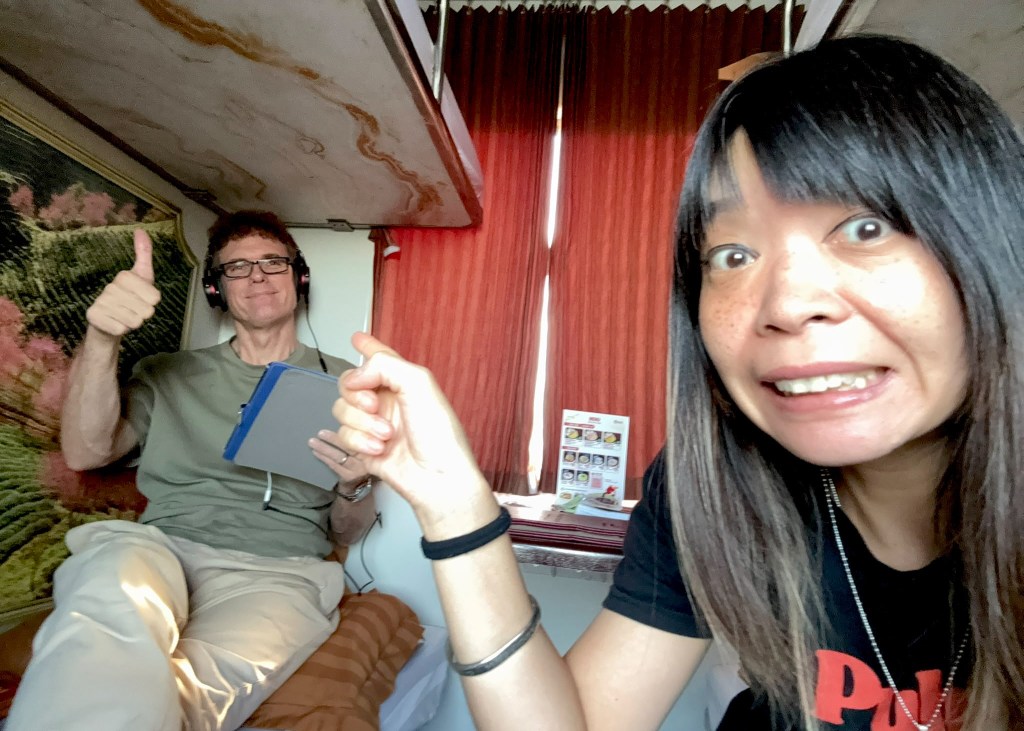
Four hours out of Danang, night falls. We still have a long ride ahead in the dark. At six, staff appear with dinner, which we wash down with cold cans of Tiger. Drowsy on food, beer and train motion, the evening passes quickly enough despite the challenge of getting comfortable for more than a few minutes at a time.
At eleven we roll into Nha Trang, halfway to Saigon. It’s clearly a popular destination: our coach almost empties. A few new passengers climb aboard and we plough on into the night towards Saigon.
Tuesday 29 September
I dream we’re caught in an earthquake. We’re not, of course; we’re on a train rattling through the night into the deep south of Vietnam.
At dawn I wake from an uncomfortable sleep as we clatter through Saigon’s northern suburbs. It’s barely six, but the city’s already teeming. In the quiet lanes beside the track a mother and son perch on tiny plastic stools slurping noodles, an old man sips his morning coffee, and a woman squats over a plastic bowl washing vegetables for the day ahead.
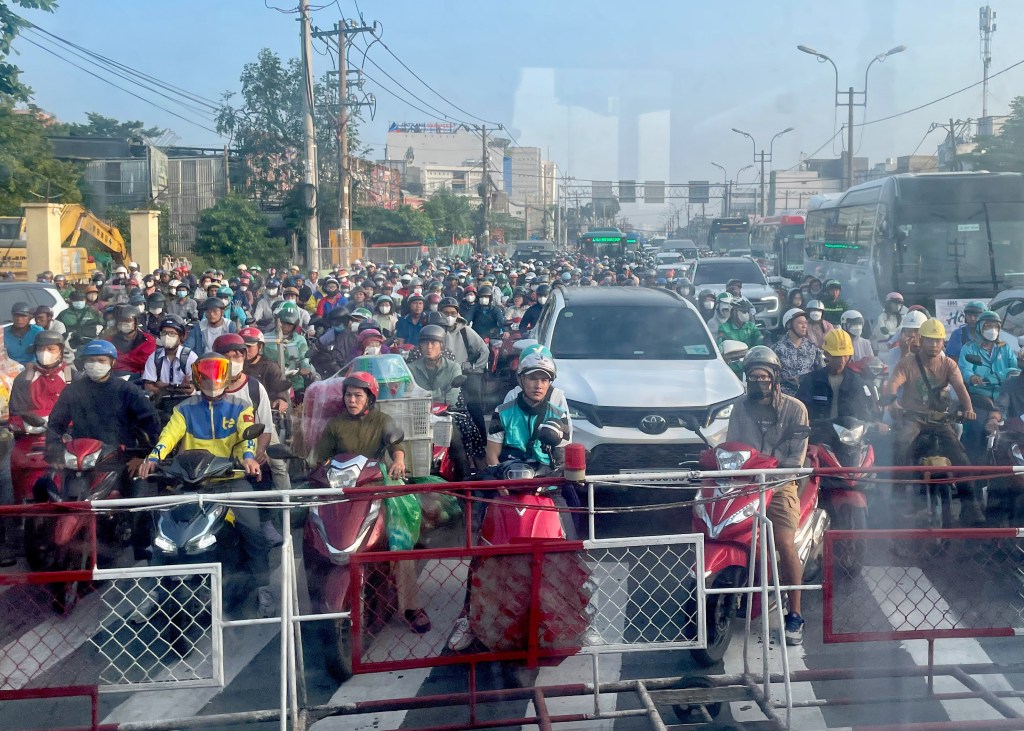
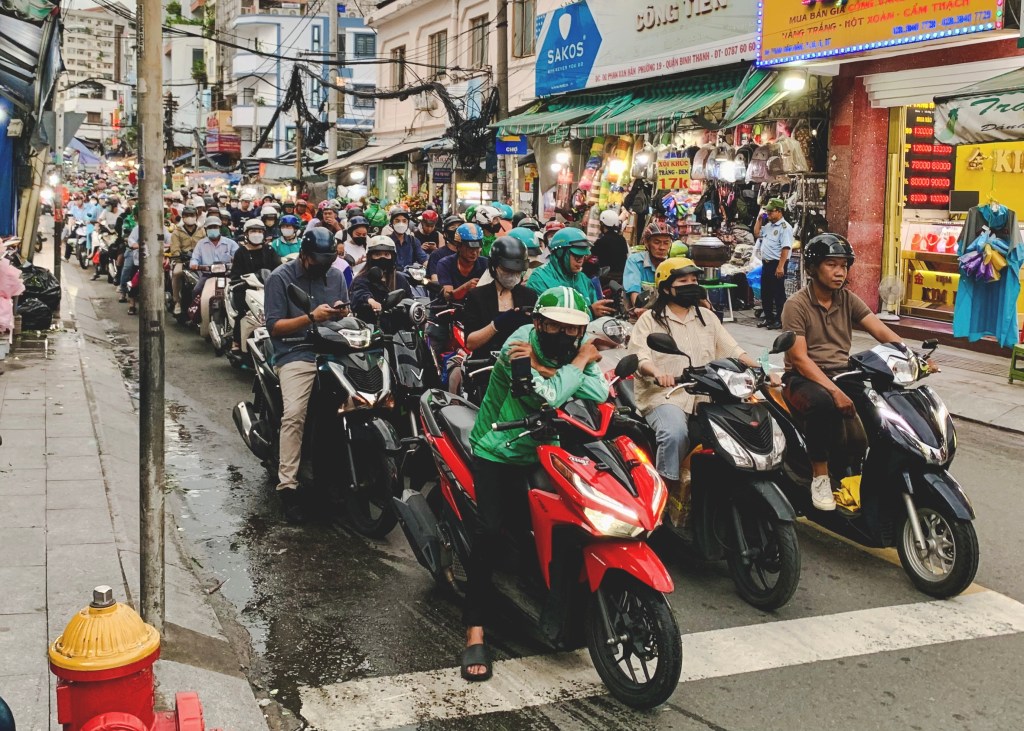
With so few trains, bridges and tunnels are rare. Instead, level crossings slice the track every few hundred metres. Behind each barrier, a sea of scooters waits patiently for us to pass:
At six‑thirty, we pull into Saigon station. Everyone carts their luggage across the tracks into the almost empty station building. It’s too early to drop our bags at our Airbnb, so we find seats and bury ourselves in our books. I munch a banh mi; K settles for an iced coffee.
Four hours later, we climb into a Grab and plough into Saigon’s sea of scooters. Who would drive a car in Saigon? Surely the comfort of air con can barely compensate for the nerves of steel required to avoid maiming someone day-in, day-out.
The old security guard in his battered uniform at the entrance to the rambling 1970s apartment block is all smiles. The fifteenth‑floor flat is still being cleaned, so we drop our bags, leave our number with the cleaner, and retreat to a nearby western-style vegetarian restaurant for an early lunch. We’re onto a second refreshment before a WhatsApp message finally appears telling us we can move in.
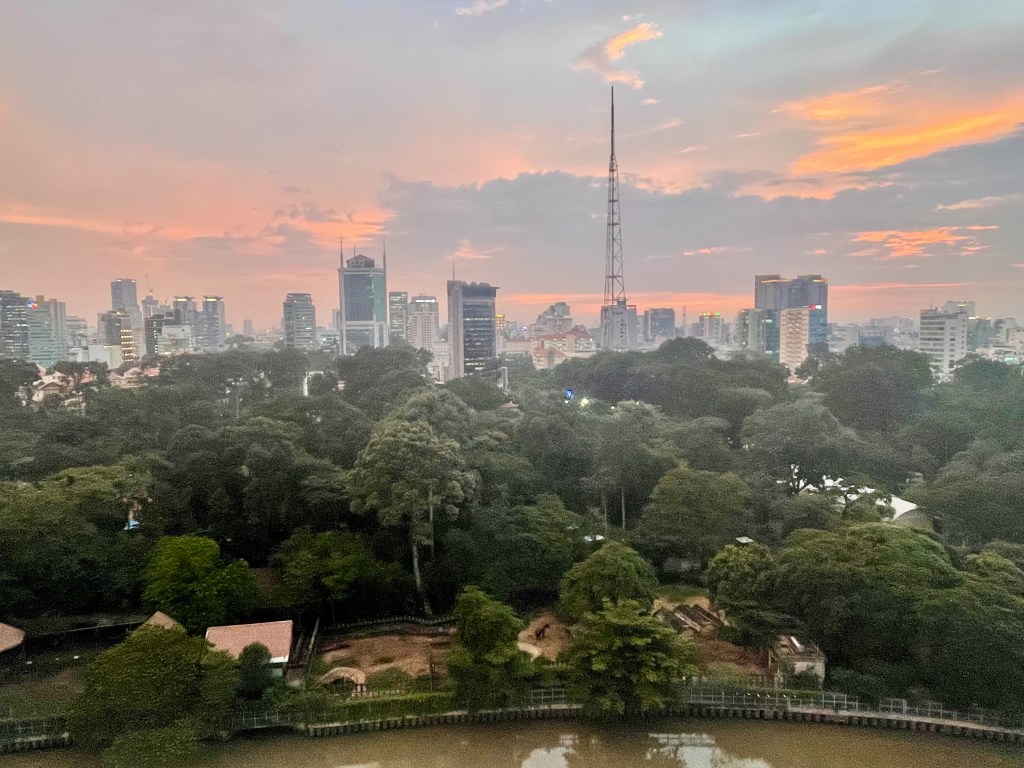
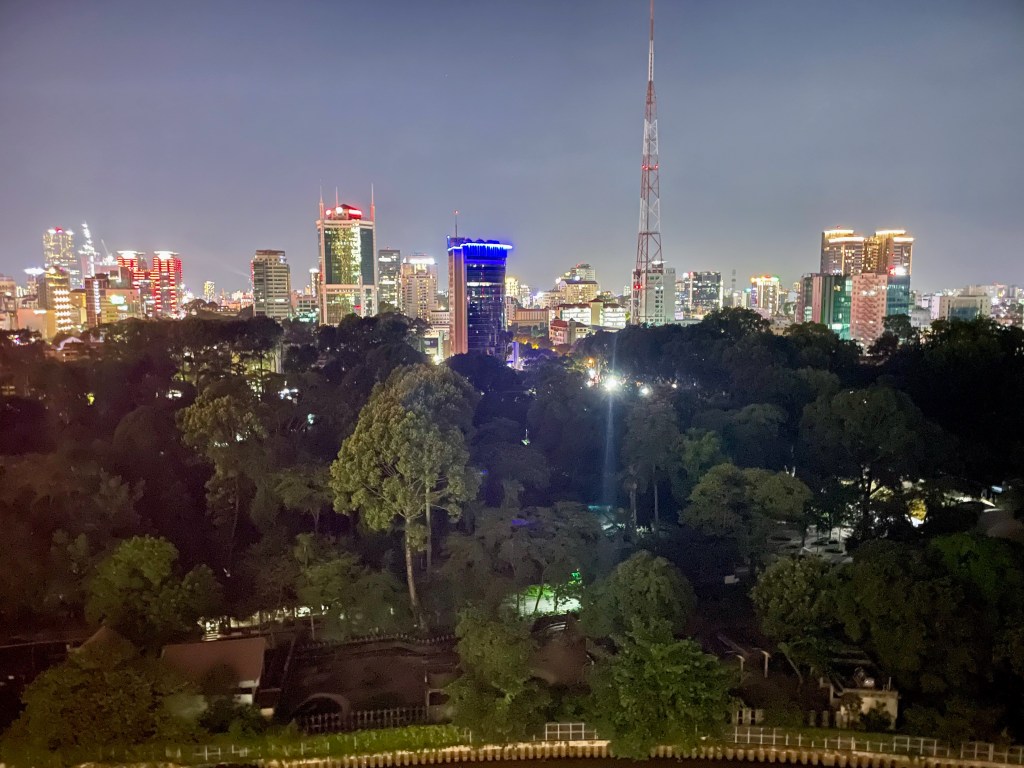
Initial impressions: it’s fine. Pretty much what we expected. Older than it looks in the photos, but we knew that from the reviews. The view over the river to the zoo adds a welcome layer of green — plus elephants and giraffes.
We’re both drained from the train journey. We grab a few basics at the local Winmart and retire for the rest of the day.
Wednesday 30 September
Our first full day in Saigon is mostly admin and practicalities. After lunch we locate Saigon’s answer to Waitrose/CitySuper and stock up. Back in the flat, a thunderstorm looms but eventually skirts us. In the zoo below, the elephants and giraffes seem to have the place to themselves: everyone’s taken shelter, seemingly expecting a deluge that never quite arrives.
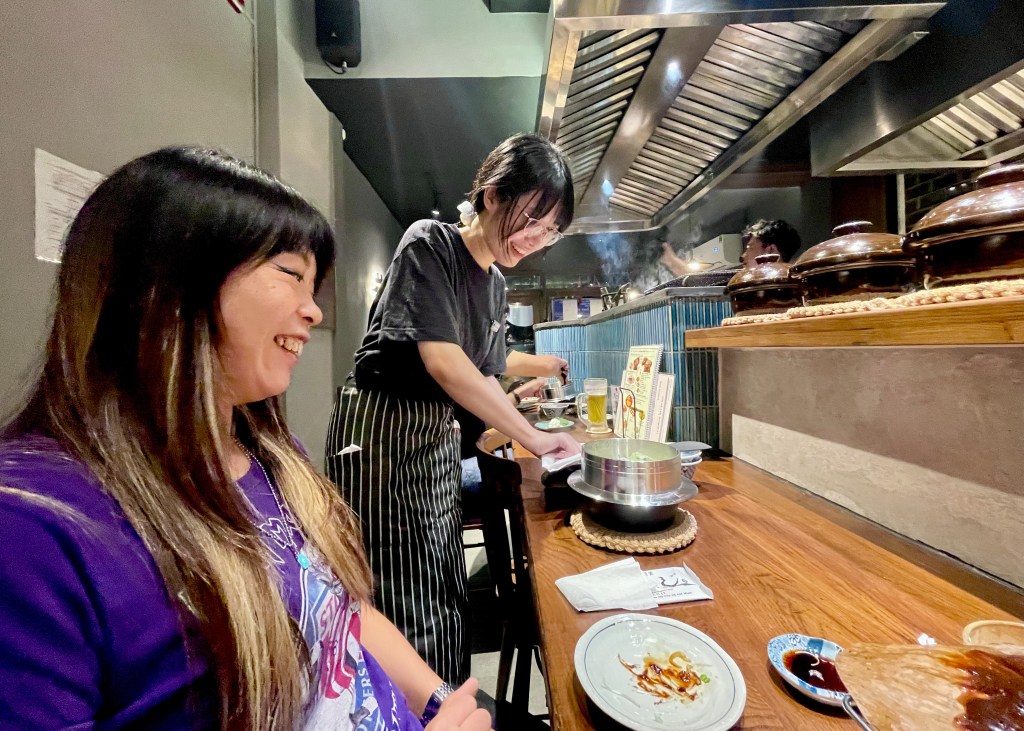
It’s Wednesday night: time to eat out. Our neighbourhood turns out to be full of Japanese izakayas and ramen joints. We had no idea. We pick an izakaya on account of its being brand new and offering 30% off this week, and settle at the bar.
Inside, the customers are mostly Japanese. So is the friendly head chef. Highly promising. The food takes a while, the head chef endlessly apologetic but charming, but when it arrives it’s excellent: hagama salmon rice, miso chicken, a wagyu croquette, sashimi — all presented with quiet flair. It’s easily the best meal we’ve had in Vietnam. Were we in Hong Kong or Japan — which it feels we are — the beer alone would cost what we pay for the whole spread.
Head chef-san even sees us out and hands us a token parting gift. A smashing evening.
Thursday 1 October
K’s come down with the lurgies. She predicted it at the izakaya last night when she felt a tickle in her throat. Today she’s drained, running a temperature, and nursing a dry cough. I slip out for cough medicine and paracetamol, and we nest down for a quiet day indoors.
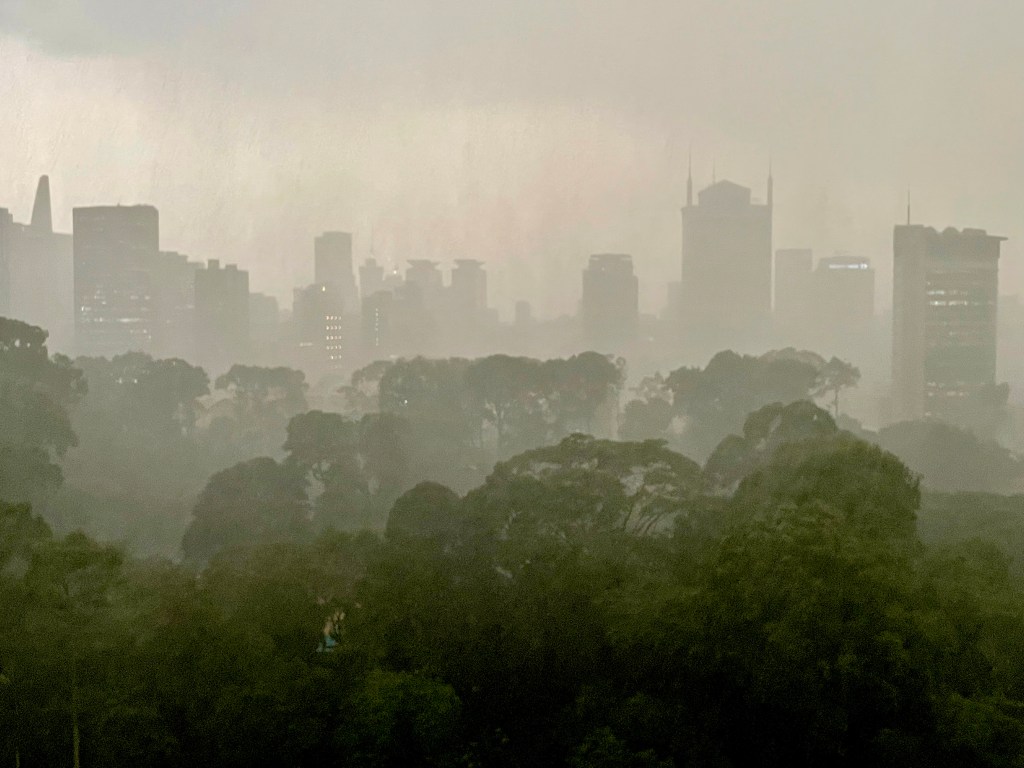
I’m entertaining the idea of slipping out a second time for a late afternoon ramble when a spectacular thunderstorm intervenes. Unlike yesterday, this storm has no intention of skirting us. From our sheltered fifteenth‑floor balcony we watch the city disappear under sheets of water. It rains like Armageddon until well after dark.
Friday 2 October
K’s still subpar, so I focus on filing my UK tax return and getting a haircut. Round the corner, I stumble on a small barber shop run by what I assume is a husband-and-wife team about my age. He’s busy with another customer, so I sit quietly and read until wifey slips a sheet around my shoulders and it’s my turn. An April photo at Tikal serves, not for the first time, as a reference shot. Hubbie shears and snips until I look reasonably like my April self. Wifey speaks a little English: “Where you from?” You like Vietnam food?” Just for fun, I tell them I’m Danish. No harm done. I’m just humouring myself.
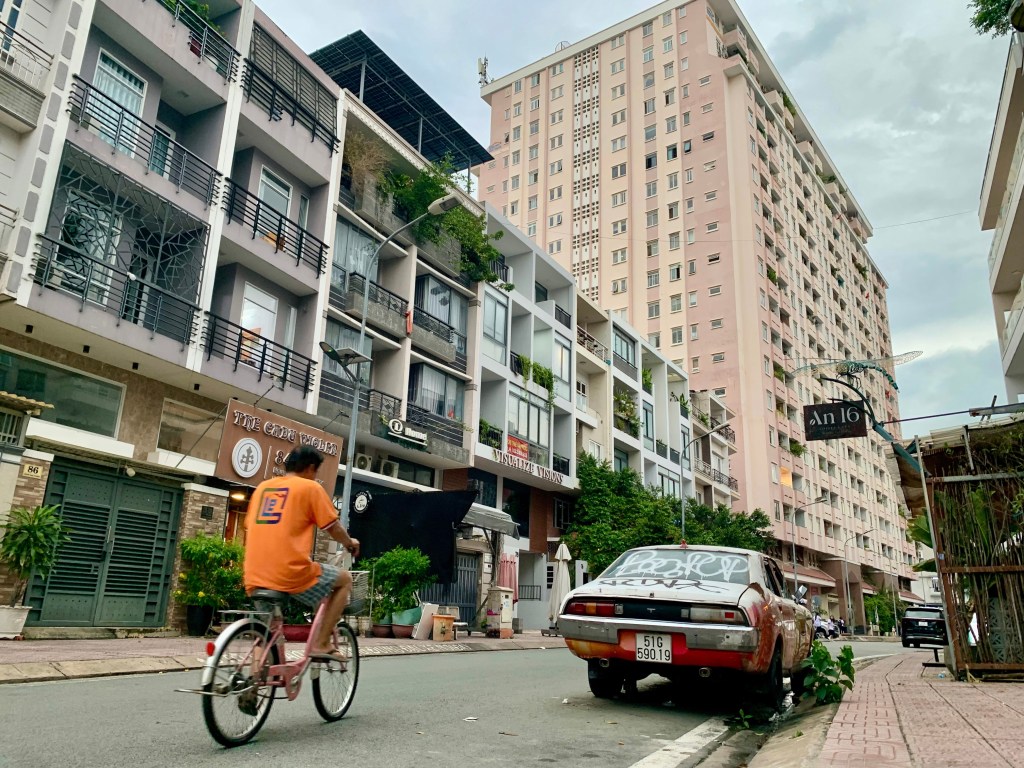
Freshly sheared, I deliver more groceries to the flat, then pop out again to poke around the neighbourhood before this afternoon’s downpour arrives. (It never does, but again it comes razor-close.) We’re only just over the river from downtown Saigon, so it’s perhaps no surprise to notice telltale signs that we’re in a solidly middle-class area: a bus from an international school drops off the last kid of the afternoon outside the health spa opposite our block.
Two days resting indoors seem to be helping K. We should be able to start hitting the sights tomorrow.
Saturday 3 October
The Vietnam War was a tragedy, but I’m deeply sceptical of any Communist narrative of it. Yet of course, this is what we’re presented with at Saigon’s War Remnants Museum. (Once known as the Museum of Chinese and American War Crimes, it was apparently renamed to avoid offending Chinese and American tourists.)
In true Communist style, the language is coded: Communist fighters and their supporters are ‘patriots’, everyone else is simply ‘the enemy’, the Ho Chi Minh Trail is the ‘revolutionary supply route’ etc. It goes without saying that reality was far more complicated. As nationalists who oppposed both colonialsm and communism, many South Vietnamese must have genuinely believed they were the true patriots. K complains the official narrative leaves her no better informed than when she arrived.
Also in true Communist style, we’re bombarded with unsubstantiated claims such as: “Scientists agree that ‘Dioxin is the most harmful and toxic chemical ever discovered by mankind’”. The photos of Argent Orange victims, some born as late as 2000, are among the most harrowing portraits of misery I’ve ever seen. But that doesn’t make the claim objectively correct.
I navigate the museum with a mixture of horror and compassion, tempered by irritation that authoritarian regimes are incapable of presenting any narrative but their own. The ‘tiger’ cages are appalling, but the North used them too. Naturally, there’s no mention of this.
Many photographs illustrating US atrocities are from US sources, including images of the My Lai massacre. I’m studying them when I’m politely greeted in good English by a man about my age. I look up to see he’s a triple amputee, offering up an arm stump for me to shake. Awkwardly, I take hold of it.
“Nice to meet you”, I tentatively offer, lightly grasping where his right elbow used to be. I have no idea how to talk to a stranger with no arms and a prosthetic leg. He tells me, as he must have told thousands of tourists before me, that he was blown up by a landmine when he was eight.
But he hasn’t approached me for a chat. He’s selling books.
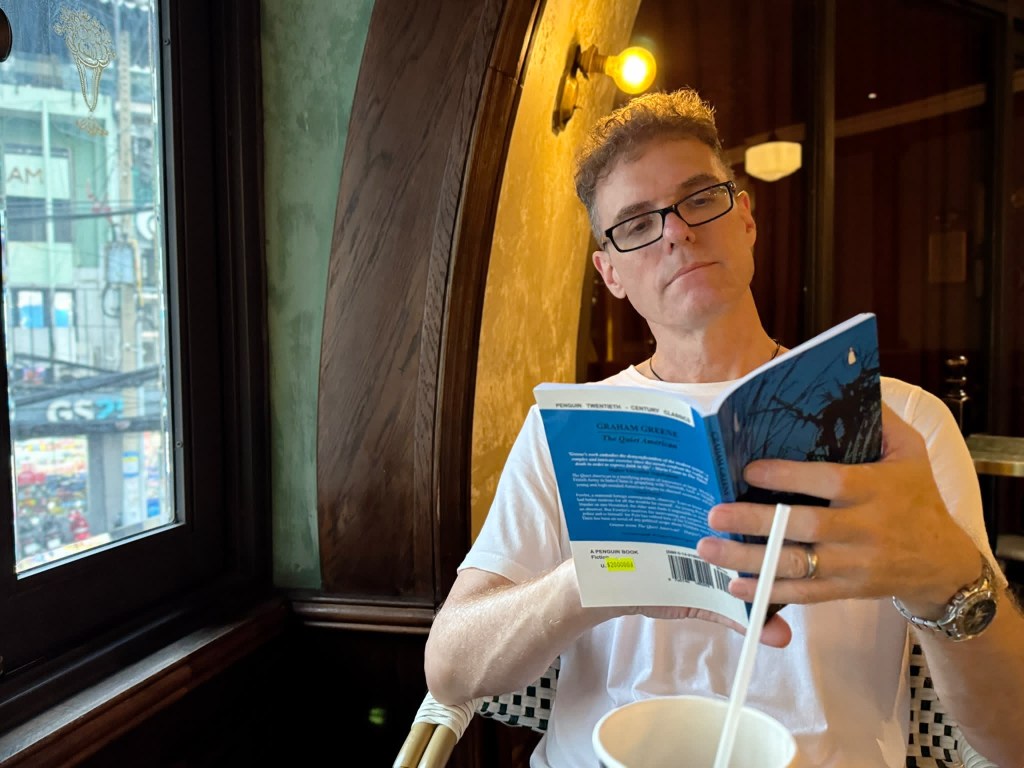
Using his arm stumps, he rummages in bag slung over his shoulder and shows me a selection of English-language books about the war. I pull them out one by one, already resigned to buying. Fortunately, he has a copy of Graham Greene’s The Quiet American, a book I owned forty years ago but never got round to reading.
By now, K’s joined me, her mere presence more or less obliging her to buy a book as well. She picks A People’s History of the Vietnam War. They’re not cheap. Fortunately, I have the right notes on hand. After all, few things would be more churlish than asking a crippled man if he has change.
We move on. The final exhibit is a gallery of photos from the war taken by photographers who lost their lives covering it. Among them are some 1954 shots from Robert Capa’s final roll of film, the last one taken minutes before he was also blown up by a mine. The even-handedness of the gallery is a welcome change after the shrill propaganda elsewhere in the museum.
Still, despite the relative one-sidedness of many of the exhibits, I doubt there are many museums anywhere that drive home so effectively the message that war is horribly brutal, and that many of its victims are civilians.
We leave as the museum closes. Night is falling and it’s just cool enough to wander a few blocks with no fixed destination in mind. Fifteen minutes later we’re sweating and ready for an air-conditioned Grab. We pick another Japanese restaurant back in our own neighbourhood, where we slurp comforting bowls of ramen.
It feels an appropriate occasion to watch a film about the war. Back at the flat, I dig out an old VCD copy of Stanley Kubrick’s Full Metal Jacket on my laptop. The first half is as mesmerising as it was when I saw it at the old Basingstoke ABC. But having dispensed with the two most interesting characters, the second half now seems to go nowhere. I adjust my IMDB rating from nine to seven.
Sunday 4 October
Having spent the final two days of last week indoors, K’s prepared to break a strict habit and step outside on a Sunday. Nothing too ambitious: just an americano at an otherwise empty café up the road, where I begin The Quiet American, and a detour to our local Japanese mini-supermarket.
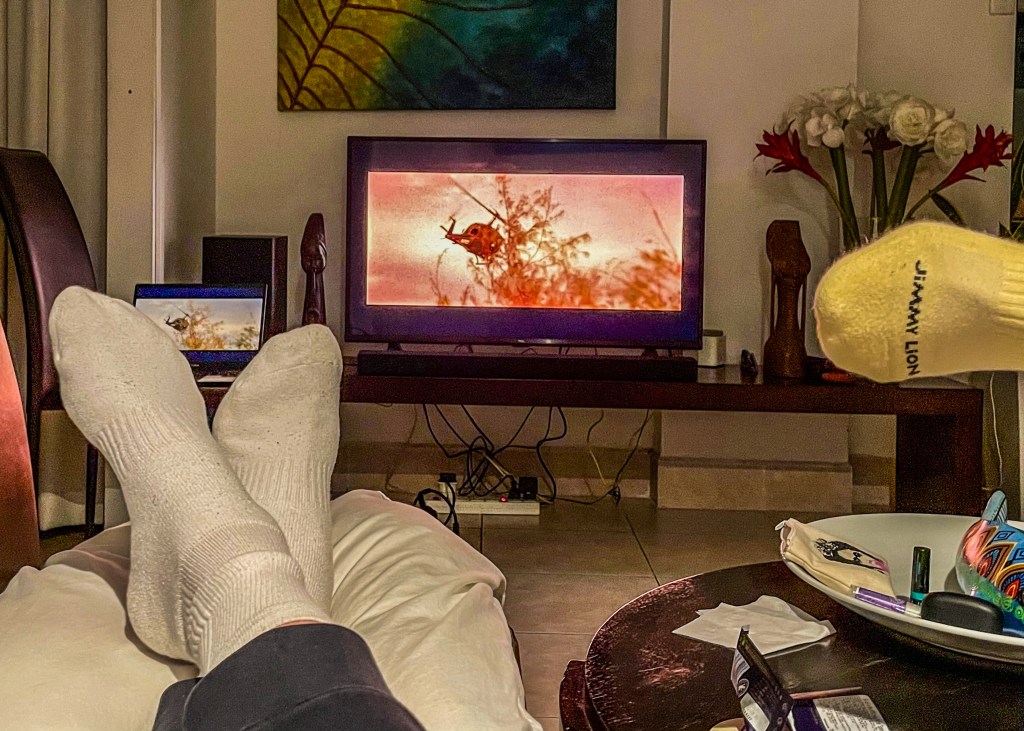
We’ve been in Vietnam a month, but I’m only now gripped by a sudden desire to revisit the slew of films about the war. Tonight it’s the turn of Born on the Fourth of July, a film I soon realise I’ve never seen. Tom Cruise carries it — I had no idea he could be so much more than a pretty face — but like most films it’s twenty minutes too long (although it does feature an exploding helicopter). Worse, despite its length, it somehow never really establishes how and why its real-life hero Ron Kovic turned against the war.
7/10
Monday 5 October
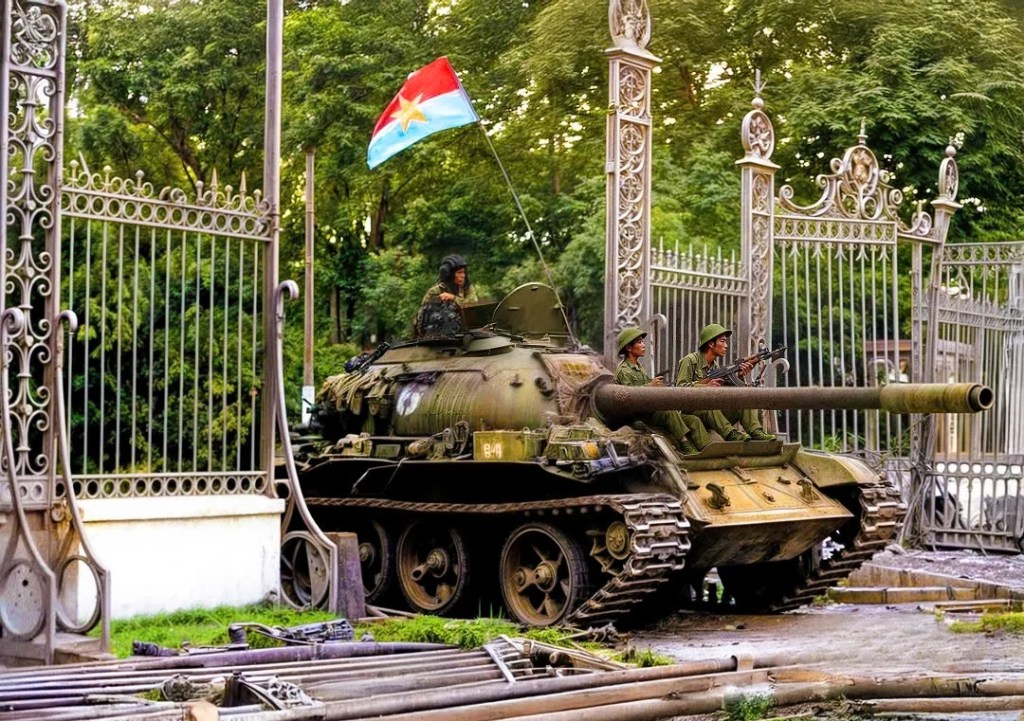
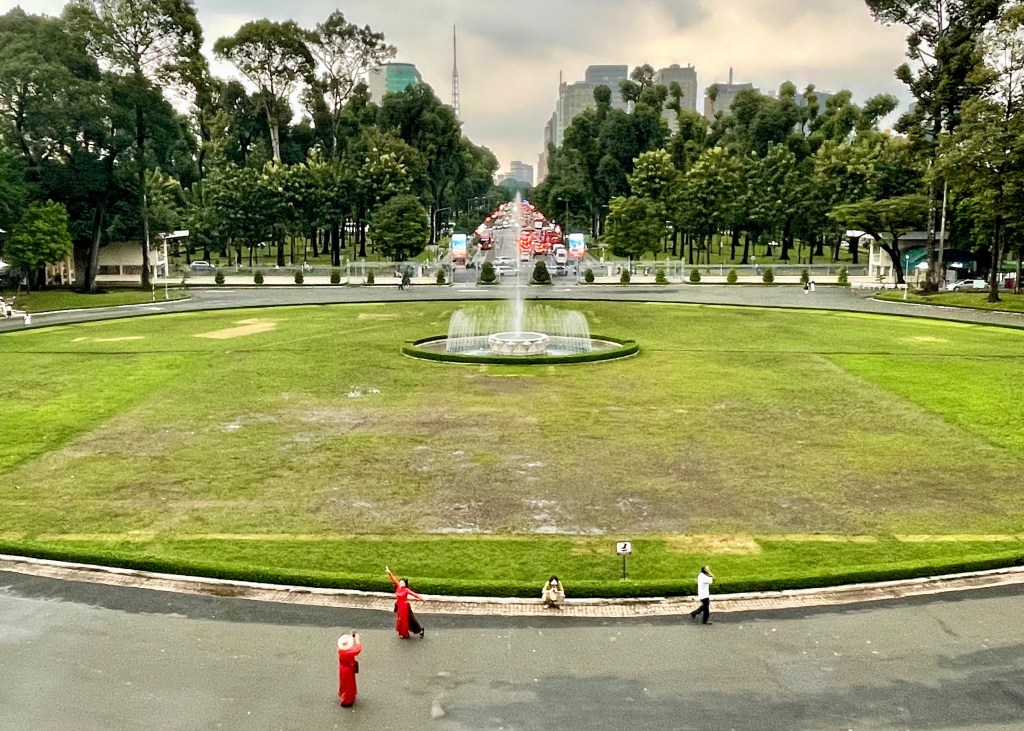
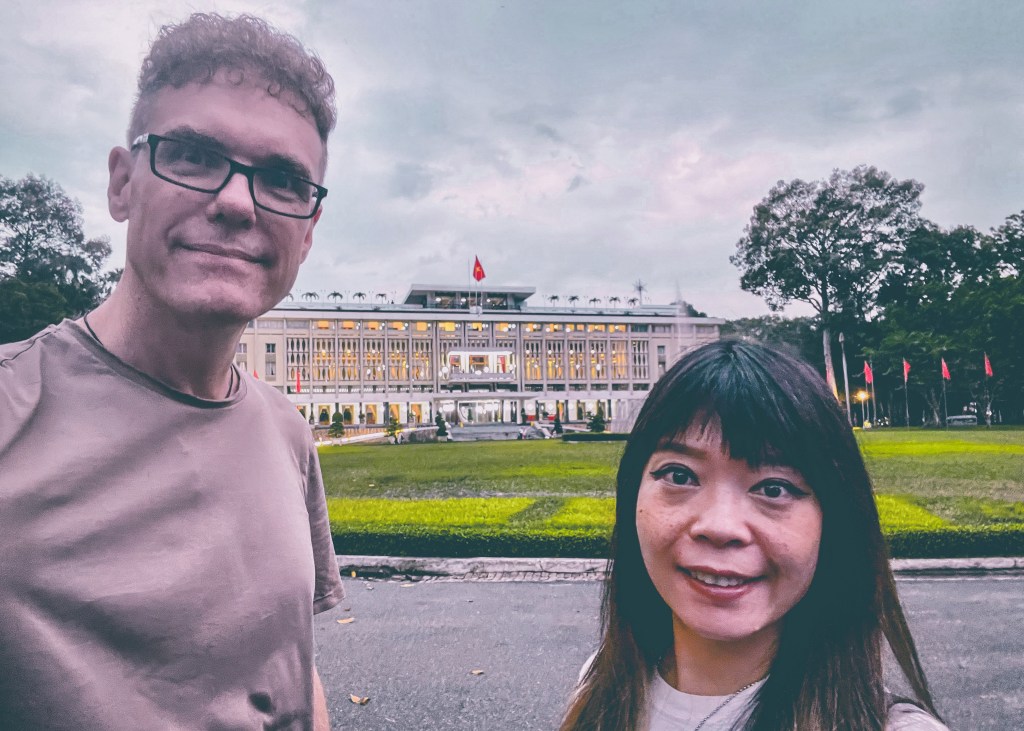
Today’s destination: Independence Palace, home of the old South Vietnam regime. The wrought-iron gates the tanks crashed through on 30 April 1975 have been restored, but it’s easy enough to picture the scene that day. Here’s a restored colour version of the famous photo:
An electric cart first delivers us to a small museum in the grounds, where a surprisingly even-handed exhibition explains the history of the site and the events leading up to the 1963 assassination of Ngo Dinh Diem.
The Independence Palace itself dates from the 1960s, the original nineteenth-century building having been badly damaged in an earlier assassination attempt on Ngo Dinh Diem. It’s a handsome piece of modern architecture that somehow feels worthy of a head of state. At least it would had a young boy not escaped from his mother, darted under the velvet ropes, and crawled under a meeting table:
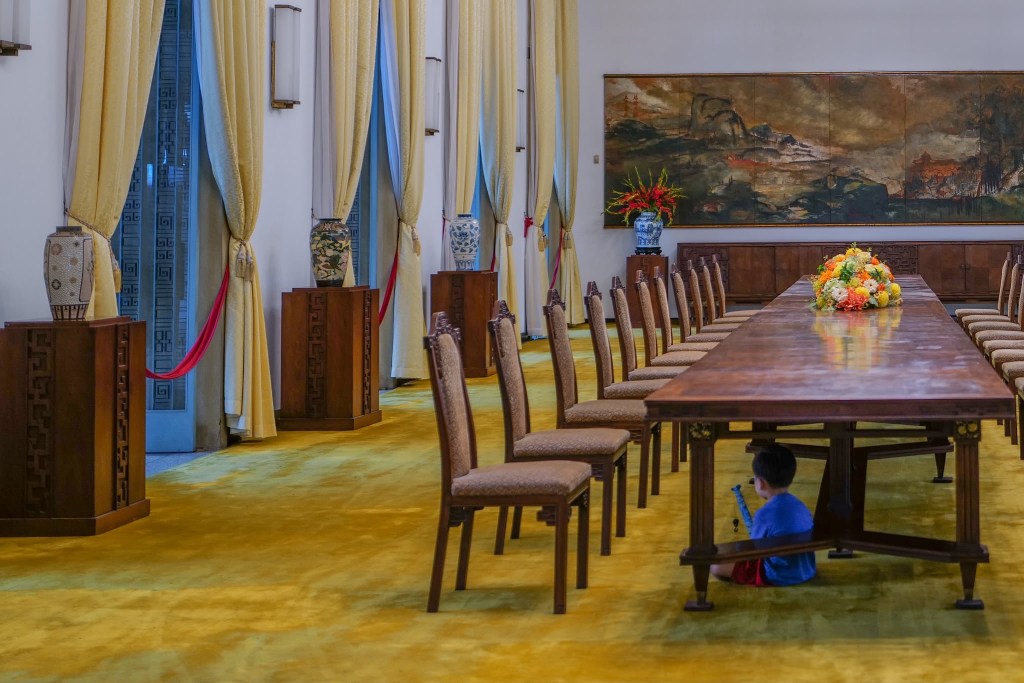
His mortifed mother scurries under the rope and tries to shoo trouble boy out from under the table. He’s having none of it, and he’s too nimble for her. We leave them playing cat and mouse while a security guard howls at them.
It feels rather eerie walking through the tastefully designed halls, preserved almost exactly as they were the day South Vietnam ceased to exist. A rotary-dial telephone sits on the Presidential desk. Contemporary maps hang on the wall of the room that housed the National Security Council. So careful is the attention to preserving everything as it was that there’s no air con. Thankfully, the Saigon air today is just about bearable.
Tuesday 6 October
Today’s lashing of rain is out of the way by lunchtime. A good opportunity to coast up to the viewing deck on the eighty-first floor of Landmark 81, Vietnam’s tallest building.
Oddly, we’re the only visitors. The only other people we see are a couple of bored souvenir-photo sellers and a security guard, who helps us into our harnesses so that we can step onto the outdoor platform.
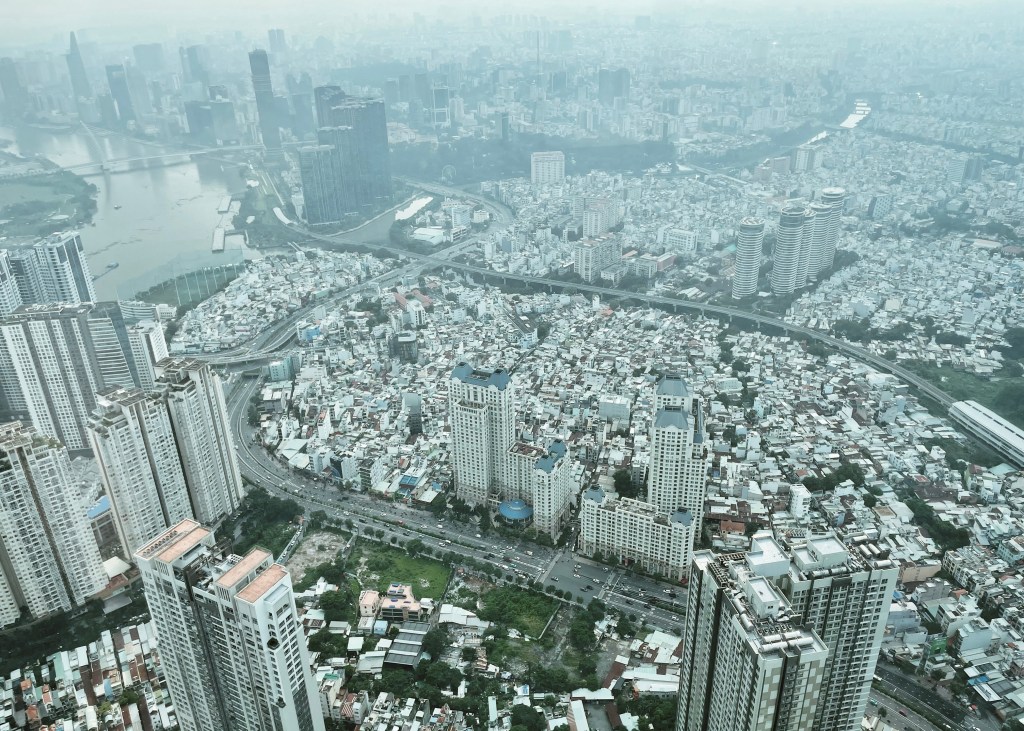
Saigon is overcast and polluted this afternoon, the horizon lost in thick smog. I guess most folk come at sunset.
Still, the small corner of the city we’ve got to know is easy to pick out, our behemoth of an apartment building clearly visible in the middle distance. Below, the Saigon River twists through the city in stately loops, almost garrotting one peninsula and choking another.
Ears popping in the elevator, we hurtle back to ground level. Harry Styles drifts through a proper supermarket-sized Winmart as we pick up most of what we’ll need for our remaining week in Saigon. There’s time for coffee and a surprisingly tasty slice of banana cake at a busy branch of chain café Highlands before we head back to the flat to rest.
And then it’s time for a pub quiz.
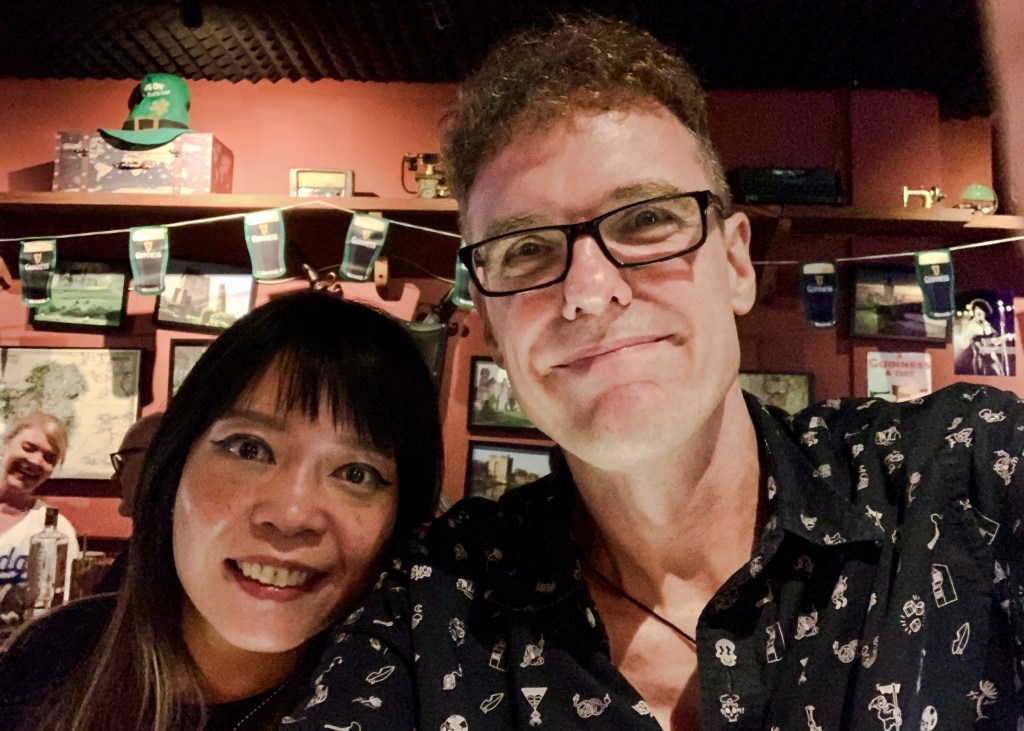
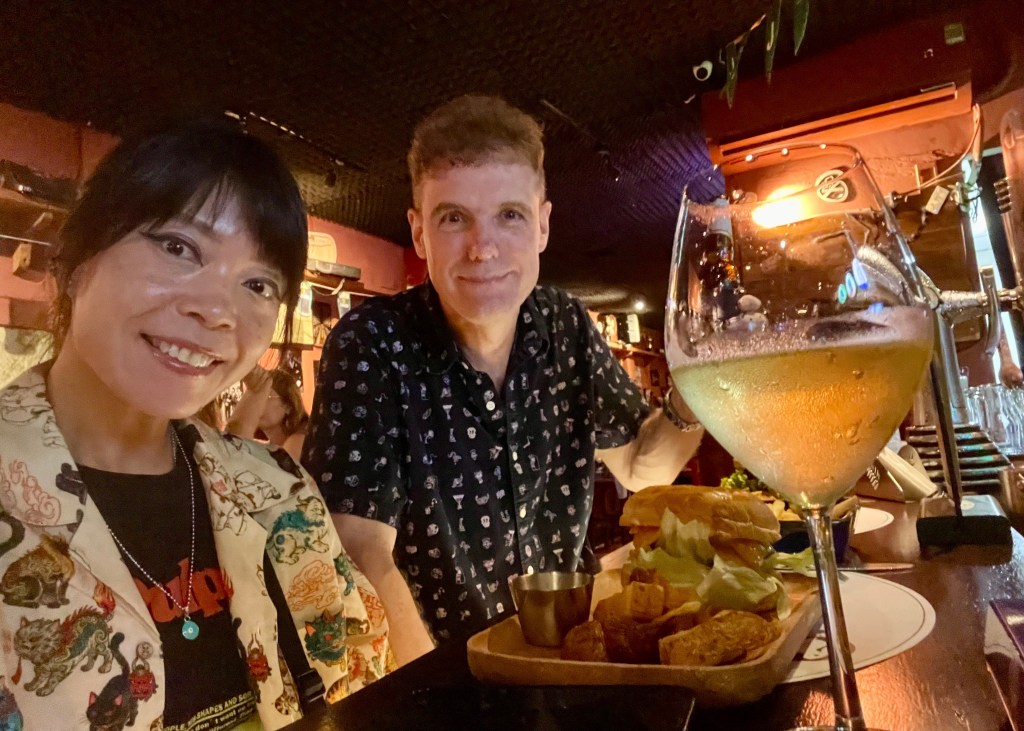
The splendidly named Rabbit Hole Sports Bar is deserted when we arrive. Are the staff sure there’s a quiz tonight? They are. We take seats at the bar — the tables may be empty, but they’re all reserved — order a platter of pub food, and wait.
Three quarters of an hour passes before there’s any sign of life besides the staff. Gradually, the tables fill and we meet Niall, the quizmaster. He takes time to chat and find out something about us. We discover he hosts Vietnam’s longest-running English language podcast, Discover Vietnam. No wonder he’s engaging.
He’s also a first-class quizmaster: he writes good questions, lets us mark each other’s papers, and provides regular updates on the scores. Most importantly, he seems to know everyone, yet goes out of his way to make us outsiders feel welcome.
In the break, an African American chap from the team we’re swapping papers with wanders over to chat, lamenting that we could have joined forces and made a team of five. He’s well-travelled — he’s also lived in Senegal and Kenya — and asks questions we don’t often hear, such as how far ahead we book our accommodation.
I can’t recall feeling so welcome since we started travelling full-time.
To top it all, we scrape over the line in sixth place out of eight. Had we picked up more than a single point in a dreadful final music round, we would have finished fifth.
That’s next Tuesday night settled then.
Wednesday 7 October
I’m looking forward to settling on the sofa to re-read my blog from Rabat this time last year when works comes in. For the first time since Rabat, I take an AsiaEdit job. It’s the busy research proposal window after all.
And there goes the day.
The late afternoon storm is spectacular today. To the south, an eerie sunset is little more than a faint red blot behind a curtain of intense tropical rain. We gawp at it from the balcony, jumping at each burst of lightning. Then it’s back to my desk to tap away.
Thursday 8 October
The AsiaEdit job consumes most of a second day. I’ve almost done when the electricity fails. Fortunately, the high ceilings stop the flat rapidly becoming an oven, allowing me to finish. By now it’s already too late to do much, so we settle for going out for coffee.
The lifts are still working, but outside we soon discover the whole neighbourhood is without power. Overhead, a storm is brewing and the afternoon has turned dark and gloomy. Without power, shops and cafés are dark as night.
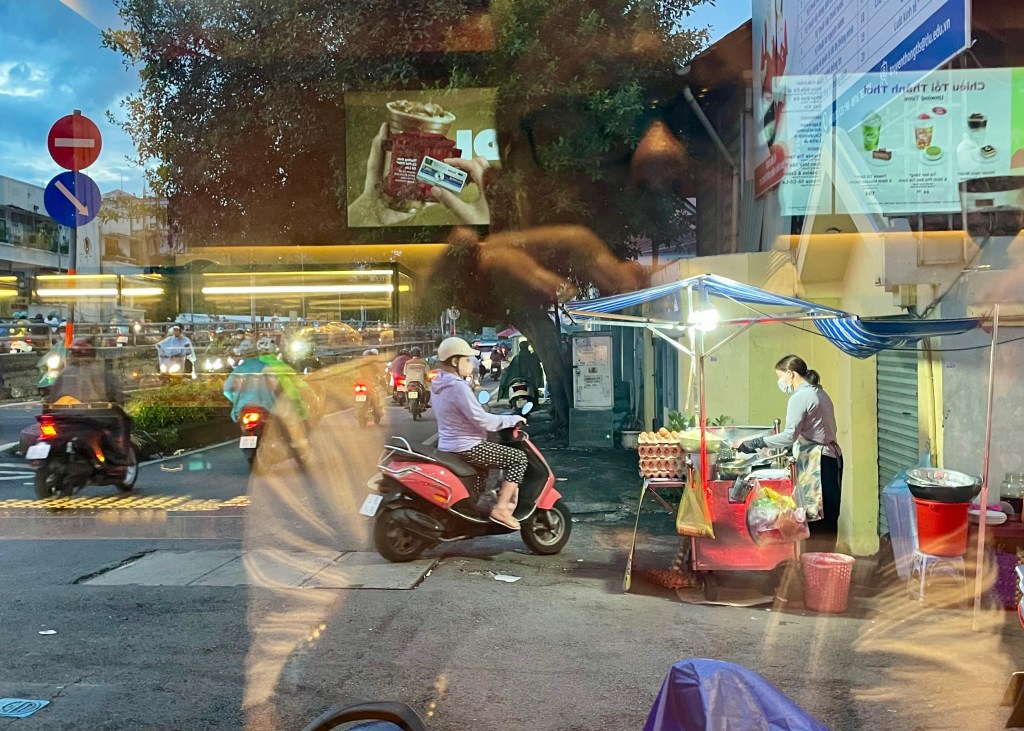
We push on beyond the neighbourhood in search of electricity, and hence coffee. A few hundred metres away, lights return. We spot a Highlands across a busy road, which we somehow cross unmaimed. I bury into The Quiet American as darkness falls, occasionally glancing up at a food cart outside, where a woman prepares omelettes stuffed with beansprouts.
Approaching our block after dark, we can see the electricity is back on. Relief. Rather than sitting in the dark tonight, we can watch our next film about the war: Platoon.
It’s another one I’ve seen at least twice, yet remember almost nothing about. It’s bleak and contemptuous, much as you’d expect of Oliver Stone. It’s also riveting from beginning to end. I can’t imagine why the only scene I recall is the final one as Charlie Sheen escapes the chaos in a helicopter.
It’s just a shame the soundtrack is ruined by over-relying on Barber’s Adagio for Strings.
Friday 9 October
We have less than a week left in Saigon, yet so far we’ve barely left our neighbourhood. I take myself off the AsiaEdit schedule — that one job this week has fogged my brain; I really don’t want another — and we hop in a Grab to Saigon’s Fine Arts Museum.
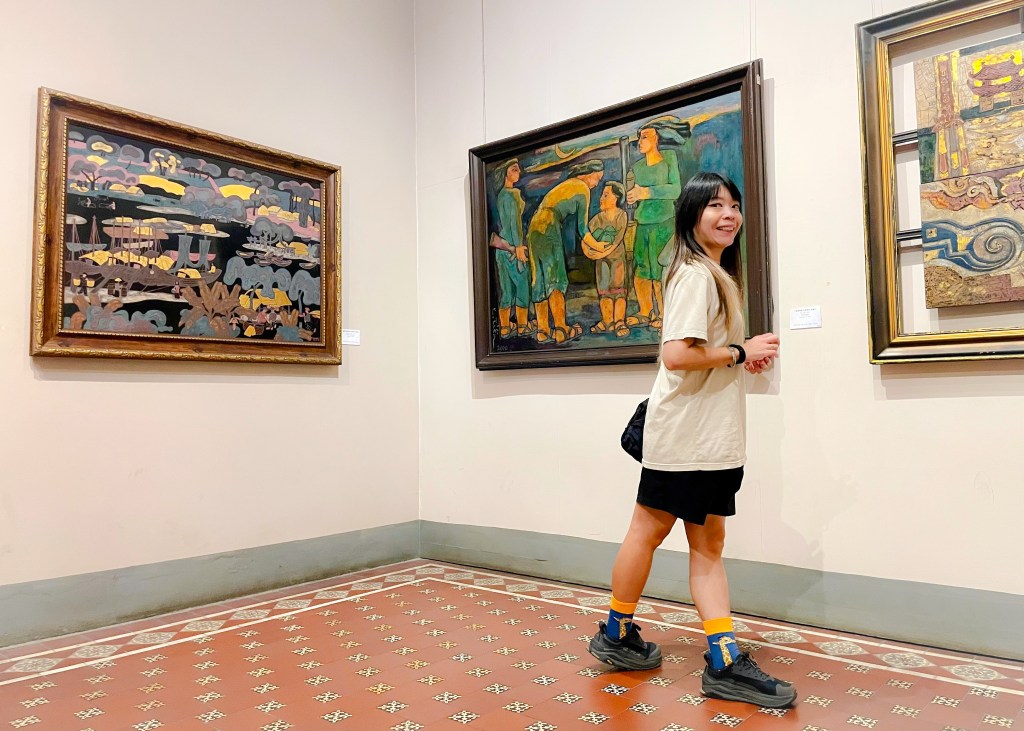
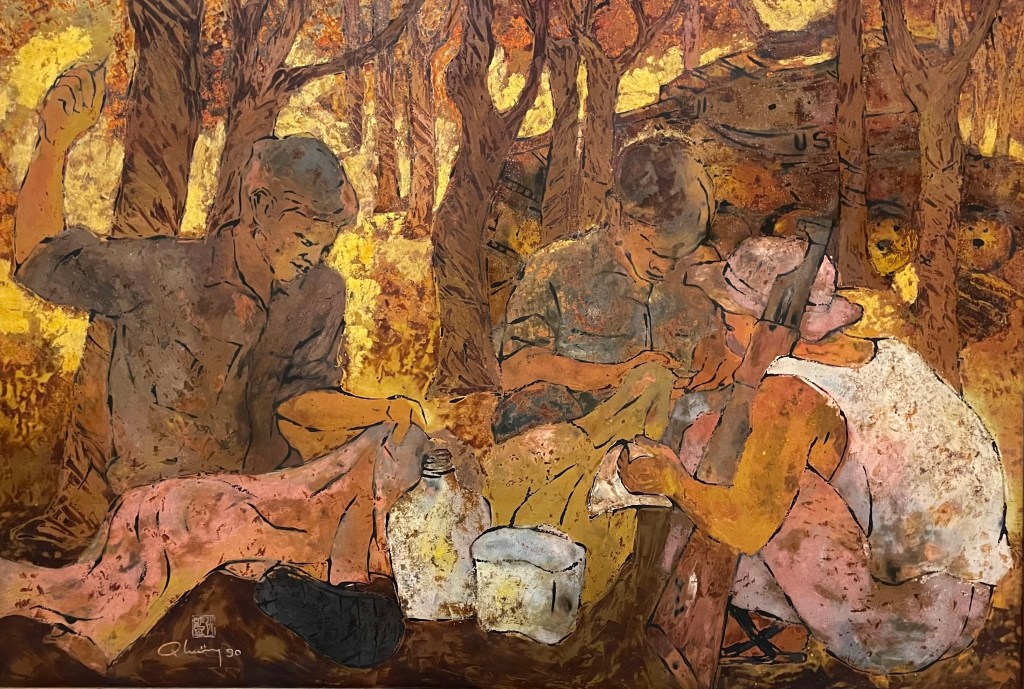
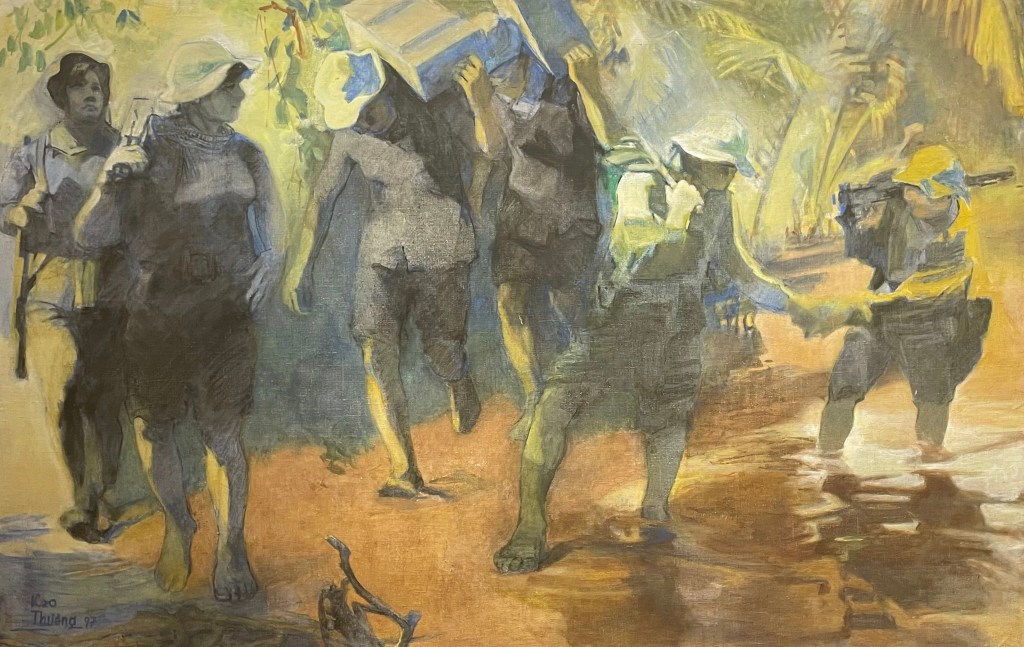
The museum occupies a slightly dilapidated colonial-era building and features one of Saigon’s oldest lifts — the only lift I’ve seen that doesn’t sit in a shaft. Unsurprisingly, much of the art is inspired by the war, but there are more abstract pieces too. We while away a pleasant hour and a half, often enjoying the building as much as the art.
Ten minutes away, the bizarrely named Cheese Café was briefly featured on the sole episode of quizmaster Niall’s Discover Vietnam podcast we’ve watched. We arrive just as the afternoon downpour is about to let loose.
To our eyes, the café is unexceptional, yet it seems to be a hit with the Instagram crowd. Inside, young women are busy doing their hair and make-up, squeezing into racy dresses, and posing for photoshoots. None of this was hinted at on the podcast. Then again, Niall never stepped inside.
The appeal appears to be that the interior looks vaguely (and entirely unremarkably) European, of which the only feature I remember is wood panelling. We sit reading by an upstairs window while three girls at the next table spend half an hour making themselves up before disappearing downstairs. On our way out, we find them at the foot of the staircase taking photos of each other throwing provocative poses.
I’ve rarely felt so old.
Saturday 10 October
Chanel. Rolex. El Gaucho Argentinian Steakhouse. The familiar trappings of international comfort slip past the window of our Grab as we crawl across downtown Saigon.
We get out at the central market, which briefly detains us, then cunningly use the pedestrian tunnels of the brand-new metro to head towards Saigon’s party central: Walking Street. The clever tunnel plan bombs: we end up risking our lives fording more rivers of scooters than if we’d simply crossed the road outside the market.
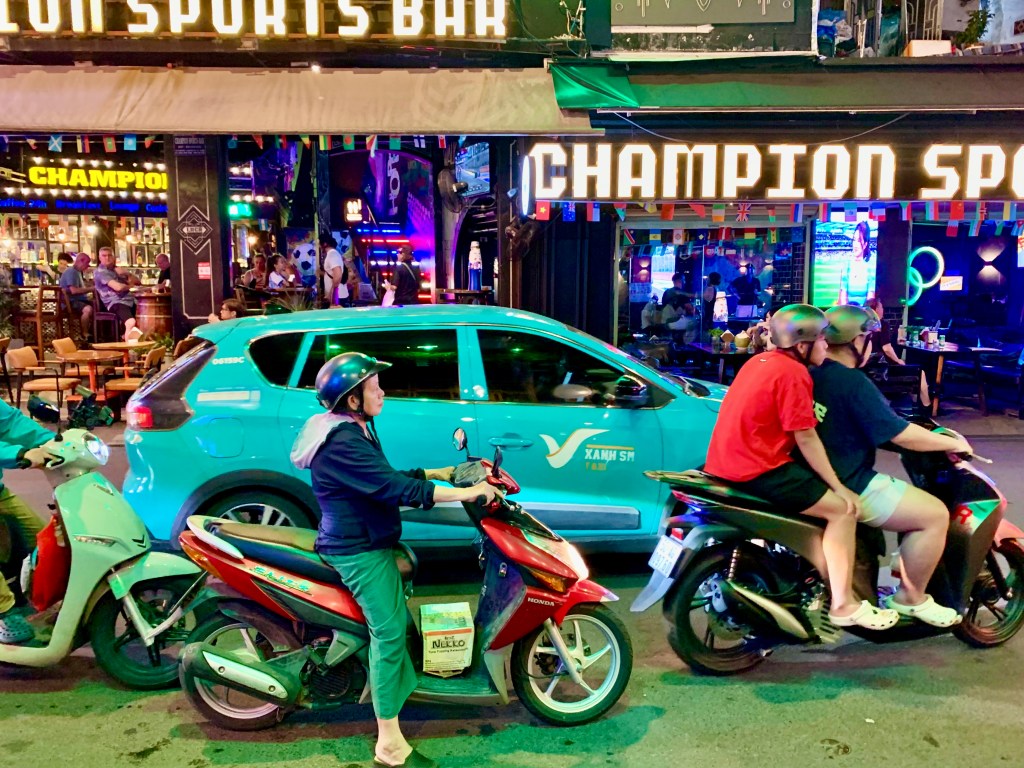
Dusk is falling on Walking Street, officially Bui Vien, and it’s coming to life. Finding a sports bar for tonight’s early match is straightforward, but it’s not even six yet — too early for a beer. We wander to the end of the street and back, past several ghastly club-bars already pumping out cheesy EDM.
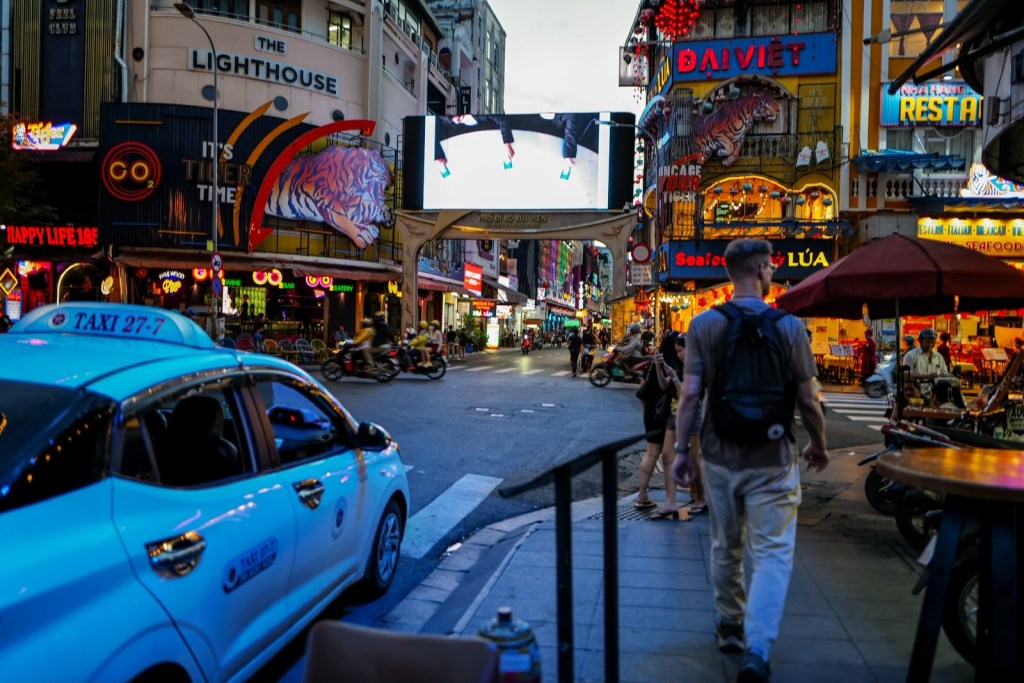
And then my brain shuts down.
I think the match kicks off at seven-thirty, which means we still have an hour and a half to kill. We wander off in search of iced coffee.
Arriving back at the sports bar an hour later, I’m bewildered to find the first half of Arsenal–Leeds almost over. Of course it is. Vietnam is six hours ahead of England, not seven. I know this. I’ve known it for weeks. But tonight…well. I guess self-inflicted mishaps are all part of fun.
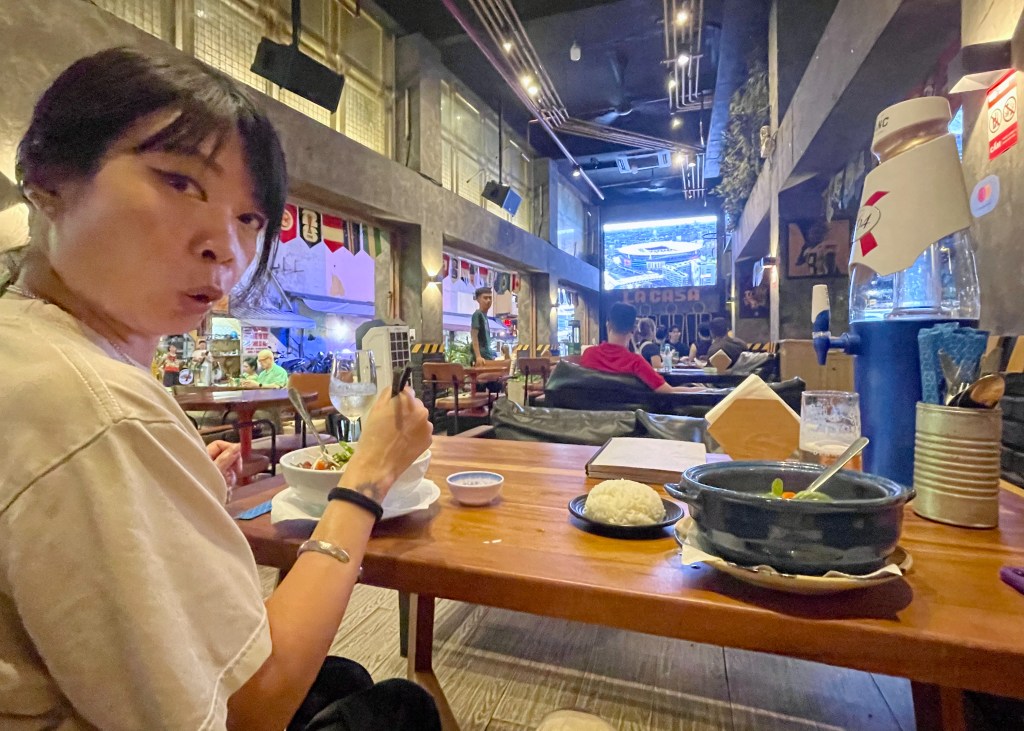
Never mind. The match — the first after a long international break — remains goalless. Mine’s a chicken curry, K’s roast pork neck. Arsenal go on to pip Leeds 2–1.
Sunday 11 October
A day for recharging quietly indoors. Late afternoon, I pop to our local Japanese supermarket for a few basics. The only other customer — she walks in right behind me — is a carbon copy of a twenty-something Yana, right down to an elegant tattoo on her left shoulder blade. A surreal few minutes follow as we drift past each other several times in the cramped space, two westerners in a Japanese supermarket staffed by a Vietnamese girl.
Monday 12 October
My encounter with the one-limbed bookseller at the War Remnants Museum last week turns out to pay handsome dividends. Not only is The Quiet American a very good novel, one I finish this afternoon, it’s also an excellent film starring Michael Caine, which we watch tonight.
We’ve saved the best film about the American entanglement in Vietnam until last. After the frustrating, if entirely understandable, focus of other films on the American experience of the war, The Quiet American observes shadowy American involvement in early 1950s Vietnam through the eyes and ears of the British, the French, and the Vietnamese themselves. It’s first-class filmmaking, standing on the shoulders of a subtly powerful novel.
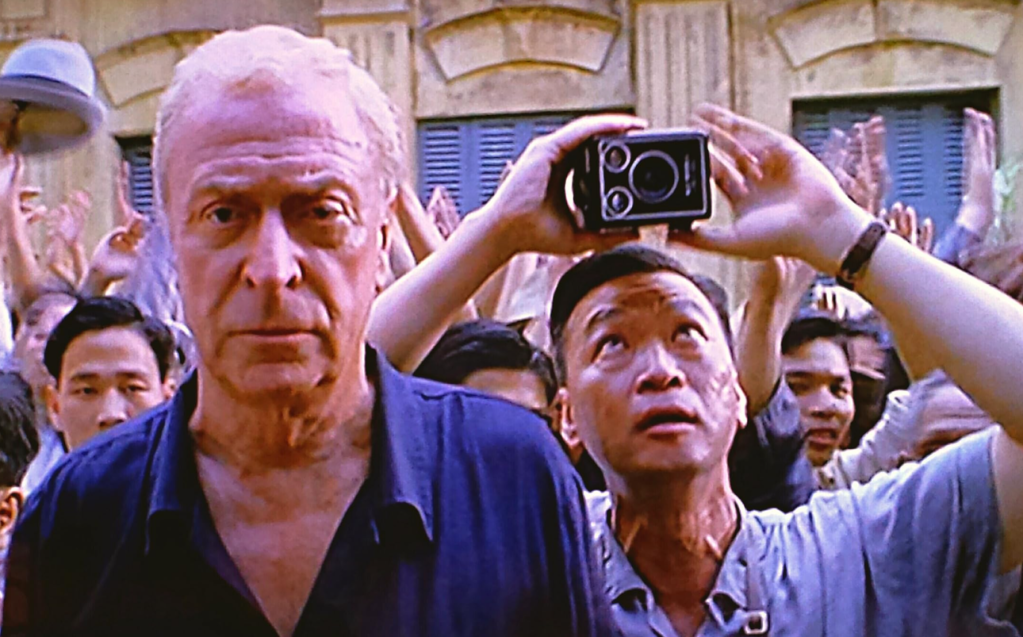
At heart, both are cautionary tales about the dangers and deceptions of innocence.
“How many dead colonels justify a child’s or a rickshaw driver’s death when you are building a national democratic front?” rails Graham Greene in the novel.
Indeed — the unintended consequences of good, but naïve, intentions echo down the decades, one dubious war after another. Had Kennedy read The Quiet American? What if Catholic JFK hadn’t lent American support to fellow Catholic Ngo Dinh Diem, or later backed the military coup that murdered him? Vietnam would still have suffered the trauma of civil war. But had America stayed out, South Vietnam would probably have collapsed much sooner.
I guess George W. Bush hadn’t read it. It goes without saying that Donald Trump hasn’t.
The road to hell is forever paved with good intentions. Man plans, God laughs etc.
The Quiet American aside, we spend the afternoon at the Museum of Ho Chi Minh City. It’s slightly shabby and, like the Museum of Fine Arts, sweltering. Old 1950s photos provide some impression of the Saigon Graham Greene would have known.
Otherwise, the museum is mostly notable for demonstrating how history is written by the victors. Its shrill propaganda is a cautionary tale of what happens when curation succumbs to political interference.
“With the scheme to divide our country for a long time, turning the South into a new type of colony, the Americans attempted to sabotage the Agreements, and suppress the revolutionary movements,” reads one panel, unhelpfully for anyone wanting to understand what the heck was actually happening.
“Saigon young people boisterous in revolutionary ardour”, reads the caption on a photo of several youths who appear to be fleeing tear gas:
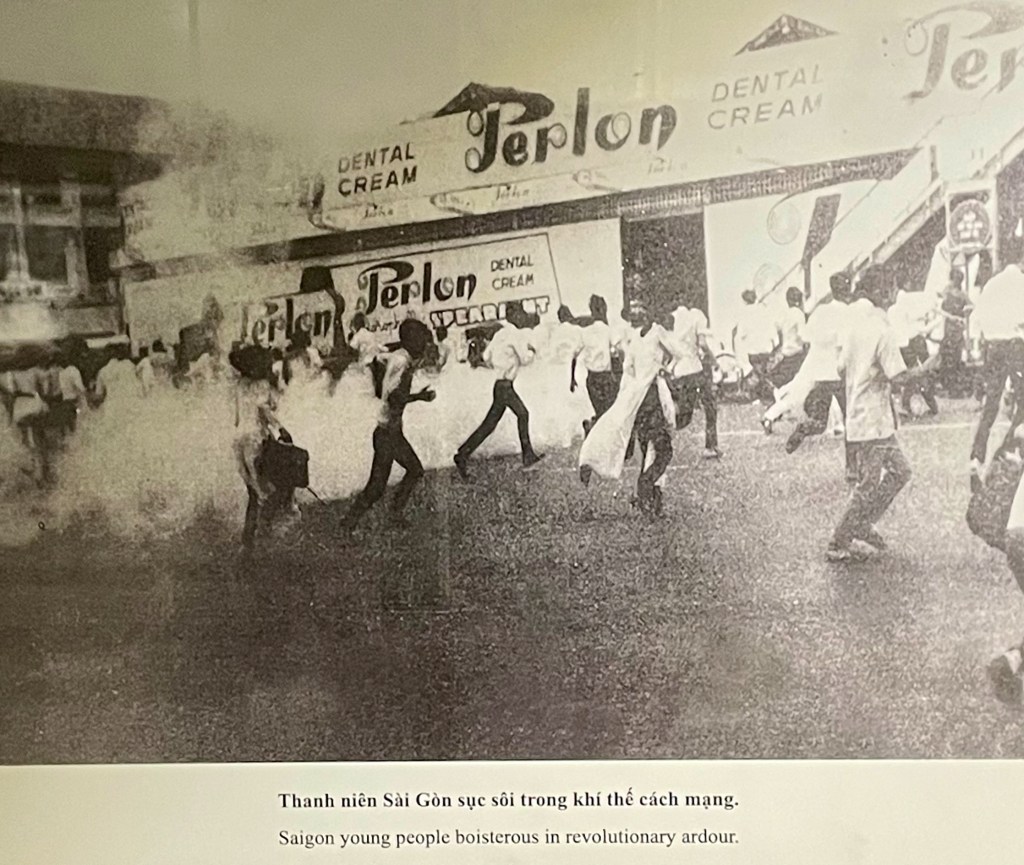
I don’t recall a similarly sympathetic official account of Hong Kong young people being “boisterous in revolutionary ardour” in 2019. We have no plans to visit the ‘improved’ Hong Kong History Museum, but I imagine these days it’s not entirely dissimilar to the stiff Museum of Ho Chi Minh City — albeit with air con.
Tuesday 13 October
We’re not huge fans of zoos, as opposed to wildlife parks, but we’ve been gazing at the elephants and giraffes from our fifteenth-floor balcony for the last two weeks. It’s time to go down and say hello.
It’s raining when we arrive. On a wet Tuesday afternoon, zoo-goers are thin on the ground, and most shops and food stalls have closed early. We potter around under umbrellas, taking in the views back to our flat across the river:
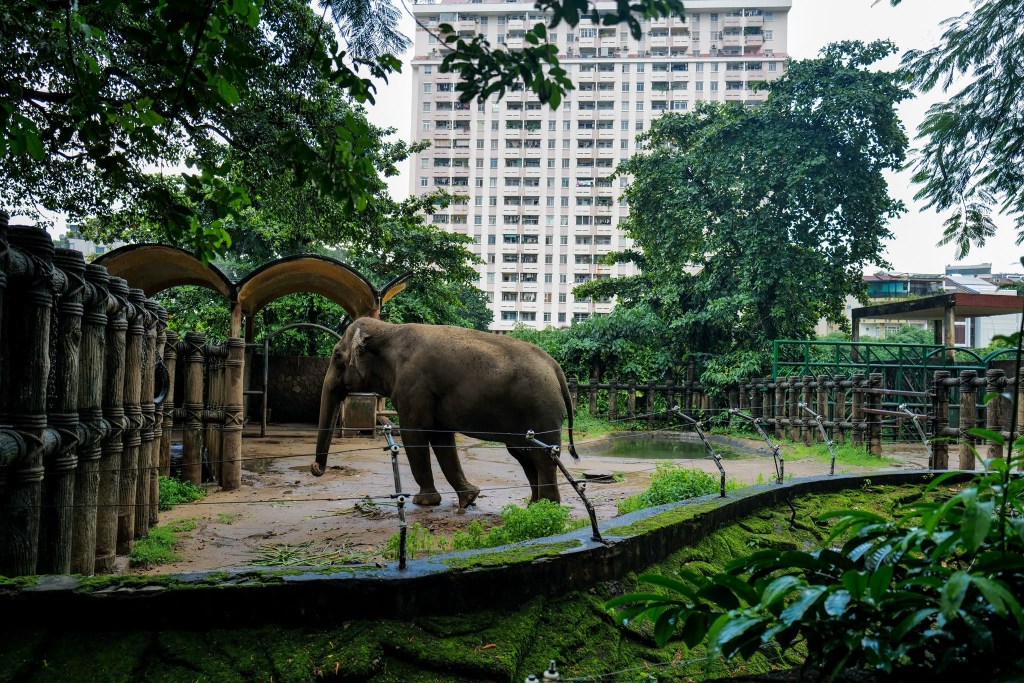
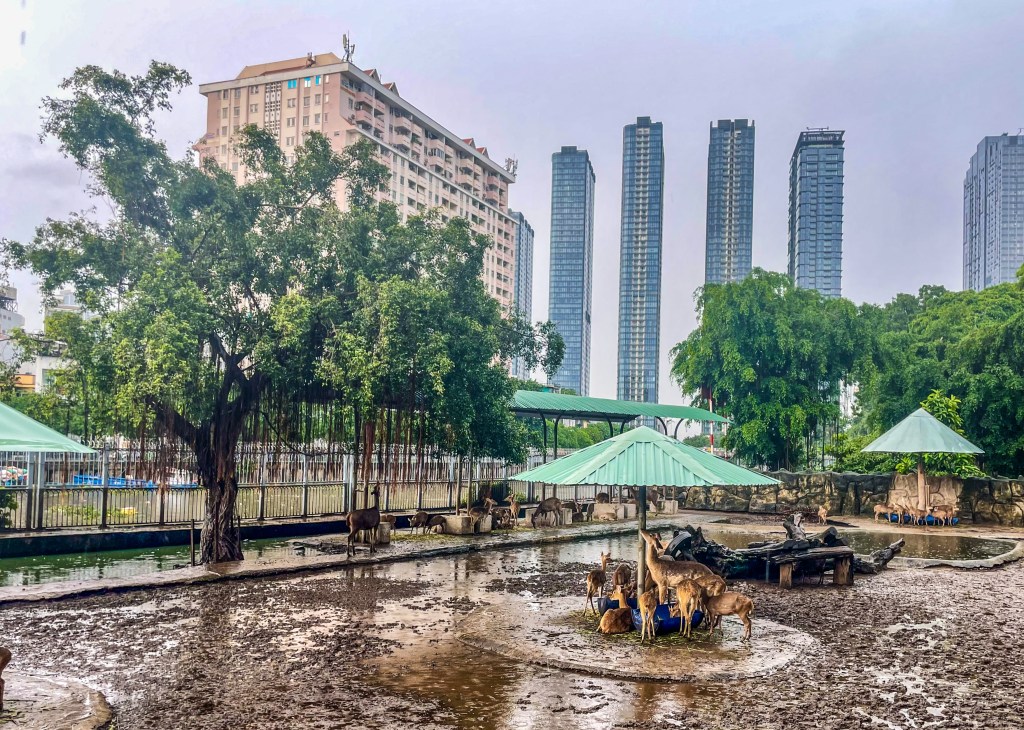
As we wander, it becomes clear the zoo is a rather sorry affair. I don’t doubt the staff do their best for the animals, but few appear to have enough living space. There’s been some attempt to landscape the enclosures to create a semblance of natural habitat, but there’s also a lot of cement. The pitiful tigers seem to have the worst deal. One paces endlessly back and forth; the other lies in a corner on the hard concrete.
I walk out wrestling with my conscience for having bought a ticket. What Saigon needs is a twenty-first-century wildlife park, not a twentieth-century zoo.
We find a nearby cafe, where I start Jane Austen’s Emma. Despite her being a local Basingstoke girl, I’ve never read Austen. This can go on no longer. I’m going on 58.
Later, we’re back at the Rabbit Hole for another quiz night. Nine teams this week, a mix of expats and in-the-know visitors like us. Niall remembers us. He even remembers where we’re from and where we finished in last week’s standings. Bless.
Less interaction this week as everyone spends the break wrestling with a fiendishly difficult ongoing round of film anagrams. Still, the place buzzes all night. I make a complete hash of our joker round, correctly identifying the patterns in sequences of numbers, but failing on elementary arithmetic and pencilling in the incorrect next number in each sequence. Four points instead of a full twelve. K scowls.
I partly redeem myself on the music round — all UK number ones of the past fifty years — with five out of six. Two teams, both playing their jokers, score zero. The team next to us at the bar manage just half a point. Thanks to the inglorious mishaps of other teams, we finish sixth out of nine: respectable enough for a team of two.
We’d both love to show up to such a well-run quiz every week. But much as we’ve enjoyed Saigon, we couldn’t live here.
Wednesday 14 October
A low-key last day in Saigon.
We visit Book Street, a charming pedestrianised lane of tiny bookshops, but naturally most of the books are in Vietnamese. A couple of shops have small selection of second-hand English books, but nothing whets our appetite.
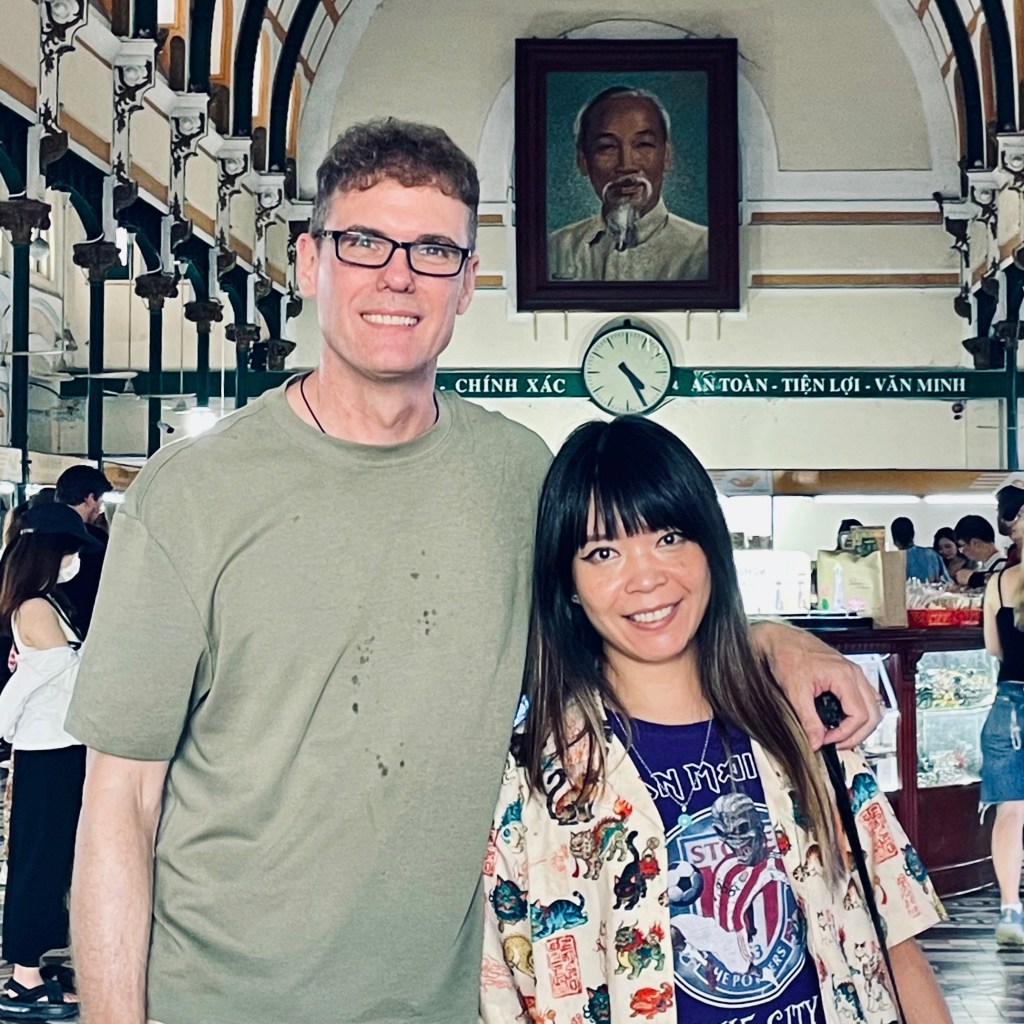
Nearby Notre Dame Cathedral is closed for renovations, but the handsome colonial-era Central Post Office, also nearby, is worth a short diversion — if only to have ourselves snapped with Ho Chi Minh:
Book Street also features the occasional al fresco café, but the heat is stifling. Instead, we plunge into the luxurious air con of Highlands one final time, where I nail another chapter of Emma.
Final nights have become eating-out nights in recent months, so we return to our local ramen joint toting a 10% discount card they handed us last time. Tonight, we’re the only customers. It’s a low-key end to a low-key day.
We’ve just finished packing when the electricity cuts out. Could we be in for a restless, sweltering night without air con? Memories of the Great 1999 Lamma Power Cut start creeping to mind. I sit on the balcony sorting photos on my phone, the outdoor air still like a furnace hours after dark. K scurries around inside using her phone torch. I’m about to attempt sleep despite the heat when the power returns. Crisis averted.
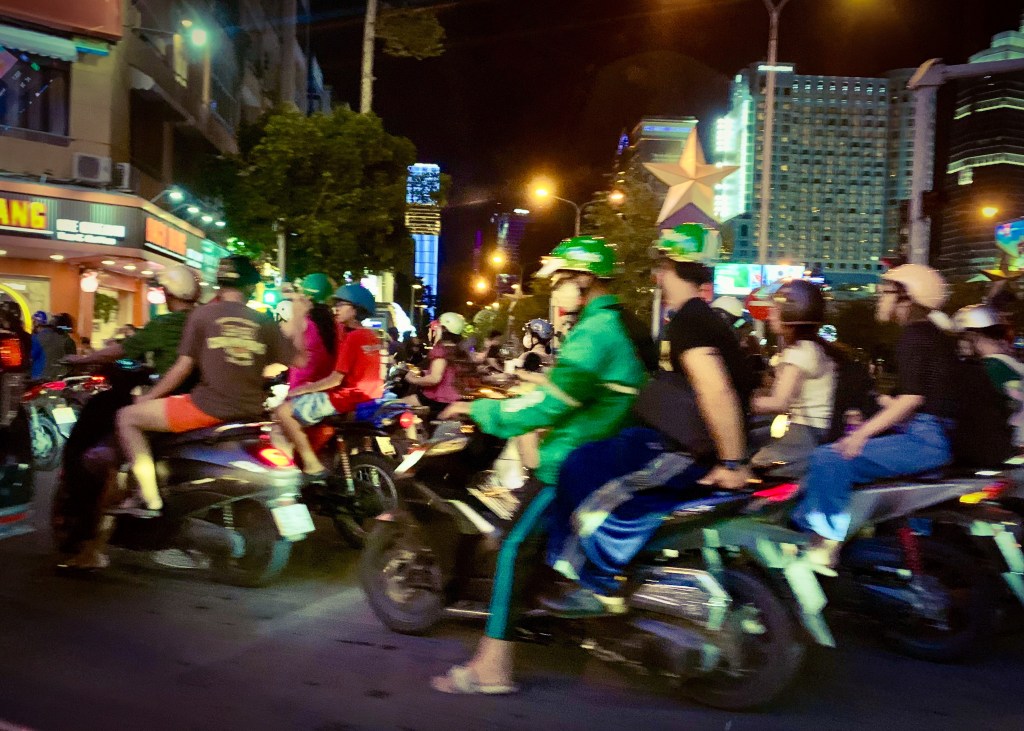
So, goodnight, Saigon. We’ve really enjoyed this city. The sea of scooters filling the streets has been a constant buzz (as well as a constant concern every time we’ve wanted to cross the road). And a great Airbnb, with its dramatic view of downtown Saigon.
Many Vietnamese my age and over must have had a pretty bleak, cheerless early life. Vietnam clearly still has its fair share of problems, but the Saigon of 2026 is clearly a more prosperous place than the Hanoi I visited twenty-five years ago.
It’s time to be somewhere familiar and easy. Like Hong Kong.


Leave a Reply