It’s only an hour up the coast from Casablanca, but Rabat has a more relaxed vibe.
Monday 6 October
After displaying a calamitous lack of ability to read a map, our taxi driver eventually finds us and drives us to Casablanca Voyageurs train station. He may not be able to follow real-time GPS on his phone, but he’s a lovely young chap who speaks enough English to chat and proudly shows us his Raja Casablanca bronze membership card. We now understand why app-based taxi drivers insist that one passenger sits in the front—it disguises the fact that the driver is operating an illegal taxi service. Since Omar, our tour guide in the south, our driver is the most valuable encounter we’ve had with a local.
Our eight-person compartment is full, but this time we’re the only foreigners. At the only stop en route to Rabat, a woman enters the compartment with a screaming toddler. The toddler eventually calms down and nods off while an elderly gent strikes up a conversation with the mother in Arabic. I say ‘conversation’, but I don’t think he asks her a single question all the way to Rabat. He talks; she demurs. He seems to be entertaining. A couple in their seventies sitting in the window seats tear themselves away from watching the passing countryside and turn to face the garralous gent and his hapless one-person audience, all wry smiles. I can’t be sure if they’re quietly chortling with the motormouth or at him.
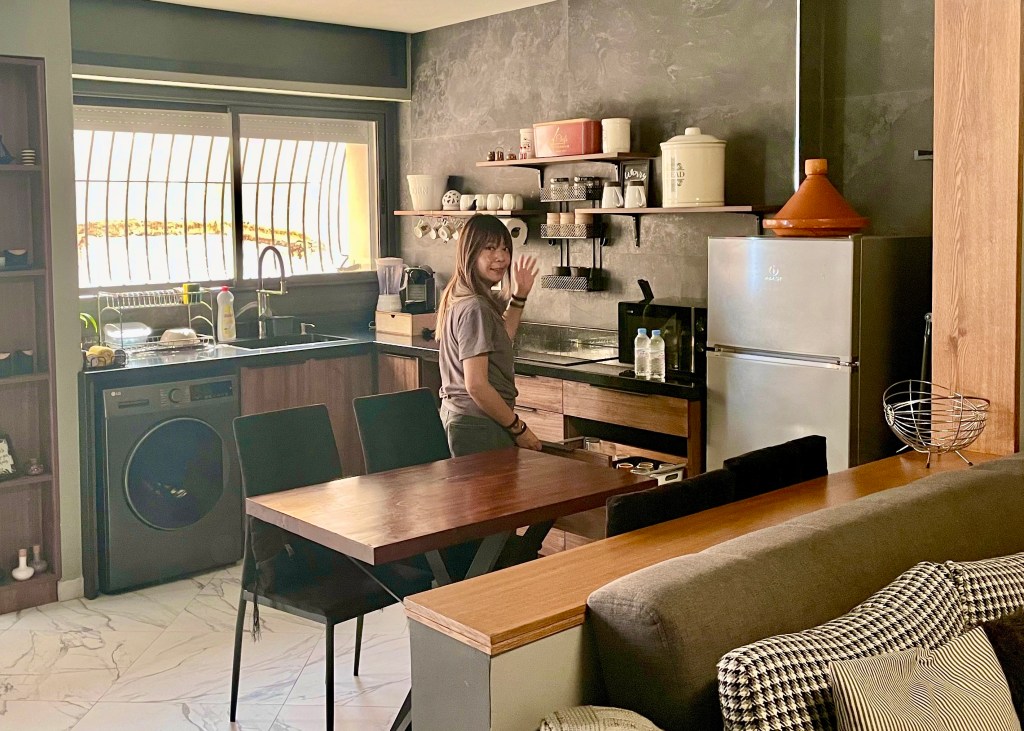
Rabat Ville station has no lifts in service, so we haul our suitcases up to street level. Thankfully, our flat is less than ten minutes on foot. First impressions: as we suspected from the photos, it’s rather dark—it faces the wall of another building and doesn’t get a lot of direct sun. Otherwise, it’s fine.
We’ve already eaten out the past two nights, so we do a big grocery shop and eat at the flat. We can start exploring tomorrow.
Tuesday 7 October
Our first full day in Rabat is overshadowed by more admin isues, this time involving HSBC. I’ll get all of these issues sorted, but right now everything seems to be one step forward, one step back. It’s like walking around with a constant small pebble in my shoe.
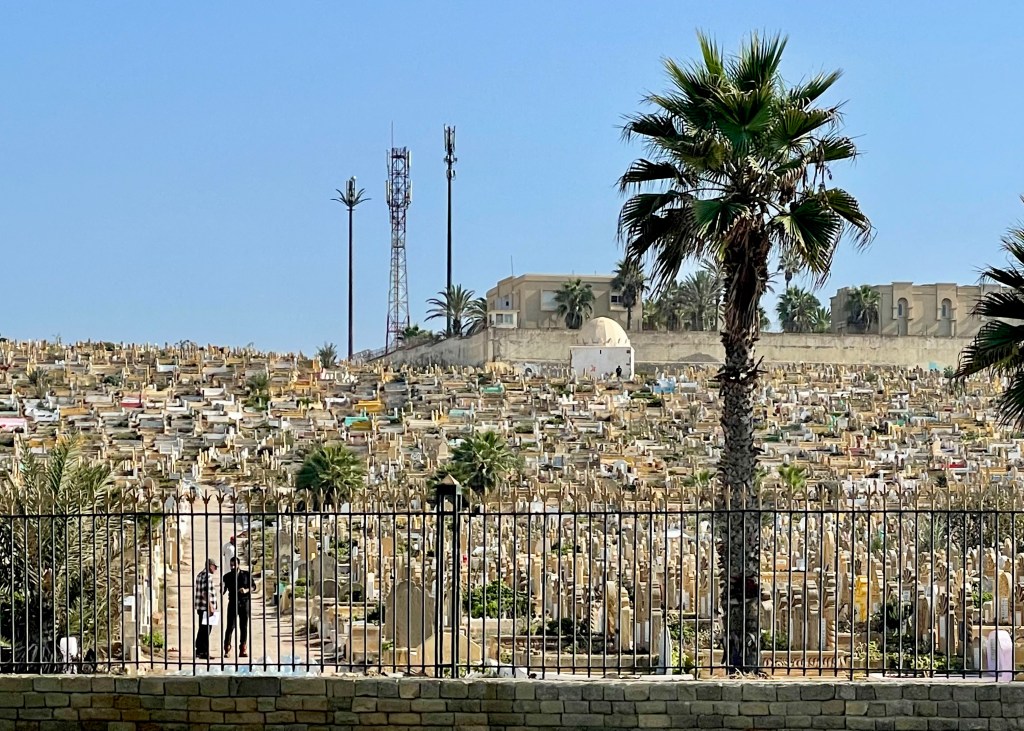
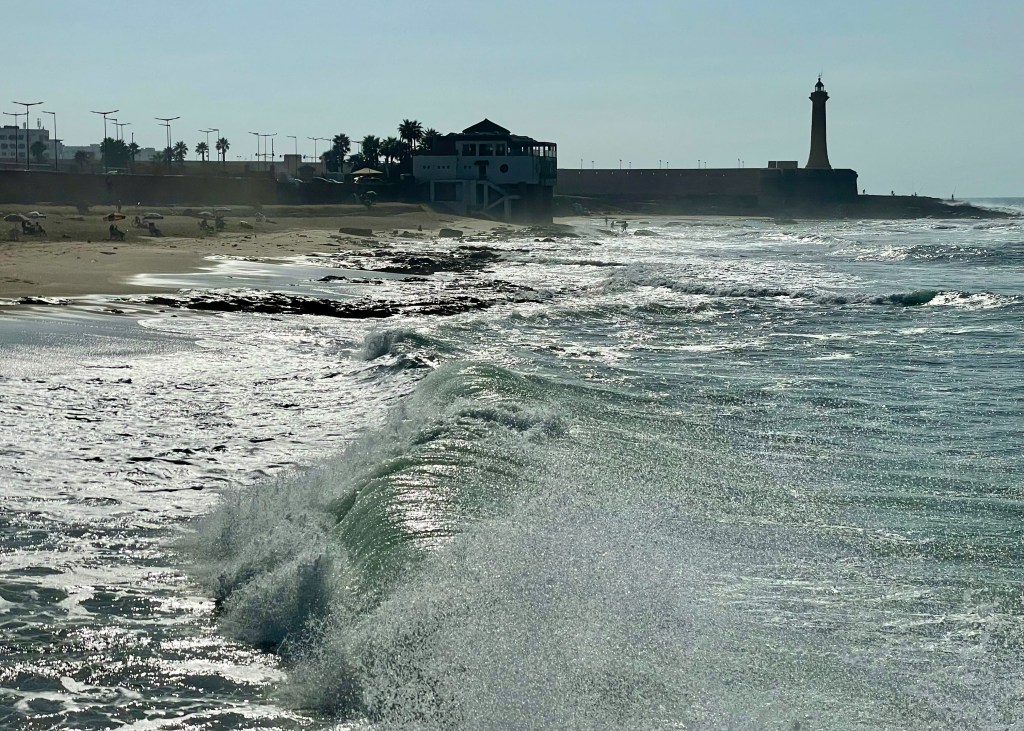
Our only objective today is to get a feel for Rabat. The 25-minute walk to the coast takes us through the medina and past an enormous cemetery that backs down to the Atlantic, where some serious waves are thundering in. A couple of dozen surfers are out in the water—there’s even a surf school on the shore, from where we can Pink Floyd’s ‘Shine On You Crazy Diamond’ on the stereo (odd: we listened to that album just this morning).
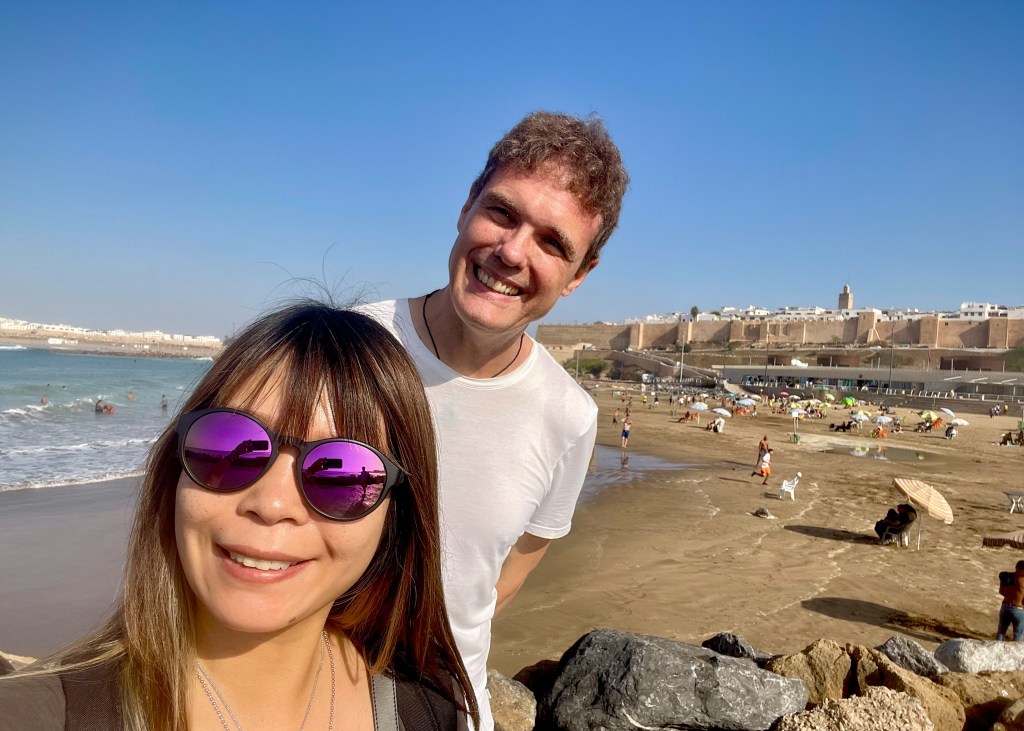
More foreigners are noticable here than in Casablanca, especially when we sit down at a beachfront cafe for coffee and cheesecake, and when we walk back through the medina.
Rabat feels more compact, more walkable, than Casablanca. There seems plenty to see and do. Initial impressions are good.
Wednesday 8 October
Our second day, or at least late afternoon, of exploring Rabat takes us downtown to the Bab el Had, site of the recent wave of protests that have been continuing steadily for 10 days now. We’ve yet to see anything going on, and naturally we’ll keep our distance if we do. But the protests seem to have gained some traction.
The nearby Nouzhat Hassan Garden is a shady oasis of peace in the city centre. It’s rather unfortunate that the garden’s ducks and geese are behind not one but two fences, making them not the easiest to see as they glide around their modest lake.
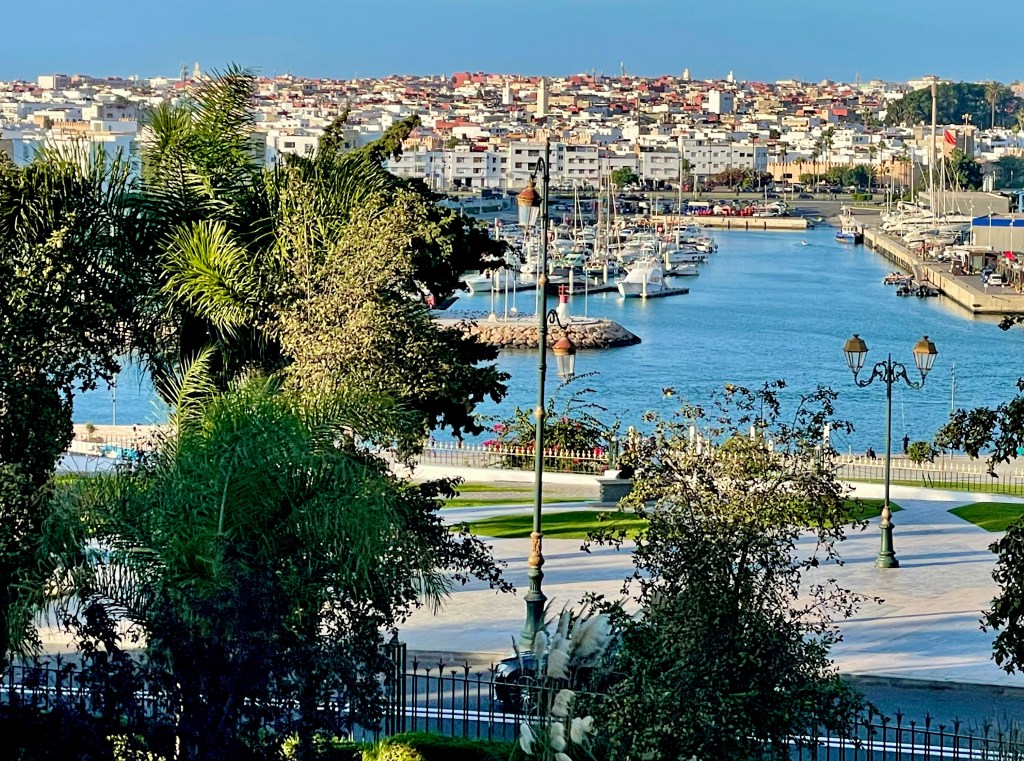
Past the garden, we arrive at the embankment above the Bouregreg river that divides Rabat from Salé to the north. It’s a fine view across the river. Salé sports a marina fronting its own medina, while the Rabat side is squeaky clean and boasts the finest grass we’ve seen in Morocco.
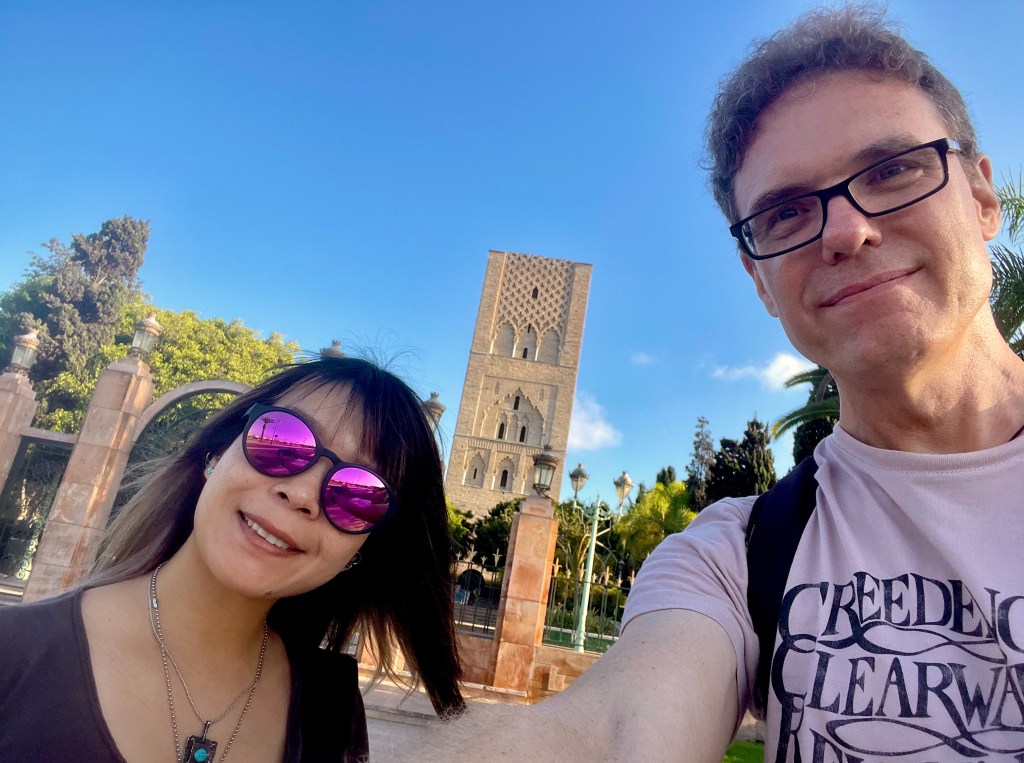
At nearby local landmark the Hassan Tower we run into a coach party of Hong Kongers busy taking photos. This time, I pipe up that we’re also from Hong Kong and briefly exchange words as they’re about to reboard their coach.
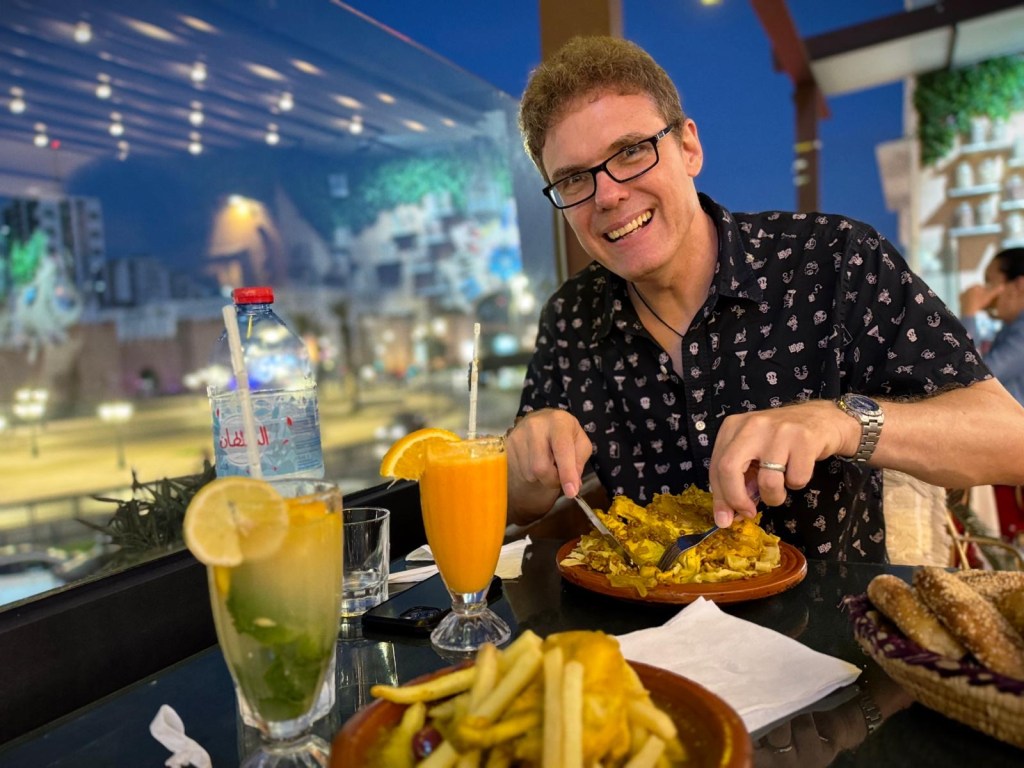
After dropping off some groceries at the flat and a change of clothes to make myself more presentable for eating out, we strike out for a restaurant we saw featured on a YouTube video. We’re given seats with a commanding view of Bab el Had at dusk, but despite the agreeable surroundings the food is stodgy and the portion far too big to finish. Back at the flat I almost immediately fall into a food coma.
Thursday 9 October
Work is really beginning to pile in now. The next month is going to be full on.
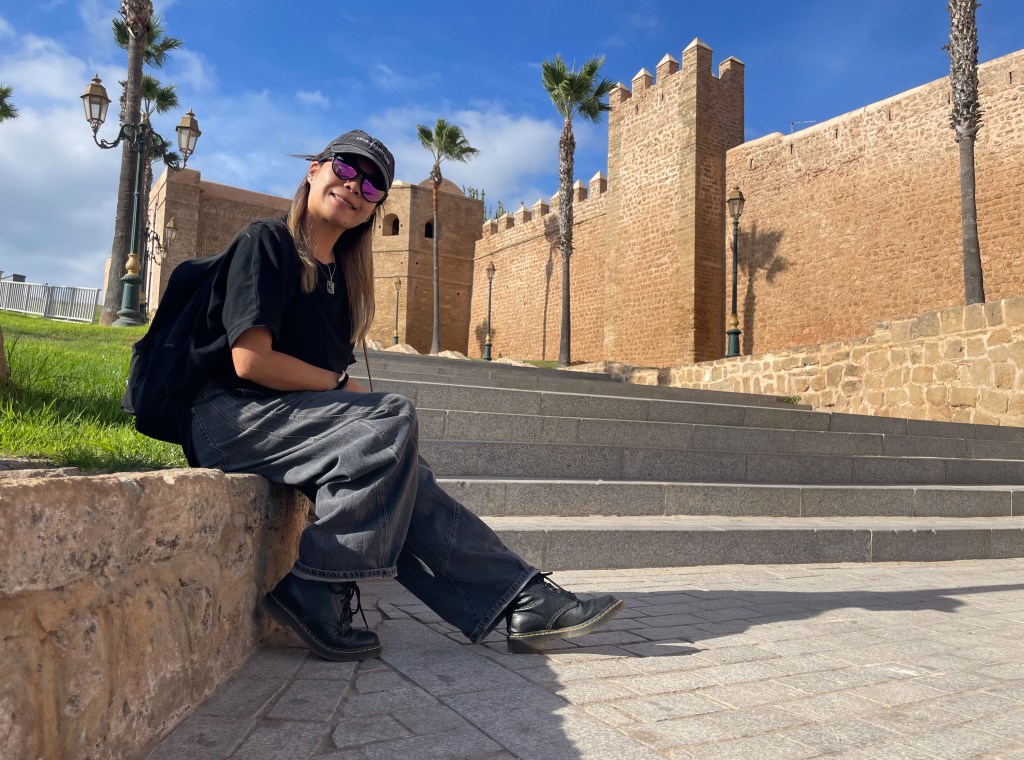
Again, we emerge from the flat only after 4pm. Today’s walk takes us through the handsome souk area of Rabat medina, and on to the Oudayas Kasbah—a modest collection of whitewashed buildings atop a bluff between the coast road and the water. The peaceful lanes and bright bougainvillea remind me somwhat of Paros.
The only people appear to be other tourists and those involved in selling trinkets to them, but despite this the kasbah manages to maintain a laid-back vibe. We enter at the top and slowly wander down to a cafe overlooking the estuary of the Bouregreg river. Everyone’s a tourist, and French and German are the only languages I hear. Still, it’s a good spot to stop for coffee, try some local pastries, and read our books. A few people are swimming in the river estuary, which looks surprinsingly clean for a sizeable developing city.
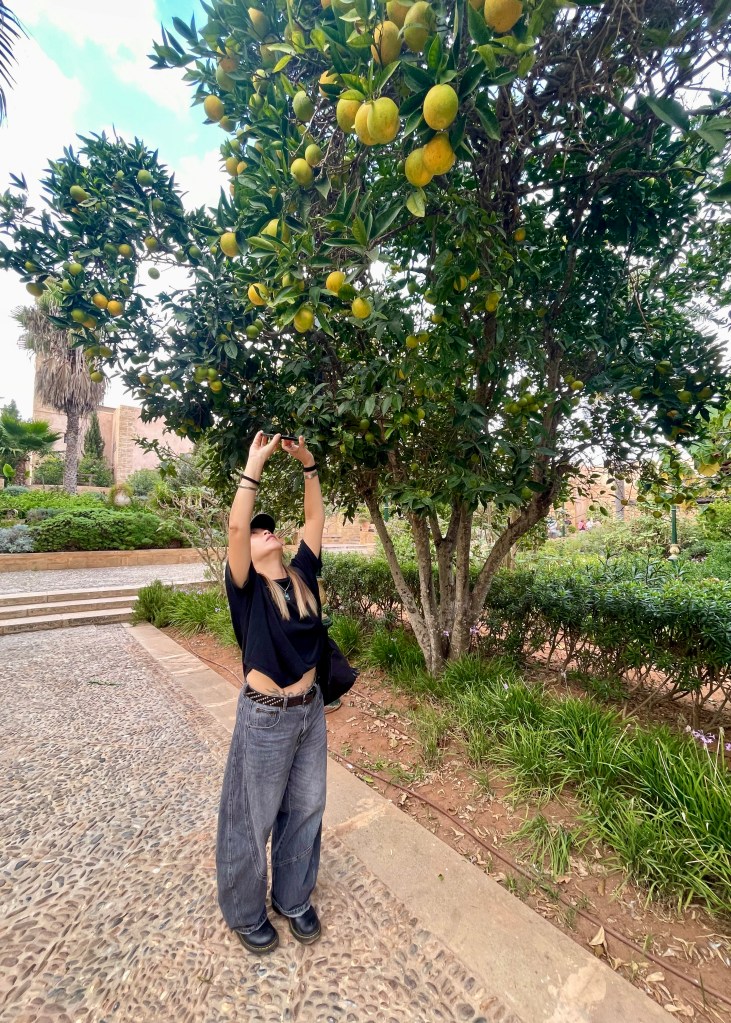
The best moments are often the surprises. I haven’t looked at Google Maps, so when on leaving the cafe we stumble into the adjacent Andalusian Gardens, I’m all wonder and awe. Oranges are ripening all around us and the gardens are walled in by fine Moroccan architecture:
Friday 10 October
As we stroll to a nearby museum, we can see that the streets around Rabat Ville station and the parliament building are thronged with people of all ages. Some are wearing traditional costumes, some are playing rhaitas or thumping drums. We’re unsure if it’s connected to the current spate of ‘GenZ 212’ demonstrations and thus keep a cautious distance. At the museum, two security guards announce that they’ve received instructions in the past few minutes to close the museum for the rest of the day to exercise caution. “Didn’t your embassy inform you what’s going on?” one of them asks, reminding me of our perennial forgetfulness to inform the UK embassy of our presence wherever we go.
We retrace our steps, but on closer observation it looks like an official event, not a demonstration calling for reform. Huge Moroccan flags are secured outside a large official-looking building, there are marching bands, and—this is going to sound judgmental—many in the crowd don’t look like the types to protest. K does a bit of Googling and we learn that the King is due to deliver his annual addresss to parliament this afternoon. The crowds are possibly a bit of both: loyal regime supporters and skeptical types intent on reform. We stop to watch, feeling more comfortable as the minutes pass and the atmosphere feels more carnival than riot.

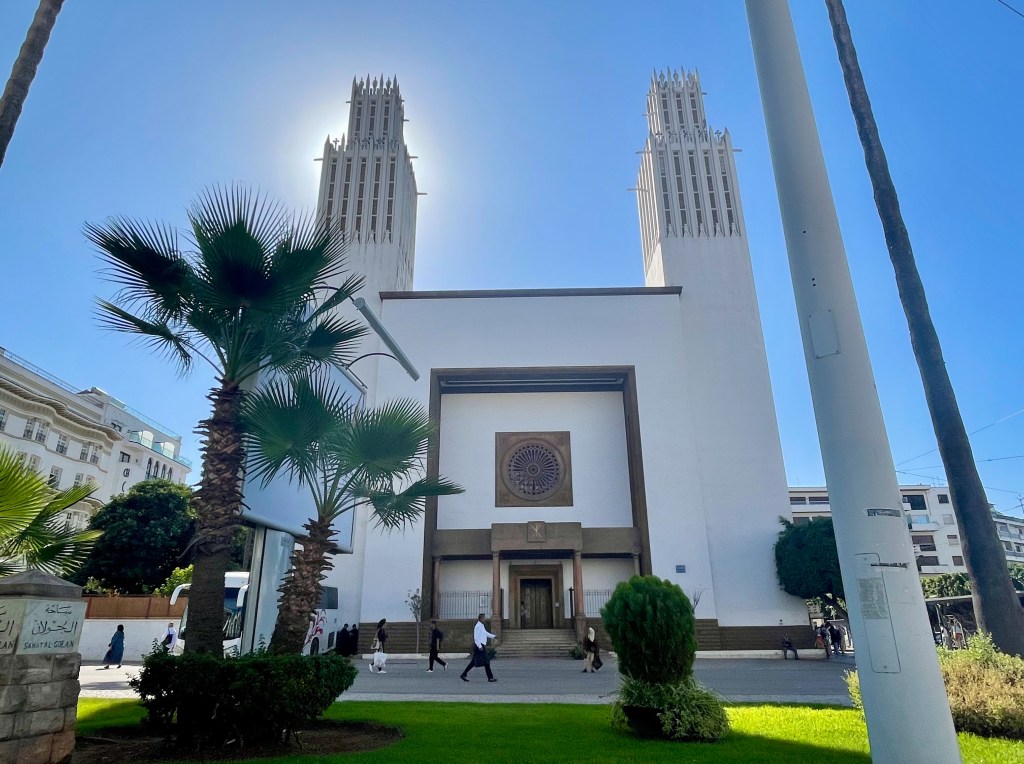
With all museums closed, we amble off to visit nearby St Peter’s Cathedral—striking from the outside but much-of-a-muchness inside:
Saturday 11 October
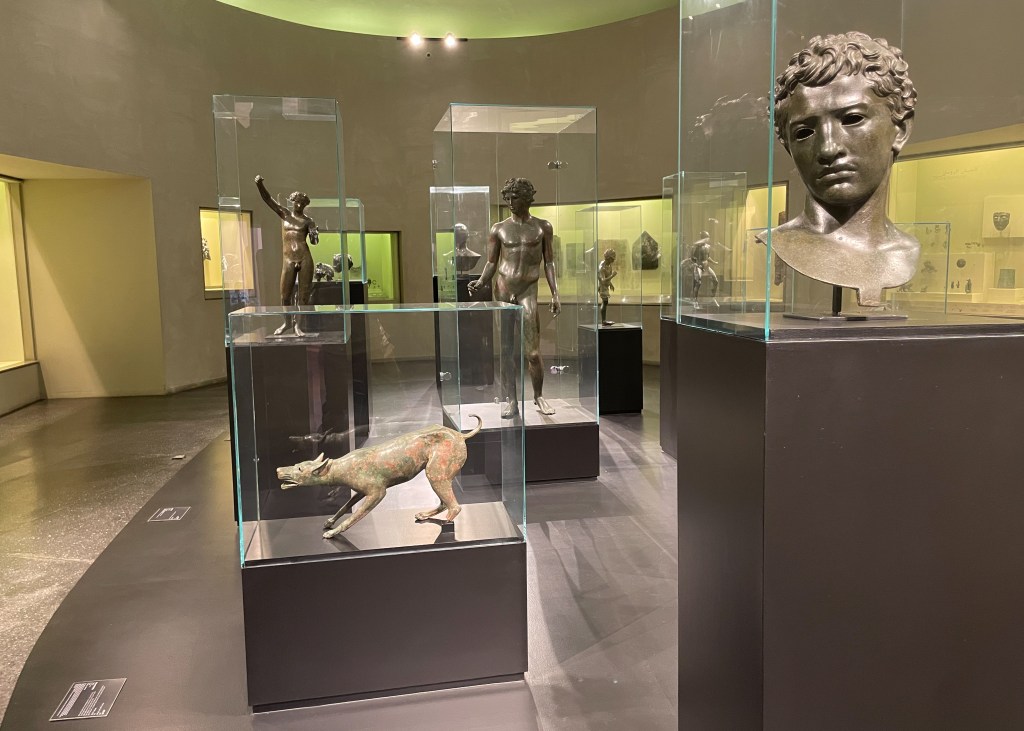
I had no idea that the Romans had reached this far around the coast of Africa. An afternoon visit to the Museum of History and Civilisations soon puts me right on this. Its highlight is a room of terrific bronze sculptures. Although the museum is small, we happily while away a whole hour—a lot of that taken up laboriously reading the supporting panels in French. I’ve never been in a cultural venue that doesn’t offer labels in English as the non-local language. It’s a pleasure. I absorb numerous new words related to archeology and ancient history, none of which I’m likely to need when ordering deux cafe noirs, une tranche de cheesecake, et deux fourchettes.
After a brief walk around the block, during which we realise that the Moroccan parliament building is less than five minutes from the flat, we settle on a downtown Chinese restaurant. I become hopelessly confused about a sticker on the cover of the menu announcing ‘Les prixs sans les taxes‘. To me, this implies that the prices we see in the menu are net of tax, so I ask how much extra we’ll be charged in addition to the listed prices. This completely baffles our server, who attempts to explain that she can give me an invoice if I need one. And this completely baffles me: how is it relevant to my question? K talks to the Chinese manager in her limited Mandarin, but also seems confused. We eventually establish that the prices in the menu are the prices we’ll pay. In all honestly, I still don’t really understand the purpose of that sticker.
Over a rather disappointing meal in a near-empty restaurant, we revisit the topic of money laundering—last discussed at a similarly near-empty Chinese restaurant in Novi Sad in May. Or at least K, with the patience of a saint, explains how Les saveurs de chine restauant is almost certainly a front for a money laundering operation for someone with the resources to get their money out of China. It’s been a confusing night, but this time I do finally understand how a money laudering operation works.
Sunday 12 October
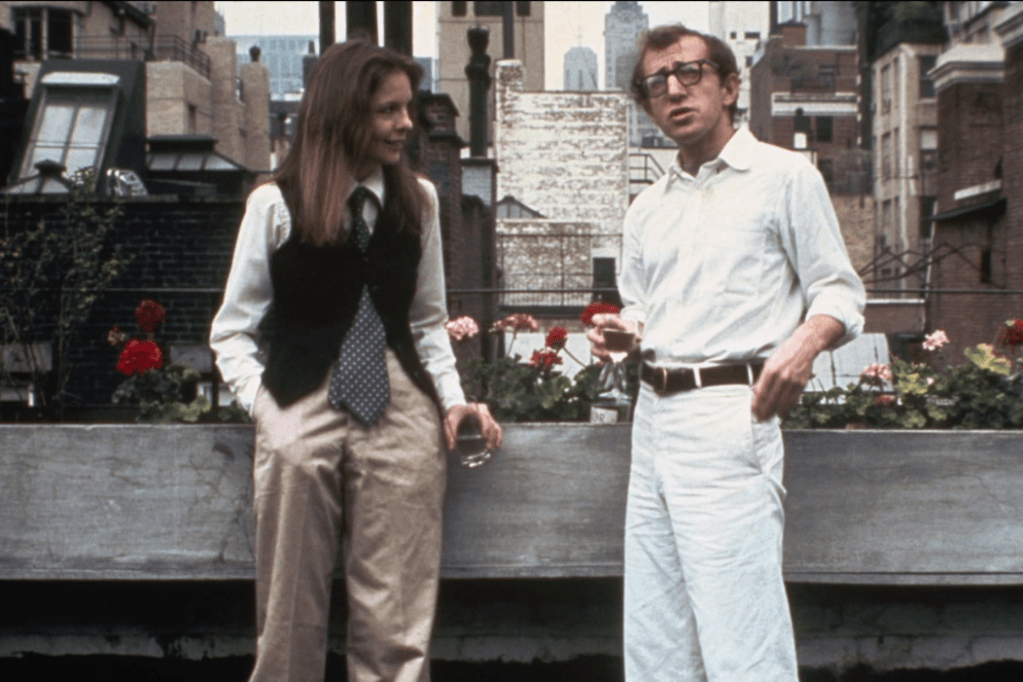
Work. A quick stroll around the block around 7pm to loosen up. Diane Keaton passed away yesterday—time to revisit the razor sharp, endlessly quotable Annie Hall for the first time in many years.
Monday 13 October
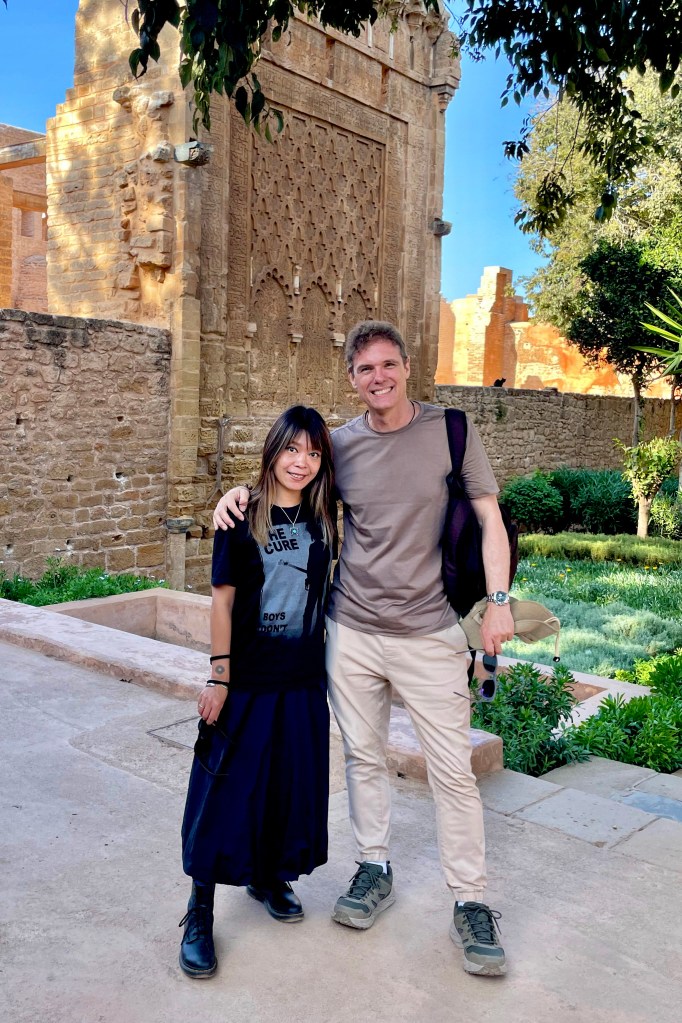
Today’s amble takes us to major historical site Chellah, half an hour’s stroll to the south and overlooking the Bouregreg river. Its roman ruins, royal tombstones and handsomely landscaped gardens alone would make for an arresting afternoon potter. But what really makes Chellah special is the colony of storks nesting in and around its grounds. In one afternoon, I see more storks than I’ve seen in my life. The posh storks have built their nests atop the minarets, roofs and walls of the site. The others have to make do with trees.
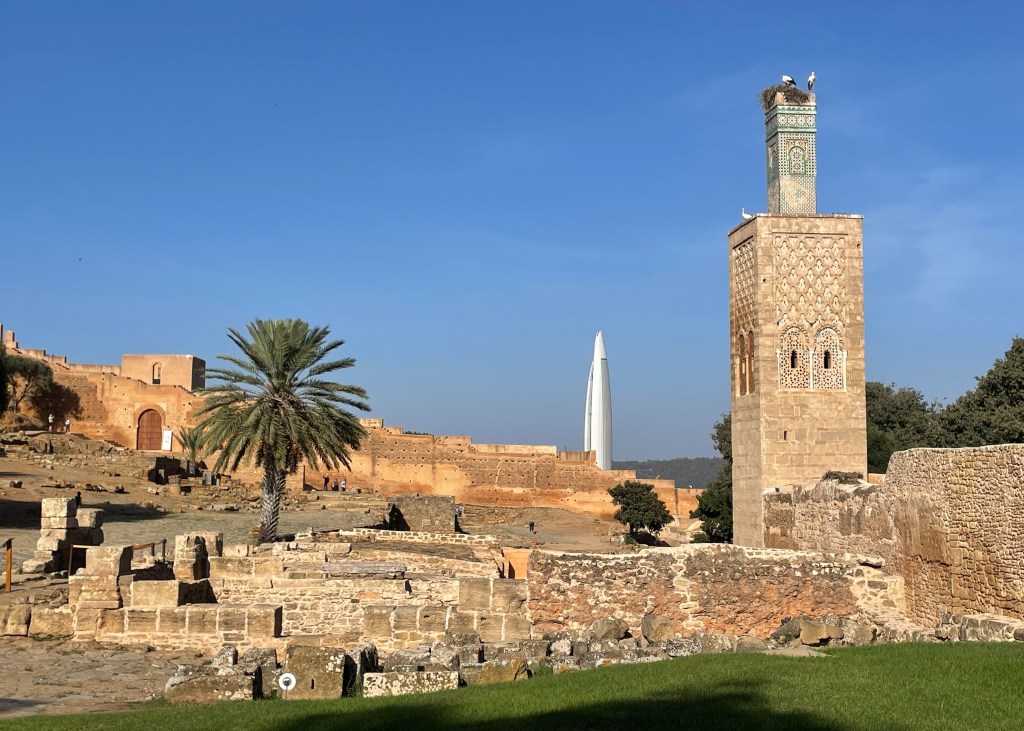
It’s a marvellous place to amble for a hour or two. Given the views, we don’t even baulk excessively when the cafe inside the grounds is charging London prices (and then some) for coffee and mint tea.
Tuesday 14 October
I’m finding the constant work demands increasingly frustrating. Two long, demanding jobs for AsiaEdit last week have brought me a bit low. I’m facing a busy few weeks with work coming in from PolyU, so I’m done with AsiaEdit for now.
I’m just about still finding it worthwhile keeping a hand in with AsiaEdit. I’ve learned a lot by carefully checking the senior editor’s edit of each paper I work on. But financially it’s a drop in the ocean. Even if all my PolyU work was swept from under my feet—not likely in the forseeable future—I wouldn’t want to take on a lot more AsiaEdit work to replace it. The remuneration just doesn’t warrant the mental effort.
Work also means we’re not making the most of Rabat. It’s an agreeable place, but I feel we’re only scraping the surface of the city as work takes up much of most days. It was much the same at this time of year in 2023 and 2024, but somehow I’m resenting it more this year—probably because I had so much time to myself earlier this year when work was thin.
Today, we extend our phone plans and visit the supermarket—everyday chores that have their own modest rewards. But I’m aware that we only have five days left in Rabat, yet still a list of places to see and things to do.
Wednesday 15 October
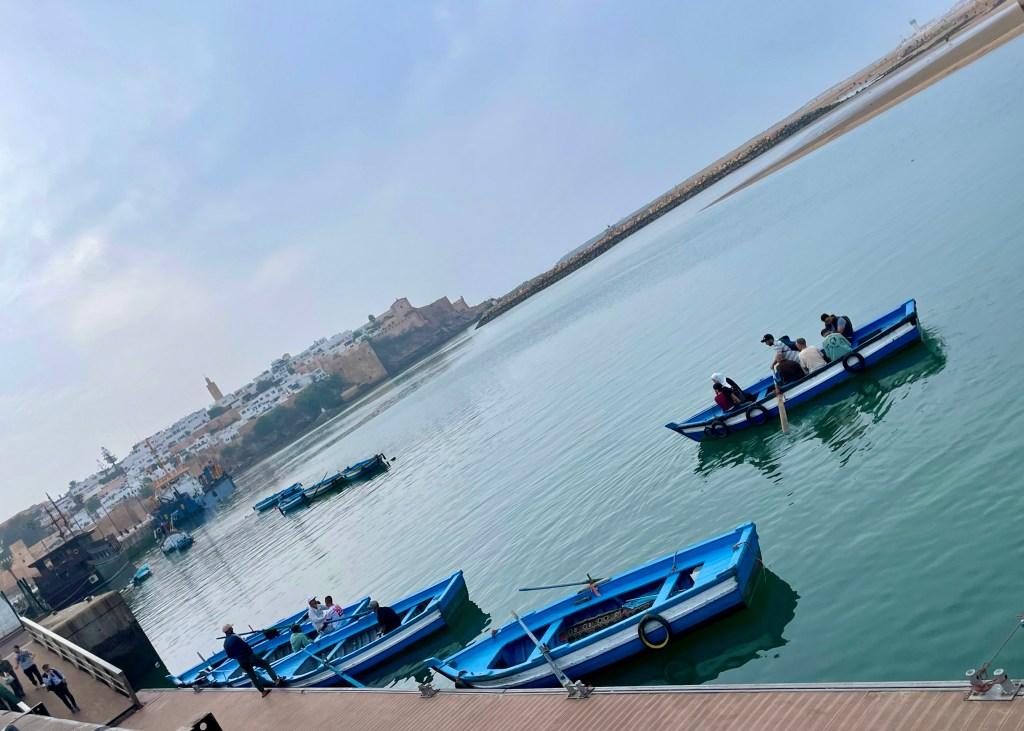
A better day. Work is less gummed up. We manage to get out by mid-afternoon and amble down to the Atlantic to watch the waves crashing in. After a cursory poke around a small archeological site outside the kasbah walls, we wander through the kasbah to take in the views looking north to Salé across the river, and west to the vast expanse of the Atlantic. At the same beachfront cafe, we stop for coffee and cheesecake before meandering along the river aiming for the shot of the kasbah that appears on Wikipedia as the headline photo for Rabat. Although it’s early evening, the light isn’t good today: for the first time since we left Marrakesh, it’s overcast:
A thirty-minute walk brings us to a tapas bar we spotted the other day. Les Deux Palais is exactly what we’ve been looking for: somewhere to eat that serves good food, offers reasonably priced adult refreshments, and draws a crowd. It’s buzzing when we arrive; by the time we leave, it’s packed with (mostly male) customers knocking back draft beer, local wine, and plates of marianted sardines, stewed white beans, and cheese croquettes. It’s also smoky—the first time I’ve really noticed cigarette smoke in Morocco. But it’s a small price to pay for the atmosphere. I’ve missed lingering over a meal and chatting.
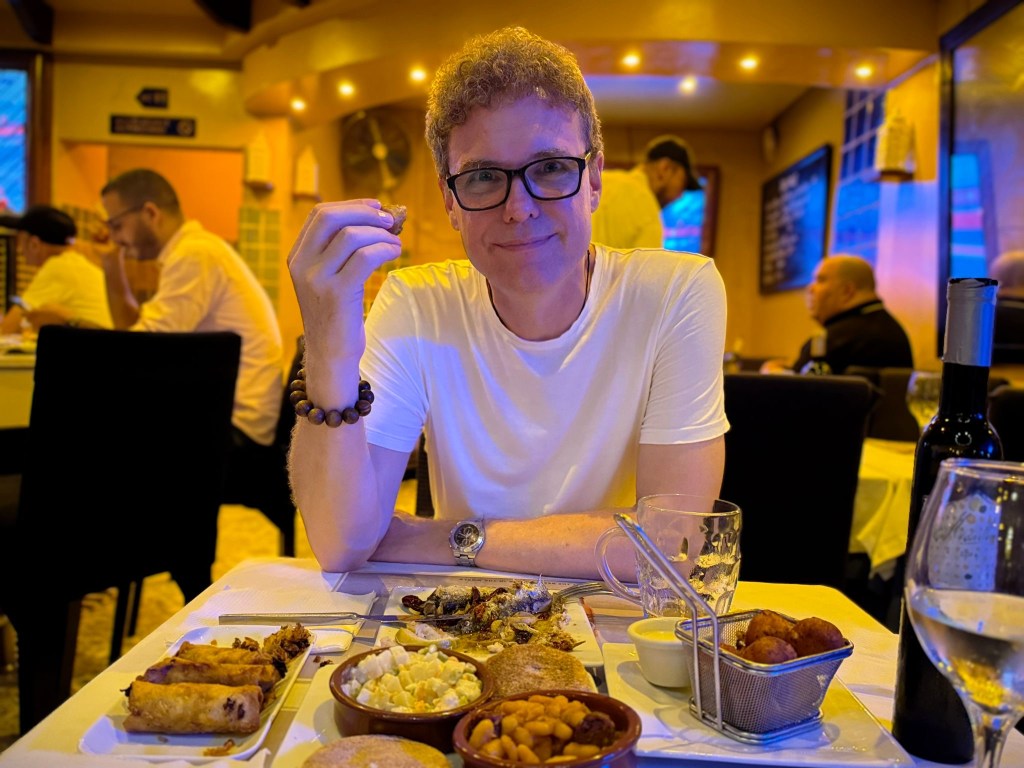
Thursday 16 October
With work under control, we spend the afternoon at the nearby Mohammed VI Museum of Modern & Contemporary Art. I’ve seen enough contemporary art museums to be deeply skeptical of paying good money only to see a pile of bricks accompanied by pretentious gobbledegook about how the textures open a world of new sensory perspectives etc. So I’m not expecting a lot as we cough up the modest entrance fee.
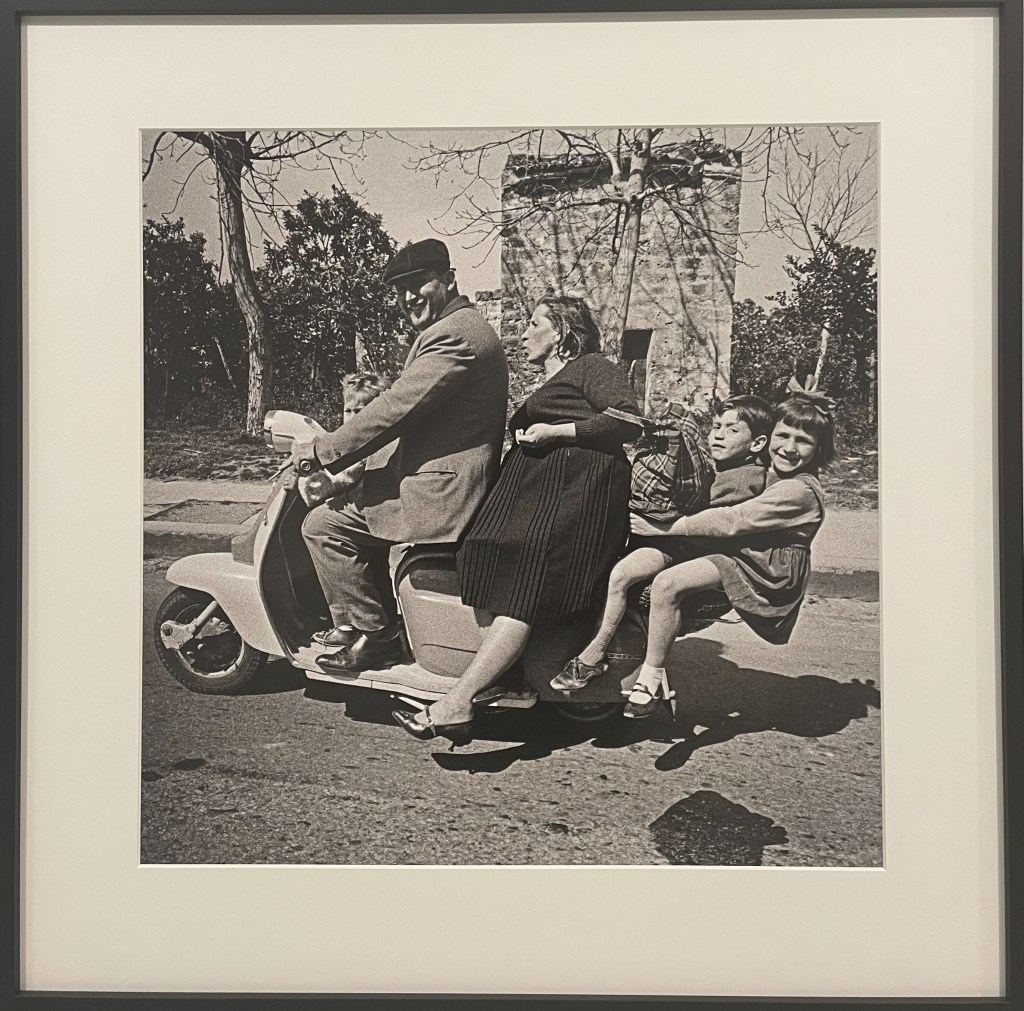
But we came at the right time: the museum currently has a double exhibition of the work of two great twentienth-century French photographers: Marc Riboud and Moroccan-born Bruno Barbey. Both exhibitions span every corner of the world, from Morocco to China, and from Poland to Brazil. Both cover social movements, war and conflict, as well as scenes of everyday life, such as this one taken in Italy in 1964:
Unusually for Morocco, the exhibitions are labelled in English as well as Arabic and French. There’s plenty of opportunity to read the blurb in French before checking my understanding against the English and picking up some more new words.
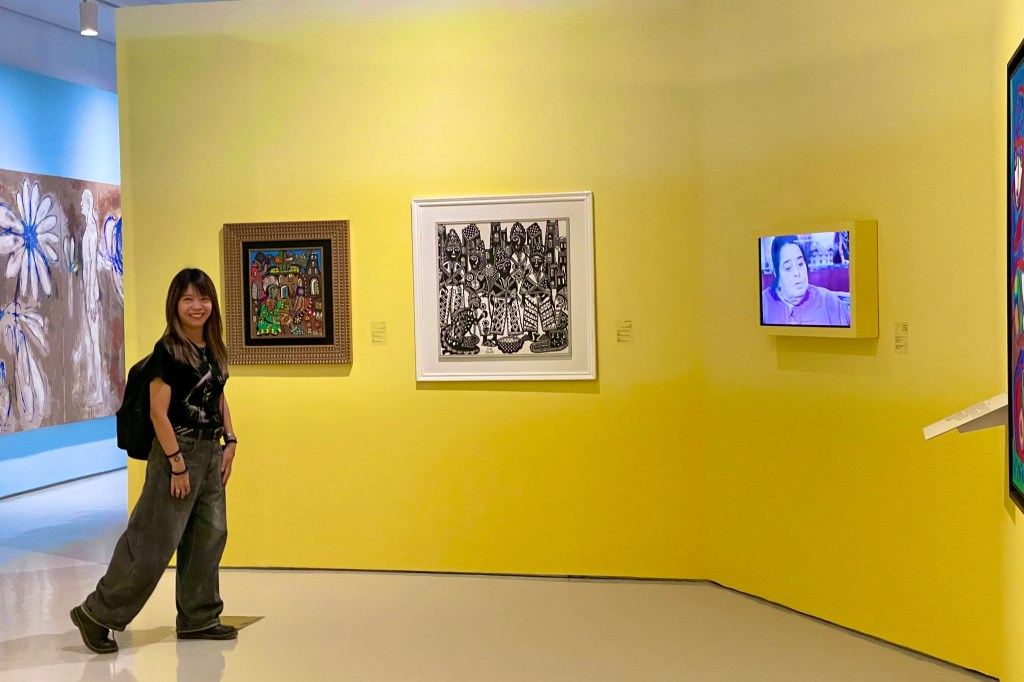
The rest of the museum is given over to post-WW2 Moroccan art. It’s diverting enough but not in the same class as the photography exhibition:
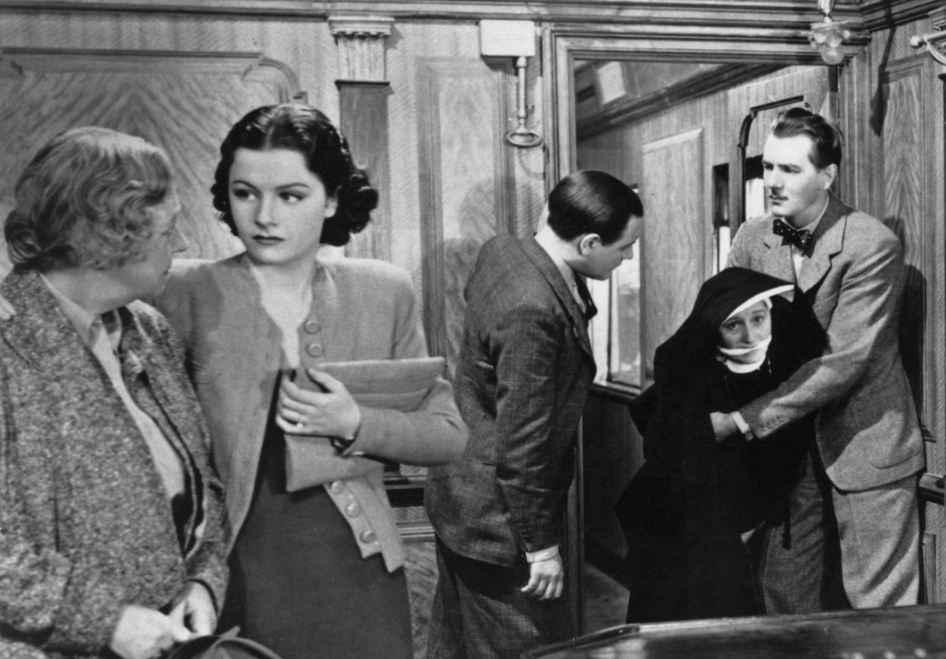
We spend the evening on YouTube watching a colourised print of Hitchcock’s 1938 comedy thriiller, ‘The Lady Vanishes’ with Margaret Lockwood and Michael Redgrave. A marvellous romp.
Friday 17 October
For a second day running, we find ourselves focusing on photography: this time at the National Museum of Photography, which is creatively housed in a renovated fortress/bunker on the seafront. While the work on display isn’t quite as gripping as yesterday’s exhibition, the ten featured photographers are all Moroccan. And there are some excellent ideas. The most visually striking is a set of photos in which people wander round a Tangier housing estate with satellite receivers attached to their heads, mimicking the blocks of flats:
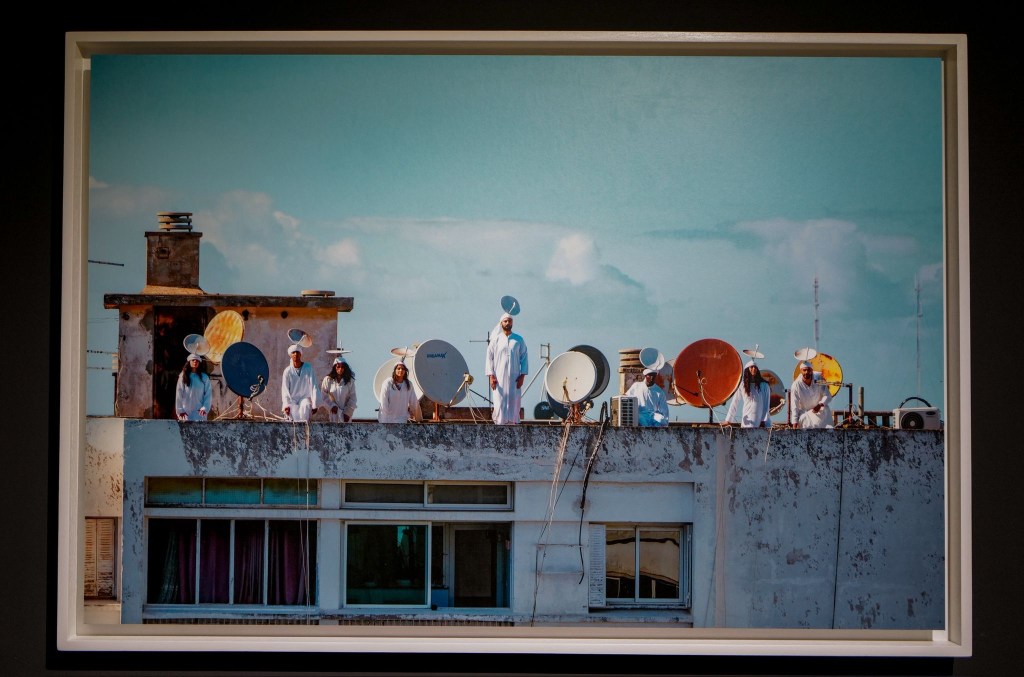
Along the waterfront, we notice a coastal strip of residential buildings, stretching from the edge of the medina all the way to the museum, in various states of demolition. Some, have already been reduced to piles of rubble; others, like this one, remain almost intact with just one flat demolished:
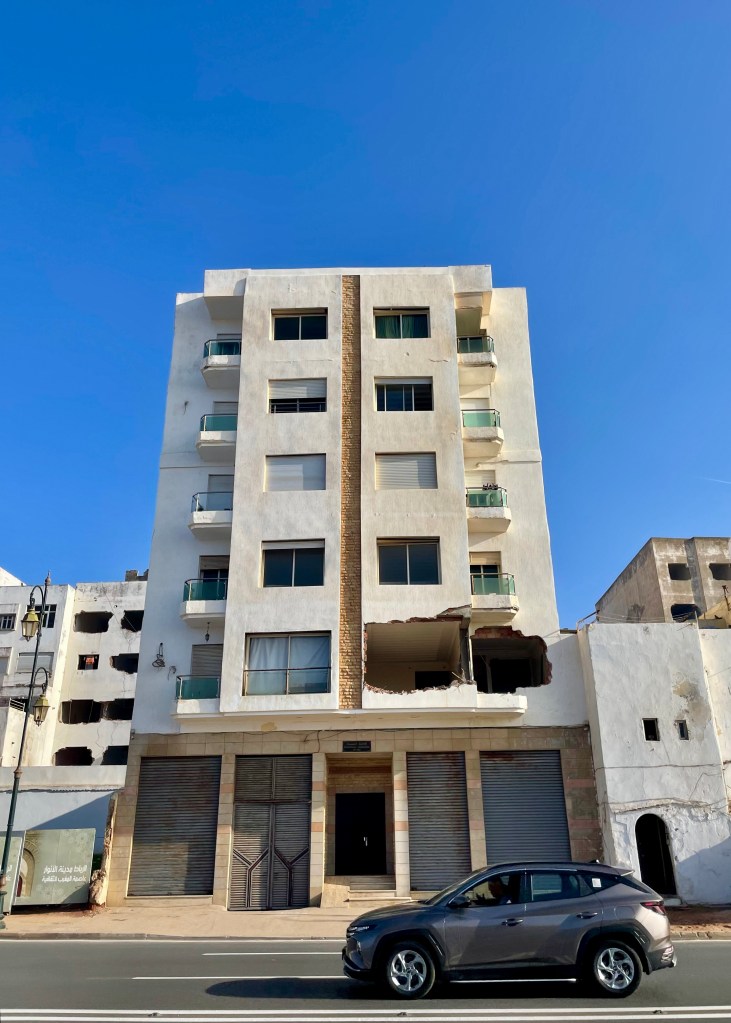
A bit of research suggests an official story of much-needed urban regeneration pitched against a more believable story of money, vested interests, corruption, intimidation and forced relocation.
Saturday 18 October
Before we leave Rabat, we want to cross the river and get a feel for the city of Salé on the other side to the north. We’re rowed across the narrow river in two minutes and initially find ourselves in an unpromising neighbourhood of fancy new developments that haven’t really gained traction. The flats are occupied, but the commerical space at ground level sits mostly empty. Still, scattered fishing boats on the river bank go some way to compensate for an otherwise underwhelming neighbourhood:
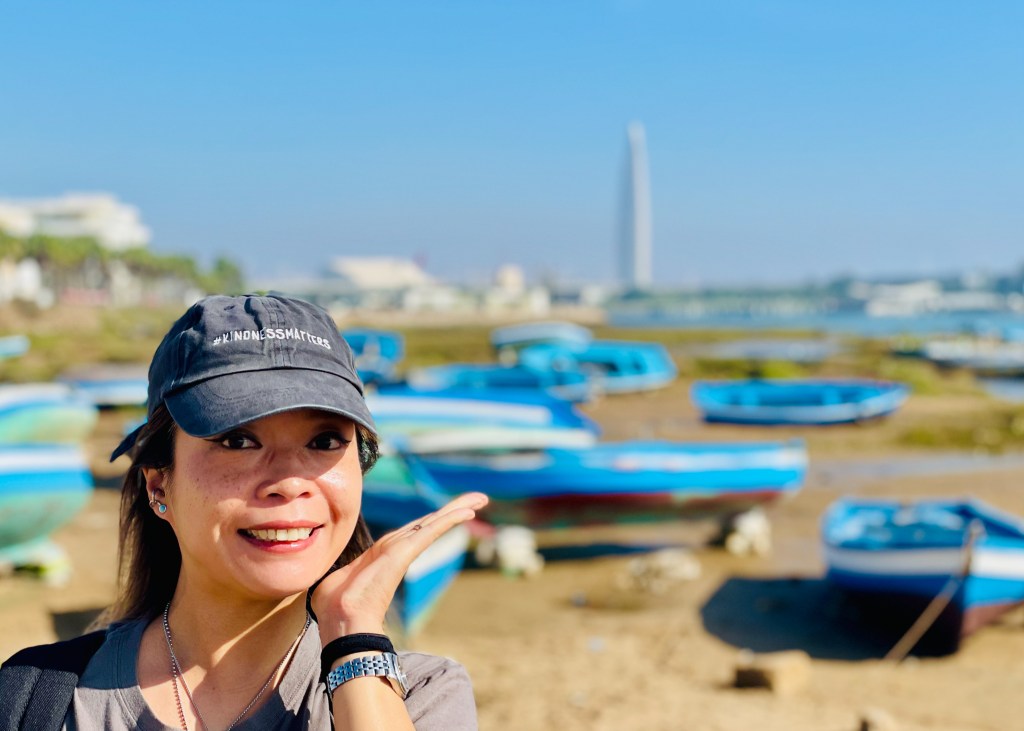
Further towards the nearby estuary, the enormous beach manages to be both busy and uncrowded at the same time. There are some marvellous views back acoss to Rabat’s kasbah, best photographed in black and white due to the sun directly behind:
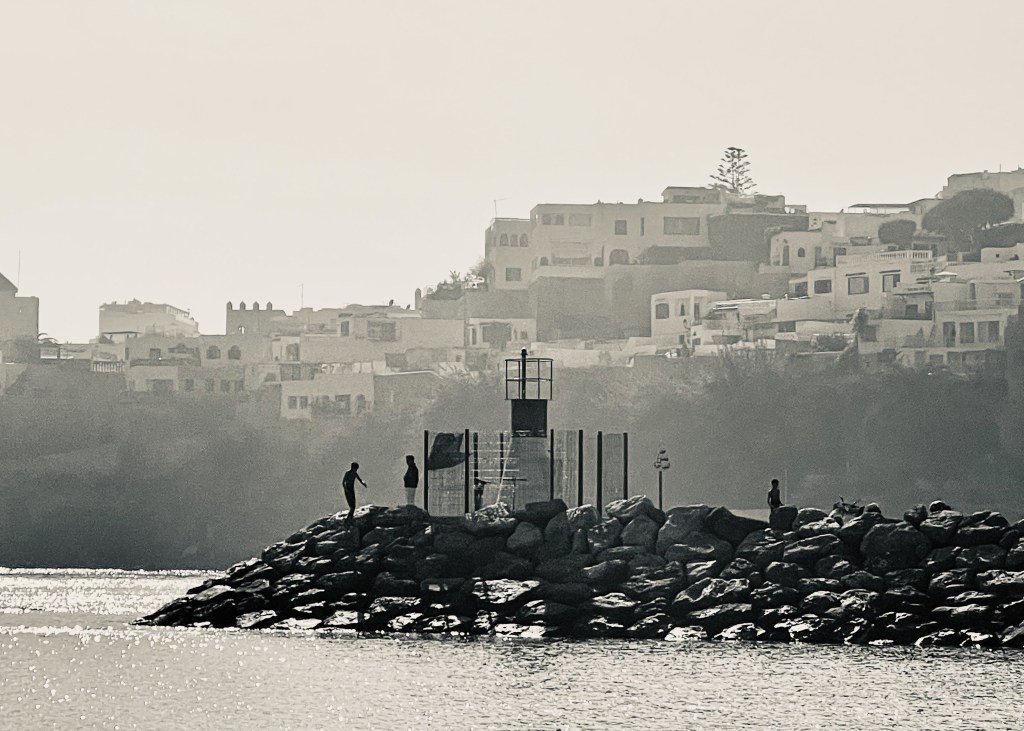
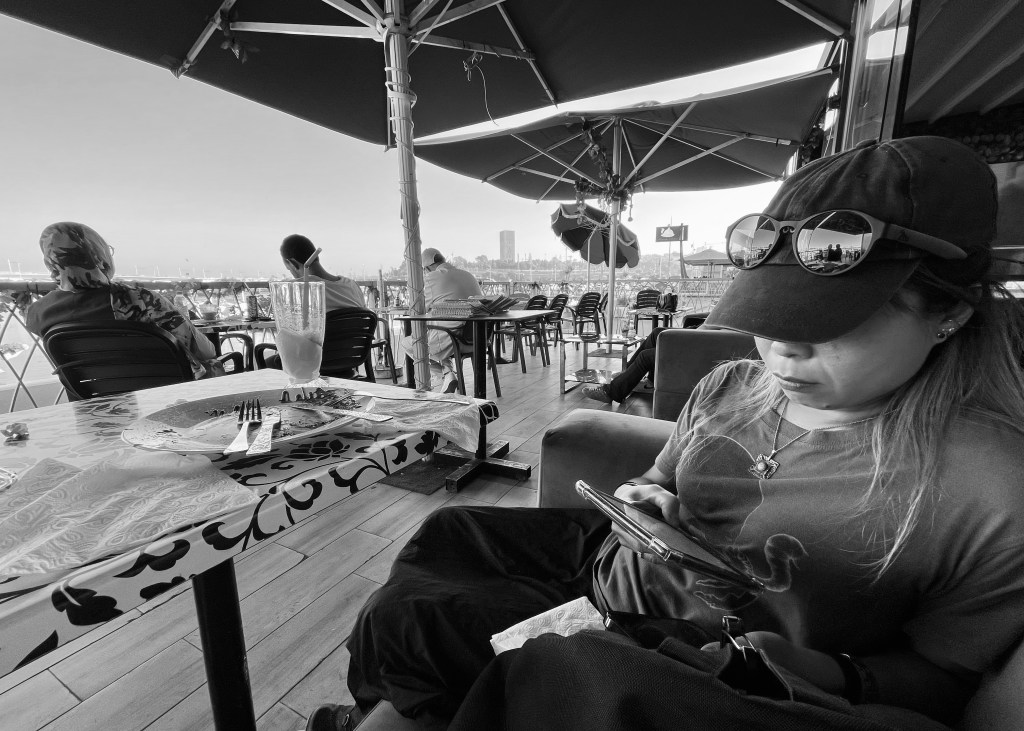
We wander back through the wannabe luxury neighbourhood that’s more brushweed than BMWs, aiming for a marina that we spotted from the Rabat side last week, clearly lined by cafes and restaurants. This turns out more promising. We settle on a sofa on the shaded terrace of ‘Starcups’, order iced coffees and a crepe and settle down to read. After a few minutes, a live band starts up inside the cafe playing cheesy Arabesque, and customers start pouring in. By the time we leave shortly before six o’clock, the terrace is heaving.
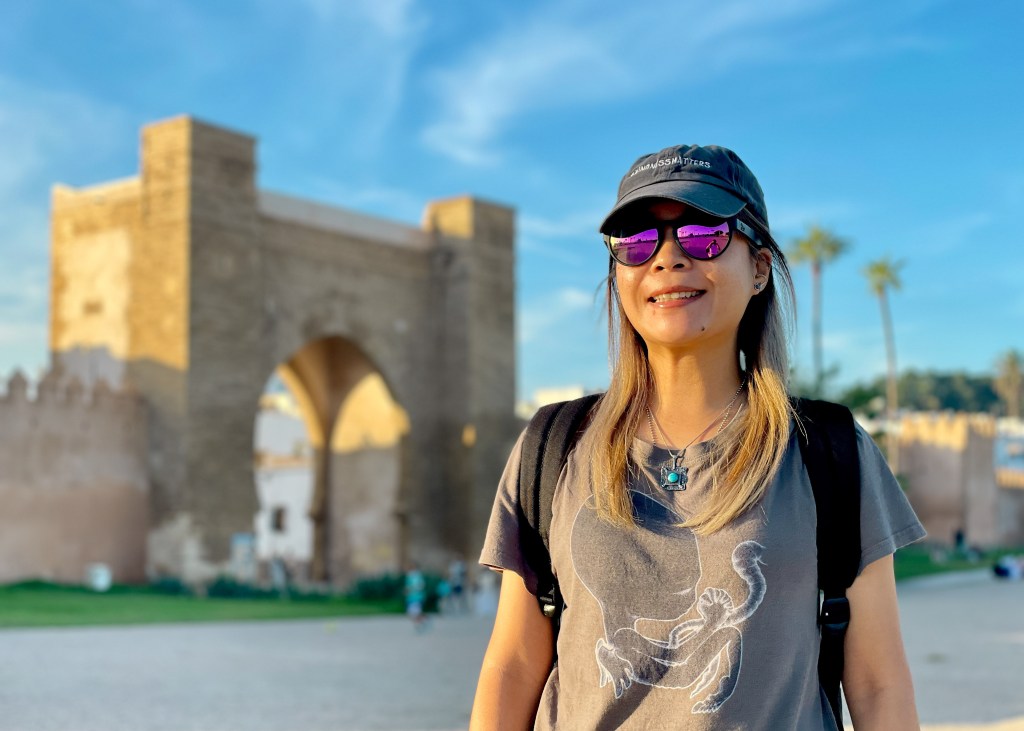
We plan to walk back across the bridge further upriver. In a strike of serendipity, Google Maps sends us the wrong way towards a section of the bridge that’s closed to pedestrians. The serendipitous part is that we find ourselves wandering through Salé’s family playground, a big open area immediately outside the medina’s sprawling red stone walls:
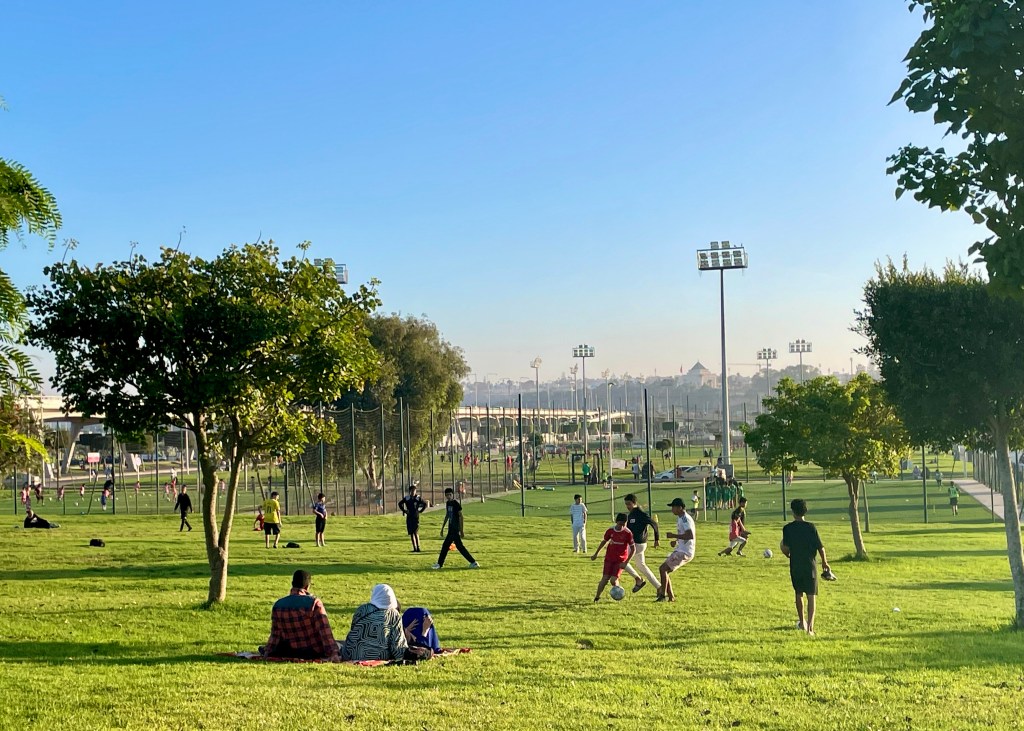
Much of the area is given over to grass—by far the most grass I’ve seen in Morocco. Families bask in the early evening sunshine while all around kids of all ages kick footballs. I’ve rarely seen so many games of footie happening at the same time:
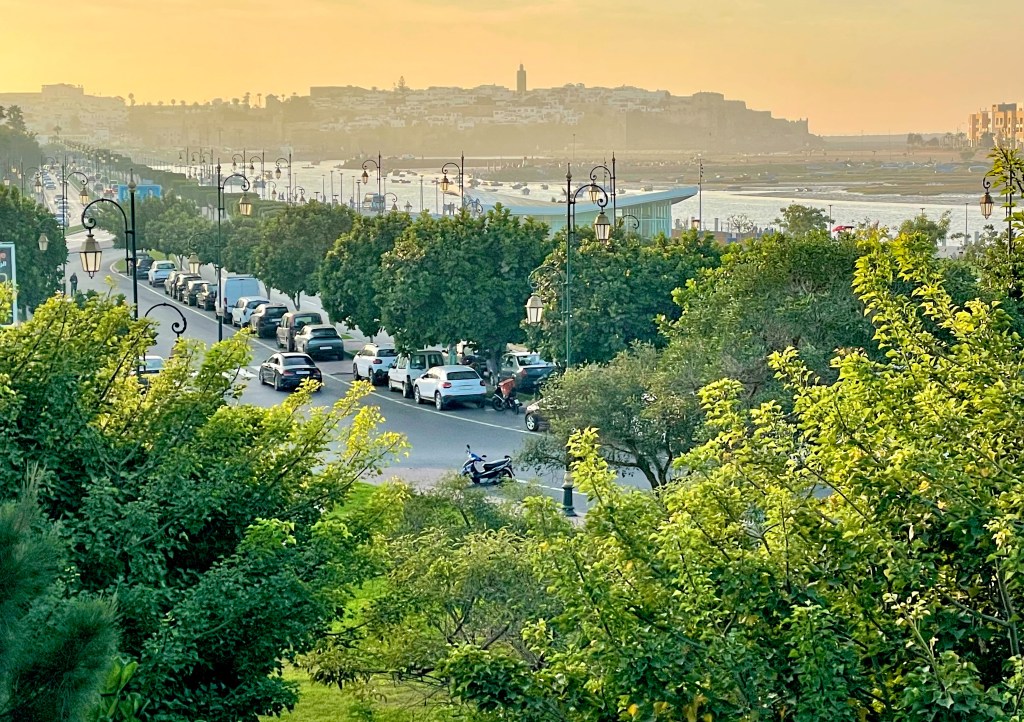
Finding that the bridge (background, above) isn’t accessible to pedestrians and looking a bit lost, a friendly English-speaking policeman points us in the right direction to access the pedestrianised section. Reaching the ramp requires us to complete a loop around this wonderful family area, which is busier than it looks above. A pre-teen girl on roller blades tries to photobomb us (unsuccessfully, more’s the pity—I only realise she’s there after I’ve taken the photo).
The thirty minutes we spend in this neighbourhood is one of the most magical travel moments of the past two years. Nothing especially memorable happens, but life is going on everywhere, everyone’s having fun, the weather is perfect, and we appear to be the only non-locals anywhere in the neighbourhood.
Eventually, we find our way onto the ramp that takes both pedestrians and the tram up to the bridge. We reach the Rabat side just before sunset and make our way back to Les Deux Palais, the smoky but thriving restaurant-bar on a quiet tree-lined street not far from our neighbourhood. It’s jammed tonight, and there are noticeably more women than on our initial midweek visit. We take seats at the bar, order beer, wine, and tapas, and fall into a conversation about the logistics of next summer and autumn in South East Asia.
Sunday 19 October
We spend our final day in Rabat planning our three months in Mexico next year. We’ve been kicking our Mexico itinerary down the road for a long time. It’s still six months away, but I’ve been growing steadily more concerned that we need to book decent accommodation while it’s still available. By mid-afternoon, we’ve worked out where we’re going to be every night in Mexico, booked three weeks in Puebla and four weeks in San Miguel de Allende, and bagged tickets to see Belle and Sebastian play in Mexico City in May. We’ll finish off the bookings this week.
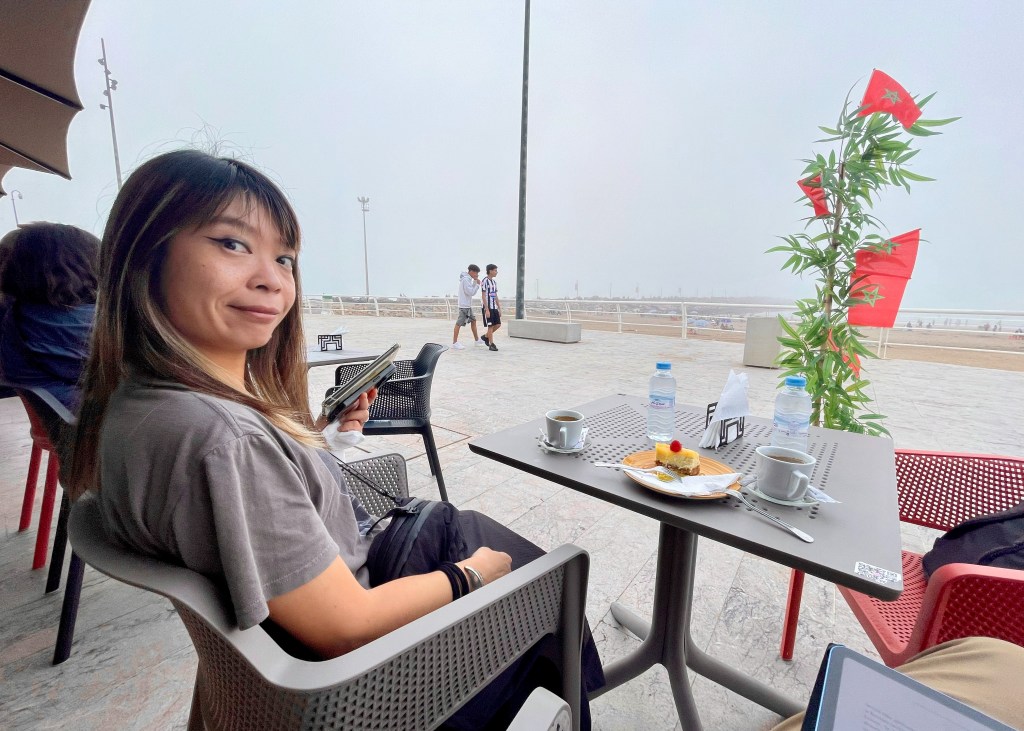
While we’ve been busy researching and planning Mexico, a bank of mist has rolled in from the Atlantic. Rabat looks grey and bleak today, a stark contrast to its usual white buildings pitched against a bright blue sky. We wander down to the beach cafe that serves good cheesecake. The surfers are still out in the water, but the beach looks far from inviting in the thick grey mist. The only colour is a fake plastic plant to which someone has attached small Moroccan flags. We bury ourselves in our books.
We’re all out of groceries, so we need to eat out again tonight. A Spanish restaurant just around the corner serves alcohol, but the food is average and the ambiance rather too white-tablecloth for our tastes. It does the job. Time to head north to Tangier.

 Two On Tour
Leave a reply to Neil Mitchell Cancel reply