It’s a bit like Lamma…
Wednesday 11 March
After several weeks in Central America, we seem to be adapting well to the local concept of time. So, it’s little surprise, and certainly no cause for alarm, when our minibus to Panajachel arrives nearly half an hour late. We’re the last to board, our suitcases jostling for space on the roof. K finds a seat at the back; I sit behind the driver next to a 21-year-old Canadian who was apparently born simply to talk.
While we’re the very definition of slow, cautious travellers, he’s doing what perhaps every 21-year-old should do: making it up as he goes along. He only arrived from British Columbia yesterday, spent one night in Antigua hanging out with some local farmers (so he claims), and now he’s off to Lake Atitlán without any idea where he’ll sleep tonight. Good for him. He says he regrets never knowing the world as it was before the internet and has every intention of making this trip as analogue as he can, only falling back on his smartphone if necessary. He reminds me of me at 23, hurtling around Anatolia with no more than a vague plan of where to go next and where to sleep each night.
The minibus inconveniently drops us on the other side of town from our hotel. Received wisdom in Guatemala is to use Waze for navigation, not Google Maps. I should have listened. Google Maps seems fine at first, but as we near our hotel it plunges us into a narrow unpaved alley. A stray dog takes an instant dislike to us, barking aggressively. We retreat to the paved road, but this too soon peters out into a rough track, passable for cars but punishing for suitcase wheels. We trudge the last couple of hundred metres, dragging our luggage over a surface no suitcase was designed for. K is not happy.
The hotel is clean and simple. We unpack the bare minimum and head out for an early dinner, having all but skipped lunch.
And this is why we should have downloaded Waze. Turning the opposite way out of the hotel, we’re on a pleasantly cobbled street all the way down to Lake Atitlán, along the lakefront and into the town centre. It could have been so much easier.
We walk up one side of Panajachel’s main street and back down the other. Not surprisingly, every business is aimed at the tourist trade: the usual souvenir stalls, restaurants, hostels and tour agents. We settle on The Little Spoon, a YouTube recommendation, because nothing says adventure like following internet tips. From the second floor we have a good view of the town at dusk, and tuck into delicious, very affordable salad bowls.
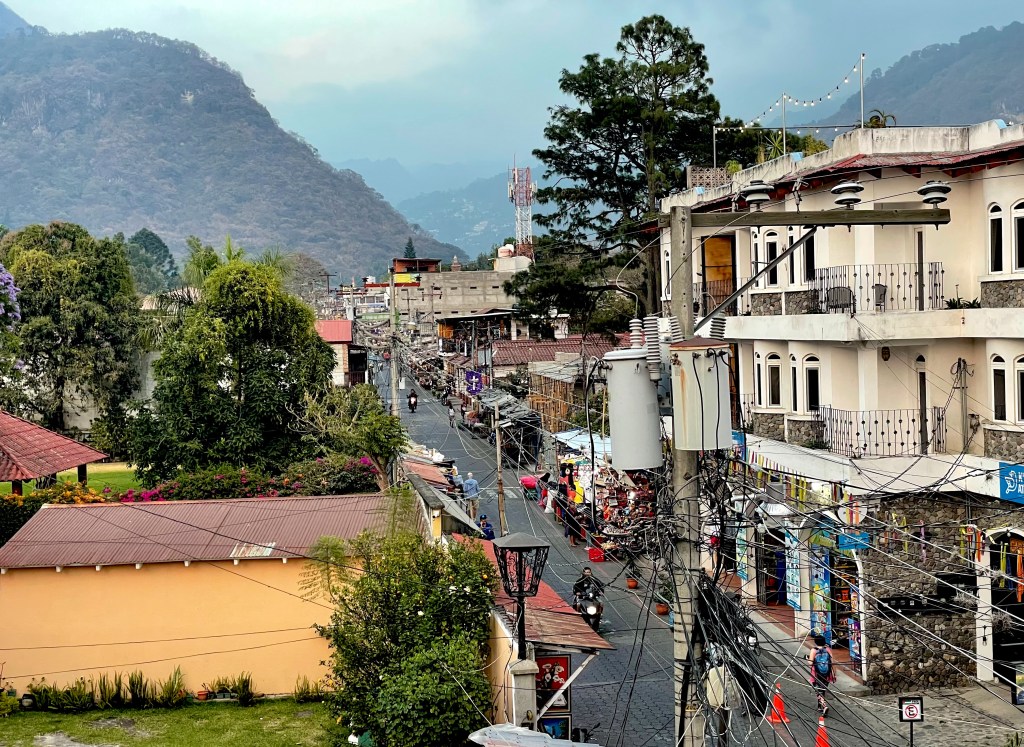
Step one complete. Across the lake tomorrow to San Pedro.
Thursday 12 March
I’m down at the lakefront early to see how the lanchas work. The lake, rather choppy when we arrived yesterday afternoon, is perfectly calm this morning. It’s a pattern we’ve read about, and the reason we stayed overnight in Panajachel. Lanchas are constantly coming and going, and it’s clear we’ll be accosted by a boat captain well before we reach the lakefront with our luggage. I head inland to check what’s available in Panajachel’s biggest supermarket, picking up a couple of items I suspect may be hard to find later in San Pedro.
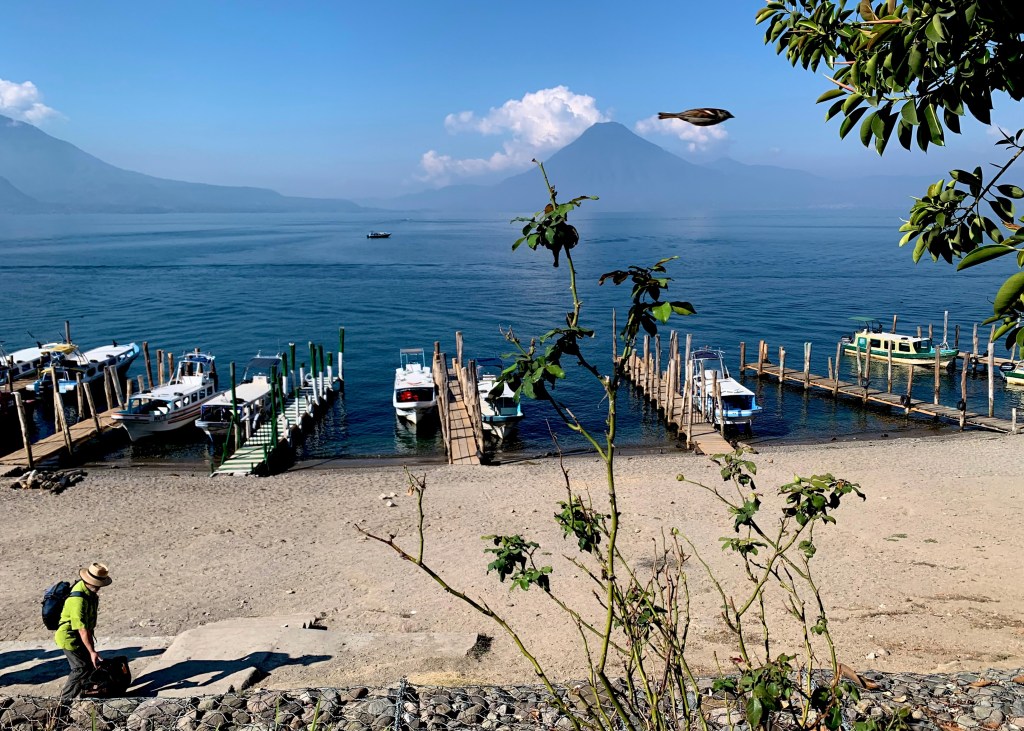
As expected, we’re spotted with our cases long before we reach the lakefront. The lancha we’re directed to is Q5 (50p) more than the standard Q25 fare, but we opt for the path of least resistance. I have concerns about our suitcases being hauled onto the roof to cross the lake and just have to trust they won’t slide off and sink hundreds of metres to the bottom.
The captain waits until every possible space, and even some borderline impossible ones, are crammed with a human body. Only then do we set off, stopping at several small settlements around the lake before eventually arriving safely in San Pedro. Initial impression: the waterfront area looks not unlike Lamma. We’ll be right at home here.
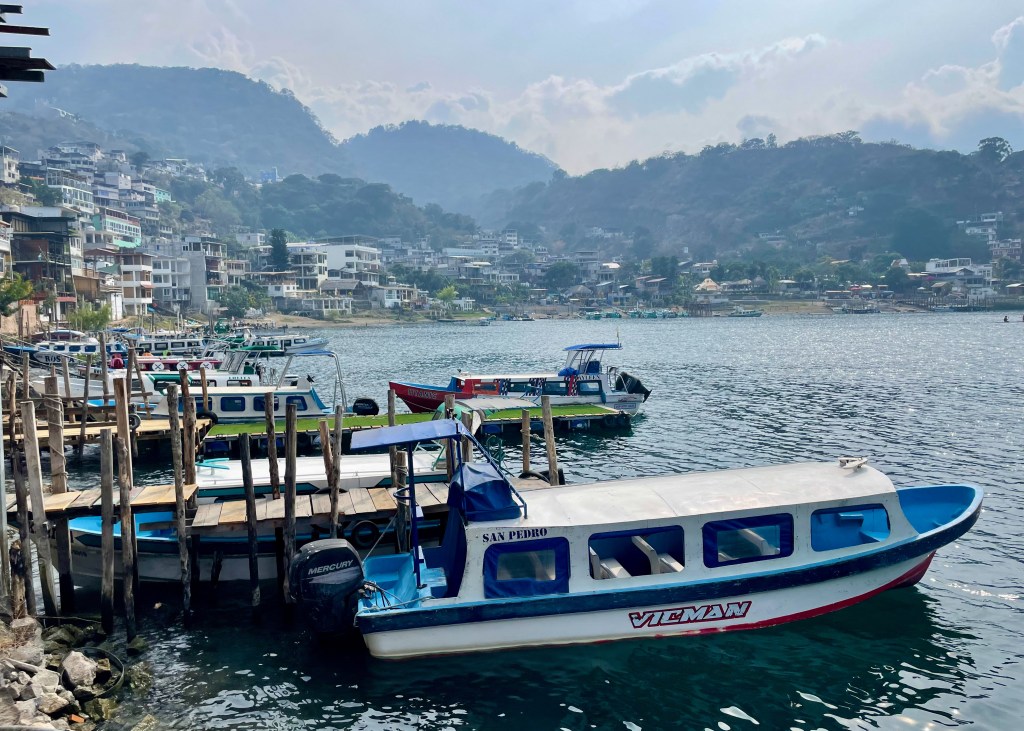
A young tuk tuk driver somehow manages to squeeze all our luggage in along with us. K’s in the back with the suitcases and backpacks, while I’m squeezed on a perch next to the driver, my head jammed against the roof, barely able to see three feet of road ahead. Thankfully the journey is brief.
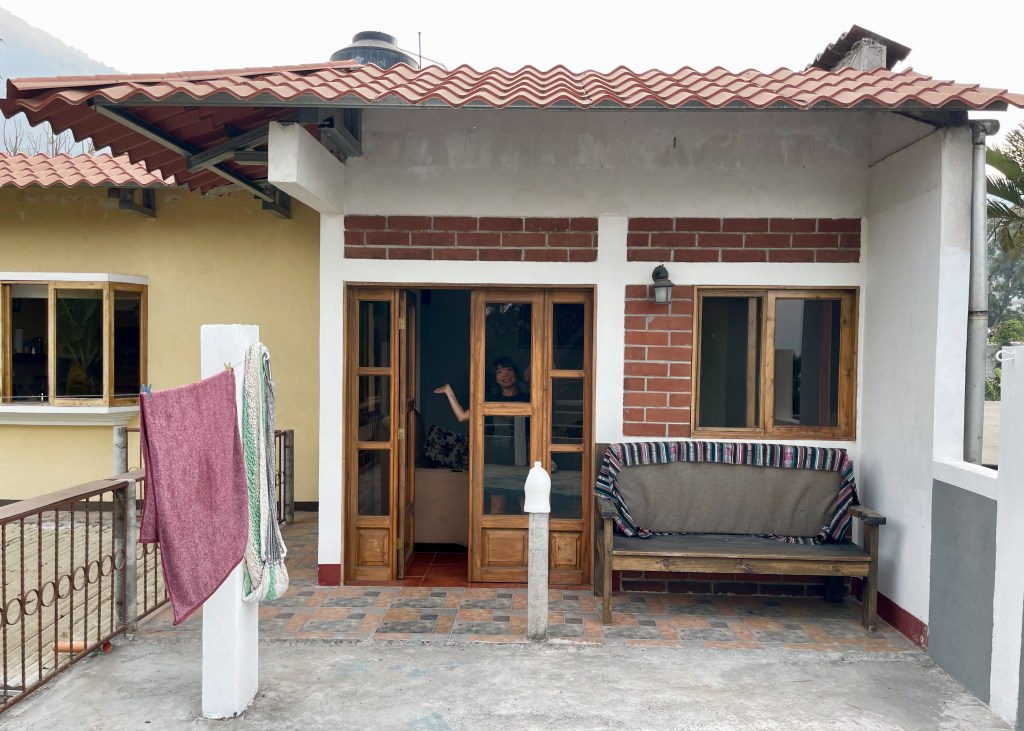
Five minutes later we’re dragging our luggage down a warren of narrow paths in search of our Airbnb. A friendly old lady is keen to help. I tell her we’re looking for Griselda and show her a photo of the house. She recognises it immediately, leads us there, and knocks on the door for us. We’re greeted by Griselda’s husband, Antonio, who takes us upstairs and lets us in.
The flat is clean, bright and spacious. After Antigua, we know we’ll forever be managing our expectations, but we soon adapt. A terrace, marooned in bright sunshine now at midday but clearly lovely at sunrise and sunset, offers us a good view of the lake.
We retrace the tuk tuk route back towards town, stopping in several stores to get a feel for what’s available in San Pedro. Most are no more than basic tiendas, but we find one mini-supermarket to cover most of our needs except fresh fruit and veg. We stop for lunch, where I ask for directions to the nearest place to buy fresh produce. They point us to a nearby stall. The choice is limited, but we find enough to see us through today. To complete our reccie of the town, we continue downhill to the waterfront, then make our way back to settle in properly.
There’s no TV here. We could watch something on the laptop or iPad, but after dinner we opt to simply chill through our first evening in San Pedro.
Friday 13 March
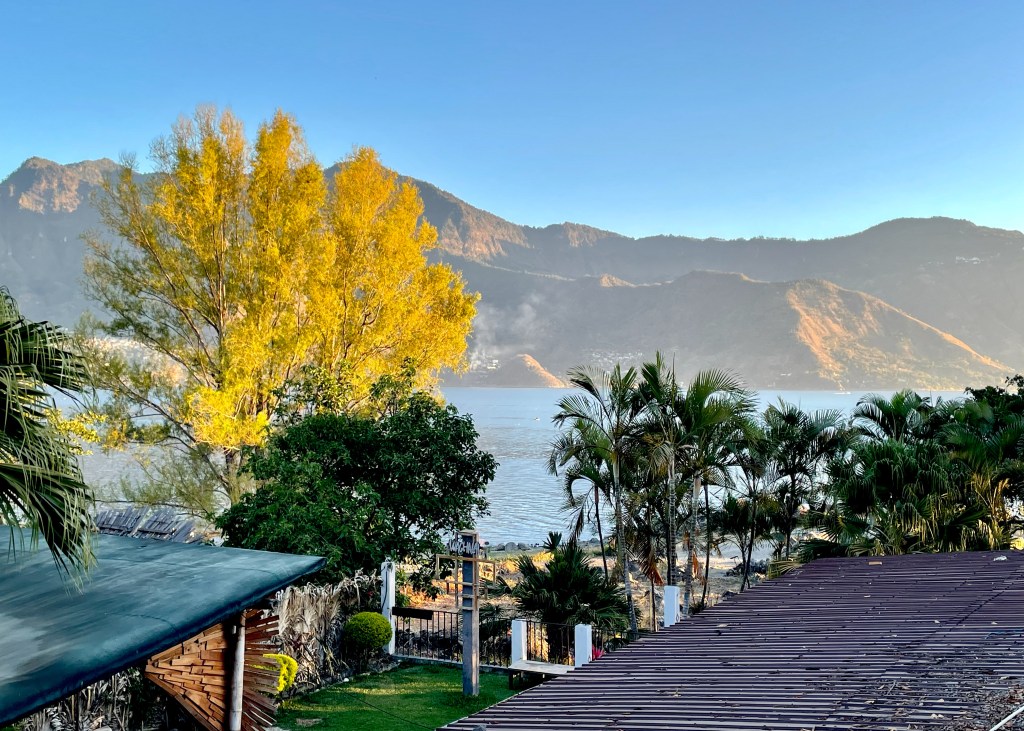
For our first full day in San Pedro, I’m on the balcony early with a cup of tea. The only sounds are birds, roosters, and the occasional squirrel scurrying in a tree. Everything ripples with peace.
The early morning sunlight on the lake is spectacular. But at seven sharp, the sun creeps over the leaves of the banana plants in the yard and it’s immediately too bright to sit outside.
Early morning texting reveals that Oli has handed in his notice in Hong Kong. He and Maria plan to move to Newcastle, NSW for two years to formalise their Australian residency. We exchange thoughts on making the big call that working any longer will cost more in lost experiences than the gain to be had in financial security.
The last two days have involved much running around relocating from Antigua, so today is for slowing down. We venture as far as a small market five minutes further out of town with a selection of fresh fruit and veg. Otherwise, it’s a day for catching up with this blog, reading, and studying Spanish.
Once again, we could use the laptop or iPad to watch something tonight, but we enjoyed our night off yesterday so much that we decide to chill quietly again. K finishes her biography of Picasso; I eventually scuttle into a YouTube rabbit hole that leads to the 1979 documentary The Secret Life of Plants. I settle down to listen to Stevie Wonder’s much maligned soundtrack album song by song — first as documentary score, then as standalone audio. Still a hard album to love, but it makes more sense in its original context.
Saturday 14 March
For the second time in a week there’s a morning knock at the door. Antonio, our Airbnb host, has brought a new five-gallon bottle of drinking water. We get talking and I learn that, like his wife Griselda, he’s a Spanish teacher. When we arrived on Thursday, he only spoke to me in Spanish; today I realise his English is good — far better than my Spanish. The family have lived on the downstairs floor for fifteen years. His oldest son recently started an engineering degree in nearby Quetzeltenango — or Xela as locals call it, using its Mayan name. He’s 53 and lived around Lake Atitlan all his life. Before he leaves, he invites us to visit one afternoon to chat more.
We spend the afternoon exploring San Pedro. The busy street running parallel to the lake shore is much like Panajachel’s main drag, a hotchpotch of souvenir shops, convenience stores, restaurants and tour agents. Clichés abound: the moment we arrive we hear Bob Marley’s Buffalo Soldier. We establish our bearings by locating the berth when our lancha dropped us on Thursday, then circle back to the flat, picking up more groceries on the way.
Antonio has warned us that the guest house next door is hosting a techno night. We picked this property because it seemed far enough from San Pedro’s main drag to escape the party crowd. Alas, it seems we’re not to be spared. When we get back to the flat, the thumping bass has already started. I clamp on headphones to block it out as best I can, though I’m more concerned about later.
It’s our first time venturing out after dark in San Pedro. The narrow alleys leading to the main road are dark but feel safe. We’ve only been here a couple of days, but it’s long enough to realise that our neighbourhood, although poor, is family friendly. Still, I’m not taking chances: I carry only our burner phone and enough cash to eat out. K, despite my protestations, not only has her proper phone, but also her camera.
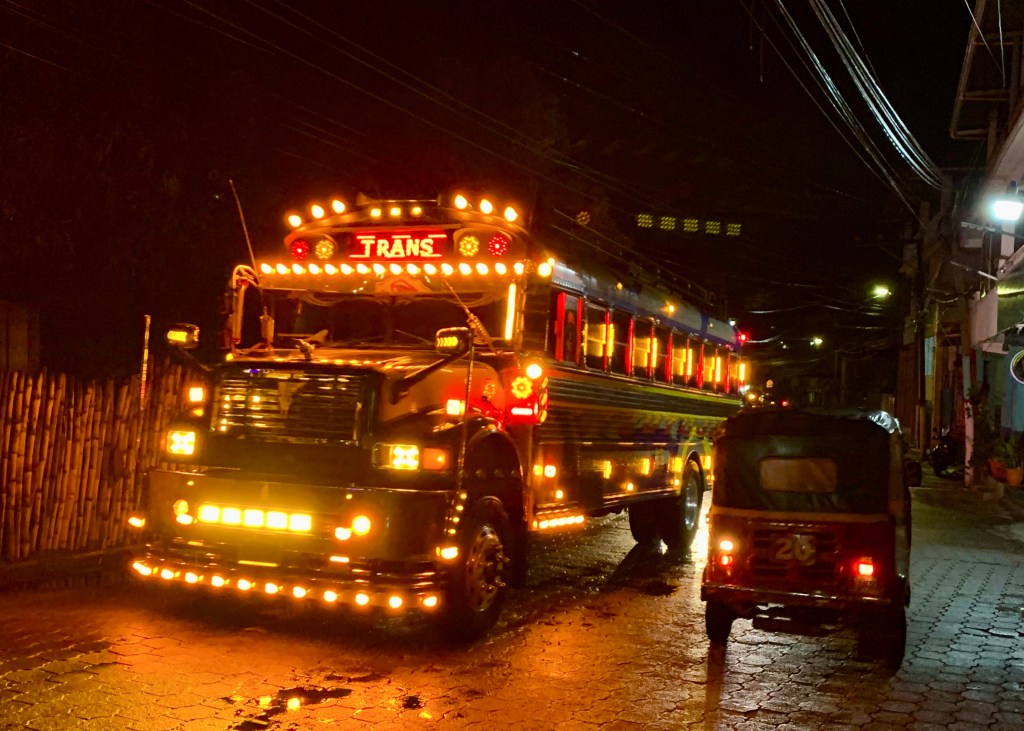
Once on the main road, traffic is a far greater hazard than crime. There are no pavements; we just keep to the side as tuk tuks, motorcycles and the occasional chicken bus roar past in the darkness.
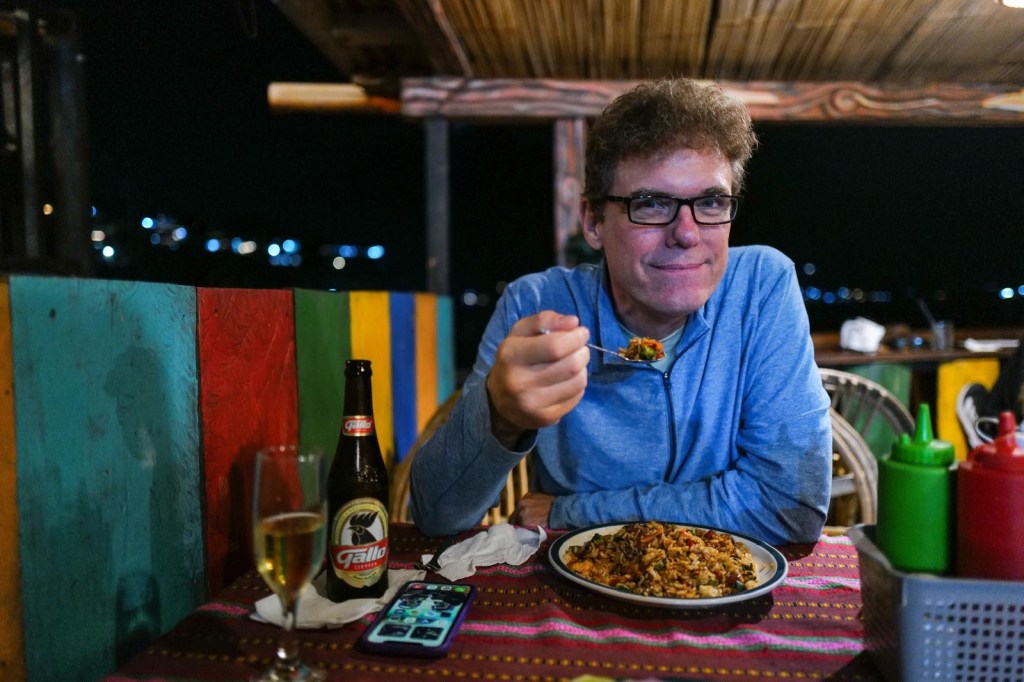
We last barely two minutes in the first restaurant we pick. We’re just settling down to read the menu when hideous Latino rap starts blasting at ear-splitting volume. We leave the menus on the counter and beat a hasty exit. A quieter, more rustic place a few doors down suits us better. There’s plenty of space, it’s cheap as chips, and the more traditional Latino music plays at a pleasant ambient level. The food won’t win any awards, but it’s good enough. Two main dishes, two beers and two glasses of wine come to under HK$200 (£20).
By nine, San Pedro’s main drag is a backpacker hellscape of bars and restaurants competing to lure in the herds with the loudest, dumbest music. No tuk tuks buzz us for business, so we walk home, appreciating how quickly the town takes on a local character away from the lakefront.
The evening would end peacefully there were it not for the thumping techno party next door. The bass waves blast across the neighbourhood as we approach the flat. “Are you looking for the party?” asks someone, thinking we’re making a wrong turn as we head off the paved path onto the dirt track leading to our place. I wish I’d replied, “Of course not. Why on earth would we want to contribute to disturbing a peaceful neighbourhood with moronic ear-splitting music?” Instead, I reply politely that we’re not.
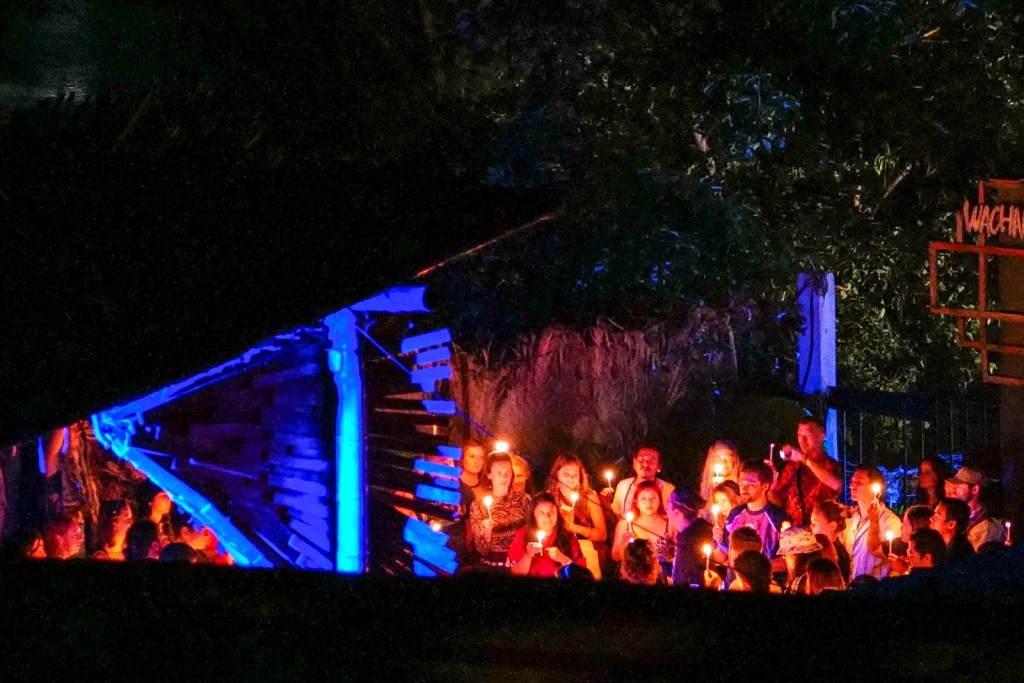
Back in the flat, it’s just about tolerable with the windows closed, the fan on, and headphones. From the terrace we can see the party crowd inexplicably holding candles. What is this — a Jesus rave?
Earplugs make little difference to the shuddering bass, so I fall asleep to podcasts. Thankfully, by the time I wake to use the loo, they’ve packed up next door. Perhaps they ran out of candles.
Sunday 15 March
Sunday this week is even quieter than our established baseline for Sundays. Around lunchtime, the electricity cuts out. Fortunately, our devices (and battery packs) are well-charged. But as the hours pass, we move into triage mode just in case: laptops off, app use minimised. We both nestle with our Kindles, the ultimate low-energy fallback in the absence of paperbacks.
In the late afternoon, I wander down to the lakeshore. Our local beach is busy with local families, some doing their laundry in the lake. (I dropped our washing at a laundry earlier — is this where it ended up?) I find a rock a few hundred metres away and monitor the lanchas coming and going. The lake is functional grey today, the far shore hazy, and the mountain tops lost in cloud. But it’s marvelously peaceful — even a couple of jet skiers struggle to disturb the calm.
The electricity is still off when I return. If night falls, we’ll be in trouble; we have no candles. If we’d joined the ‘Jesus’ rave last night, we could have brought some home as insurance against power cuts.
Just as we’re about to lose the light entirely, the electricity flickers back into life. I’m on kitchen duty tonight and in a clumsy moment manage to massively overdose my eggplant casserole with K’s super-hot chill powder. We each stir in several spoons of yoghurt to make it palatable.
Monday 16 March
A break with routine: we want to reach the municipal market before it winds down for the day. It may be San Pedro’s main market, but it sits awkwardly on the edge of town, accessible only by a steep climb. Despite our best efforts, we’re too late — many stalls are already closed and we’re among the only customers. We buy what we need and keep climbing uphill towards a café even higher up. The neighbourhood around the market is very poor — San Pedro is the poorest place I’ve seen outside the Philippines. It feels safe enough in daylight, but I find myself exercising more caution than usual.
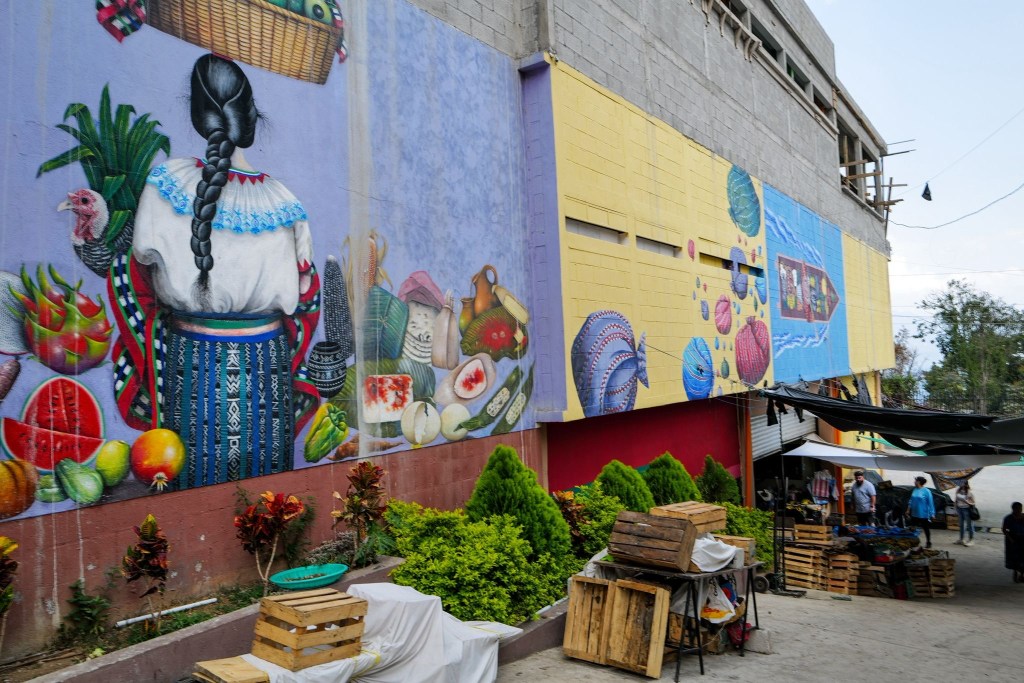
Like the municipal market, Café Panorama sits in an unpromising location. As its name suggests, it sits way above the town. The final approach, a cul-de-sac, is one of the steepest streets I’ve ever walked. It’s certainly not located to draw a passing crowd; you have to know it’s here and want to reach it.
It’s worth the climb. We’ve wisely waited a few days before coming up here for a bird’s-eye view of San Pedro, long enough to be able to identify a few landmarks and pinpoint where our flat sits in relation to the town centre. A proper 3D view trumps Google Maps every time.
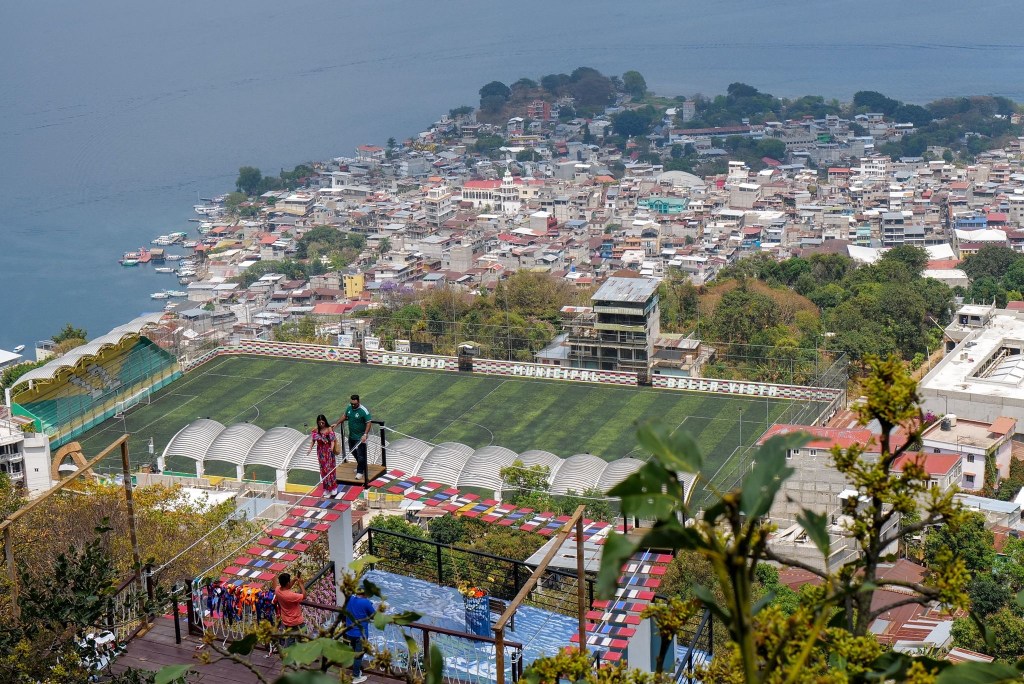
Remote as the café is, we’re not alone. To our right, three north American girls compare notes on their travels through Guatemala; to our left a women is deep in conversation on her phone in French. Lunch arrives: avocado toast, scrambled eggs and tropical fruit for me; chicken nachos for K. My only wrong step is ordering a mango soda, which turns out to be luridly coloured sugar water.
The walk down is much easier. In half an hour we’re back at the flat at a time when we’d usually readying ourselves to go out for the afternoon. I trot out again to collect our laundry and confuse cincuenta and quinientos, generously offering to pay 506 quetzals for their efforts instead of 56. I realise my mistake and the shopkeeper and I both chortle. It could have been worse.
In the evening, a long chat with Tim. It’s several months since we’ve caught up by phone. It shows: we natter on for an hour and a half.
Tuesday 17 March
Rain is forecast this afternoon. We opt for prudence and head out in the morning for the second day running — a rare burst of sustained morning activity for us.
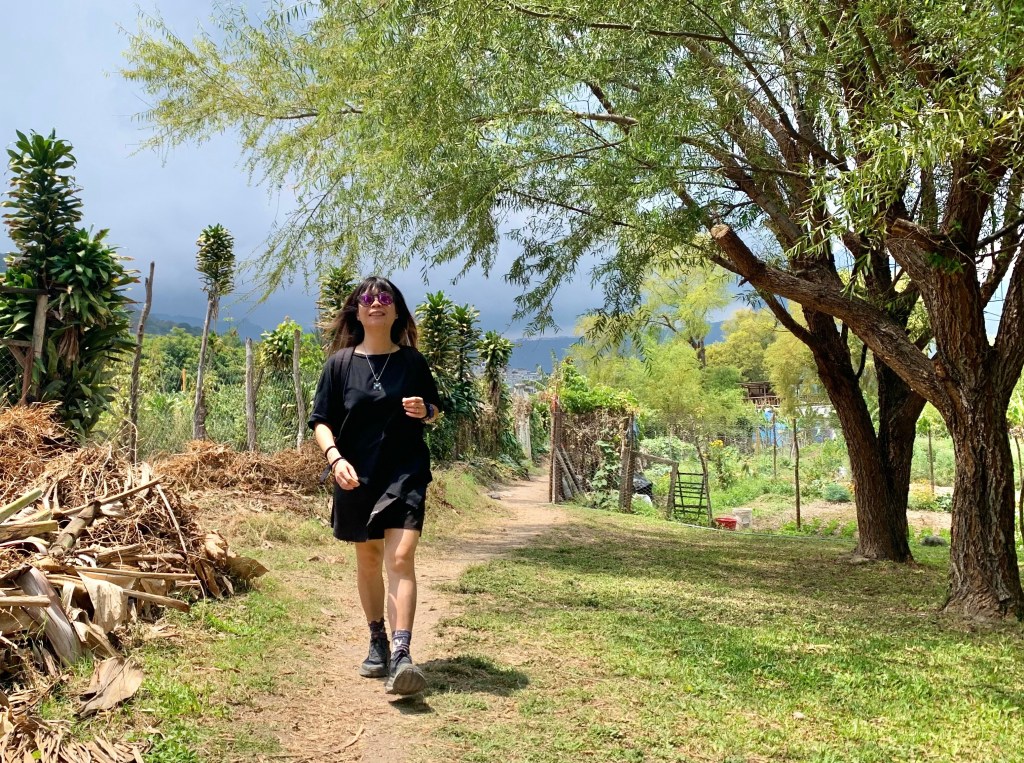
Today’s plan is modest: follow the lake shore in the direction of town, then cut back through to Andy’s Minisuper to bag some groceries. The lake shore is a patchwork of tiny farming lots. We exchange holas with the occasional farmer as we follow the unpaved path through neat rows of cabbages, corn, parsley and spring onions. The path soon crosses a road that runs down to the shore at the Santiago de Atitlan jetty. We follow it up into town, making a short detour to visit San Pedro’s tiny park and handsome church before arriving at Andy’s, now our regular grocery store.
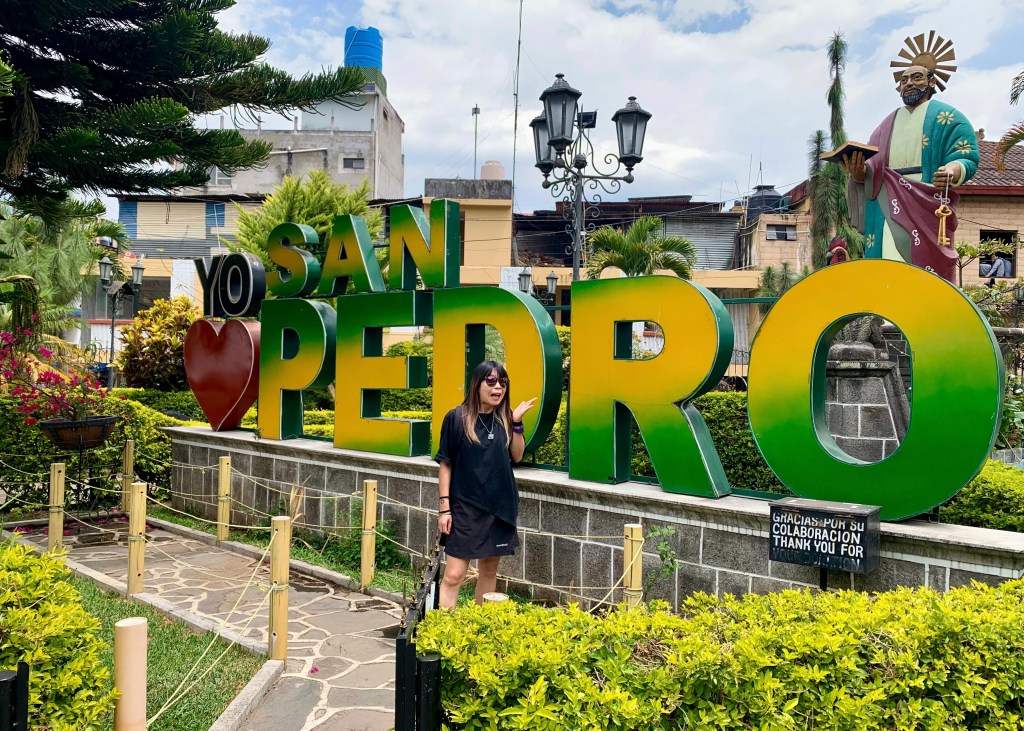
With backpacks full of groceries, we retrace our steps along the shore. It’s far more peaceful than the busy main road. We’ll make this our new route into town:
The rain arrives soon after lunch, a full-on tropical downpour. The electricity flickers a few times, then goes completely — a third consecutive day of power cuts. We settle down to read and while away a quiet afternoon.
Dusk arrives. The rain has long stopped but there’s still no sign of electricity. Antonio knocks at the door and offers us a candle, apologetic, insisting that three days of power outages are unheard of. Soon it’s dark. K cooks by candlelight, supplemented by the torch on her phone.
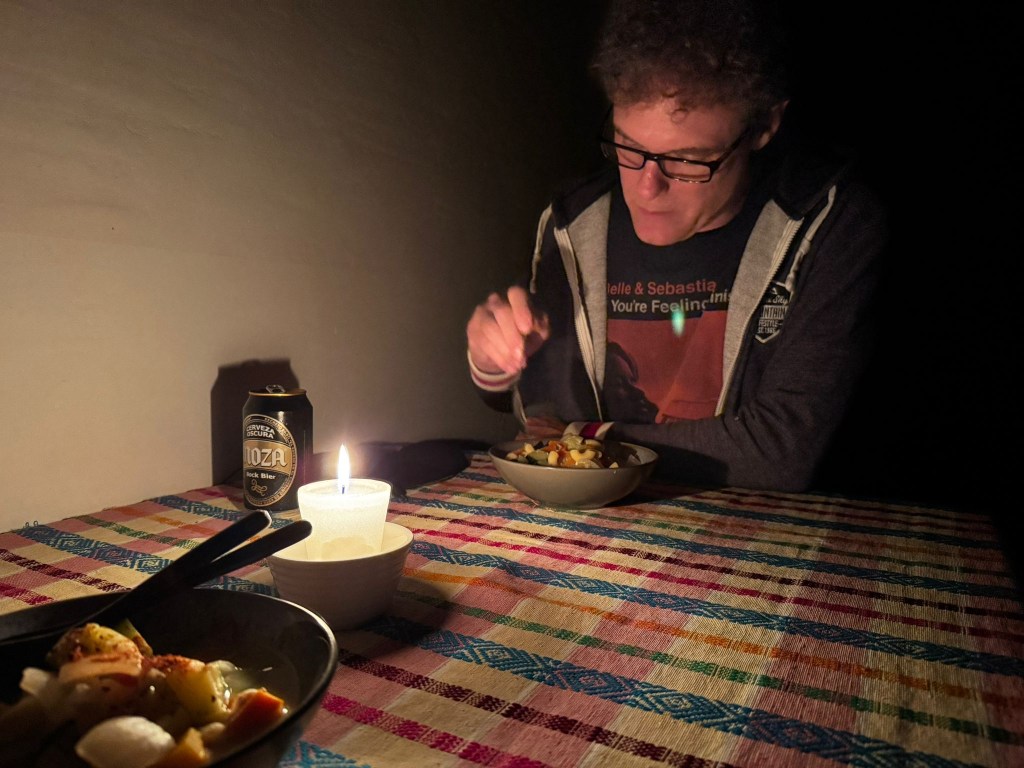
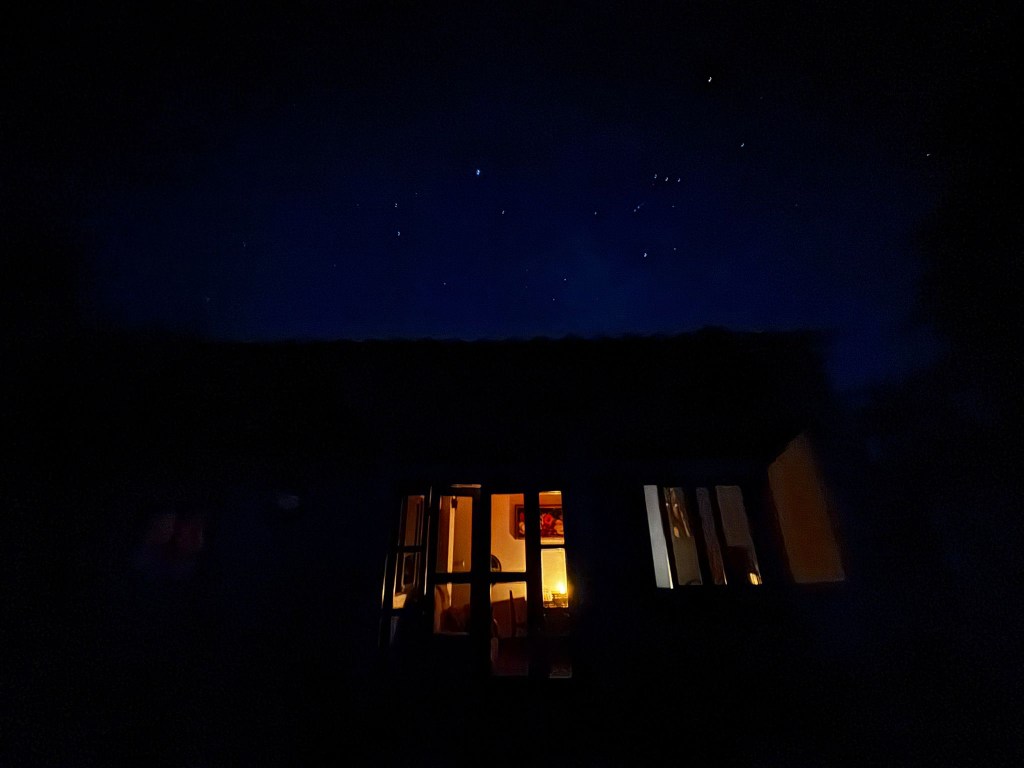
We spend the rest of the evening in candlelight, reading on our screens — the least draining use of what battery power we have. With the whole town dark, the night sky is stunning.
We go to bed in the dark, hoping the power will return in the morning.
Wednesday 18 March
The electricity is still off when I wake up. I wonder how long this power outage will last.
The answer is until 10am. I’m on the sofa reading a paperback Lonely Planet I found in the flat when K yells from the shower that she suddenly has hot water. We immediately charge all our devices just in case.
After lunch, we venture beyond San Pedro for the first time. A tuk tuk delivers us to the entrance to neighbouring San Juan village, from where we make our own way on foot. A circuitous route brings us to the steep main street, which like San Pedro is given over to trinket shops, cafés and tour agents. At the top we follow a several hundred locals (a religious procession? a funeral cortege?) through the local quarter until we reach the bottom of a path up to a viewpoint we’ve earmarked for climbing. Dark clouds are gathering overhead. Looks like we’re in for more rain.
Despite the well-maintained path and regular refreshment stalls, the climb is longer and tougher than expected. But from the top we have what we came for: a view of San Juan, and much of San Pedro behind it. Like San Pedro, San Juan is mostly low blocks of drab concrete that peter out near the lakefront into small farming plots (the lake level is at a cyclical highpoint: a lot of farmland must have been lost in the past twenty years). Far more impressive than the ugly concrete sprawl are the rugged mountains ringing the town. A kite glides on an updraft almost within touching distance. Almost as impressive is the colourful mural painted on the viewing platform, which workers are repainting.
The first specks of rain fall as we make our way down. By the time we reach the town centre, we’re reaching for our umbrellas. We seek shelter at a covered basketball court. From above, San Juan looks relentlessly drab, but at ground level we’re pleased to find it full of brightly painted murals:
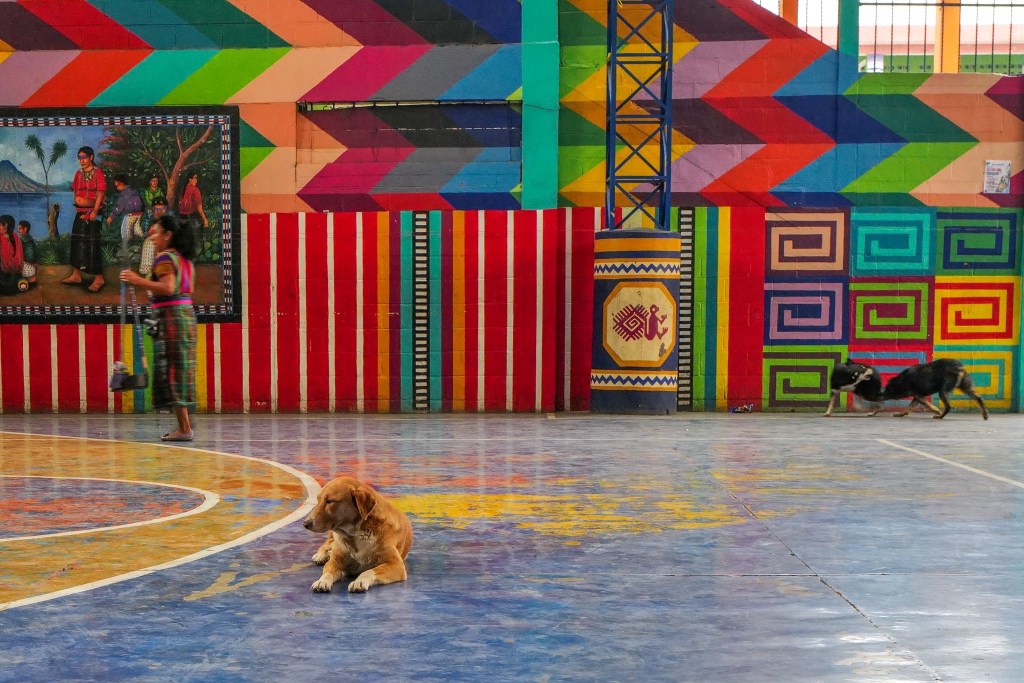
The rain shows no sign of stopping, so we duck into a café for coffee and banana bread. Back on the steep tourist street, rainwater cascades downhill and there’s little sign of life. We still have time to kill, but in this rain our options are limited.
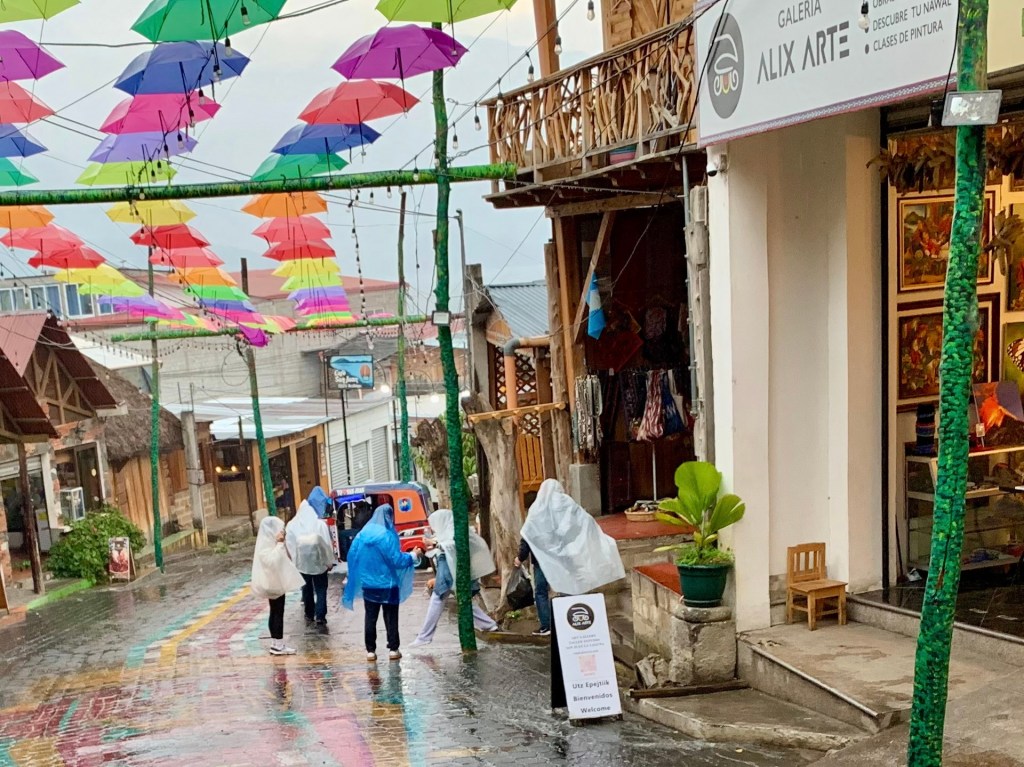
We decide to beat an early retreat to San Pedro. We hop in a tuk tuk, but as it tries to pull away, its rear bumper gets entangled with a metal pole. The driver — he can’t be more than eighteen — remains surprisingly good-humoured as he manoeuvres degree by degree free of the obstacle in what might be the world’s first ten-point turn. A small crowd gathers offering advice and encouragement. Having scraped most of the paint off the right side of his tuk tuk, he eventually breaks free and delivers us back to San Pedro, still in good humour.
It’s only just after five: too early to eat, but too far to return to the flat and come out again later. Heavy rain continues; San Pedro’s usually thronged main drag is empty. We pick the only option realistically available: head straight into a restaurant.
Chicken Bus is an Asian joint looking out over San Pedro’s lancha jetties. We’re the only customers, so we order drinks and make ourselves at home, wandering around to take photos of the view as dusk begins to fall. The restaurant’s two cats decide we’re acceptable company and allow us to pet them as we tuck into kung pao chicken and pad thai:
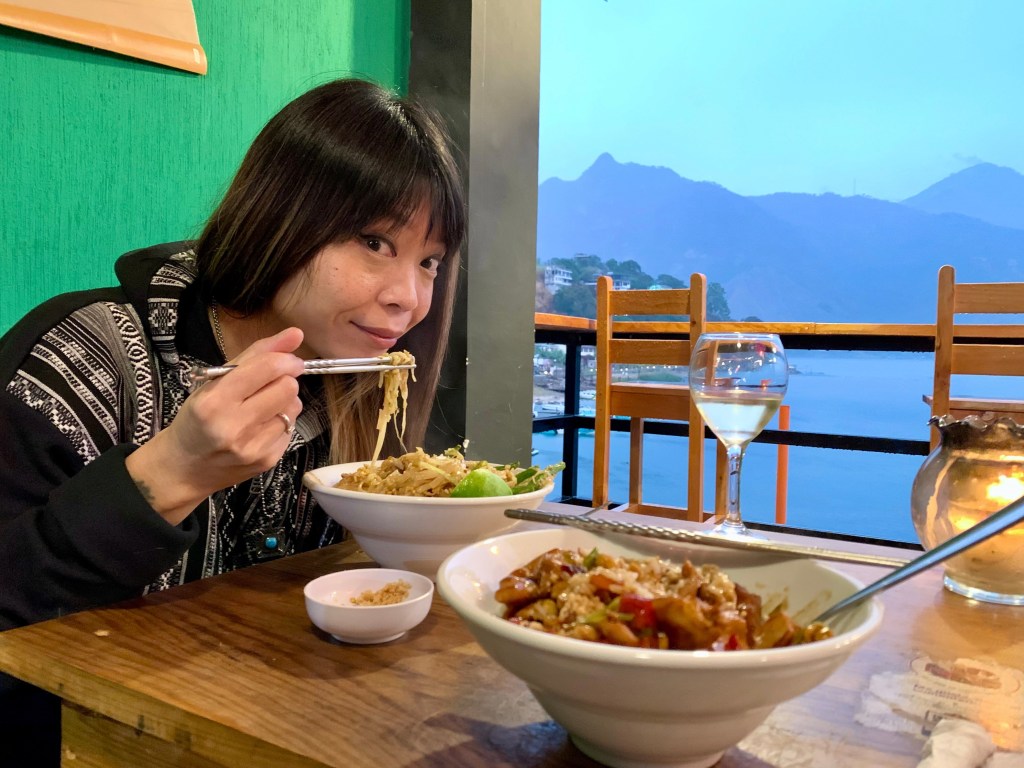
By the time we leave, the rain has stopped. We wander back through San Pedro’s steep streets, still flowing with rainwater, and brace ourselves to return to another power cut. Thankfully, the electricity is still on. A hot shower will be very welcome.
Thursday 19 March
A quiet day. Our ambition stretches no further than walking to the end of the road that runs out of town through our neighbourhood, perhaps grabbing a coffee, and stocking up on groceries.
We skirt the lakefront for the first few hundred metres, then cut back to the main road via one of the narrow paths connecting road and lakefront. We’re already further out of town than we’ve previously been in this direction. The traffic has thinned to almost nothing.
We spot our favourite tuk tuk, number 247, decorated with Ninja Turtles paraphernalia. It looks quite the business after dark all lit up, but this afternoon it sits quietly outside its owner’s home. Beyond the tuk tuk, the road is still lined with tiendas, hostels, the occasional café, and even a shop selling glasses. I know little about running a business, but setting up shop near the end of a little-visited cul-de-sac doesn’t seem promising.
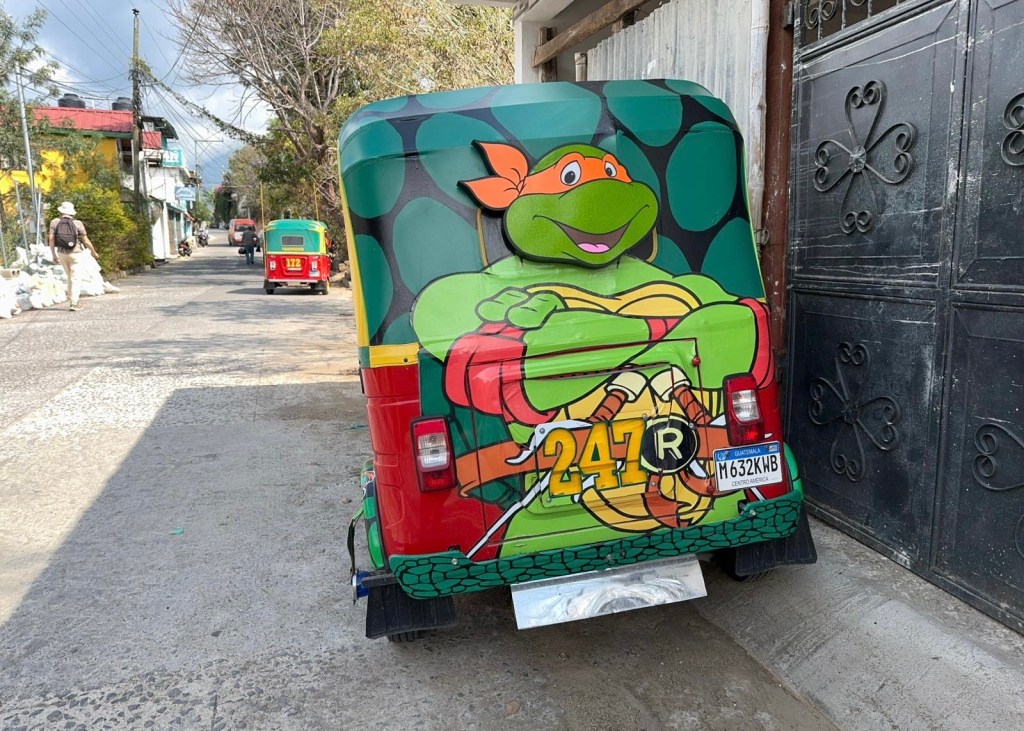
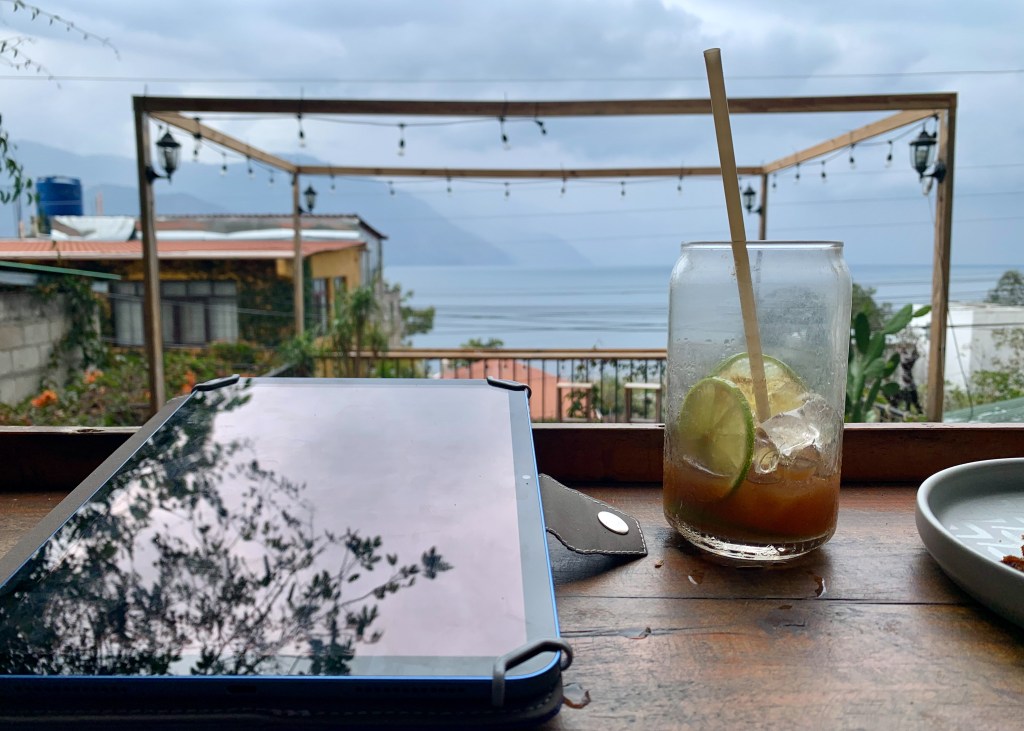
The road eventually peters out into a dirt track. We could follow it another 500 metres to its end, but we didn’t bring water and we’re already thirsty. We turn back, stopping at a café for expresso tonics and carrot cake, where we read for an hour. The sky has clouded over again and it’s cool enough to pull on an extra layer:
The cloud eventually brings several hours of rain, but not before we’re back home. Afternoon rainstorms are forecast a couple more days. We’ll learn from yesterday’s washout in San Juan and delay trips to other villages around the lake until the weather settles.
Friday 20 March
Another pleasantly quiet day. Our weather apps are forecasting rain this afternoon, so we again run our errands before lunch: groceries, tickets for our transfer back to Guatemala City, and cash from the town’s sole ATM (the exchange rate is dreadful, naturally). We studiously while away the afternoon. When I spoke to Tim on Monday, he suggested using GPT to take the drudgery out of financial research. I try. It works wonders. I wish I’d thought of it earlier.
With no work intruding at the moment, I rustle up dinner for an unprecendented second time this week. A comforting smell of oven-baked potatoes lingers for the rest of the evening.
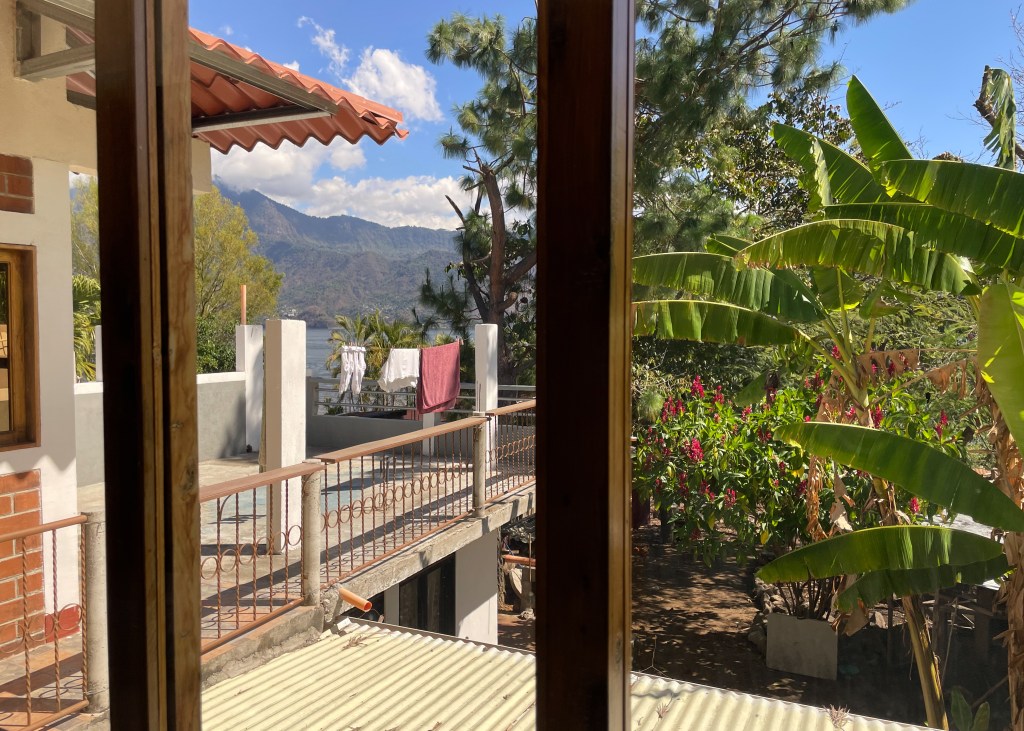
Morning view, before it clouded over and rained:
Saturday 21 March
The weather here in San Pedro continues to start glorious, cloud over, and turn wet in the late afternoon. We’re continuing to mostly lie low, waiting for better weather next week. Today, we book accommodation in Ottawa. Airbnb choices are limited, but we’ve found a basement flat on a residential street within reach of the city centre by bus.
On an afternoon walk to get myself out of the flat, I find a whole area of San Pedro that we haven’t explored yet, full of hostels and restaurants. Good for dinner tonight.
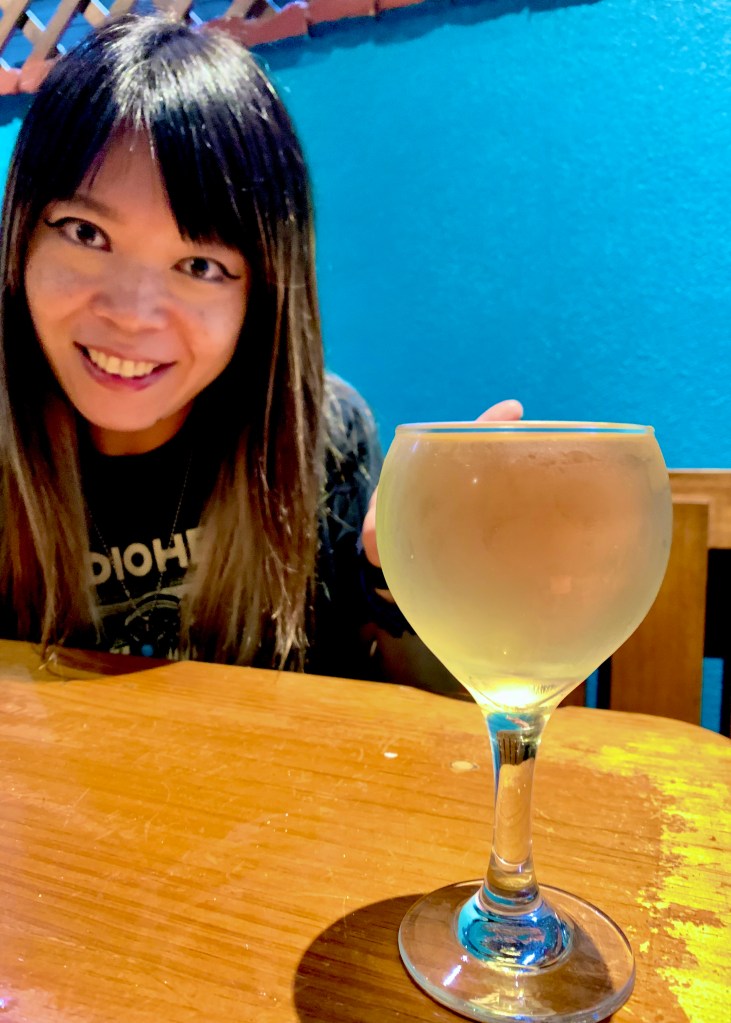
It starts raining shortly before we head out to eat. I walk K through the area I bumbled into earlier, and we settle on the brightly painted garden restaurant of the modest Jarachi’k Hotel. With us, three tables are occupied: enough for a little atmosphere without the bustle. Excellent food — baked fish for me, mango curry for K — and a very generous glass of wine.
Conversation tonight resolves around our ups and downs in our attempts to learn Spanish, prompted by K’s most confident food order to date in Spanish.
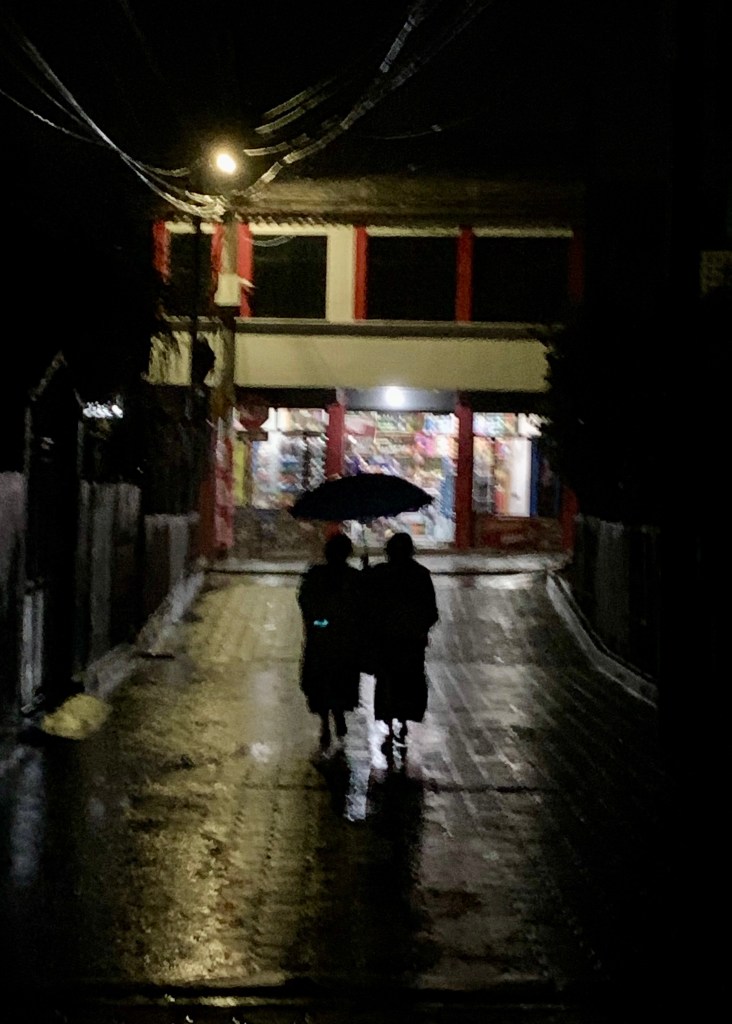
It’s been raining heavily for a couple of hours. We wait for it to ease before setting off for home, but it makes little difference to the water already gushing through the narrow alleys. We both arrive home with soggy feet.
Sunday 22 March
The wi-fi cuts out mid-morning and stays out all day. Griselda and Antonio downstairs also have no wi-fi — the issue seems to be at the sub-station. We check how much phone data we still have: 4GB. That should comfortably see us through until the wi-fi returns. Notwithstanding a brief video call to mum, I try to limit data use: no YouTube, only downloaded music. I book accommodation in Montreal, then pop out to pick up some groceries and our laundry. Otherwise, it’s a quiet day of reading, studying, and — after dinner — clamping on headphones and listening to music.
Just before we go to bed, still with no wi-fi, our phone data cuts out as well. It seems all those albums K was playing through Spotify this afternoon were streamed, not downloaded. We’ve burned through 4GB in one day.
Monday 23 March
For the second time in a week, we wake up with no internet access. Anything could be happening in the world, but we remain none the wiser. No TV or radio to fall back on — even twentieth-century technology can’t step in this morning.
This state of ignorance continues until lunchtime. Meanwhile, a ten-minute lancha ride delivers us to San Marcos, a village we can clearly see across the lake from San Pedro. The main street, more an alley, that leads inland from the pier reveals the usual cafes, handicraft stalls and tour agents. San Marcos adds numerous health food stores — the village has a reputation as a wellness and spiritual centre (an official sign in three languages even proclaims this). Pierced, tattooed and dreadlocked stallholders sell handmade jewellery. It’s all deeply clichéd. It’s a wonder that we don’t hear Bob Marley. Instead, bland electronic beats drift through the alley, oddly out of place in the heart of Mayan Guatemala.
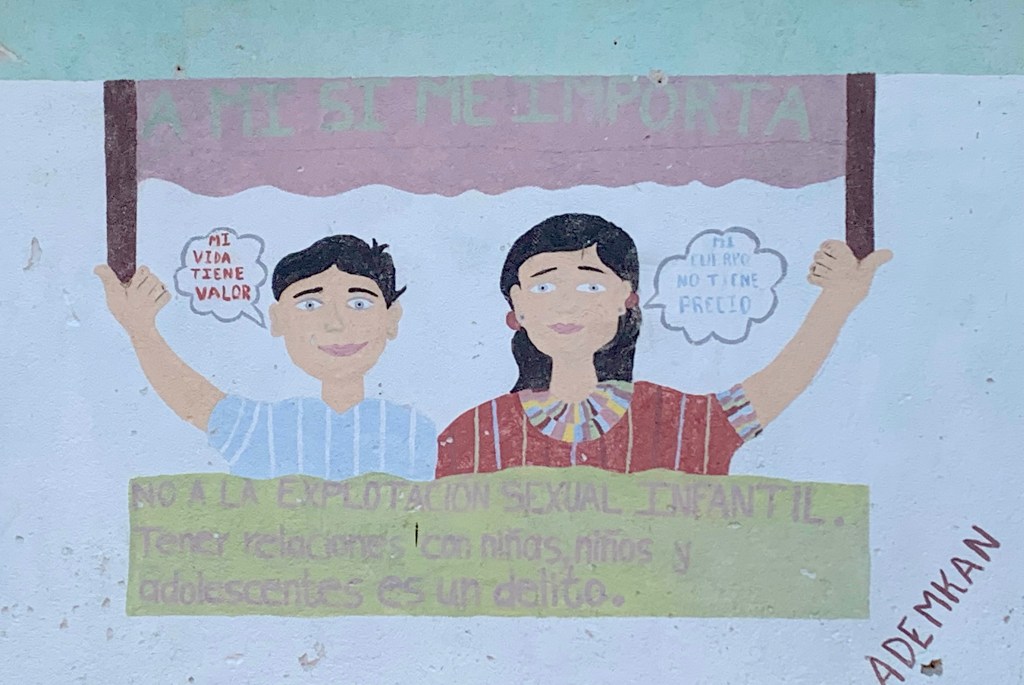
At the end of the tourist alley, the village’s modest throughfare takes over. Tuk tuks and the occasional delivery vehicle rattle up and down. Drab concrete Guatemala re-emerges here. The health food shops, artisan bakeries and modern cafes of the tourist quarter may lack ‘authenticity’, but I have to admit they’re more appealing that the scruffy, doleful poverty beyond. Outside a neglected playground, a simple mural protests the sexual exploitation of children:
We wander long enough to confirm that, for a three-week stay, we made the right call by choosing larger, more varied San Pedro over the limited options of San Marcos — even if freshly baked bread is tough to find in San Pedro.
For lunch, we settle in one of the upmarket cafes I’ve just cast aspersions on and order soup and smoothies. Our server is a young transgender woman, the second I’ve noticed in Guatemala. (The other regularly handed out flyers for a shop near our place in Antigua.) We’ve gone upmarket enough to find free wi-fi: more than twelve hours have passed since we were last able to get online. With so much to catch up on, we barely notice how long lunch takes to arrive. K tops up our shared e-SIM to last us through to the end of our time in Guatemala.
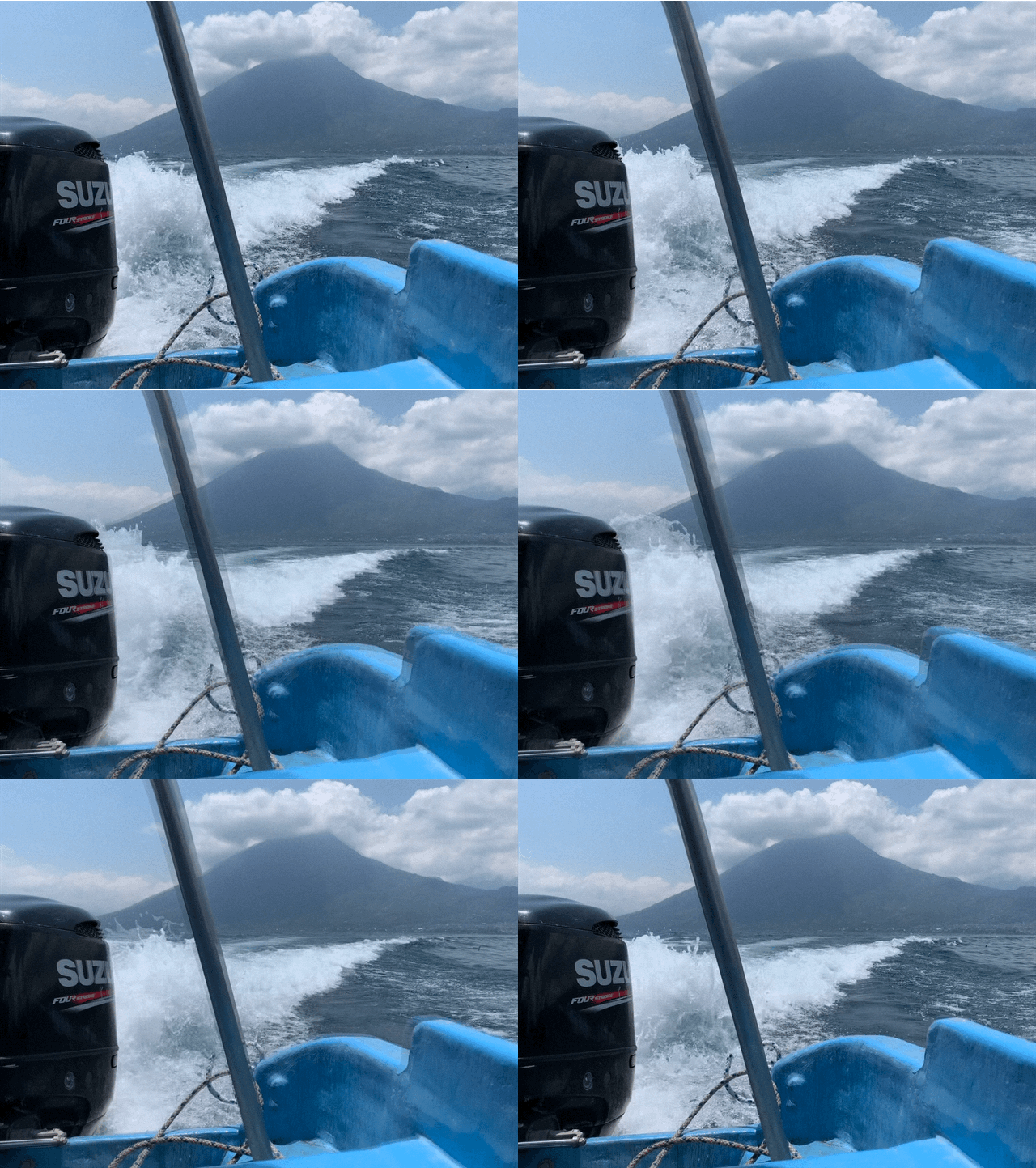
The wind has picked up and the afternoon boat ride back to San Pedro is bumpy, although not as hair-raising as a typical white-knuckle speedboat ride from Long Ke Wan to Sai Kung.
After visiting San Juan and San Marcos, San Pedro feels like the big smoke — big enough to wander repeatedly and discover new things. Back in the flat, the wi-fi is back. And, just in case, we now have plenty of phone data.
Tuesday 24 March
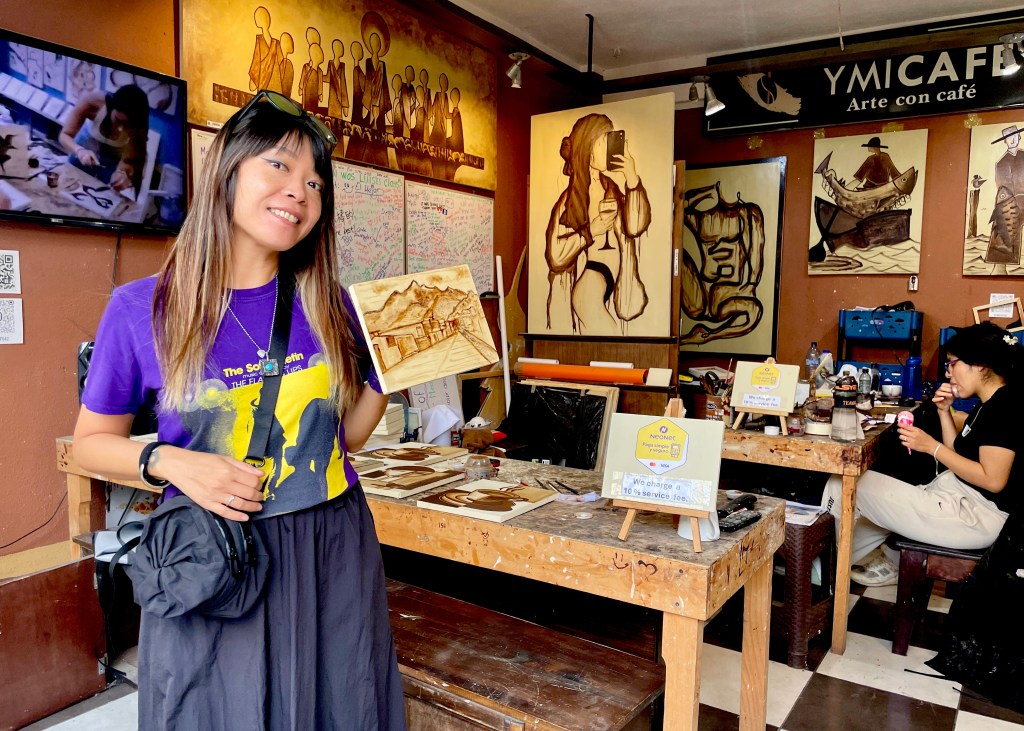
K wants to try an art class using old coffee grounds as paint. There’s a barber shop next door, so I disappear for an overdue haircut while K paints. There are a couple of customers ahead of me, but by the time my turn arrives it’s just me and Augustino the young barber. He’s friendly and chatty, and speaks slowly and clearly. He’s from San Pedro, a twenty-minute motorbike ride from San Pedro. He used to work in construction and misses the camaraderie of a regular work crew, but prefers working as a barber chatting to new people every day. I quickly run up against the limits of my Spanish when he asks about contemporary life in Hong Kong and religious denominations in the UK, but otherwise I manage to keep going. Fifteen minutes later, I emerge with a decent haircut and a significant confidence boost, having kept up my longest Spanish conversation yet.
K’s still painting next door, so I wander off for groceries with a newfound spring in my step. She’s just finishing when I return with a backpack full of yoghurt, wine and nachos. She’s used a photo she took in San Juan last week and done a fine job in little over an hour:
Wednesday 25 March
This afternoon, we’re back reading at the rooftop café oddly placed just before the road turns to a dirt track. Given its unpromising location, it’s pleasantly busy.
After an hour of Spanish back at the flat, we head down to San Pedro lakefront to revisit Shanti Shanti, the family-run restaurant we stumbled into to escape the ghastly Latinao rap music a few days ago. Quiet, peaceful meal. At one point a scraggly kid of about six wanders up to our table selling tiny bags of nuts for Q20 (£2). He looks like he struggles to get a square meal every day. We buy a bag.
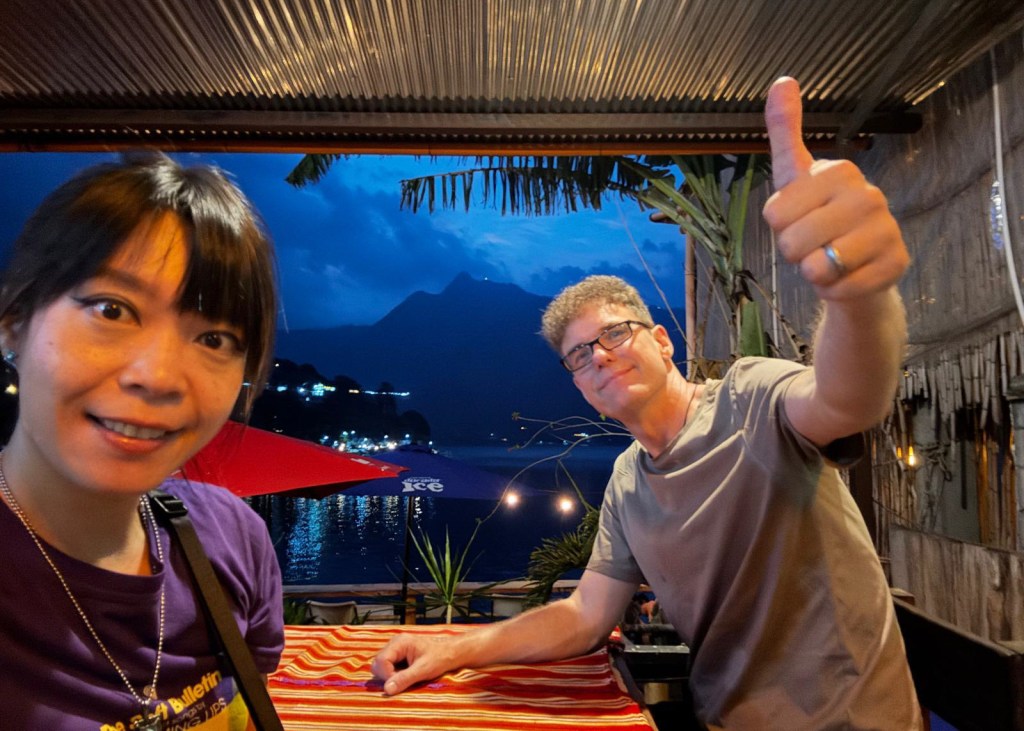
Walking back through the quiet, dark, but unthreatening streets of San Pedro, I’m ambushed by a sudden wave of gentle contentment.
Back home: Scrabble. There’s a set in the flat we haven’t used until tonight, almost two weeks since arriving. K puts in a sterling performance: I nip her by 30 points, but I get the J, Q, X and Z.
Thursday 26 March
I’m making breakfast and listening to The Property Podcast when one of the presenters mentions he’s updated his book How to Be a Landlord. I download a copy to my Kindle app to make sure I’m up to date.
A few hours later, our lovely tenant Julie announces she’s finally buying a house and will be leaving our Portsmouth flat at the end of April. She’s been there since we bought the flat ten years ago. That book will come in handy.
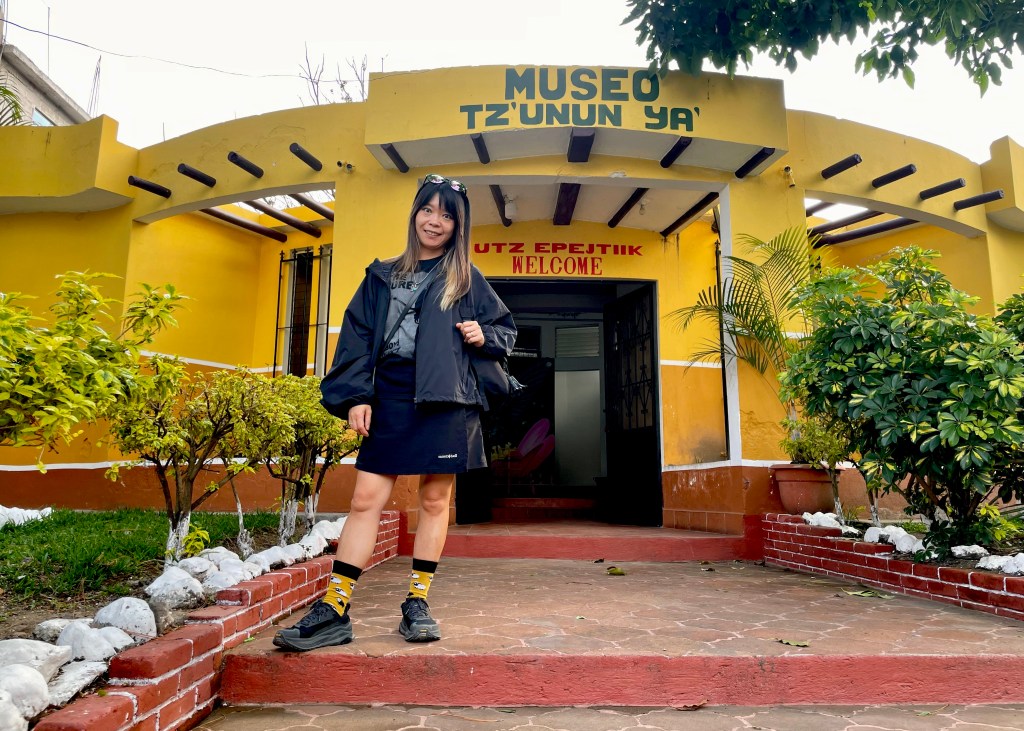
This afternoon, a trip to the local museum. We’re the only visitors. We watch two short films: one about the volcanic geography of Lake Atitlan, the other showing daily life around the lake in the 1940s. The rest is three small rooms: volcanos, handicrafts, and old photographs.
Afterwards, over coffee and a chocolate croissant, I dive straight into the chapters of How to be a Landlord on ending the tenancy and working with a letting agent.
We’re beginning to run short of cash. I put my card into an ATM and freeze. I can’t remember my PIN. It’s just…gone. I take my card back and we walk home. Thankfully I recall it after a couple of minutes, but we’ll manage another day with the cash we have. (That sudden black hole is hopefully no more than the knock-on effects of the minor stresses of replacing a tenant and running low on cash.)
As dusk falls, San Pedro takes the full blow of a thunderstorm. Rain continues all evening.
Later, I notice that Clare Yuan, our concert pianist Airbnb host in Vancouver back in 2019, has ‘liked’ our latest Facebook post. I drop her a line to ask if she’s still running her Airbnb as we’ll briefly be in Vancouver this summer, but they’ve moved far out into the suburbs. She generously invites us to stay, but it’s a two-hour ride into Vancouver proper on public transport. Reluctantly, we decline. Accommodation in Vancouver in July is eye-wateringly expensive, but by the end of the evening we’ve found a small Airbnb closer to the city that won’t shred our wallets.
Friday 27 March
Today, a trip to Santiago de Atitlán, the biggest town on Lake Atitlán, and the one most strongly tied to traditional Mayan culture.
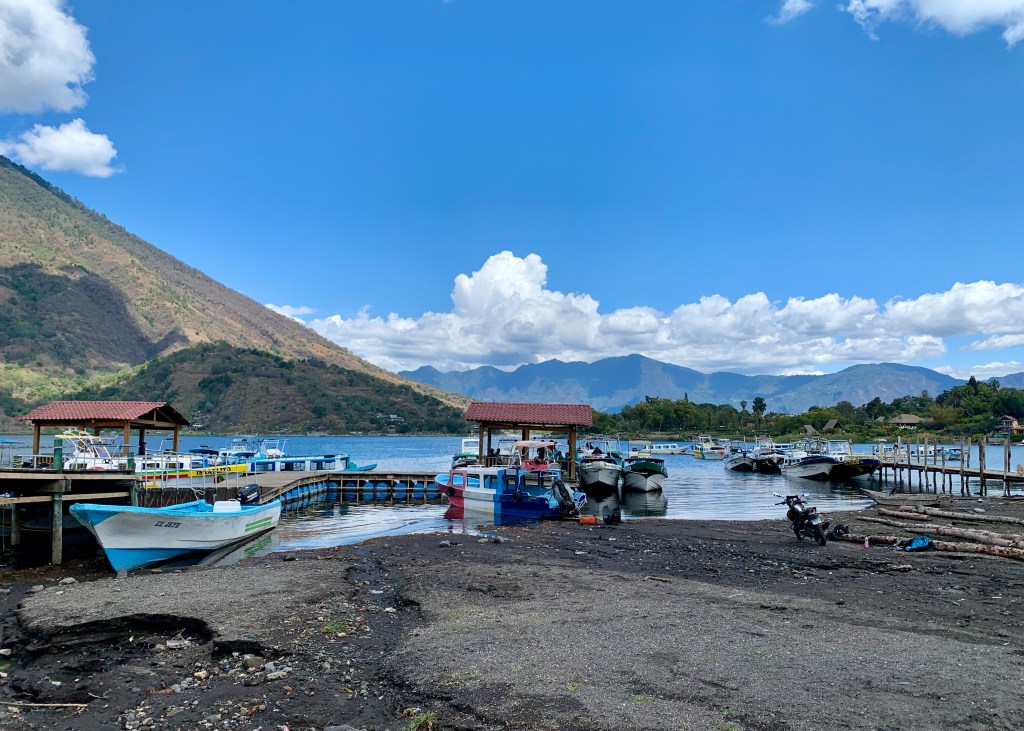
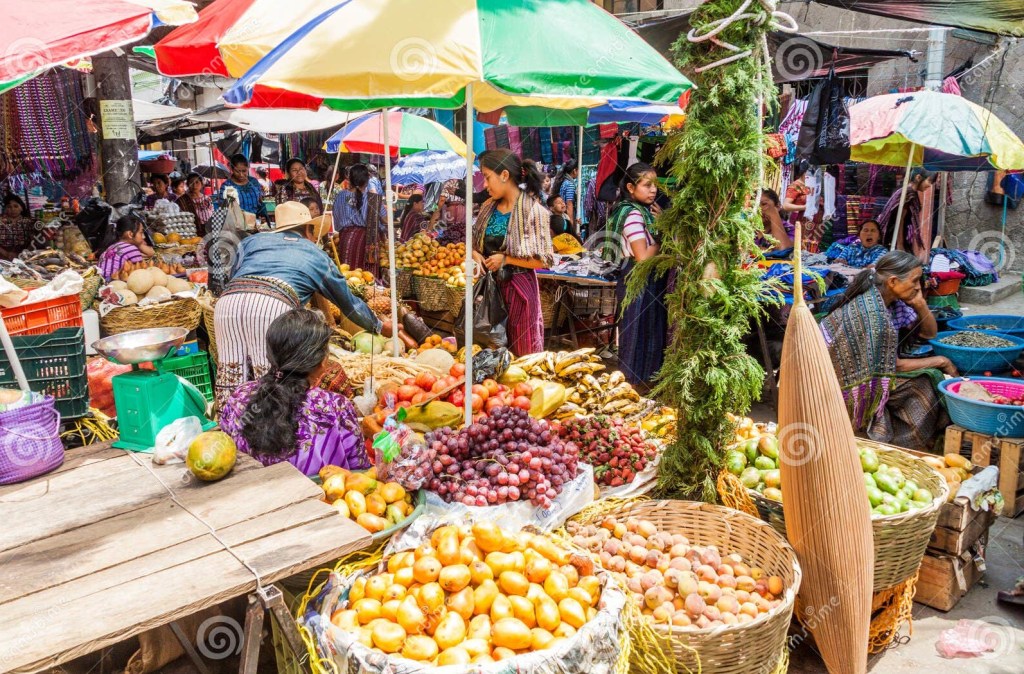
I’m initially surprised that, like all settlements on the lake, the road running from the jetty up to town is lined with stalls selling handicrafts to the few visitors. We may have strayed from the beaten track, but evidently not that far. Then, as we approach the centre, we stumble by chance into the local Friday market. Women in traditional Mayan dress squeeze through narrow gaps between stalls selling fruit and rolls of bright cloth. We had no idea it was market day, yet here we are in the town at its best. I buy platanos and mangos for breakfast. I’d love to take photos, but neither of us can intrude as if the locals were exhibits on display. Instead, here’s one I grabbed from the internet:
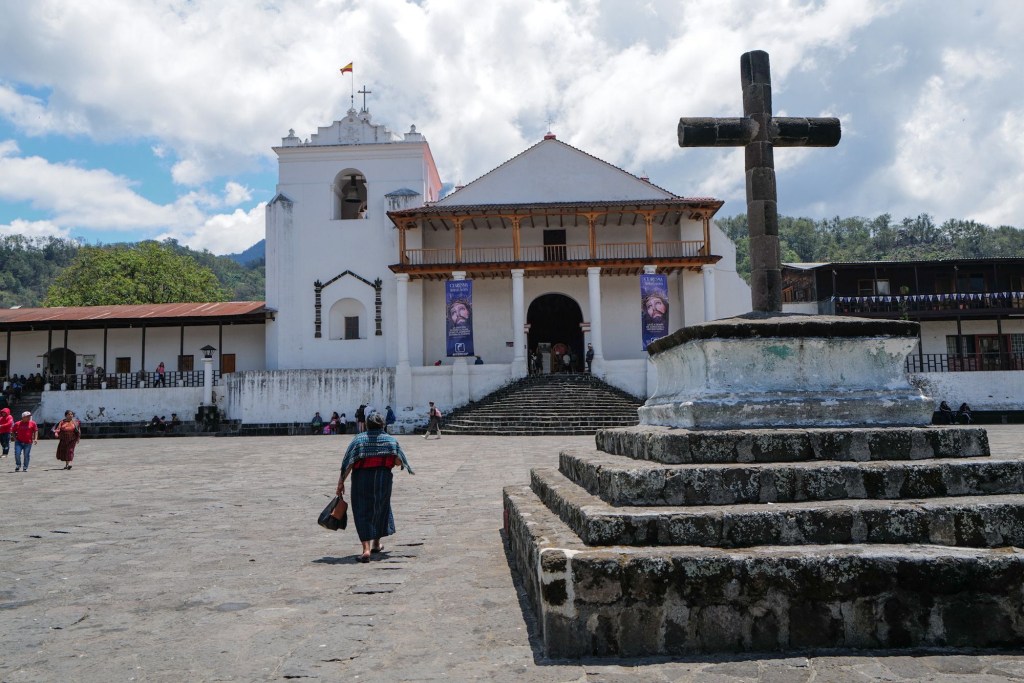
We reach the end of the market near Santiago’s surprisingly large central plaza. The town church stands on one side; a Catholic school wraps around the other three. Holy Week is almost here, and both school and church are busy preparing. Schoolkids line up in uniform, for what purpose we’re not sure. Inside the church, craftsmen put finishing touches to the processional float to be carried through town next week. A memorial recalls those murdered by military death squads in the civil war, including an American priest.
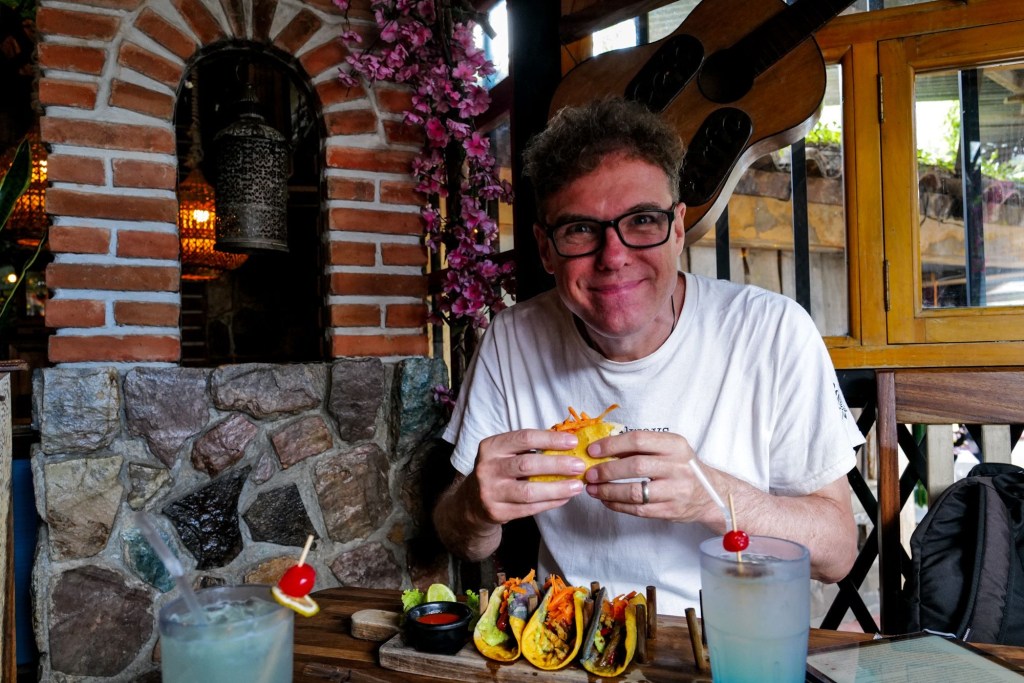
We retrace our steps to the lakefront and settle on peaceful Café Arte for a lunch of tacos. By 1.30 we’re back at the jetty waiting for a lancha back to San Pedro as clouds gather over the volcano and rain looms.
As Santiago slips behind the slope of San Pedro volcano, I feel rather sad knowing there will be few experiences in this life as vivid as today.
Saturday 28 March
Our time at Lake Atitlan is beginning to wind down. After yesterday’s trip to Santiago, we’re not planning to visit any more settlements around the lake. We’ll pass our final three days quietly in San Pedro. Today, we only leave the flat to go out for dinner, pausing at the lake shore to watch dusk fall.
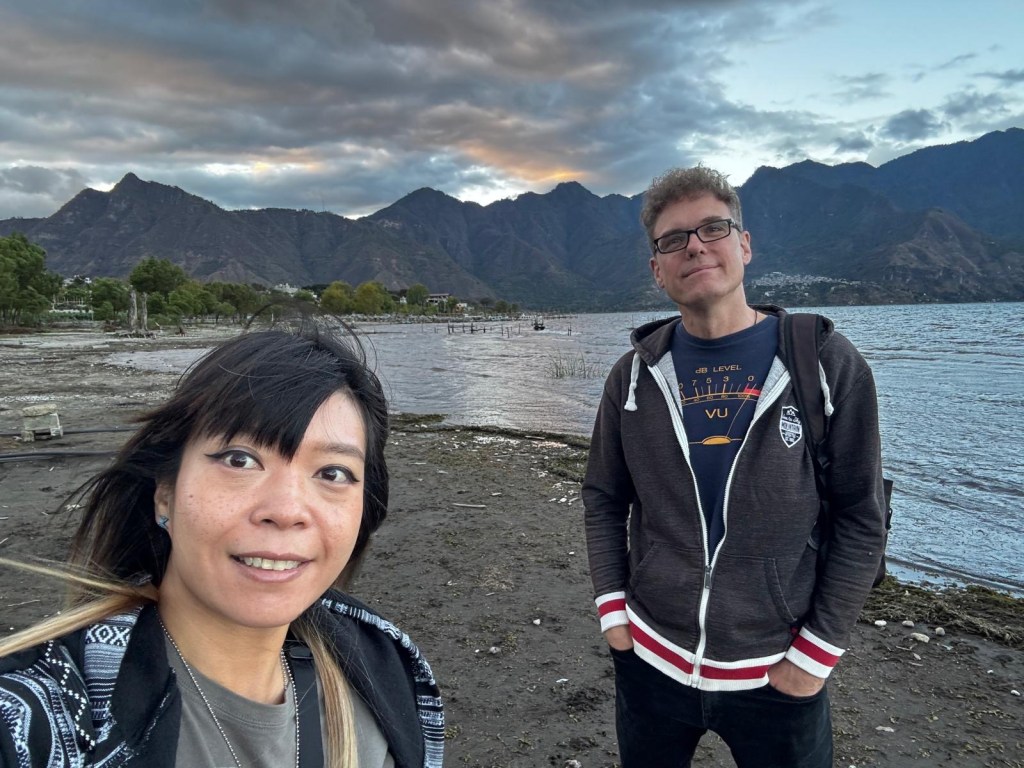
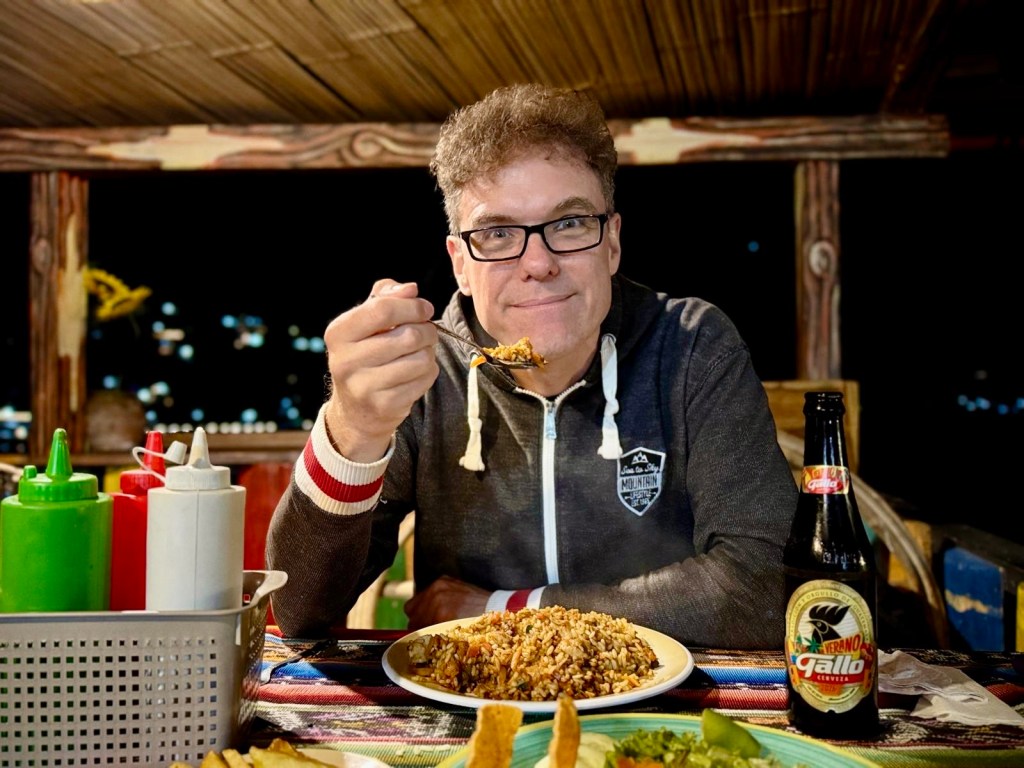
For dinner, we’re back in the garden of the Jarachi’k Hotel. I gush to the waiter (owner?) about how much I enjoyed the baked fish last week, so I’m ordering the same again. He compliments my Spanish. He’s far too kind, but I’ll take it.
Sunday 29 March
Quiet. With two days left before we embark on a week and a half of fast travel, I take the opportunity to start organising Julie’s departure from our Portsmouth flat. We have an amicable video call to discuss what we both need to do. Everything should be straightforward enough. Mum volunteers her services as needed, which could be a great help. We’re looking at a couple of upgrades to the flat that won’t come cheap: a new water heater and more energy-efficient in-room heating.
Guatemala largely retreats into the background today as I busy myself with this.
Monday 30 March
Our final day in San Pedro is much like the previous day as I busy myself with preparing for Julie moving out. Heavy rain arrives late afternoon. We wait for the worst to pass, then head out for a coffee and a final meal in the town at Shanti Shanti, the family-run place on the main drag. The staff remember us. Once again, I mistakenly ask for a ‘chicken’ beer instead of a ‘rooster’ beer. Damn.
Tuesday 31 March
Late morning we reluctantly check out of our Airbnb to make our way back to Panajachel. As we pass the tropical-style Spanish school down the path, the pleasant studious babble of Spanish wafts through the air a final time. I’ll miss it.
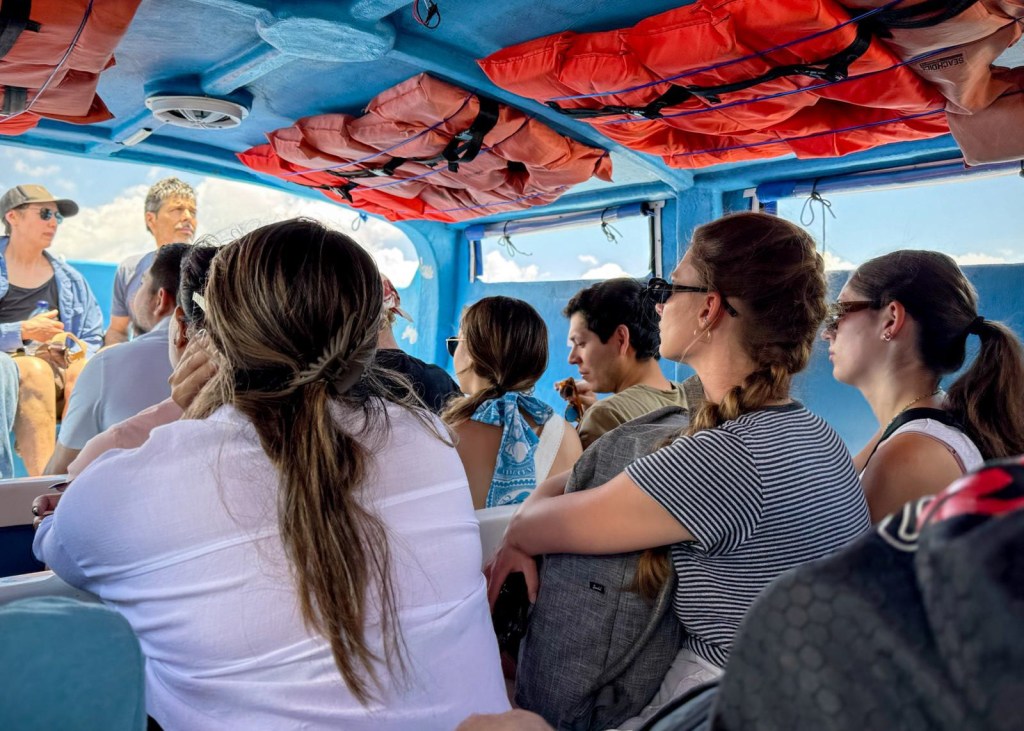
The only female tuk tuk driver I’ve seen here chugs us back to the San Pedro jetties. Soon we’re skimming around the lake, stopping at the intervening villages to set down and pick up passengers until we arrive in Panajachel.
Despite our early arrival, we’re able to check into our strictly functional hotel room and head out for a rooftop lunch nearby. This is spoiled somewhat by every business in the street positioning a colossal speaker at their entrance and competing to see how loud and annoying they can be.
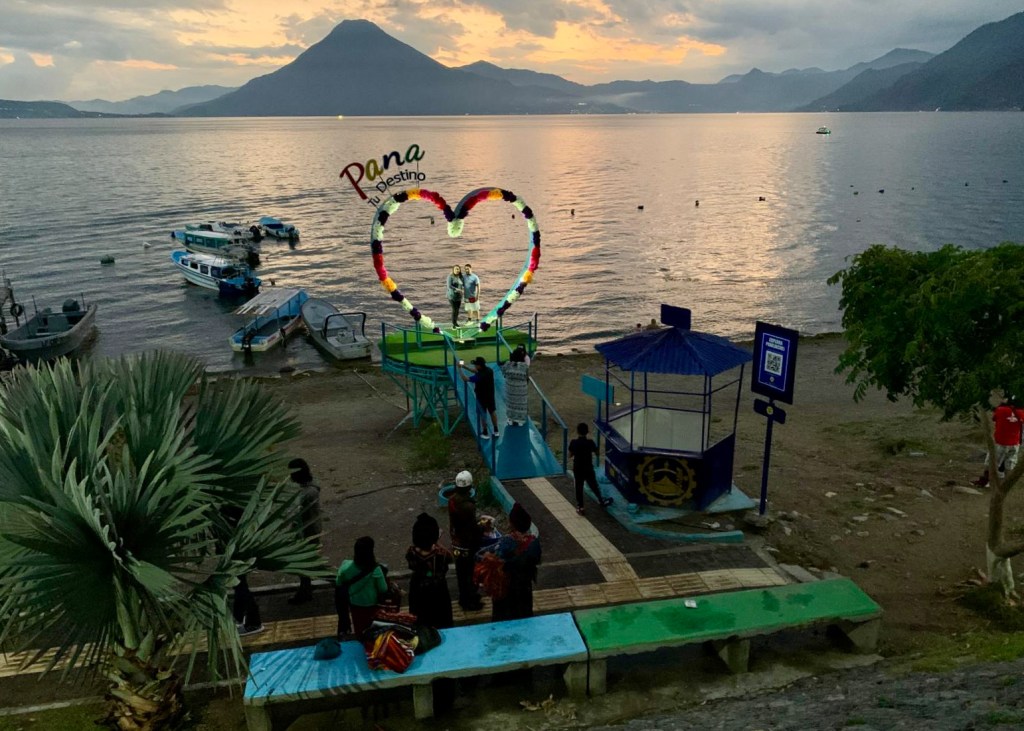
We while the afternoon away reading and studying, heading out at sunset to promenade on the waterfront. Across the lake, the lights of San Pedro twinkle in the dusk.
Back to The Little Spoon for dinner, where it’s surprisingly chilly sitting outside two floors up. I’m glad I’ve brought an extra layer — three in all.
Like everywhere, Lake Atitlan isn’t perfect. I wouldn’t want to live here, with its power cuts, low water pressure, and choking exhaust fumes. But it’s been a special place for us. Despite my glib initial comparsion of San Pedro to Lamma, it’s really anything but. People around the lake live lives that I can barely imagine. For the first time in two-and-a-half-years of travelling, I’m finally beginning to feel reasonably well-travelled.
 Two On Tour
Leave a comment