Muchos colores brilliantes!
Thursday 26 February
San Jose airport has outgrown itself: the queue for passport control stretches through the check-in hall before settling into an eight-turn snake. After thirty minutes of shuffling, our passports are finally stamped. Everything else is smooth. I have a free upgrade to posh class; K, less fortunately, is confined to cattle. I bear the separation with surprising fortitude.
I’m in a window seat and spend the ninety-minute flight to Guatemala City oscillating between a guidebook and the view. We skirt the west shore of Lake Cocibolca with its two imposing volcanos, then track the coastlines of northern Nicaragua and El Salvador. Finally, we turn inland to land at Guatemala City.
The airport sits in the city centre. One moment there are rooftops just feet below; the next we’re on the runway, braking sharply. Immigration is quick, simple and friendly. Outside the terminal, we scan the nameboards looking for our hotel transfer. None bear our names. After half an hour, K takes a detective’s eye to my email chain with the hotel and spots what’s wrong: the hotel booked the driver for 26 March. I’d managed to overlook this small but vital detail, naturally.
We jump into a taxi. It delivers us through the rush hour traffic at half the price of the official transfer. We win — a victory achieved entirely through my own administrative failure.
The hotel is exactly what we wanted for one night in a city with a report card as poor as this one. Inside, it’s indistinguishable from any other upmarket business hotel. It insulates us from any culture shock — a service I’m grateful for during these first twenty-four hours in Guatemala.
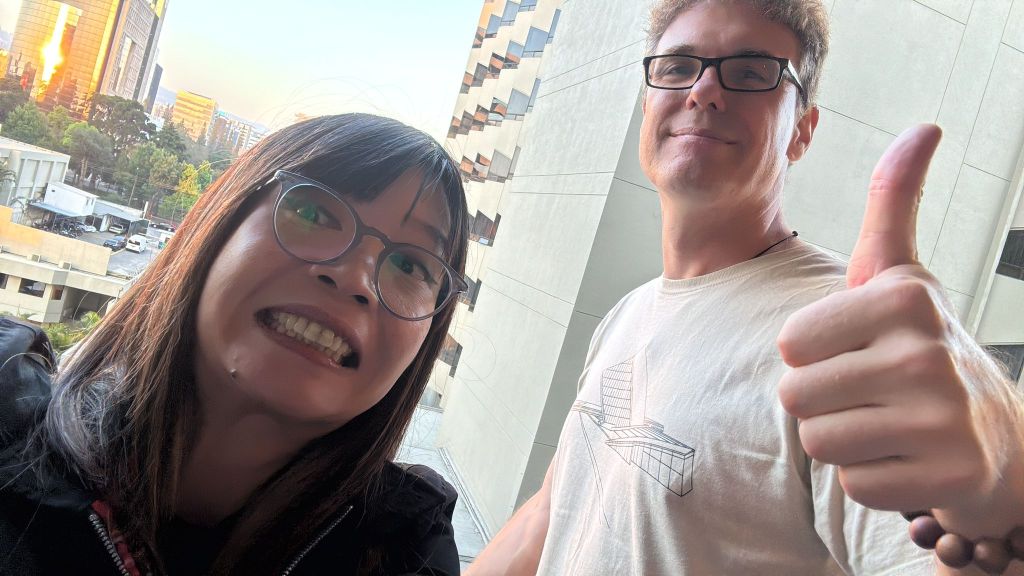
We watch the sun set from the balcony, eat in its affordable sports bar, and retire.
Friday 27 February
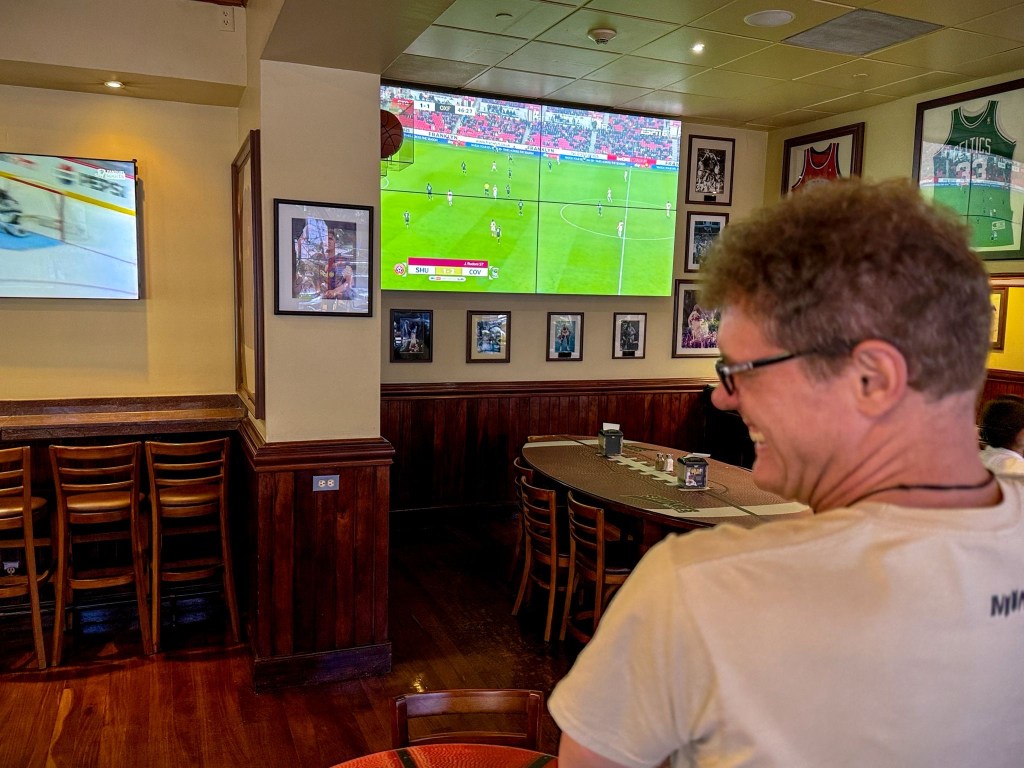
Hotel Barceló’s breakfast buffet is a cosmopolitan affair of international faces. How many of them are here, like us, for a single night before they get out of Dodge City, I wonder? Our ride isn’t due until two, so we while away the morning, check out at the last possible moment, and revisit Strikers sports bar for a lunch of chicken soup and refreshing cimarrona. Improbably, the TV is showing a rerun of Stoke’s match against Oxford United earlier this week:
At two, there’s no sign of our ride. Since yesterday, our driver (arranged through a Facebook group) hasn’t acknowledged my messages, so I’m hardly surprised. We wait twenty minutes before admitting my attempt at ‘social media logistics’ has failed. We dial in Plan B — an Uber — which arrives in five minutes and whisks us off to Antigua.
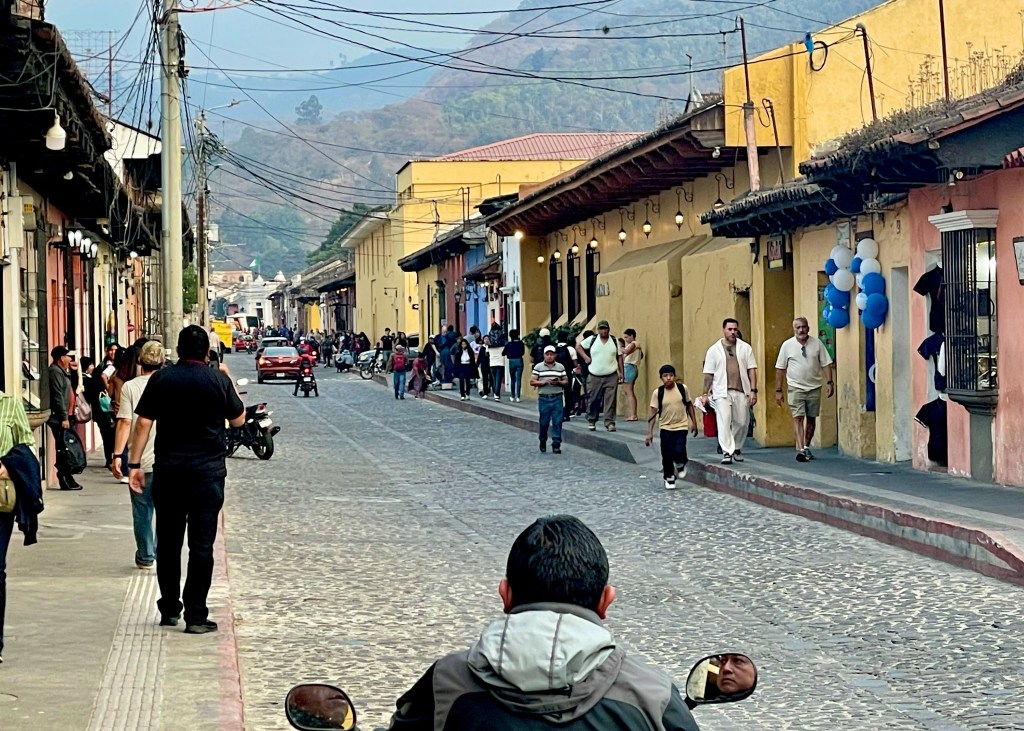
Guatemala City looks every bit as unglamorous as its reputation as we pass through its relentlessly scruffy suburbs of salvage yards and tangled overhead wires. Eventually they give way to forested hills, through which the dual-carriageway winds until we turn off directly onto the narrowed cobbled streets of Antigua.
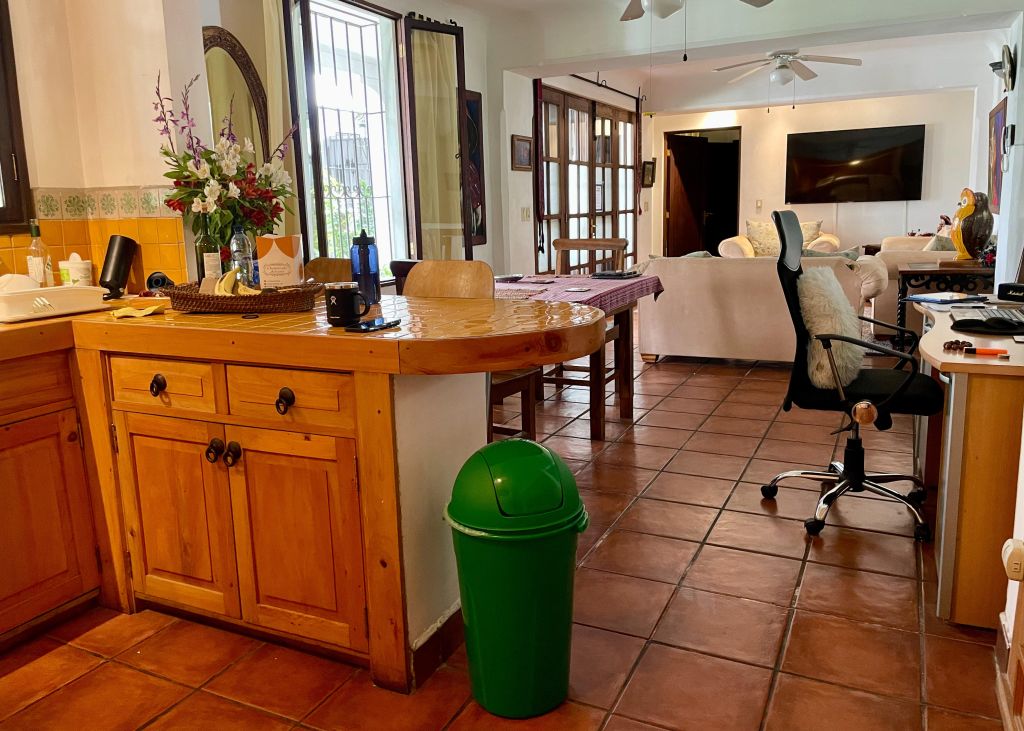
We’re met by our Airbnb host Tomas, a jovial septuagenarian Czech who’s lived in Antigua for twenty-four years. Just being met is a pleasant change from the familiar Airbnb routine of lockboxes; being met by someone who clearly loves his adopted home is even better. The flat is enormous. I joke that while most Airbnbs are much smaller than the photos suggest — a cynicism I’ve spent years cultivating — this place is far bigger than we could have imagined. It’s also beautifully decorated. Immediately, it’s clear this is our highwater mark: from now on, no matter how long we travel, every Airbnb will be a measured disappointment compared to here.
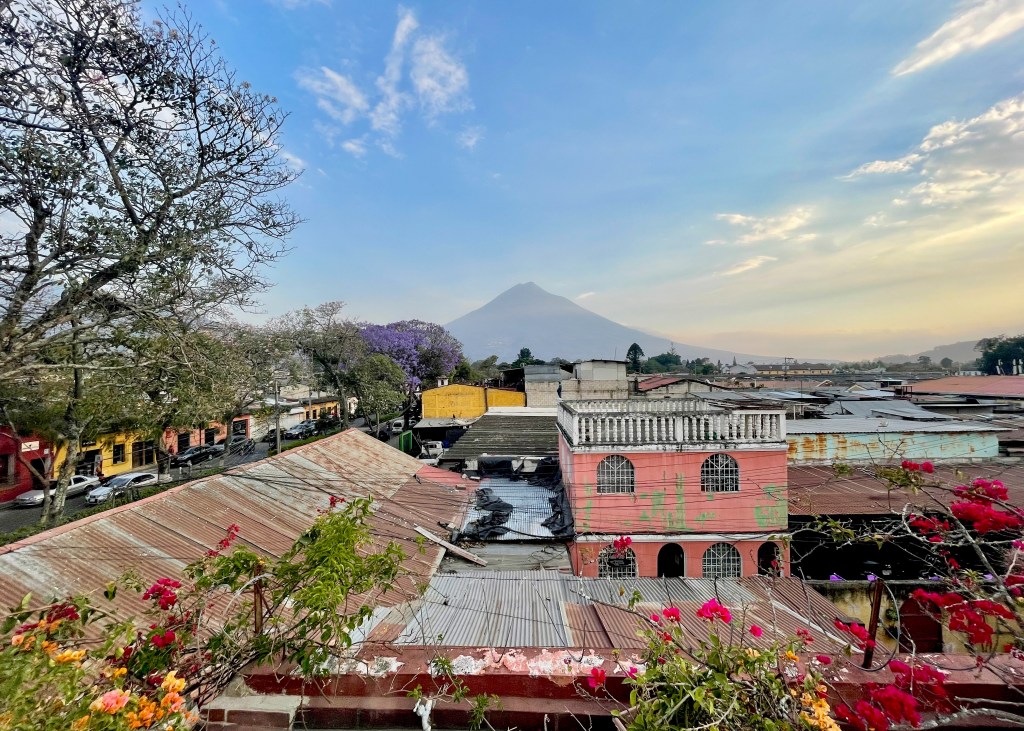
Tomas takes us up to the roof terrace, pointing out the three volcanos that loom over the town. As we watch, Volcan de Fuego — currently disrupting flights into Guatemala from North America — obliges with a puff of gas and ash from its distant cone. We’re safe from an unlikely major eruption here, but in 2018, in a town at its foot, 159 people lost their lives in an eruption that left Antigua under a thick blanket of ash.
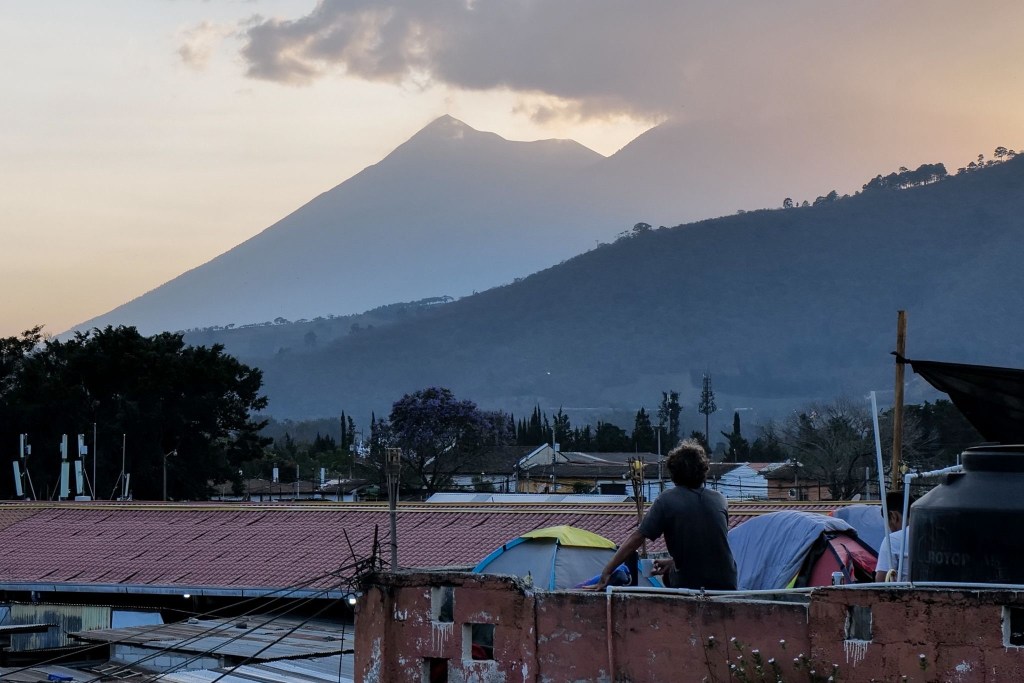
Tomas leaves us to settle in. I unpack and return to the roof to clumsily document the sunset, then we find the local, surprisingly well-stocked supermarket. There’s far more to choose from than in Costa Rica, and it’s far more affordable.
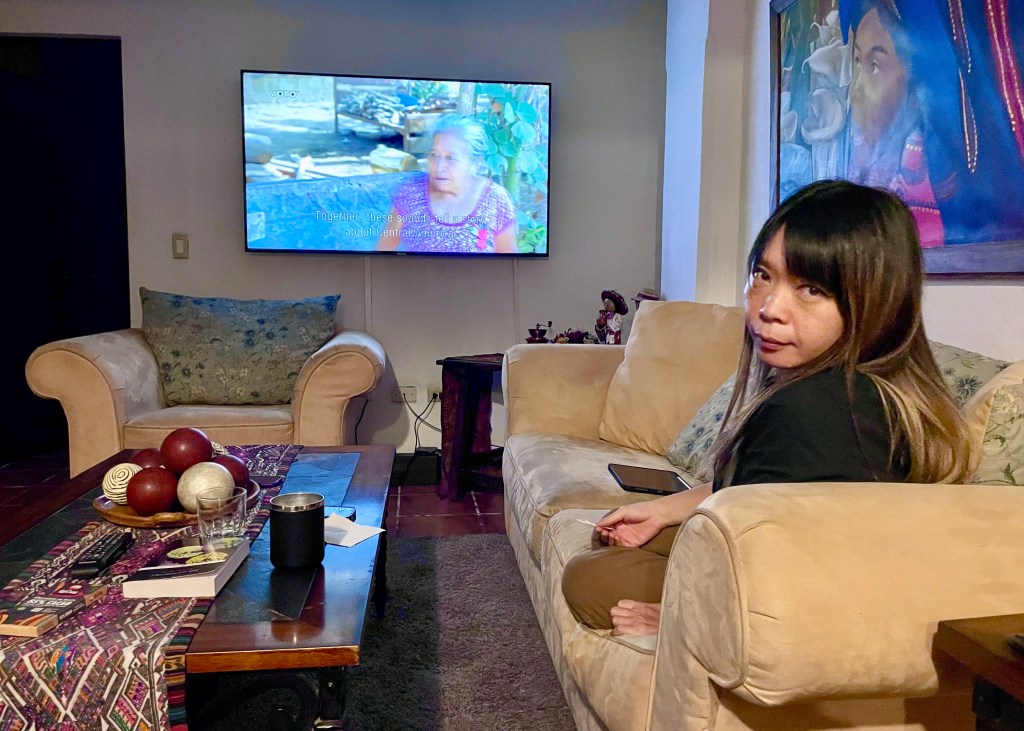
After four nights of eating out and takeaways, our second night in Guatemala is one for K’s home-cooking. We spend the rest of the evening watching a Dutch documentary about the lasting effects of the Guatemalan civil war on the Maya. Grim, but educational.
Saturday 28 February
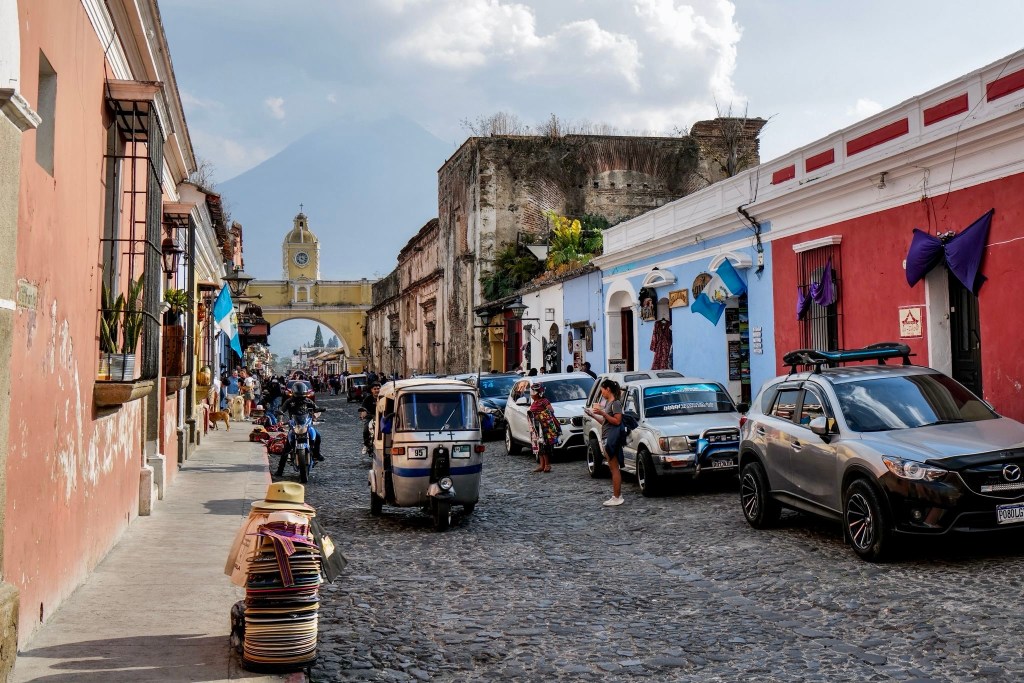
Two days of travel and a superior Airbnb leave us in no rush: we emerge late morning in need of tomatoes for lunch. Antigua’s central market is right behind our place, a cool, covered space piled with fresh fruit and veg, and mounds of brightly coloured powdered dyes. The Maya women running the market stalls are every bit as colourful as their goods. We leave with a bag brimming with tomatoes, squash, aubergines and lemons, all for HK$20 (£2). Southeast Asian prices.
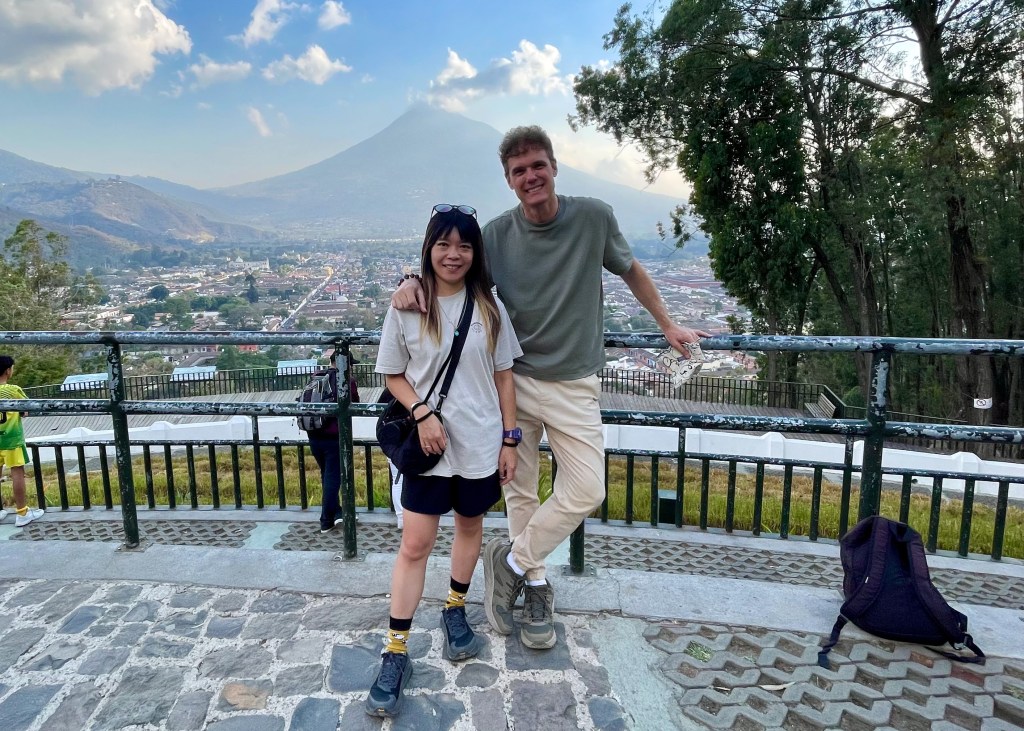
Later, we wander into town to see the famous Arco de Santa Catalina, then climb to the Cerro de la Cruz for a spectacular view over the town towards the dormant Volcan Agua. On the wooded path, two uniformed firefighters are collecting donations. I can only assume that they don’t receive enough government funding. Is the government budget simply too thin to support their operations, or are their funds being siphoned off by shameless officials? I tactfully limit my questions to enquiring if March is a busy month for firefighting while slipping them a few quetzals.
After dark, it’s cool enough to don an extra layer. We choose an unpretentious place with a good choice of local — or at least Central American — dishes. Positioned just inside the door, a woman in traditional Mayan dress is making fresh piping hot tortillas as a delicious aroma of toasted corn lures customers inside.
The food is good enough, the service friendly. We manage everything in Spanish without really thinking about it — a rare moment of linguistic competence that I suspect won’t last. With drinks, it comes to about half what we were paying in Costa Rica. And I discover that tortillas smell considerably better than they taste.
Sunday 1 March
And so into March. Our latest adventure began way back in mid-September in Marrakesh, now increasingly a memory from another life.
We’ve arrived in Antigua at the perfect time. Our host Tomas has alerted us to a Lent procession this afternoon. With the cobbled streets closed to traffic, we’re free to wander as we please in the middle of the road. Occasionally, someone passes in a flourish of bright purple robes. It’s unclear l if they’re lost or just running errands before the show.
Armed with a list of local landmarks the procession will pass, we join a thin crowd of onlookers not far from its start point. Not a lot is happening. Knots of purple-robed men and boys stand around occasionally checking their phones — presumably coordinating the logistics of carrying several tons of wood through narrow streets, or perhaps just checking the football scores.
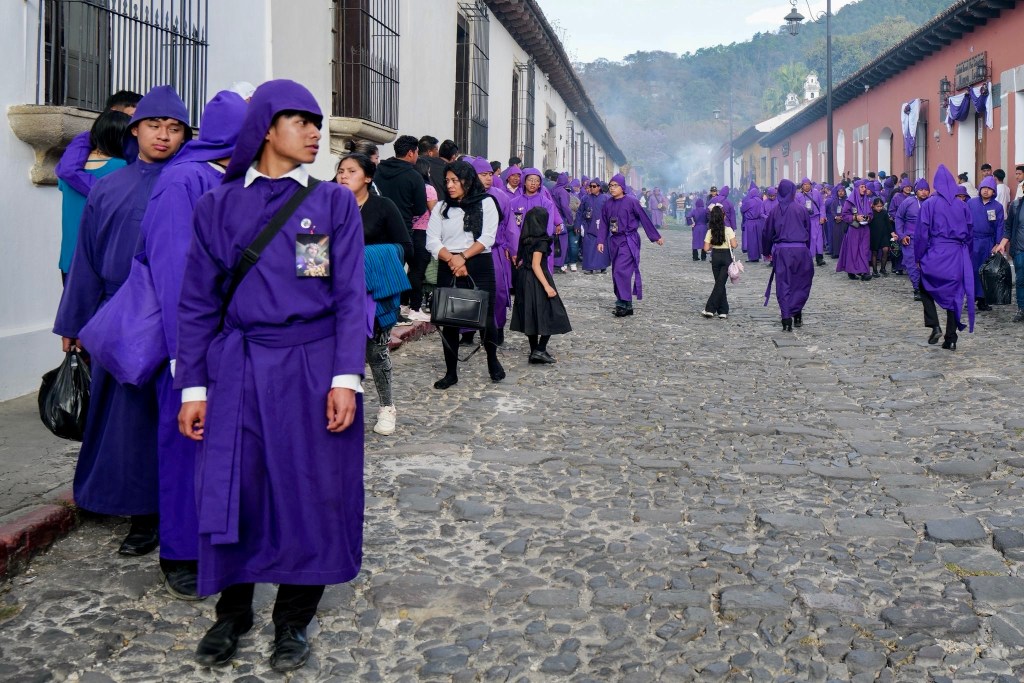
Eventually, a band strikes up and the first of two shoulder-borne religious floats begins to shuffle towards us, preceded by a thick soup of sweet frankincense. It takes twenty men to carry the first float, topped by a statue of Jesus and a large clock. The Spanish inscription claims only God knows time, which is perhaps why the procession is running late. The women carry the smaller second float dedicated to the Virgin Mary. The street is an eruption of purple cloaks, drum rolls, and fragnant smoke.
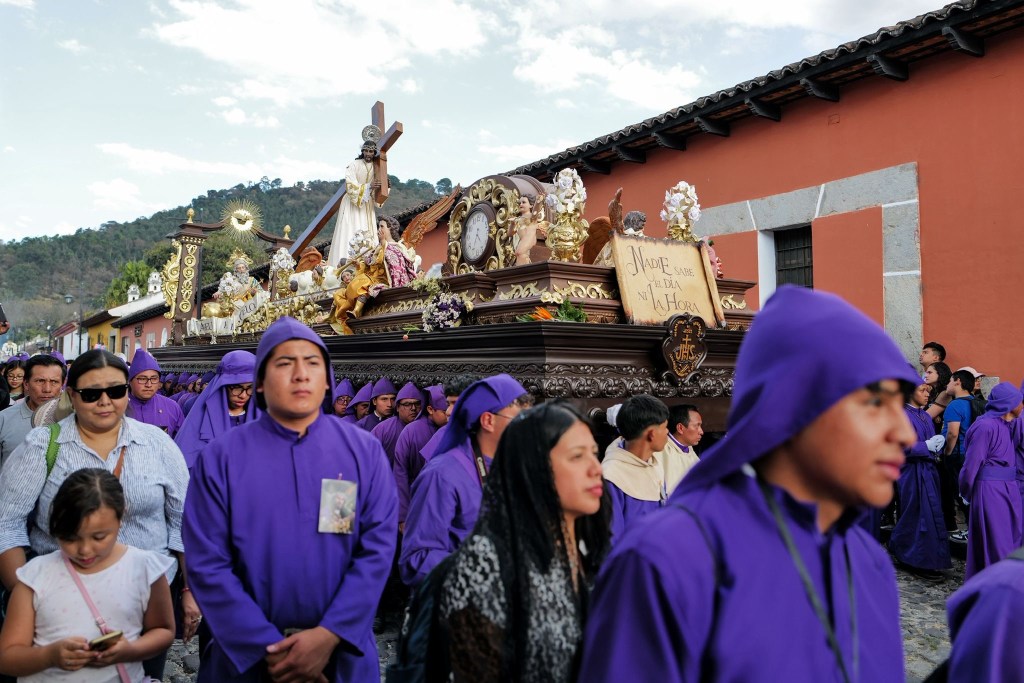
And then it’s gone, crawling towards the town centre. We avoid the crush, taking backstreets to the main square for coffee and mango cheesecake in the company of our books. Coffee, cheesecake, and a good book: more my kind of holy trinity.
Monday 2 March
After two days of getting to know Antigua, Monday replaces K’s regular Sunday rest day. I use the opportunity to catch up with admin, leaving the flat only for a small grocery run.
Tomas has helpfully equipped the flat with a twenty-year-old Rough Guide to Guatemala. Its advice on how not to get lost in Antigua and where to find Internet cafes feels like guidance from a pre-millennial world before smartphones and Google Maps. But it remains useful for the things that haven’t changed: geography, history, and Guatemala City not being a place you’d want to linger. It’s also easier to navigate than my up-to-date Kindle version of the guide — a damning indictment of my ability to master twenty-first century reading habits.
I’d briefly entertained a romantic notion of scuttling our flight to Flores and travelling by bus instead. It would save the time and expense of backtracking to Guatemala City, and I rather liked the idea of a bus ride through a couple of hundred miles of uninhabited jungle. This notion survives only until I consult people who have actually done it: everyone on the Guatemala Facebook group who replies suggests flying.
A close read of our flight details reveals a minor technicality: our baggage limit is 20lb, not 20kg — a twenty-two-kilogramme discrepancy for the two of us. Tomorrow, I’ll contact hotels in Guatemala City to ask whether they can store a bag for a week while we head north.
Tuesday 3 March
We’ve been in Guatemala less than a week but it’s already passing its audit with ease: the climate, the colours, the people. Right now, there’s nowhere I’d rather be.
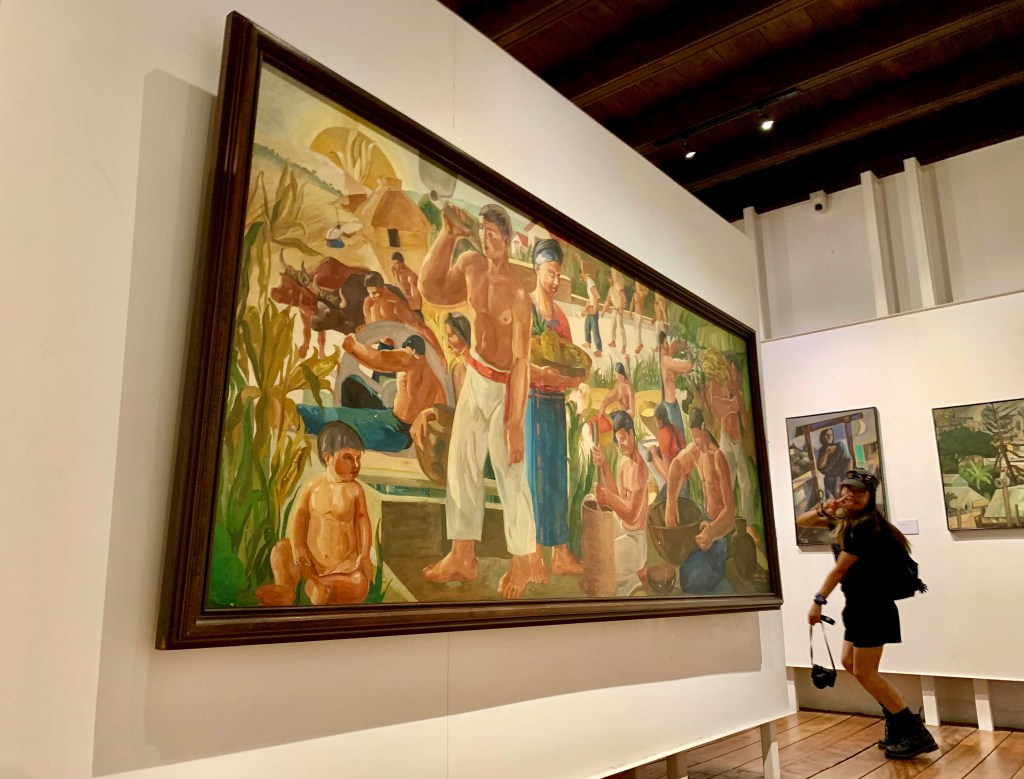
We spend the afternoon at the National Art Museum, which recently moved from the capital as no one visited it in Guatemala City. It occupies a colonial building running the length of the southern edge of Antigua’s main square, although even free entry fails to draw a crowd. The art spans pre-Columbian sculpture to modern Guatemalan painting and is full of colours and shapes that root me to the spot.
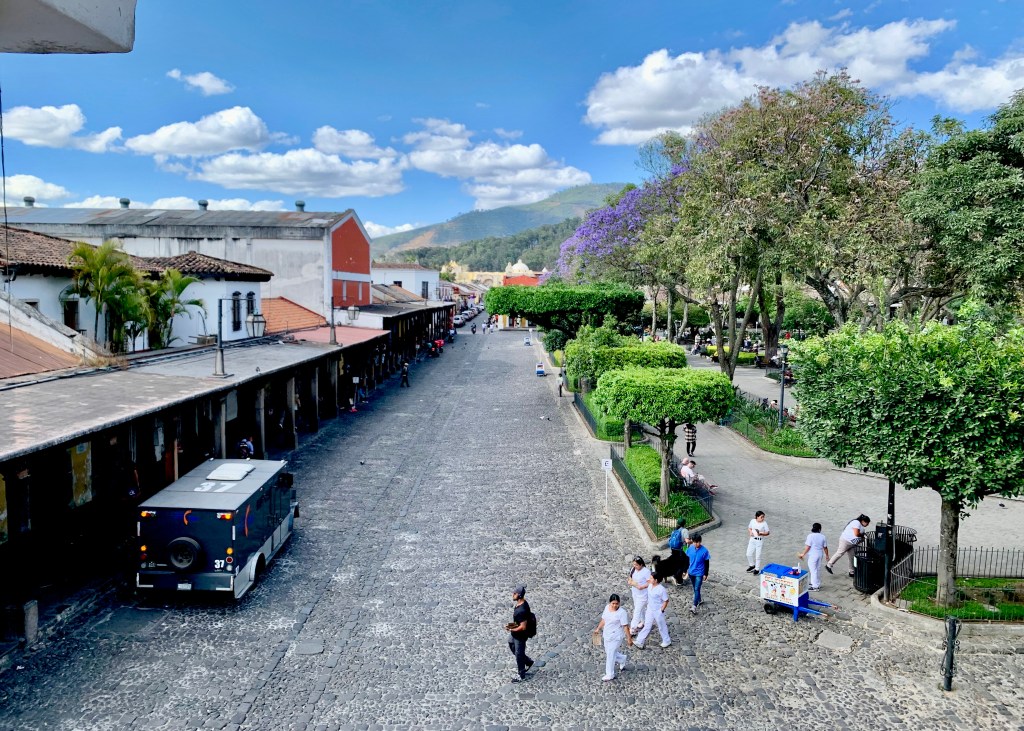
Occasionally, the guided route deposits us on a first-floor veranda overlooking the square — barely busier now than when it was closed to traffic on Sunday for the Lent procession. Antigua’s relaxed pace is just one more of its many charms:
From the museum, we leave Antigua’s central cobbled streets and follow a road choked in diesel fumes to a supermarket on the edge of town. We’ve heard it’s more upmarket than the slightly chaotic one in town, and we’re curious. After a short rest stop for ice cream, we find a modern, spacious supermarket — Waitrose in the tropics, essentially. K’s delighted to find celery for the first time since Spain.
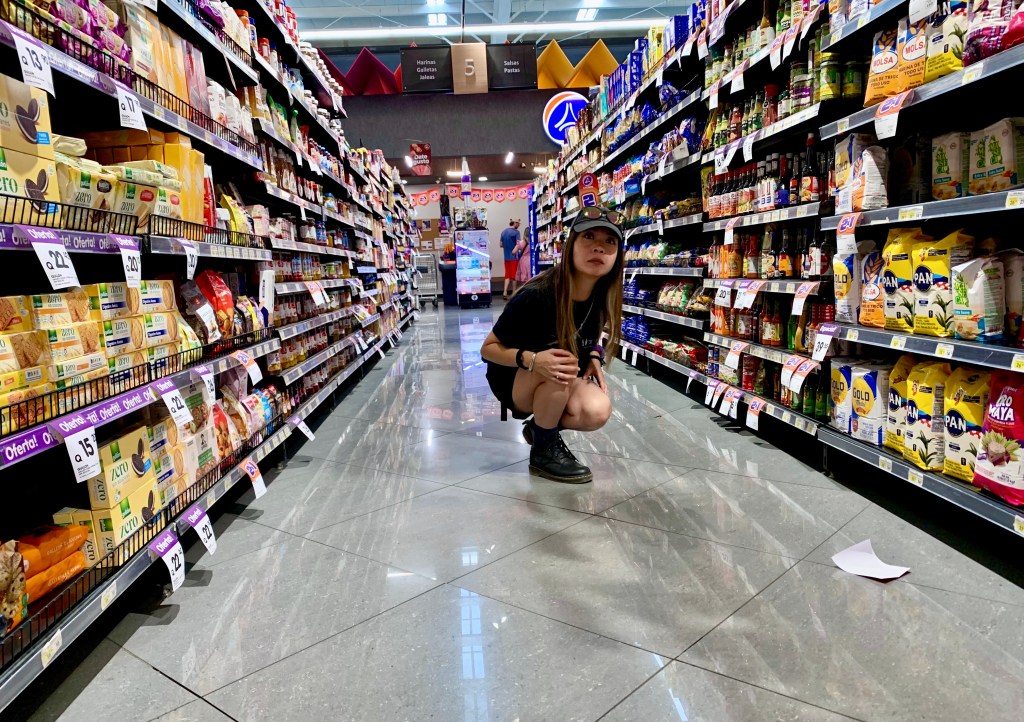
La Torre supermarket sits in a pleasant modern shopping precinct that, were it not for Volcán Agua towering overhead, could be anywhere from Ko Samui to Ashford. Far from being a disappointment, its “anytown” vibe is strangely comforting. I’m delighted to find that this little corner of Guatemala is much like anywhere else where people want to shop in comfort.
Wednesday 4 March
Even with a week-long hiatus from work, I currently find myself fully occupied by everyday mundane admin. We’ve opted for the path of least resistance regarding the northern leg of our Guatemala tour: rebooking with a different airline that offers a more generous baggage allowance. It leaves us somewhat out of pocket, but throwing money at a problem to make it go away can feel oddly satisfying.
After lunch, we visit the ruins of a sprawling eighteenth-century convent. The nuns who founded Santa Clara relocated from then-parochial Puebla in Mexico — these days a city of over a million — to the capital of a sprawling colonial territory. From these streets, the Spanish once ran the logistics for all Central America. Antigua has the resume of a continental superpower, but has long since retreated into the ghosts of its own history. Ozymandias himself might raise an eyebrow.
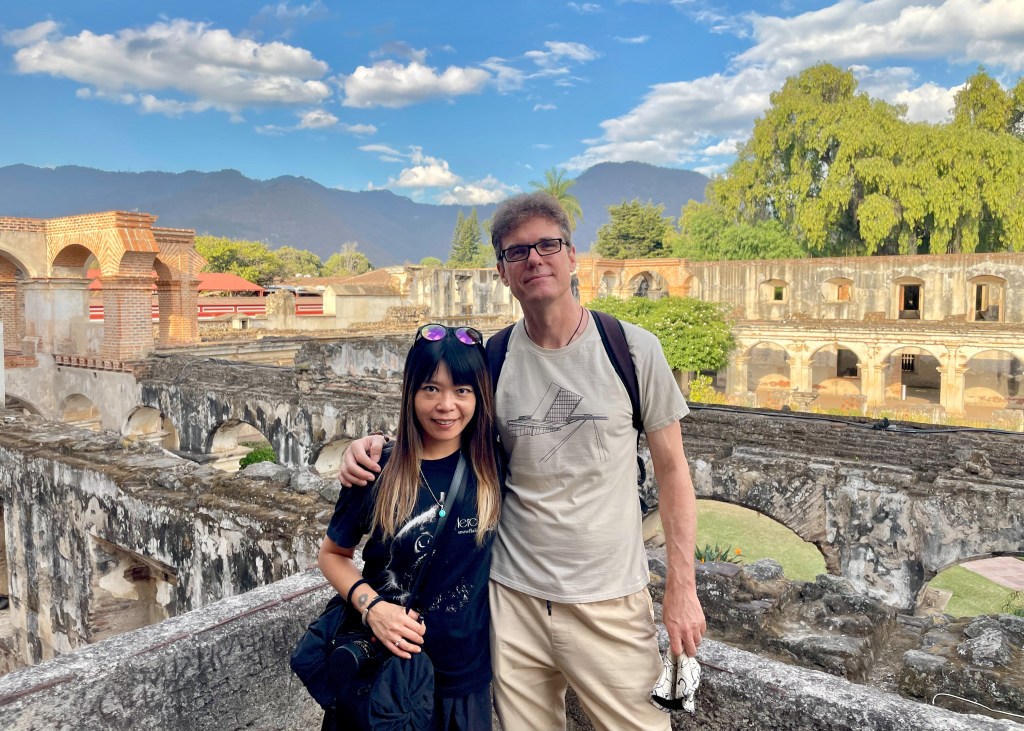
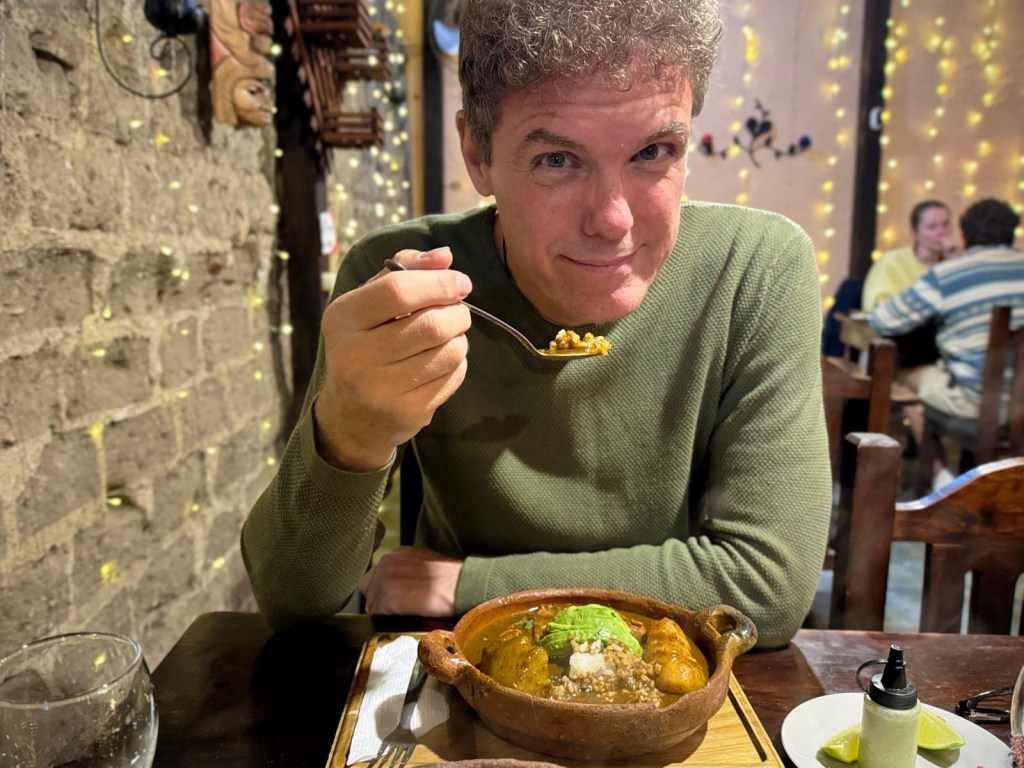
K picks a place called Casa de Las Sopas for dinner. It’s a cosy little place serving what are less “soups” and more hearty casseroles and stews. I opt for a chicken pepián, K for a beef caldo — both excellent. Our friendly server, who can’t stand higher than four-foot-six, is a dead ringer for the diminutive Indonesian woman who used to work at The Waterfront on Lamma.
Back in the flat, we watch a documentary about the 2019 eruption of the Whakaari volcano off the coast of New Zealand, which claimed the lives of 22 tourists and their guides. More deeply uncomfortable viewing. You assume that tour guides understand the risks they’re managing, but it turns out that sometimes they don’t. Running daily trips to a volcano with a track record of erupting every three years without warning seems pathologically reckless, especially when it last erupted three years ago. All travel to the island remains banned. Common sense belatedly prevails.
Thursday 5 March
We’ve been in Guatemala a week. While the space and comfort of our Airbnb are unprecedented, we’re aware that we’re largely insulated from daily Guatemalan life. Things will certainly shift down a gear next week when we move onto Lake Atitlán.
Our engagement with the real word today is limited to an afternoon excursion for coffee and cake. We find ourselves in a quiet courtyard attached to a hotel, sipping americanos among fellow tourists. I start a new book, Time Among the Maya — a 1980s travelogue spanning Guatemala, Belize, and the Mexican states of Chipas and Yucatán.
At the supermarket, I absent-mindedly stuff two packets of chocolate into a trouser pocket to free up my hands — for what, I forget. Fortunately, no one notices. I soon realise my error and sheepishly pull the chocolate out before reaching the checkout. Not a mistake I wish to repeat.
Evening entertainment is Cillian Murphy staring as the eponymous Steve, a headteacher battling for the survival of his reform school while battling his own mental health. Cillian Murphy is predictably excellent. Tracey Ullman — a face I haven’t seen in decades — is equally sharp as the deputy head. The impossible schoolboys remind me how fortunate I was to spend a career in education only teaching students who wanted to be in the room.
Friday 6 March
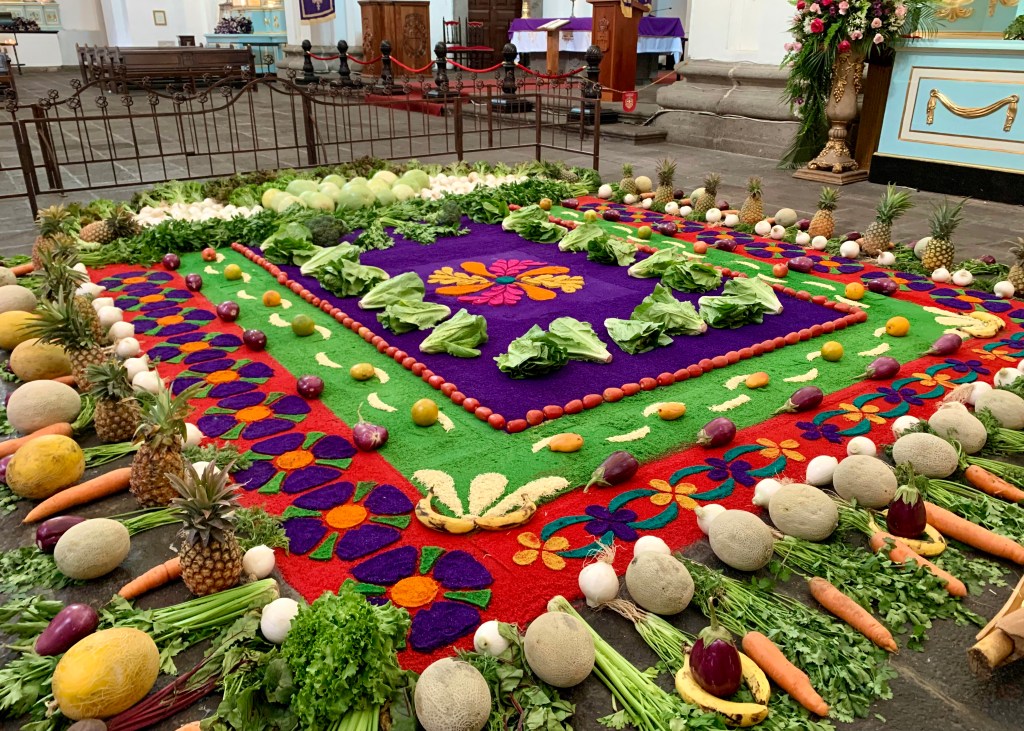
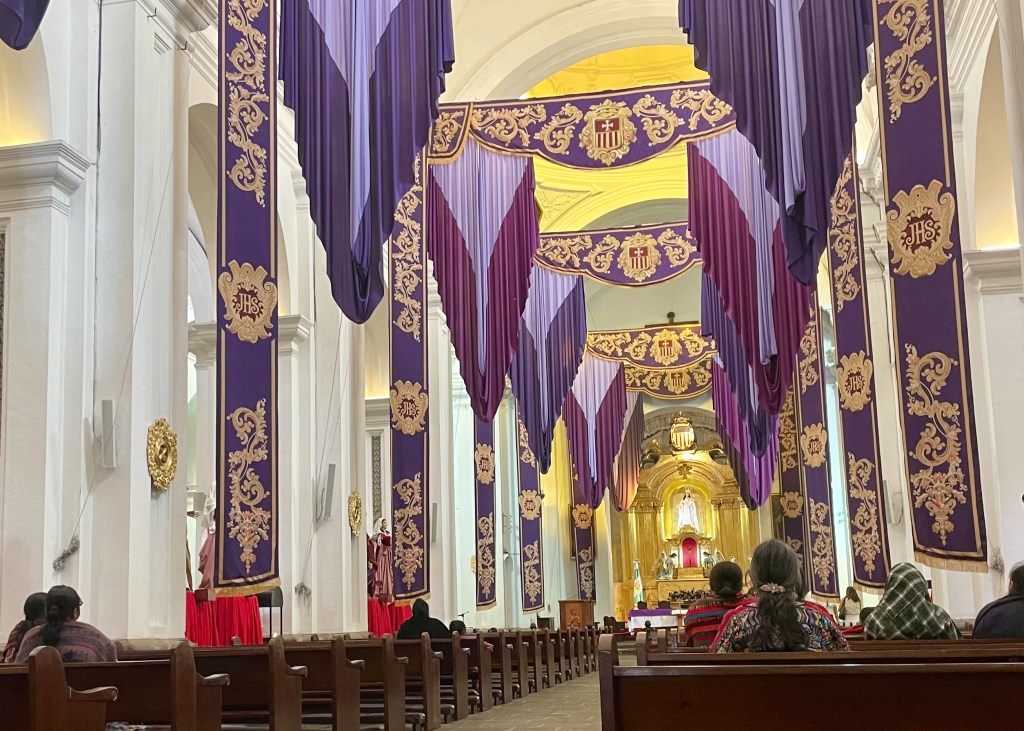
Another pleasantly slow day. We unwittingly choose a perfect time to visit our local church, the Iglesia de la Merced — last Saturday we peered inside, but a wedding was underway. Today it’s decorated for Lent with purple hangings and an ornate carpet of coloured sawdust surrounded by fruits and vegetables, which I later discover represent the garden Jesus visited before his arrest and crucifixion:
A drummer and piper keep a vigil inside the entrance. The drummer double-thumps a bass drum, like a heartbeat. The piper replies with solemn notes from a pito, a traditional flute. It’s deeply peaceful. (The flute and drum symbolise the sorrow of the Passion of Christ, apparently. We sit a long time in the pews, listening to the music and watching the local Mayan women wander in to pray:
Back on the main square, there’s a coffee stop accompanied by an enormous wedge of carrot cake. The plan was to people-watch but I’m so engrossed in my book that I barely remember to look up.
Saturday 7 March
The flat is due its weekly clean this morning. Our contribution is to make ourselves scarce, using the opportunity to head out to see Antigua before noon for the first time.
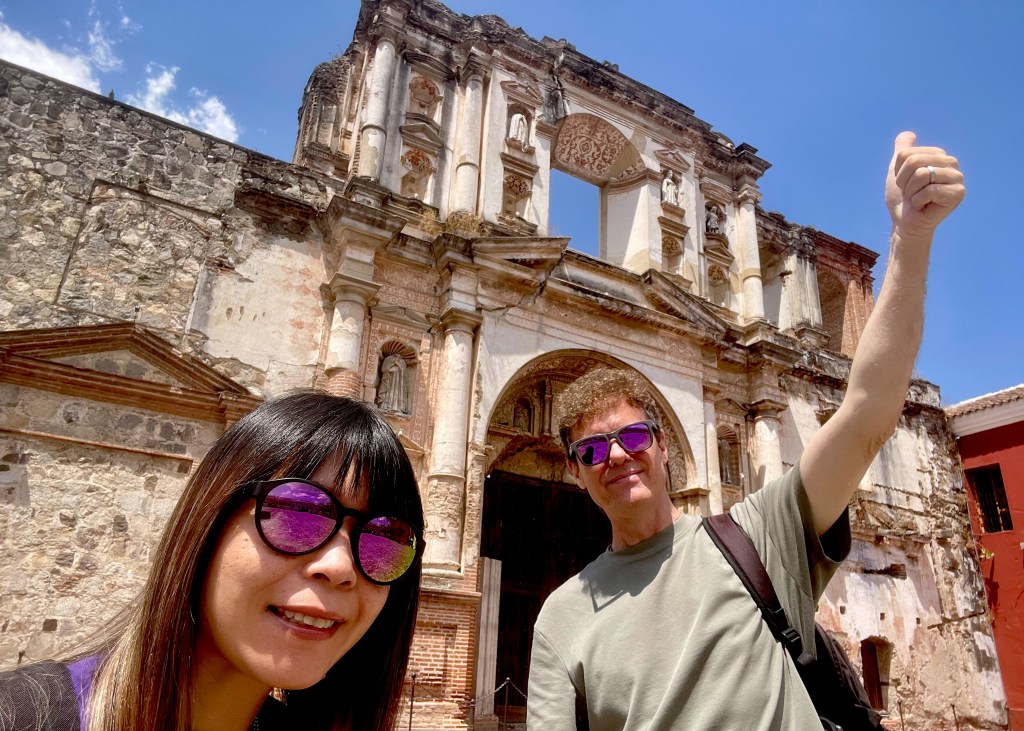
The ruined façade of the Colegio de la Compañia de Jesús has previously caught our eye. It proves more than a ruined façade fronting the rubble of an earthquake-destroyed church. A doorway to the side leads into a restored colonial courtyard housing art galleries and an exhibition tracing the history of International Women’s Day, from its 1900s origins in New York to modern Guatemala.
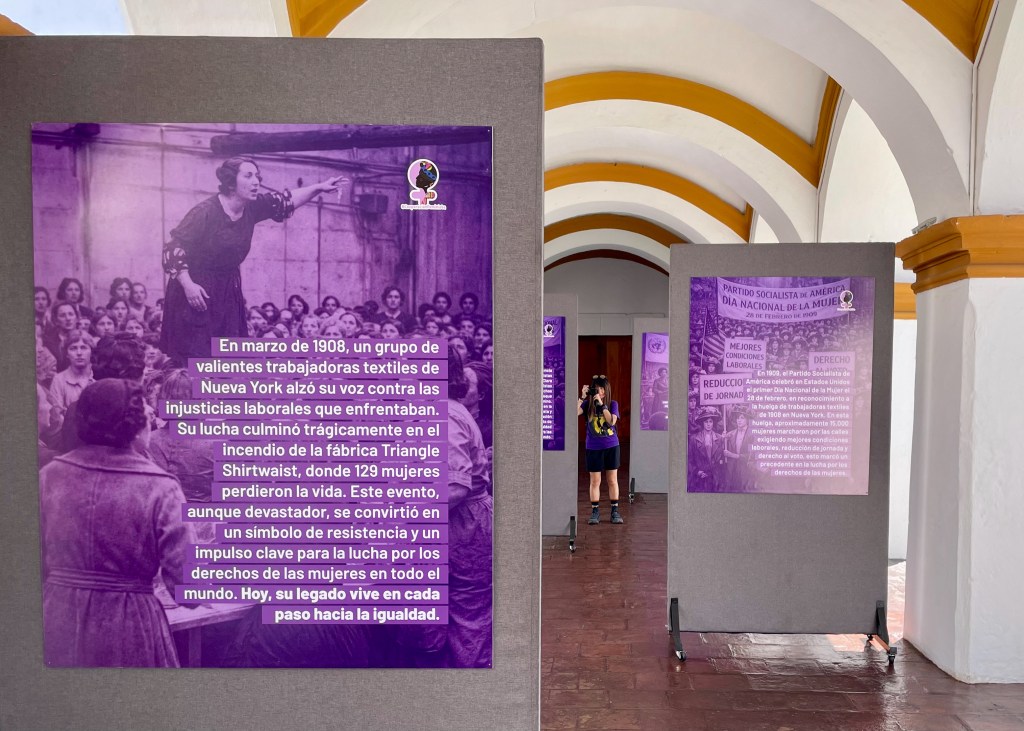
Exploring further, we stumble on a small museum housing a photographic history of the interlocking courtyards that once must have been among the most important buildings in town. But more than anything, it’s a simple pleasure to spend an unrushed hour wandering the lovingly restored complex pretending we’re discerning connoisseurs of colonial architecture, not two tourists who happen to like shady courtyards.
Afternoon is spent reading and studying Spanish. I didn’t keep my hat on my head as much as I should have earlier, and by mid‑afternoon my poor sun-management skills result in a dull sun‑induced headache. In one of the other apartments, someone is running through Bob Dylan songs on a guitar. Whoever it is, they’re pretty good — especially a languid version of Just Like Tom Thumb’s Blues.
Dinner tonight is Thai. We sit in a quiet courtyard surrounded by tropical plants, order curries and beers, and fall into conversation with owner Pablo, who lived all over Thailand for 18 years before returning to Guatemala to open the restaurant two years ago. We tell him about our plans for Thailand later this year. He dismisses Hua Hin as dull but rattles off nearby places worth a day trip. We nod, but Hua Hin will remain a base for us. Logistical necessity outweighs Pablo’s informed wisdom: K needs to be close to Bangkok for a second round of dental work.
My headache has gone, but that sun exposure earlier has left me exhausted. By nine, I’m asleep on the sofa — more pensioner than traveller.
Sunday 8 March
A typically quiet Sunday. But first, there’s a knock at the door. I open it to find Rick, a gentle bandana-wearing septuagenarian who would resemble Keith Richards had Keith Richard lived a cleaner life. I ask Rick if he was strumming Dylan songs yesterday afternoon. He was. He’s rehearsing for a festival in Woodstock a few weeks from now. He’s knocked on our door trying to locate Tomas, our Airbnb host. I explain that Tomas left for Austin yesterday, but it turns out I can help. Rick’s ride back to Guatemala City has fallen through and he needs alternatives. I suggest he tries one of the countless travel agents in town or simply orders an Uber. Apparenetly, Rick travelled through Guatemala, Belize and Yucatán solo fifty years ago. Surely he had to be resourceful back then? It’s curious that he’s asking me how to manage something as ostensibly simple as getting a ride. Lovely chap, though.
Later, I leave K to her own devices and head out for an afternoon stroll. My timing is perfect: I’ve gone no further than around the corner when I encounter another Lent procession of solemn men in purple robes carrying a heavy float while choking in clouds of incense. Even my aimless wandering occasionally looks like tight planning.
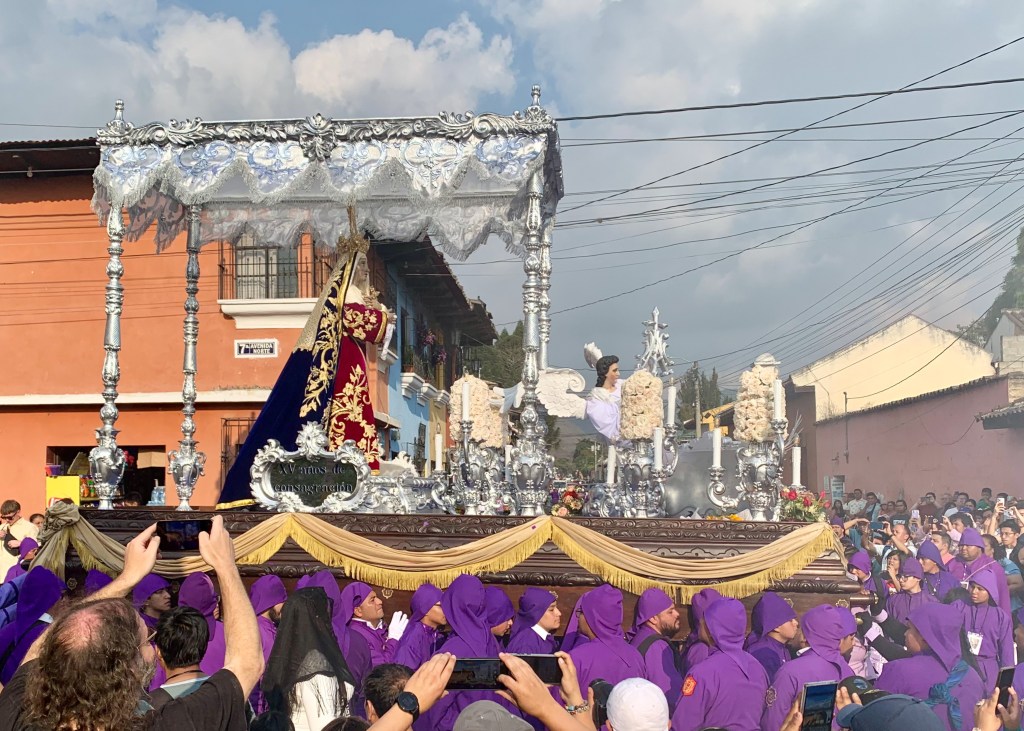
After the procession passes, curious to venture beyond the chocolate-box prettiness of Antigua, I wander out of town towards the adjoining satellite settlement of Jocotenango. There’s little specific to see, just a drab neighbourhood strung along the main road. The Lent procession must have come this way earlier: faint outlines of coloured sawdust carpets are visible on the road surface, since trampled underfoot and swept clean. Chicken buses roar by. Most are painted in multiple brash colours, but one is plain yellow and betrays its origins: “Dallas Country Public Schools” is written on the side. I arrive back in Antigua occasionally holding my breath as chicken buses and crumbling jalopies rumble past belching choking black clouds of exhaust fumes.
Also today: a message from Neil of 2GoRoam apologising for the delay in editing the interview we recorded last October in Tangier. He’s been managing health issues that trace back to his tumble down the stairs six years ago. Poor chap. He assures me he’s still committed to the Life After Work series of videos. I tell him to take all the time he needs.
Monday 9 March
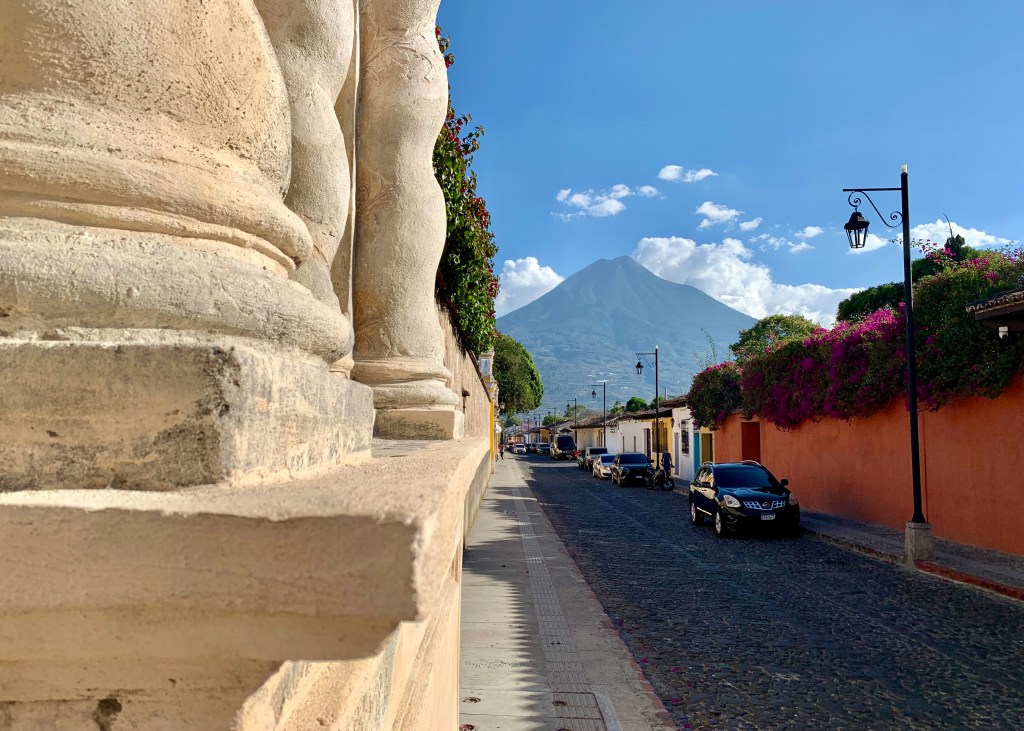
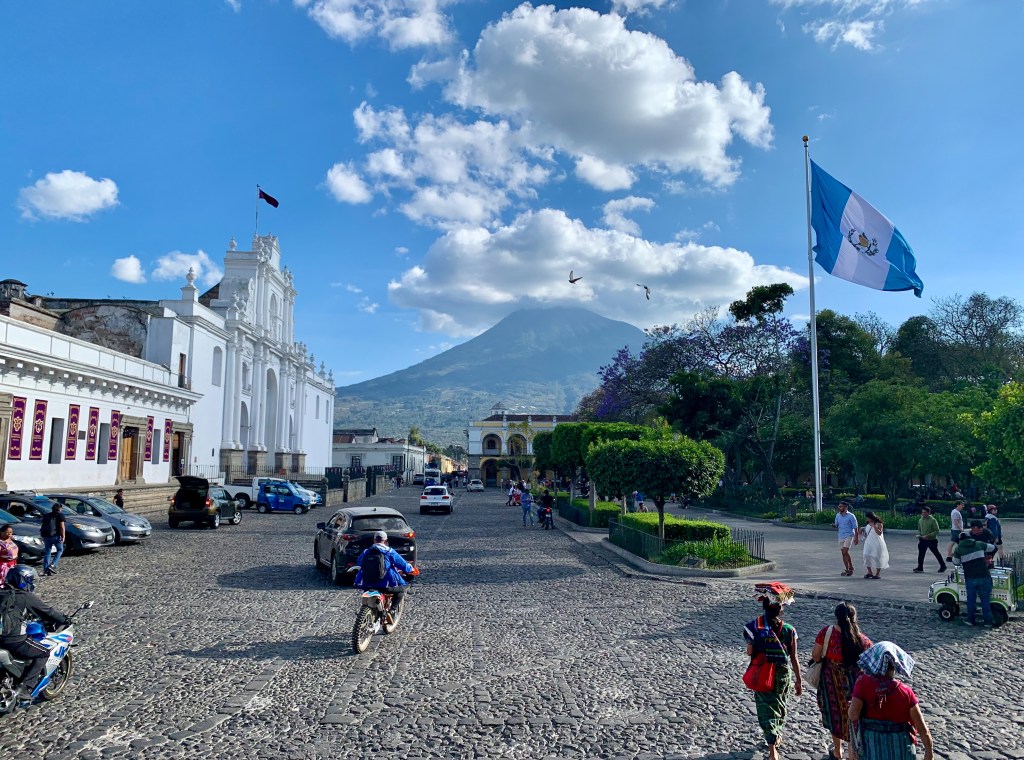
Our penultimate day in Antigua. The wind’s picked up and blown away the smog that’s hovered over the town for a week. Finally, the sharp outlines of volcanos are visible again against a bright blue sky:
En route to check out a pile of ruins at the far end of town, we stumble entirely by chance on another heap just beyond the main square. They turn out to be Antigua’s original cathedral — like other colonial buildings, destroyed in earthquakes three hundred years ago and left where they were. It’s a good thing the capital was moved to Guatemala. If not, these heaps of ruins would almost certainly have been cleared and the land redeveloped before a UNESCO designation froze the whole of Antigua in time.
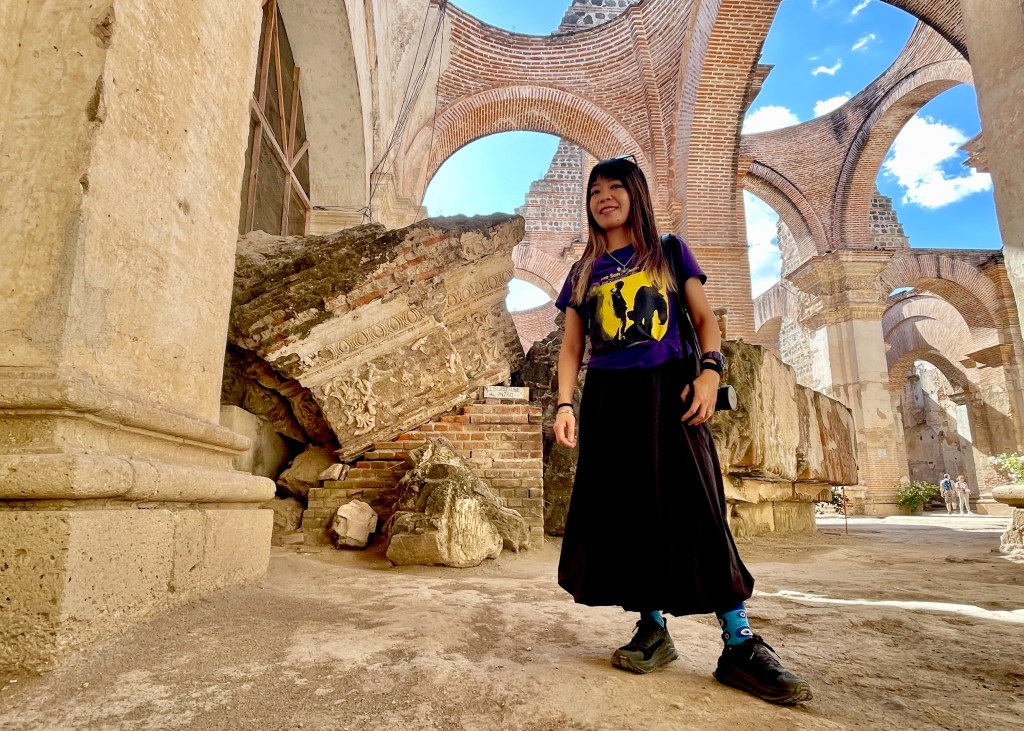
We move onto the San Francisco the Great Sanctuary, our original destination. Like other churches, it’s all dressed up for Lent in purple drapes and a carpet of coloured sawdust. We’ve seen enough ruins for today, so we pass on the adjoining obligatory ruined convent. We have practicalities to attend to: a walk across town to the posh supermarket to stock up on items we suspect we’ll struggle to find in San Pedro: bug spray, baby shampoo (I’ve carried on using it ever since my hair transplant), and lavender tea — such fragile tourists!
Evening is spent watching YouTube videos featuring Panajachel and San Pedro. “San Pedro looks like a bit like Lamma!”, K declares. She’s right, it does. Later this week we’ll see if it feels a bit like Lamma too.
Tuesday 10 March
For our final afternoon in Antigua, we’re planning to visit the Museum of Colonial Art. We arrive shortly after 3.30 to find the door already shut. Apparently, it closes at four. I guess we missed last entry. Shoddy of us.
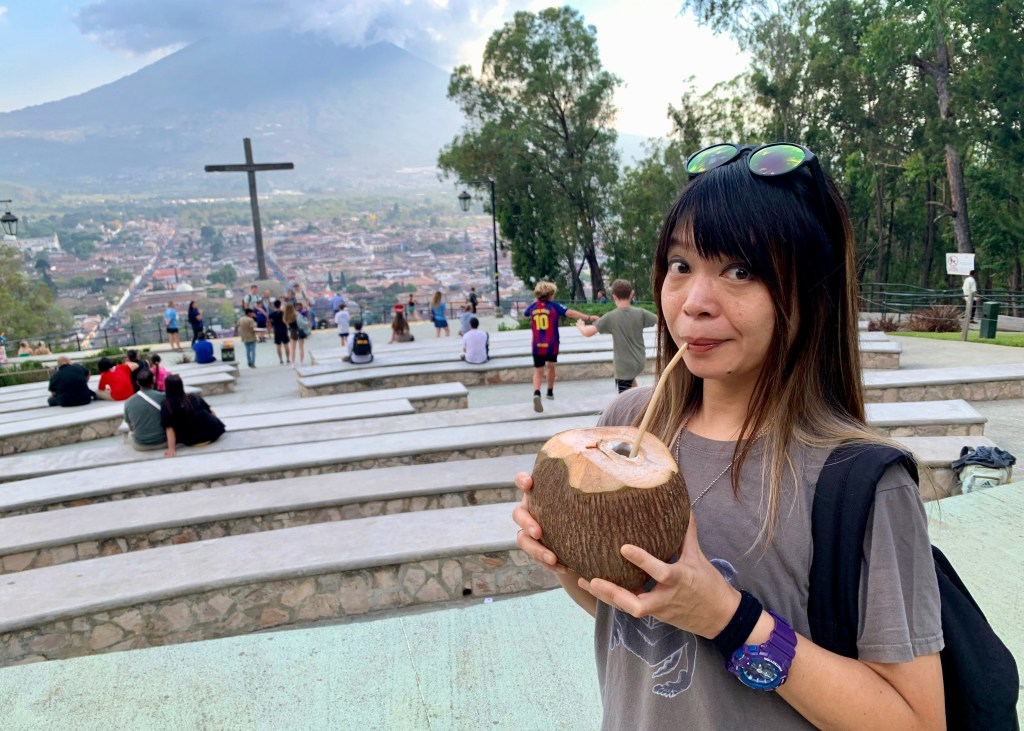
Coming up with a Plan B is easy: a climb up to the Cerro de la Cruz. On a Tuesday afternoon, it’s quieter than it was on our first day here. Half the visitors are a group of Indians who have driven up in those moon-buggy vehicles that make their drivers look faintly ridiculous. We buy a fresh coconut from one of the many refreshment stalls and enjoy the view one last time.
Back in town, the colours are brighter and deeper than ever in the late afternoon sunlight:
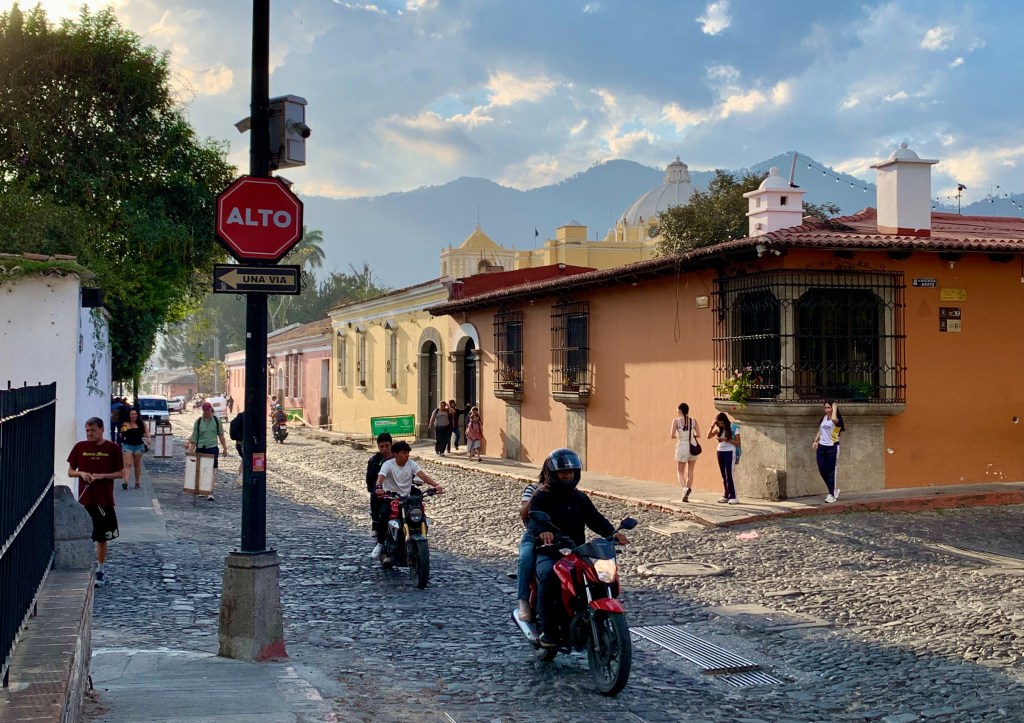
We return to Casa de las Sopas for our last meal in Antigua. It’s busier tonight and there’s a queue. With countless other eating options, we wouldn’t normally bother standing in line for a restaurant, but we’re determined to eat there again. I get talking to an English group ahead of us in the line. They’re on a Mayan ruins tour that started in Yucatán and from here will take them back north to Belize City. It’s only afterwards I reflect that there are no Mayan ruins around Antigua. Still, there are plenty of Maya.
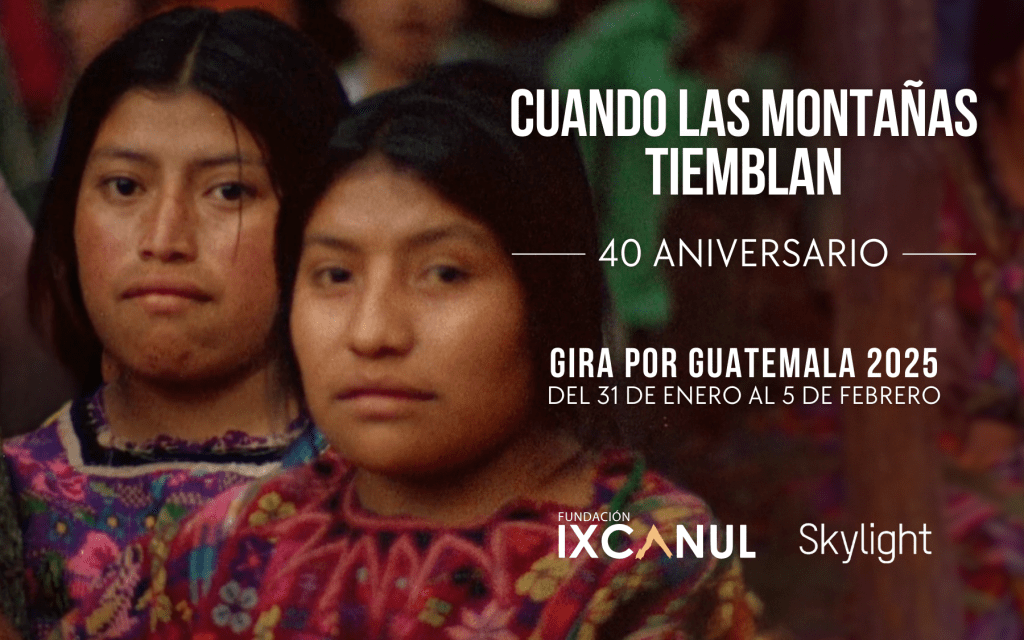
This evening: a 1983 documentary on the Guatemalan civil war, When the Mountains Tremble. It’s every bit as bleak and distressing as it promised to be, but it’s clear why it won multiple awards at the time. It’s even been doing a 40th anniversary tour recently:
Antigua has been a magical place — one of our very favourite destinations in thirty months of travel. Onto new adventures around Lake Atitlan tomorrow.
 Two On Tour
Leave a comment