Back to sunshine!
Thursday 12 February
A few minutes out of La Fortuna by shuttle bus, the rain that has plagued us for ten days finally stops. At last, we’ve escaped the town’s sodden microclimate. Soon we’re passing through hamlets bathed in dappled sunshine as we head towards San José. A woman in her twenties is the only other passenger. We exchange a brief hola but otherwise keep to ourselves. I pull on my headphones, listen to Talk Talk’s The Colour of Spring, forty years old this week, and gaze contentedly out of the window, feeling strangely old.
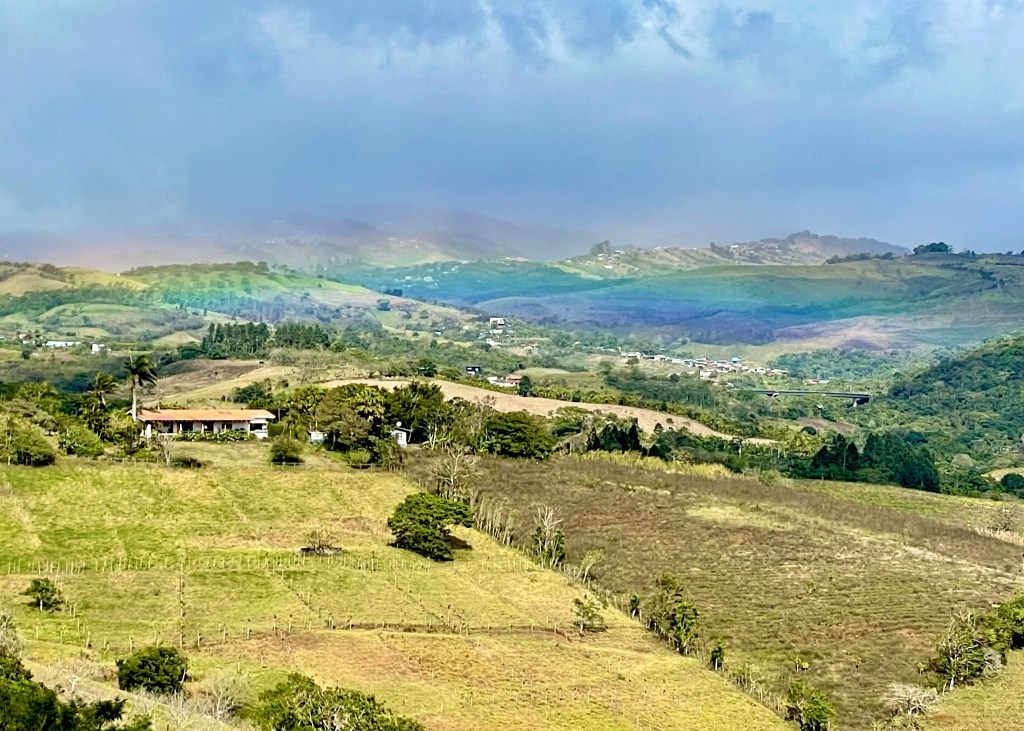
Halfway to San José, the winding road climbs into low cloud. For some time, vehicles coming towards us are little more than a pair of fuzzy headlights. Then we crest and descend back into the sunshine of Costa Rica’s central valley. At a rest stop, a band of refracted light hangs over the hills just below the clouds:
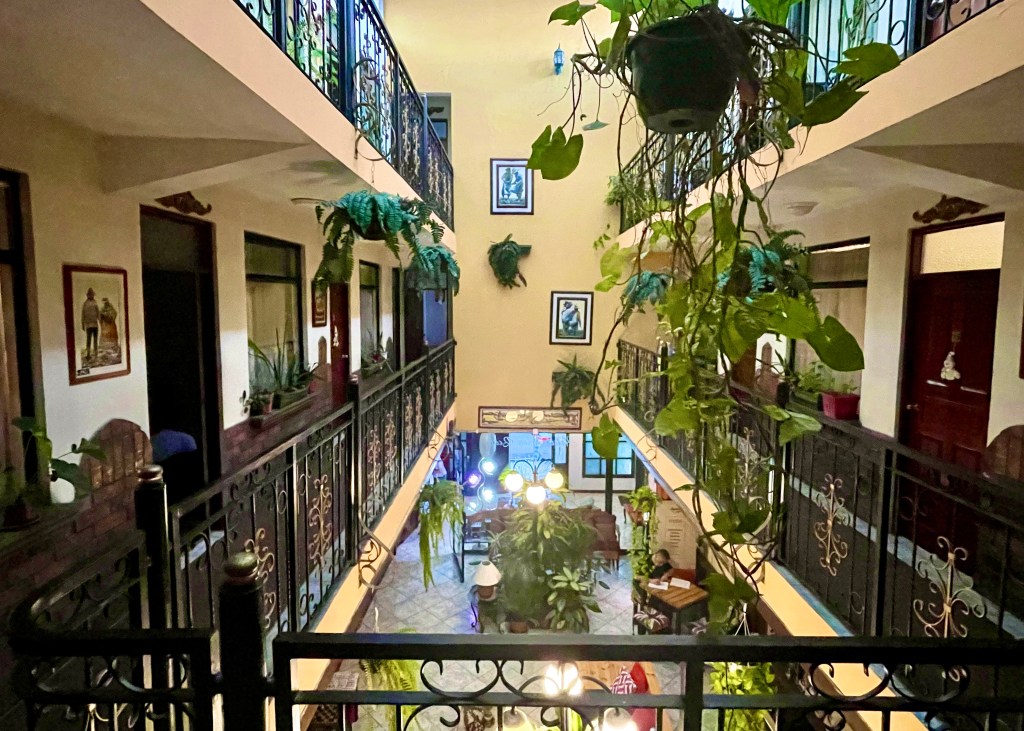
As we approach San José, the traffic thickens and we crawl the final few miles to our hotel. Hotel Amón Real is charming: three floors, rooms opening onto an atrium ringed by wrought-iron railings, and spacious rooms, if a tad dilapidated. It’s fine for two nights:
Cautious of visiting a big Latin American city for the first time, we did our homework before choosing the neighbourhood of Amón as a base. Initial impressions, however, aren’t good. After sunset, its streets are dark and mostly empty. Apparently Amón is safe, but we both feel uneasy as we complete a cursory circuit of the neighbourhood to check food options. Working girls loiter outside a casino — one of the only brightly lit buildings in the neighbourhood. We’re deliberately carrying only one credit card between us, a small amount of cash, and our burner phone.
Fortunately, just metres from our hotel, a corner restaurant with outdoor seating fenced off from the street suits us fine: it’s brightly lit, plesantly busy, and just-about affordable if we’re careful what we order.
Lovely waiter. Huge portions. No complaints.
From the street, a teenage addict tries hard to get our attention. We studiously ignore him, feeling guilty but realistic. He seems harmless but we’re cautious and on guard.
It’s less than a minute back to our hotel, but we’re still relieved to arrive at our little oasis of security without incident. Before the evening is over, unable to find anything suitable on Lamma this autumn, we’ve booked a month on Cheung Chau — one place that won’t have us clutching a burner phone.
Friday 13 February
I often ask locals if their city is a good place to live. Manuel, our waiter this evening, is the first person in all our travels to answer in the negative. “Ten years ago, San José was a good place. Very safe. But now, no.” He’s concerned about the recent influx of immigrants from Colombia, Venezuela, Nicaragua and Honduras. Crime has spiralled, and these days downtown San José is dead after dark. He voted for Costa Rica’s new president, Laura Fernandez, elected on a promise to get tough on criminals.
Even by day, San José is a tough place to love. Its narrow, grubby streets lack any architectural merit. Public spaces are scare, as is greenery. By daylight, it feels far less threatening, but there’s an unmistakable air of neglect and decay. It smells of exhaust fumes, fried chicken and, every so often, stale piss.
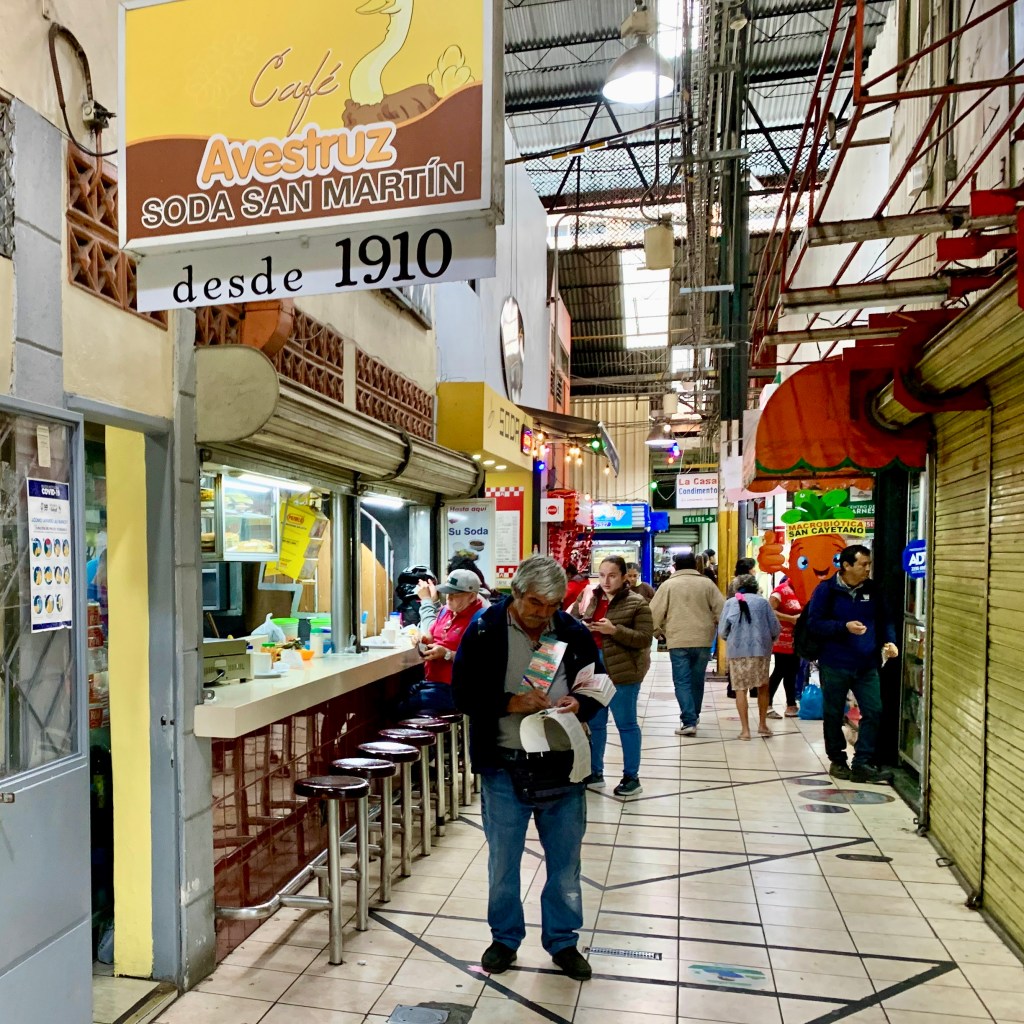
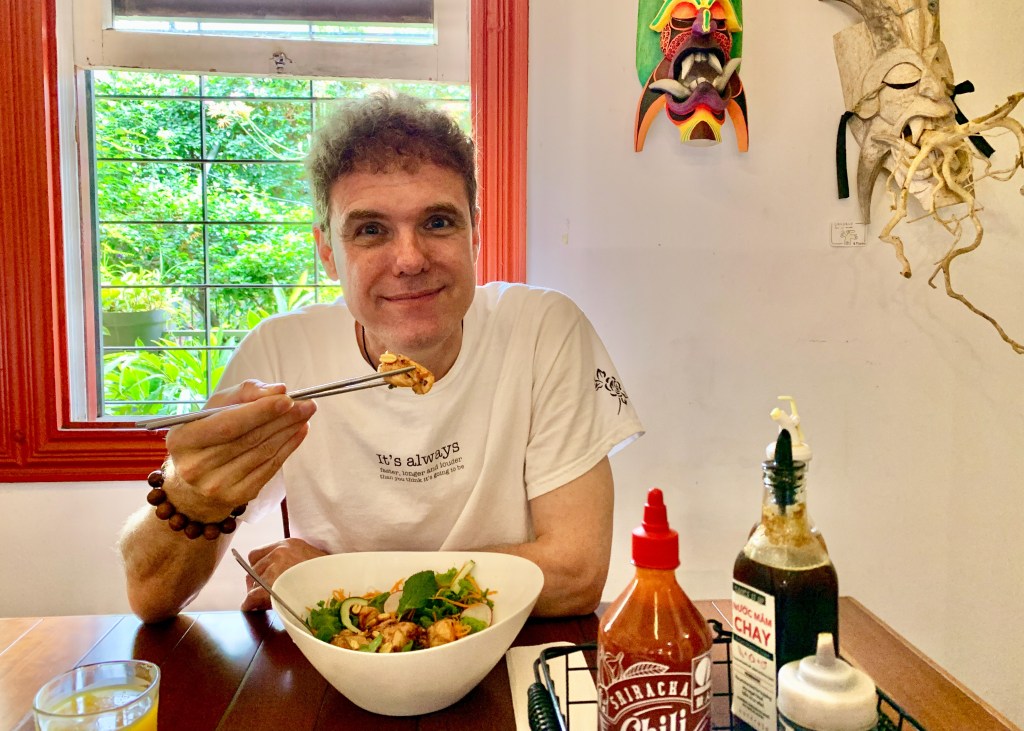
The central market is a welcome diversion, with tiny stalls selling everything from fresh produce to tourist trinkets. Its tiny soda restaurants (above) could be Hong Kong in the sixties. We pick up a waterproof bag that will be useful on the beach next week, then retire to a quiet Vietnamese café, staffed by Ticos, for lunch:
Things improve once we’ve eaten. We spend the afternoon at the National Museum, housed in what was once Costa Rica’s main barracks until it abolished its armed forces in 1949. There’s much to learn — so much that I only absorb a tiny fraction. But by the time the staff politely boot us out at closing time, Costa Rica, and Central America, make a little more sense.
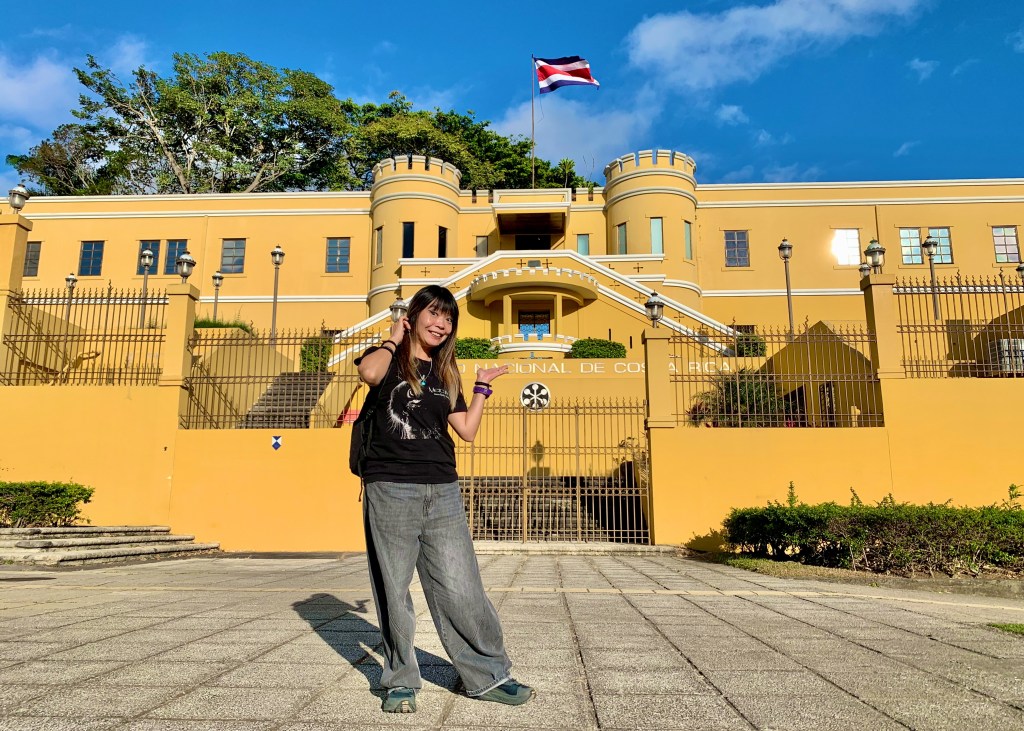
Back at the hotel, a shelf of books left behind by previous guests spans from a Richard Osman novel to a French translation of The Wealth of Nations. That’s some serious holiday reading.
We don’t fancy venturing far after dark, so we return to the same restaurant as last night. It’s deathly quiet, which is how we get chatting to Manuel, who has little else to do. Perhaps Valentine’s Day tomorrow will bring in more customers. A day in the capital has been worth our time, but it’s an easy decision not to return to San José at the end of our trip. Before bed, we book a country hotel with a pool near the airport for our final two nights. A safe bet.
Saturday 14 February
Our third shuttle ride in Costa Rica is more sociable than the last two. All eight seats fill up as we trundle around San José picking up three Scots, an American from Chicago, a surfer from Amsterdam, and a silent middle-aged gent whose origins remain a mystery. At the front, the Chicagoan and one of the Scots fall into easy conversation on discovering they’re both yoga teachers. The Scottish couple in front of us overhear the first Scot mention he’s from “just outside Edinburgh” and can’t resist enquiring where exactly — so are they, albeit from the other side of the Firth of Forth.
It’s just as well the ice has been broken. Costa Rica may have a population of just five million, but every one of them has apparently decided to decamp to the Pacific coast this weekend. The main highway is one lane each way and overtaking opportunities are rare. Everyone crawls behind the slowest vehicle for mile after mile. Thankfully, time is something we have plenty of.
At a rest stop I get talking to the Dutch surfer. She’s back in Costa Rica for a second winter to escape the European winter. Her father was born in Paraguay but never taught her Spanish. We carry the conversation onto the minibus and soon we’re getting to know the young Scottish couple. They’re not yet thirty, but they’ve travelled widely, especially in Southeast Asia, which they’ve seen more of than we have.
The traffic continues to crawl but eventually thins once we reach the coast. We cover the second half of the distance to Manuel Antonio in a fraction of the time it took us to cover the first, as the radio cheerfully blasts late seventies classics by Gerry Rafferty, Heatwave and The Knack. At the village, we tumble out, wishing everyone well on their travels.
We’ve treated ourselves in Manuel Antonio. Our home for the next ten days is a small house built on an incline, with a veranda out back looking over the jungle. Within minutes of arriving, the local monkeys arrive to check us out. We’re stretching our budget here, but I could get used to a life like this. Sitting with a cup of tea, two macaws screech by in a riot of red and blue feathers. Bird chatter aside, the neighbourhood is quiet, the veranda shaded, and the view magnificent. No volcano, though.
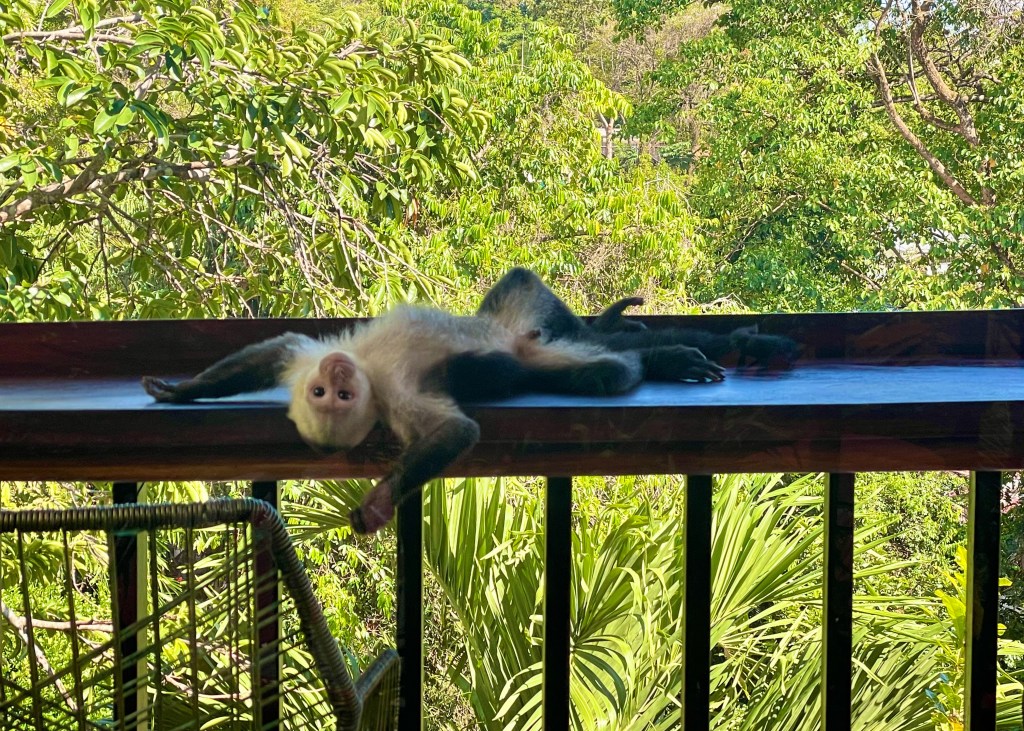
Laundry. Supermarket. Home. After three long days, we’re happy to skip our regular Saturday restaurant night and eat a simple meal by ourselves.
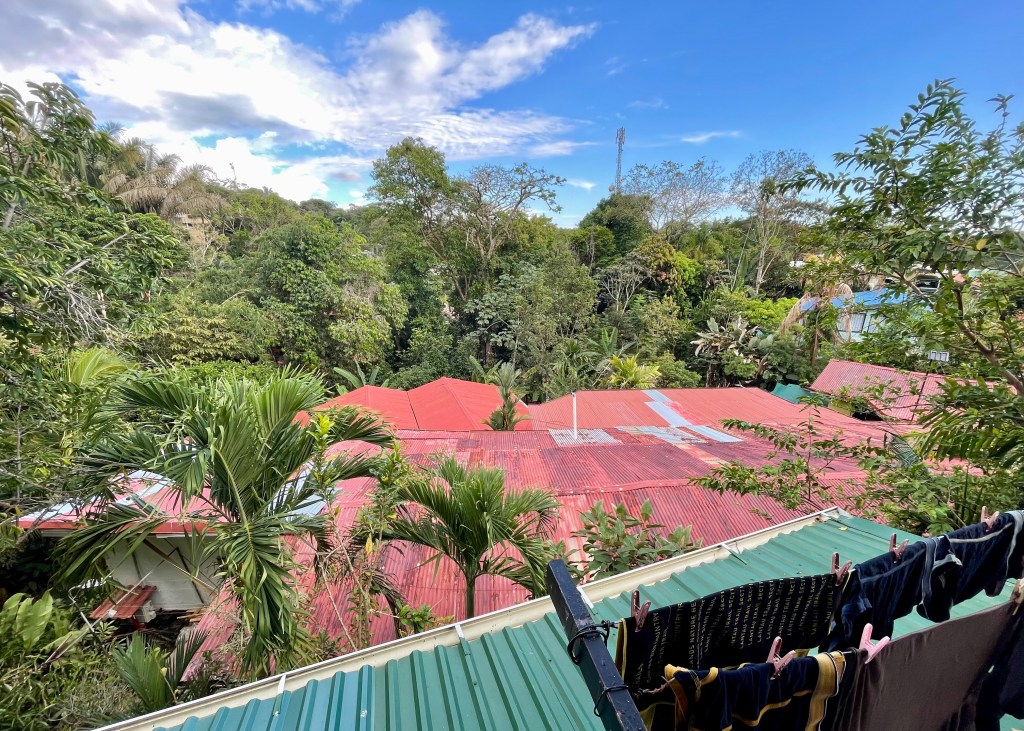
Sunday 15 February
After three days of travel and exploration, today is for enjoying the comfort and colour of our new surroundings. I wake at dawn, brew a cup of tea, and slip onto the veranda into a cushioned wicker armchair. Usually, I’d clamp on my headphones and scroll the news. But nothing on headphones can compete with the sounds on the veranda at dawn. Howler monkeys whoop in the jungle, a rooster crows, a dog barks half-heartedly in reply, and all the while the sound of a thousand invisible insects — the sound of summer on Lamma. I’ve missed it.
At six-thirty the sun strikes the veranda. I shuffle into a corner where a tree offers some protection, but before long I admit defeat and retreat indoors.
By mid-morning the sun is high enough to plunge the veranda back into shade. I venture out again and could happily laze all day reading without a care in the world if work didn’t beckon.
By the time I finish, it’s already late afternoon. The yoghurt we bought yesterday was both absurdly expensive and unpleasantly sour. Enough motivation to head into the village to asses alternatives. As I plod to the supermarket, the sun nears the horizon over the Pacific:
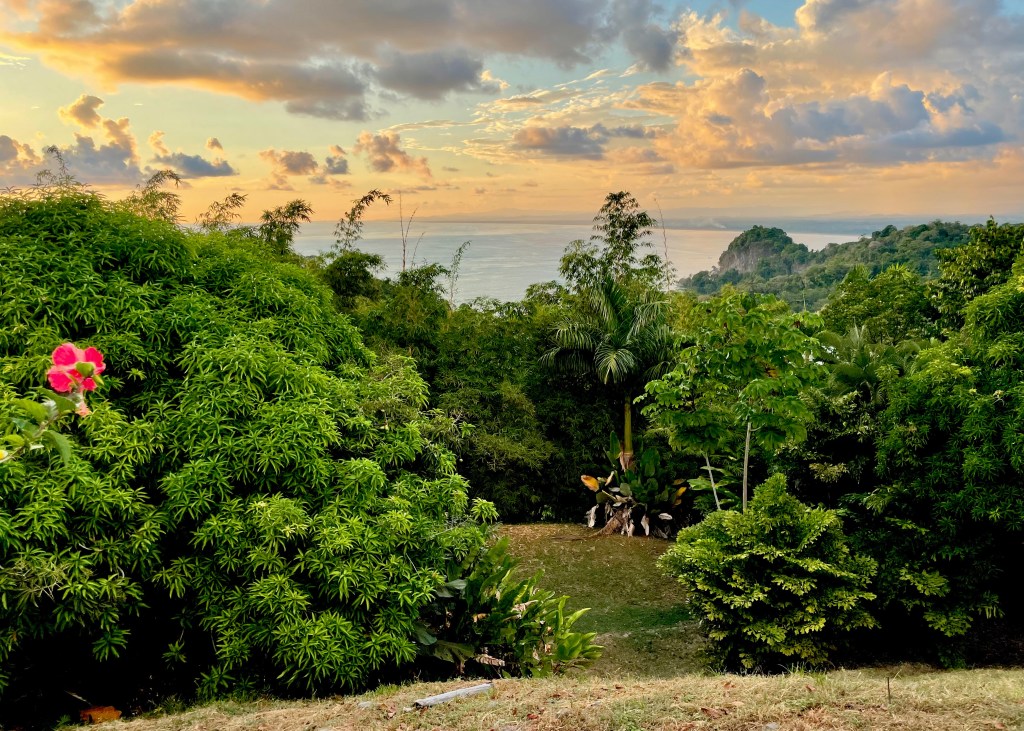
I was chuffed with my new pura vida flip flops when I bought them. Today, I feel sheepish, suddenly aware that I’m like someone in London wearing a Big Ben t-shirt. I should know better. I feel even more sheepish when the material starts chaffing my right big toe and I have to wedge the yoghurt receipt between flip-flop and toe to walk home without yelping in pain. I look straight ahead as people pass me, hoping no one notices how ridiculous I look.
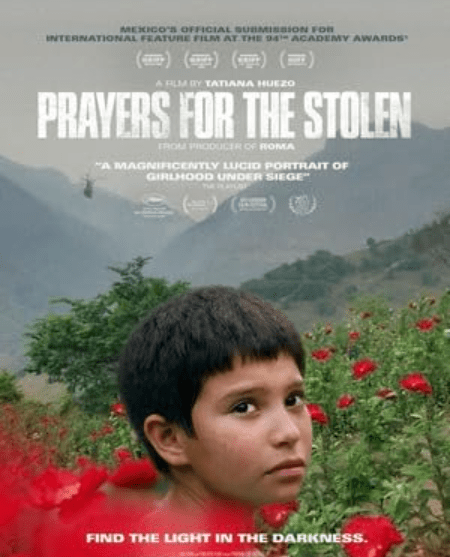
In the evening, we take a punt on a Mexican film, Prayers for the Stolen, that sheds light on the fearful lives of women and girls in rural Mexico under the shadow of cartel violence. Despite some glaring pacing issues, it’s a film that will be hard to forget. “I want to tie Americans to chairs to help them understand exactly what American drug habits and the War on Drugs are doing to desperate, terrified people”, writes one reviewer on IMDb. Deeply uncomfortable, but essential viewing.
Monday 16 February
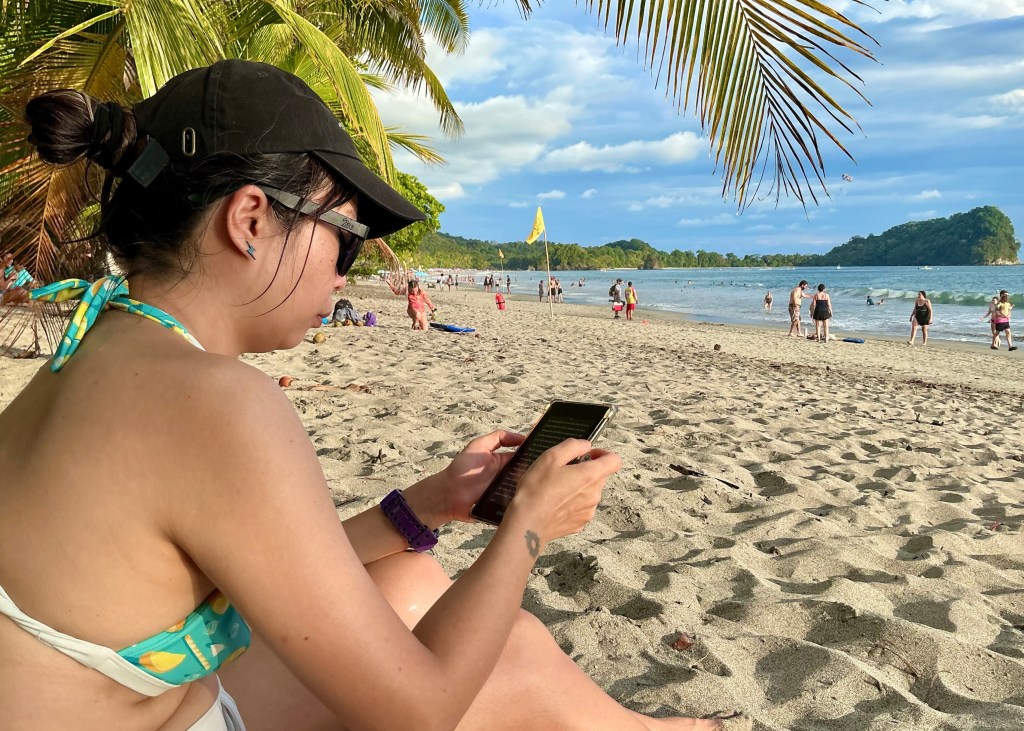
Manuel Antonio beach ticks every box: rural, jungle-backed, shady, quiet, sandy, warm shallow water. And monkeys. Panamanian white-faced capuchins, apparently. It’s far too long since we’ve sat on a sandy rural beach and frolicked in tropical seawater. Naplio didn’t cut it: stone beach, no shade, cold water. The water was even colder in Bodrum. Ko Samui had sandy beaches and warm water, but was semi-rural at best. We’d have to go back three years to our last summer in Hong Kong for a beaching day that could compete in the same league as here.
It’s a hot thirty-minute walk down from the village. The last section is unpaved, and the occasional passing four-wheel drive churns up a choking cloud of dust. Our first spot on the beach turns out to be a parking bay: no sooner have we laid out towels than an SUV pulls up beside us. We sigh, pack up, and walk down the beach looking for a better spot.
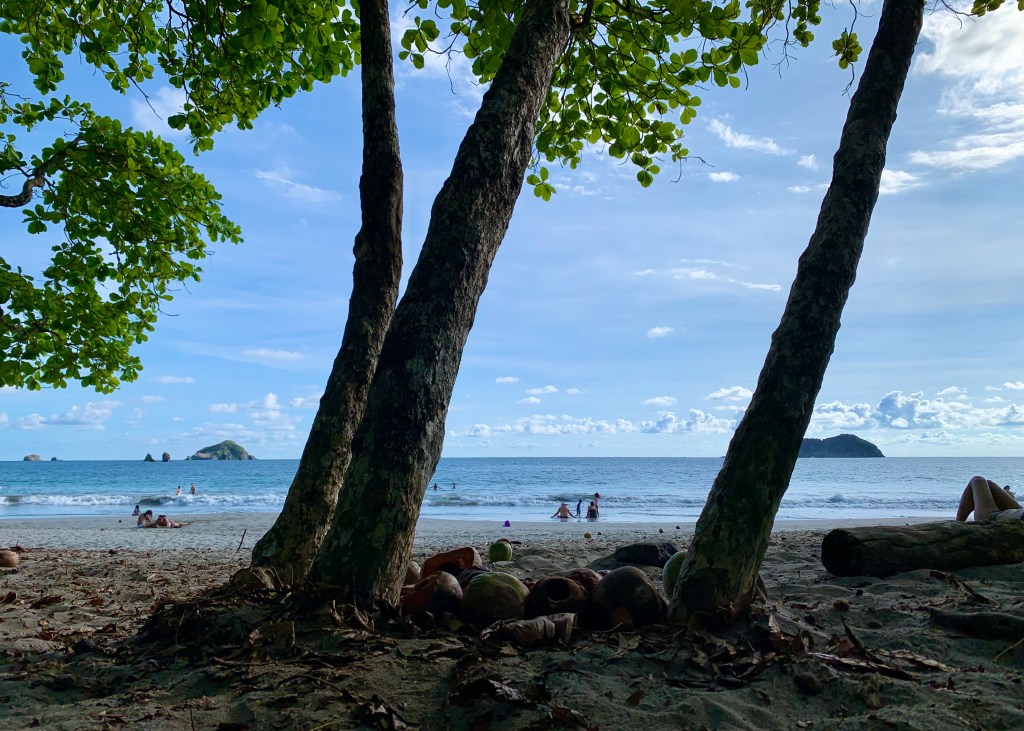
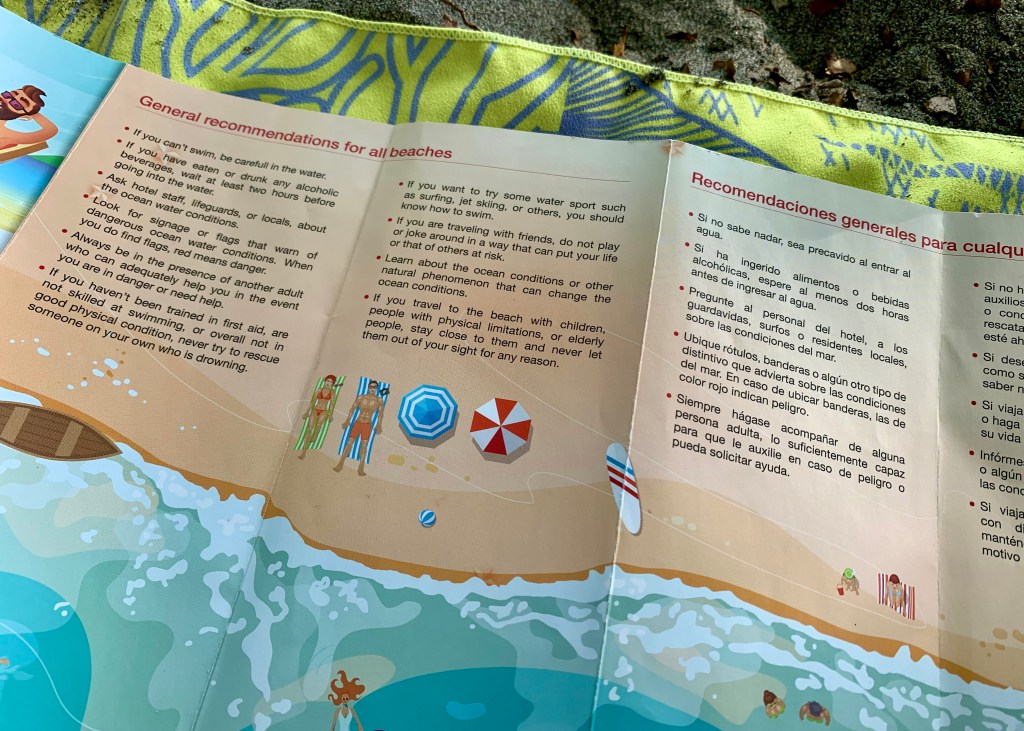
We finally settle in the shade (above) and plunge straight into the warm water to cool off. Without neither a paperback nor my iPad with the Kindle app, my only reading material is a bilingual leaflet on swimming safety I found in the flat. Word‑by‑word translation stretches this unpromising material into an hour-long Spanish lesson. While this firmly places me in the slow readers class, I now know the Spanish for ‘rip tide’. It’s a shame I can still barely order from a menu without pointing. Monkeys scamper about, wary but unafraid. Beachgoers lunge for their phones, chasing the perfect shot for Instagram feeds. The monkeys shrug and refuse to cooperate.
It’s Lunar New Year. Free from work for a few days, I take on cooking duties for a change and rustle up a Moroccan eggplant stew. It’s edible, but Michelin inspectors will remain untroubled. Life feels relaxed. A midweek park tour aside, we have no fixed plans. I’m looking forward to the slow pace.
Tuesday 17 February
With plenty of room and a veranda overlooking the jungle, our plan in Manuel Antonio is to alternate activity days with quiet ones. K uses Tuesday to book cheap flights and drain our AsiaMiles. I book accommodation in Hoi An and narrow down options in Ho Chi Minh City.
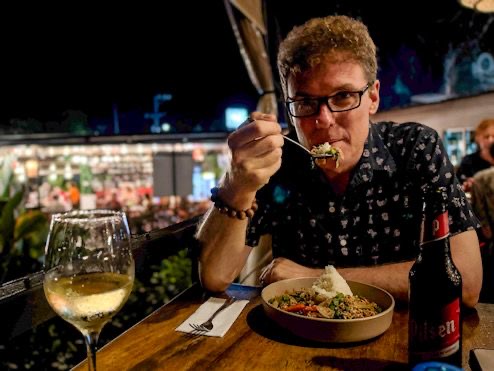
On our fourth evening, we finally venture out for dinner to a Thai place overlooking the jungle. It’s a hot night and I wish I’d stuck with shorts instead of attempting to look dapper in long trousers. The food is excellent, but the restaurants here call for deep pockets. And unlike everywhere we’ve eaten in Costa Rica until now, the already steep menu prices don’t include tax and service.
Wednesday 18 February
Manuel Antonio National Park, or at least our tour of it, is just a little underwhelming.
At USD80 per person, you’d almost expect your own sloth or monkey thrown in as a souvenir. In reality, what you get is company — the park attracts crowds, and I’m unprepared for the number of visitors, especially given the strict daily quota. On the first stretch of the well-trodden trail, our group of eight — two high school teachers from Long Island and a family from San Francisco, and us — competes with three similar groups for telescope space to squint into the jungle.
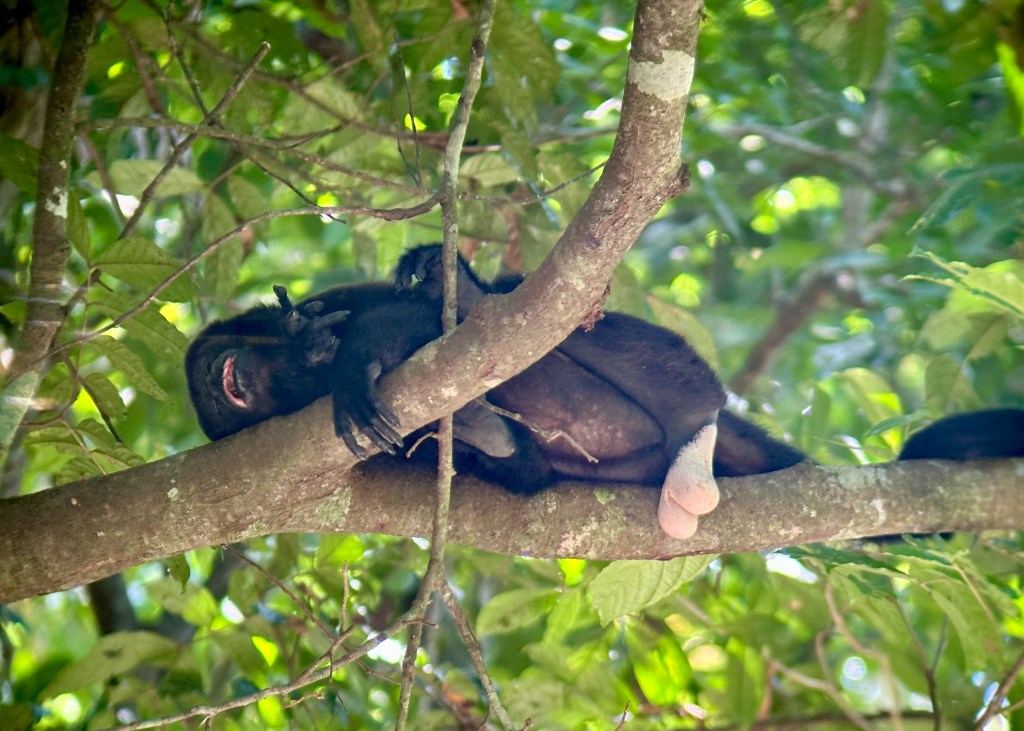
Given the space the wildlife has to roam in, it’s surprising how much chooses to hang out within sight of us tourists. But it’s not easy to spot. Fortunately, our guide Francisco was born with bionic vision and can see animals that no human eye can spot. Most of us are here above all to gawp at sloths and monkeys, but Francisco finds plenty more wildlife to train his telescope on: bats, hummingbirds, crabs, butterflies, and lizards among them. Sloths are elusive: we spot two, both fast asleep high in the canopy, their faces obscured by foliage. We must have been especially lucky sloth spotting in La Fortuna. The monkeys — capuchin, howler and squirrel — are more obliging. Capuchins chase each other through the canopy, while this howler lounges with little sense of modesty:
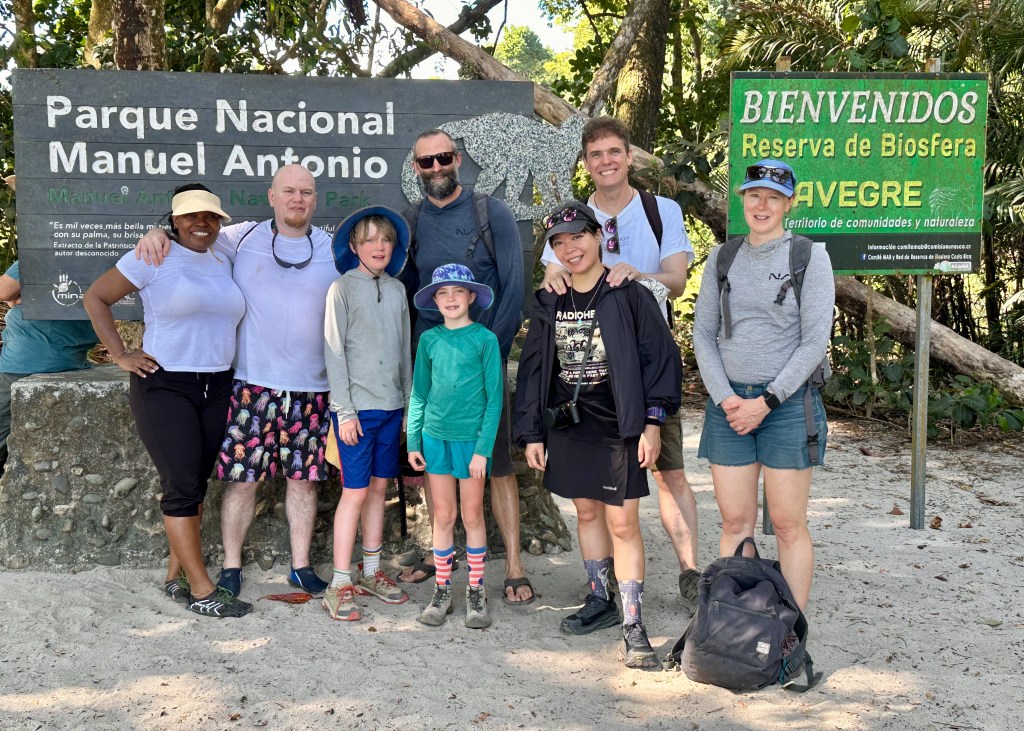
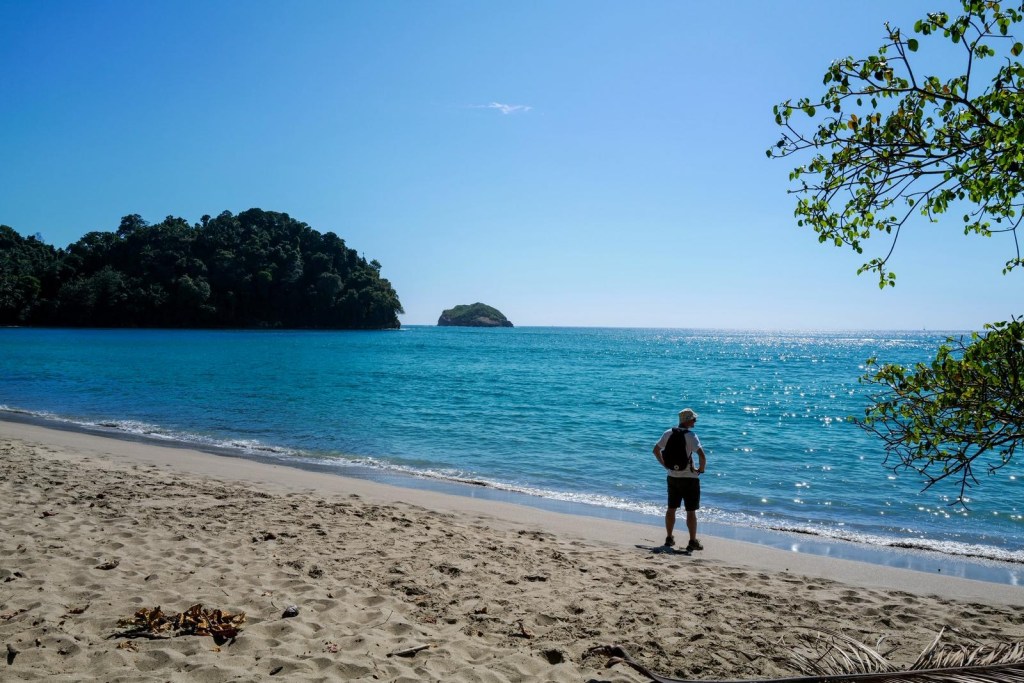
The trail ends at an idyllic tropical beach. Francisco snaps a group shot, airdrops everyone the photos and videos, and says goodbye. I’d like to linger, but K hasn’t eaten today and it’s approaching mid-afternoon. We head back to the park entrance along a boardwalk that meanders through quiet mangroves — the crowds have thinned — exit the park, and find a quiet lunch spot well away from the crowds.
We plan to walk an hour back to village, but a bus is boarding just as we reach the road. With the temperature hovering around thirty degrees, the bus wins.
Thursday 19 February
We’re halfway though our stay in Manuel Antonio. With the national park tour behind us, the first murmurs of winding down our time in Costa Rica are beginning to stir. This time next week we’ll be flying to Guatemala.
Today is mostly admin: changing our shuttle destination from downtown San José to the airport hinterland, researching altitude sickness (our destinations in Guatemala sit at 1,500 metres — higher than La Fortuna, but not high enough to cause any symptoms), and looking into dengue fever vaccines when we reach Bangkok, where it will be the rainy season.
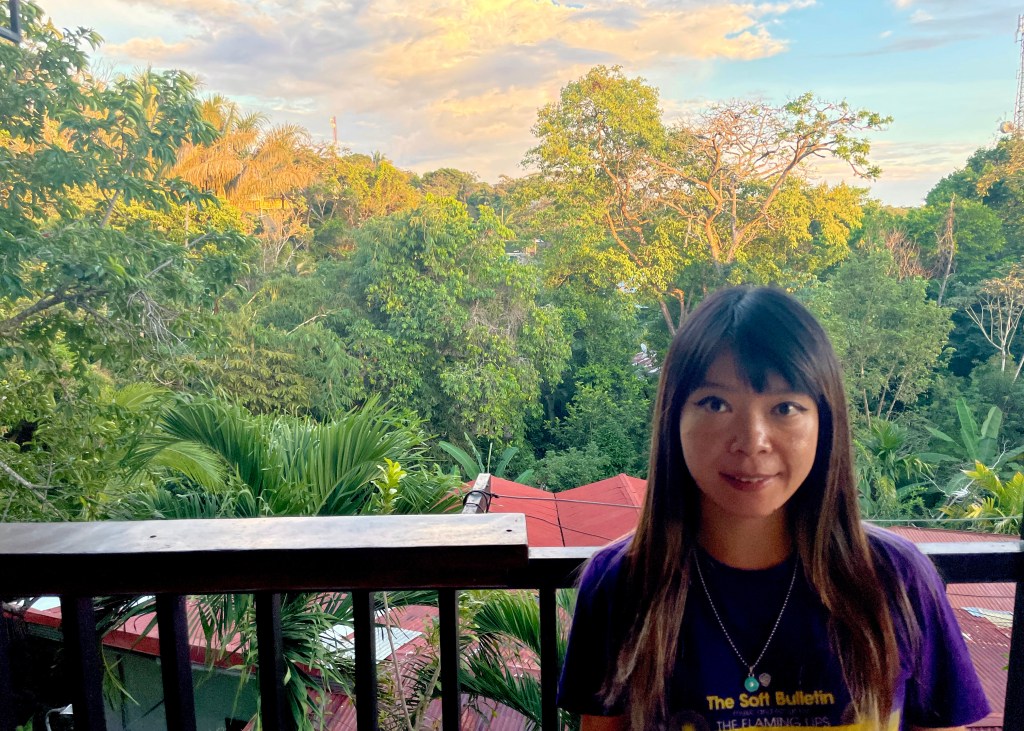
We venture out only for groceries and a late afternoon refreshment at a rooftop cafe on the main street. We’re the waiter’s first customers from Hong Kong. He invites us to stick a pin in a world map where travellers mark their homes. The north-eastern US and western Europe are porcupines of pins, but ours is indeed the first in southern China.
Friday 20 February
Four days left in Manuel Antonio. We have no more guided tours lined up. This is partly an attempt to stick to our already inflated January budget, and partly because there’s much to recommend the slow pace of life we’ve slipped into here.
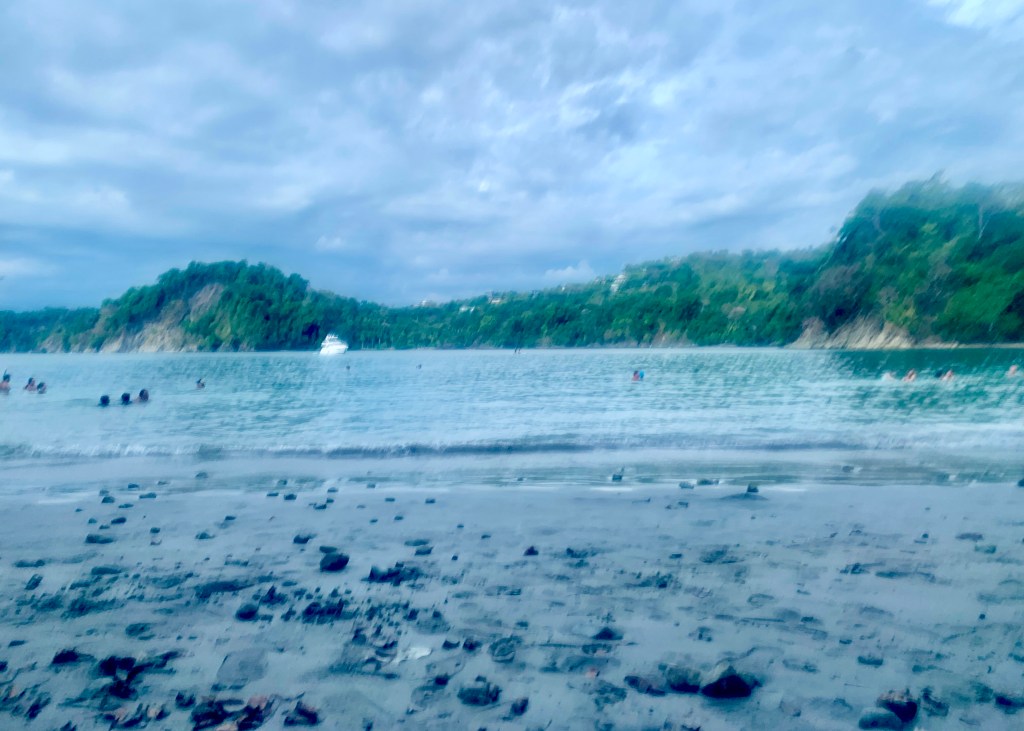
This afternoon, we head for “calm and peaceful” Playa Biesanz, a small cove promising a contrast to the long, straight stretch of Manuel Antonio beach. The two-and-a-half kilometre walk should be simple enough, but it’s hot. The newly asphalted road surface is almost black and sucks up the tropical heat. There’s little shade. K is struggling, and I’m concerned she’ll collapse from the heat before we reach the beach. Turning back isn’t realistic: we’re already closer to the beach than the village. She’s already wearing a hat but also wraps a towel around her head and takes it one pace at a time.
It’s an anxious few minutes, but we finally reach the shaded path leading down to the beach. K stops on a bench to rest and regain strength. Soon she’s recovered enough to manage the final hop, skip and jump that brings us to the cove.
We’re initially disappointed. Far from being “calm and peaceful”, the beach is crowded. In the age of Google Maps, nowhere is undiscovered. Many have driven the hot stretch of road we’ve just walked, parked near the trailhead and ambled down to the beach, which is narrow and swamped with sun loungers and umbrellas. We push on past the commercialised end towards the far side, which looks quieter. Things improve when we find a shady patch of sand to ourselves and plunge into the sea to cool off.
We stick around for a couple of hours reading (I’ve packed my iPad this time) until the incoming tide leaves the beach so narrow that a wave soaks the towels we’re sitting on up to our waists. A couple of inches further and it would have swamped our bags. We take the hint. After one more splash in the sea, we pack up and walk back. It’s uphill all the way to the village, but at least cooler than earlier. Clouds toy with an attempt to rain on us, then lose interest. We arrive back at the flat covered in wet sand.
Unfortunately, the only photo we have was taken through a protective plastic casing:
Saturday 21 February
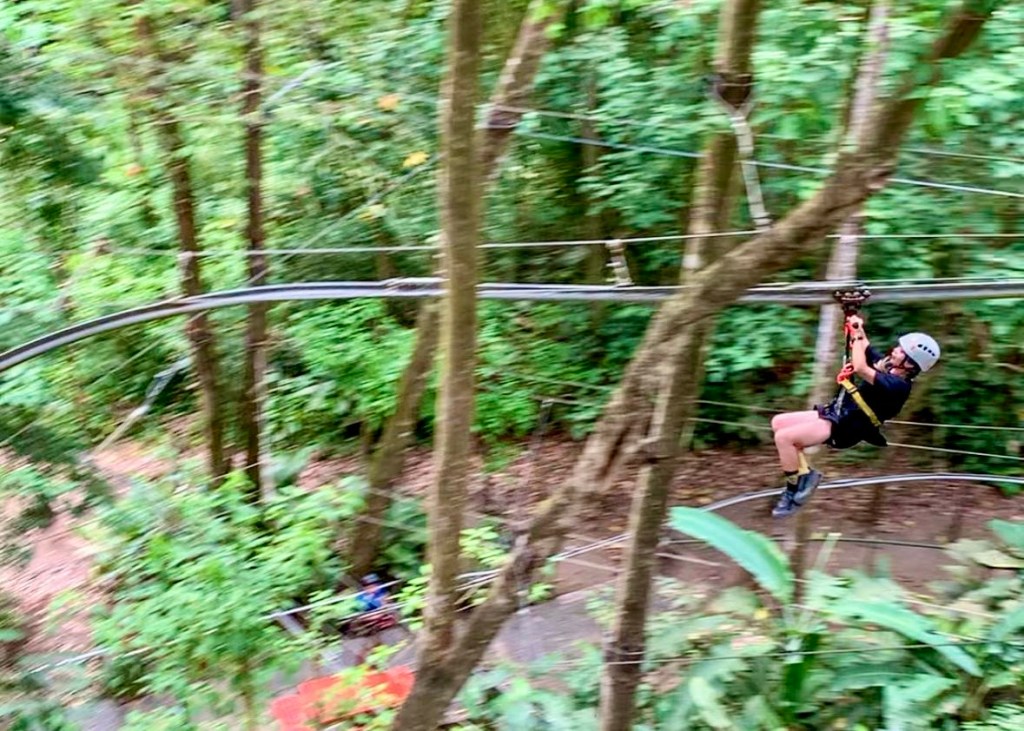
A few days ago, from the bus window coming back from the national park, I spotted a zipline through the jungle. ‘Tarzan approved’, promised the hoarding. And at USD14 each, it looked like a rare Costa Rican bargain.
Reaching it today involves a sticky thirty-minute walk — it’s overcast and rain feels inevitable before evening. We pay and are kitted out with all the requisite safety gear.
I now see this is no conventional zipline. The clue is in the name: it’s a ‘zipcoaster’ that drops to the jungle floor in multiple twists, turns, and sudden plunges. K goes first while I film her 90-second descent. Then it’s my turn. I step off the platform into thin air. I just about stomach the first drop, but keep my eyes tightly shut for the others, opening them only for the slower glides between the plunges. Tarzan I am not. Not a moment too soon, I reach the bottom and gladly plant my feet back on firm ground.
Rain starts falling heavily as we arrive back at the flat to kill a couple of hours before dinner in the village. Sitting on the veranda, everything smells fresh and the oppressive afternoon heat lifts.
We’re about to go out for dinner when a second storm hits. It’s dark now and the electricity flickers off and on through the downpour. I’m standing on the veranda marvelling at the force of nature when, from the corner of my eye, I see an electrical flash just beyond the village. The neighbourhood immediately plunges into darkness.
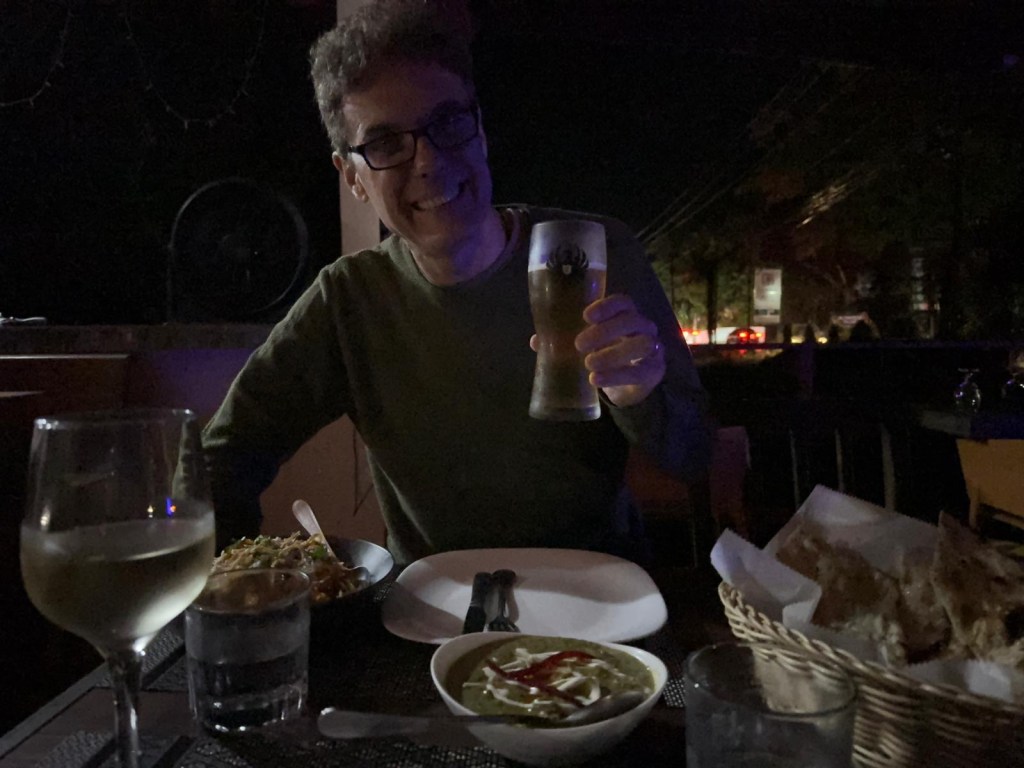
The rain eventually lets up, but the lights remain off as we walk in near pitch blackness to an Indian restaurant in the village. Two other couples are eating, lit only by a dim emergency lamp shining through the serving hatch. It certainly has atmosphere.
The atmosphere shifts when a dozen-strong Indian party arrive. Most are kids. They’re no trouble, but it’s no longer a quiet romantic evening of couples spilling biriyani over each other in the dark. Moments later a party of late-middle-aged Brits arrive and the dark restaurant is almost full.
We’re in the middle of our meal when the lights come back on. Everyone cheers. I can finally see my chicken biriyani. A text from our Airbnb host explains that a tree fell on the electricity line serving the village, which accounts for the small explosion I spotted. Civilisation returns, but Tarzan would surely have approved of the brief return to nature.
Sunday 22 February
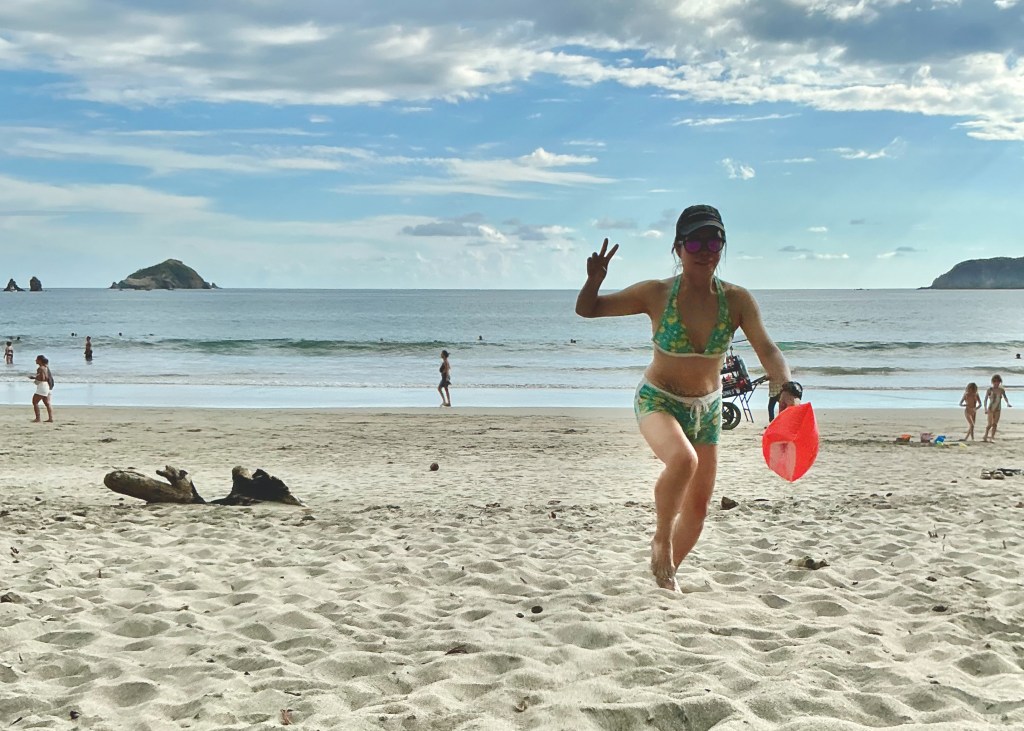
A final afternoon on Manuel Antonio beach, enjoying the tropical Pacific. Our bags would likely be fine left unattended on the beach, but we’re taking no chances as I’ve packed my iPad. K goes for the first splash in the rolling surf, while I keep watch. Then we swap. I mostly float on my back marvelling at the dense jungle that presses right up to the beach. Shortly before sunset, we trudge back up to the village. We won’t be swimming in salt water again until we reach Vietnam in September — and then only if the rainy season allows.
Seen crossing the veranda today, making their way through the jungle: a howler monkey, then a squirrel monkey — the first of either I’ve spotted from the house — as well as several capuchins, one with a mean-looking facial scar. Costa Rica has been generous in revealing its wildlife. We came primarily to acclimatise to Central America, but nature has been the real prize.
Monday 23 February
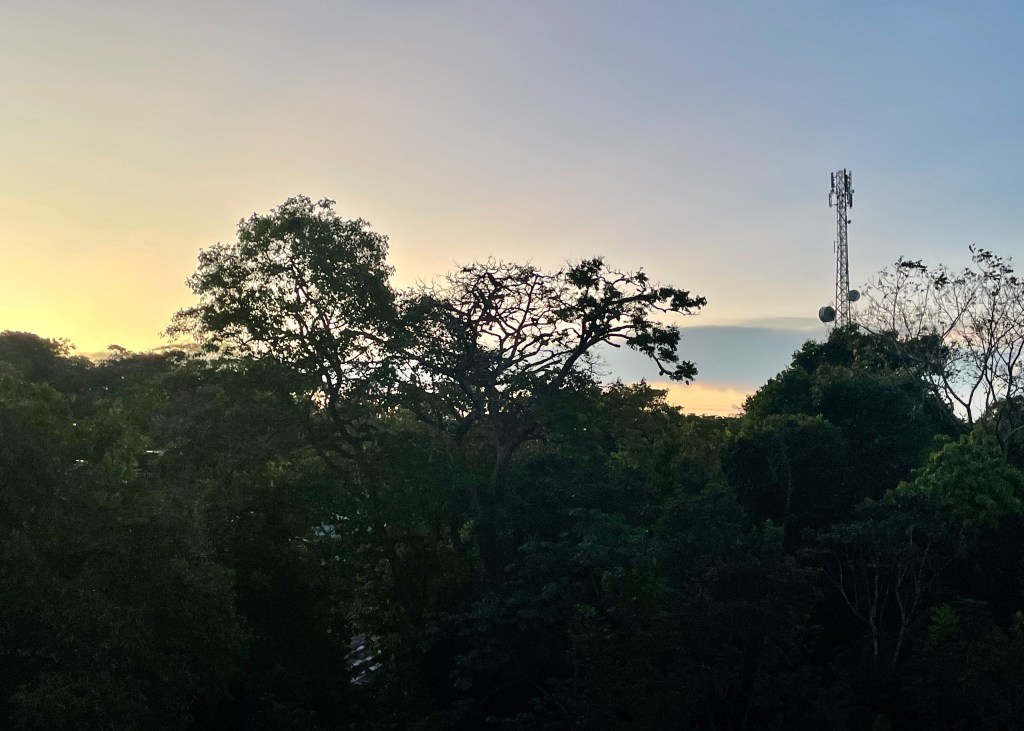
Our final day in Manuel Antonio is low key. I’m out on the veranda even earlier than usual to watch dawn break and listen to the eerie howler monkeys calling from the jungle. The rising sun soon chases me inside, as it does every morning, but today I leave reluctantly. Sadly, I won’t see dawn break again from this magnificent spot.
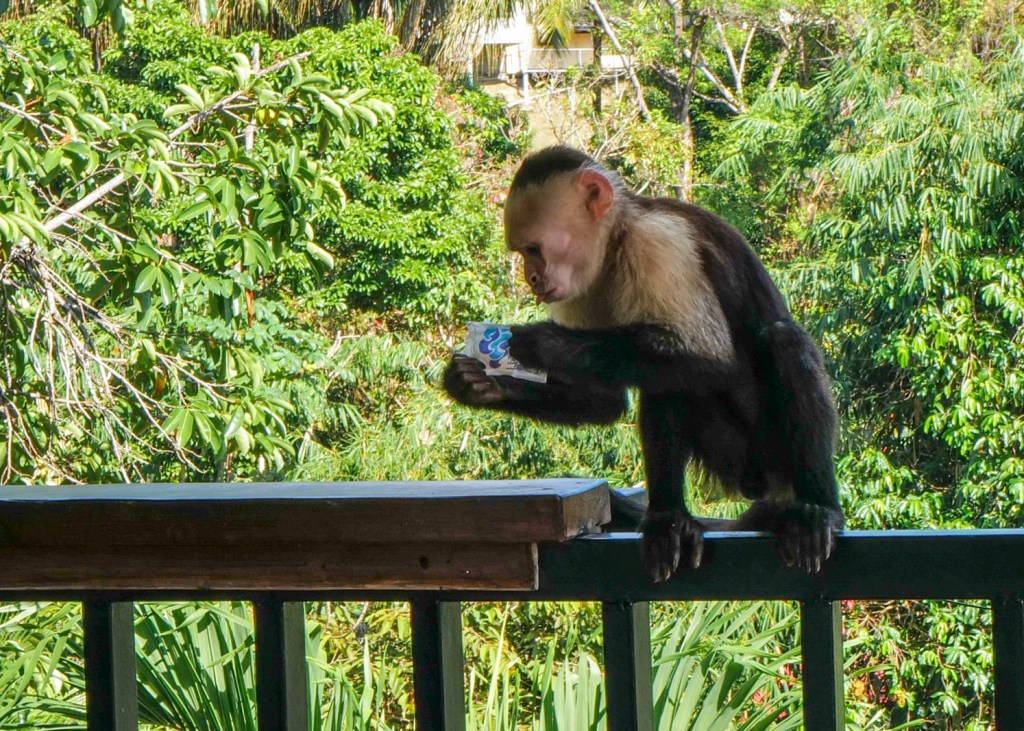
As we’re finishing lunch, a lurching shape catches my eye below the kitchen window. I look up just in time to see a capuchin monkey making off with a packet of sugar. In a flash, he’s out the back door. He rips the sugar open, spilling most of it before cramming what’s left into his mouth. He must have crept in through the open back door, crossed the hob, shifted the tub of loose sugar from on top of the one containing the sugar packets, lifted the lid, and pulled one out before I spotted the delinquent little hoodlum.
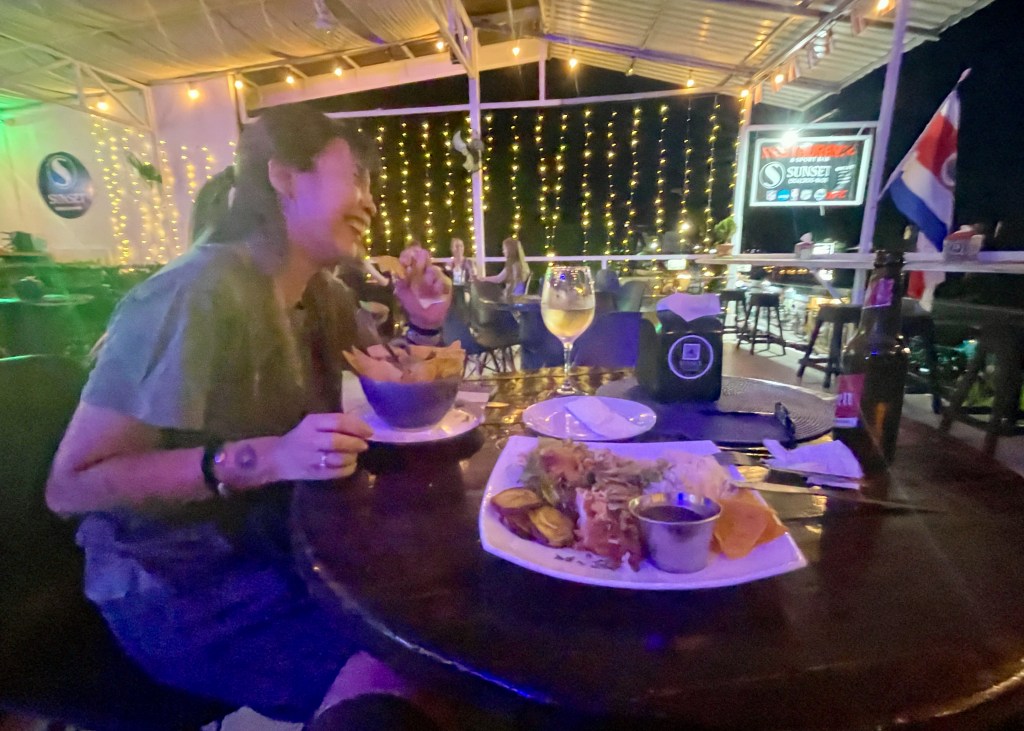
At dinner, we return to the most affordable place in the village: Sunset Bar, where we stuck a pin into a world map a few days ago. As we arrive, a lone guitarist is playing to the only occupied table. We applaud politely as he cycles through the same bar standards that frustrated musicians have been churning out the world over for decades: Knockin’ On Heaven’s Door, Tears in Heaven, Imagine. But he also throws in a few you don’t hear in every tourist bar on the planet: first, George Harrison’s Something, followed by Bread’s Guitar Man. My applause turns from polite to borderline enthusiastic. Soon, we’re the only customers and between songs we get talking. He tells me he learned the songs long ago from his dad’s “long player” (his words!) collection. I tell him mine used to play Bread songs in bars and show him a photo of dad on stage in 1976. A good twenty years younger than me, he gasps at how long ago that seems. The photo (and I) must seen almost jurassic to him.
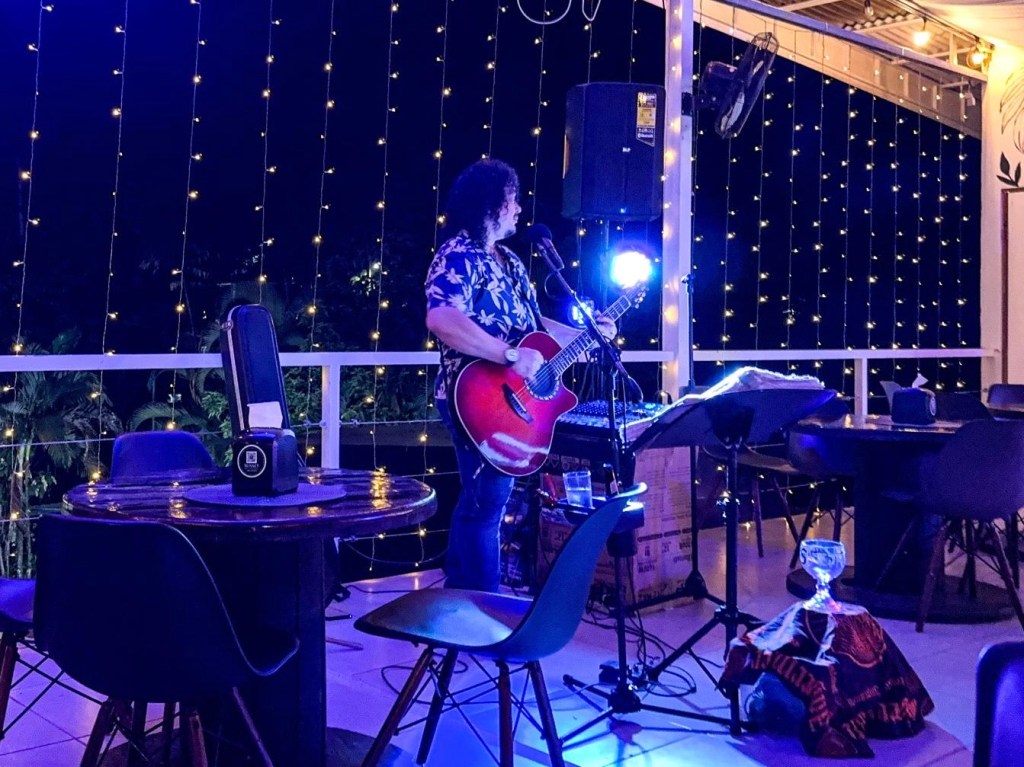
With no other customers to satisfy, I ask our new friend to play something that he wants. He promptly launches into a heartfelt Hey You by Pink Floyd that easily eclipses everything he’s sung tonight. We can hear the difference in engagement. Soon, more customers arrive and he tactfully retreats into safe bar standards.
Before leaving, we also fall into conversation with our waitress. With her punky makeup and tattoos, she’d look more at home in Madrid than here. Her English is faultless. She only moved here from San José two months ago and now balances two jobs: bookkeeping online for an employer in San José from seven to four, then waiting tables from five to ten. All the while she’s saving to start her own business, perhaps importing quality bikinis from Brazil to sell in Costa Rica. I can’t quite put my finger on why, but she reminds me both of Yana and Ashley — two very different people — in their twenties. Something about her just seems to carry a similar energy.
And that’s it for Manuel Antonio. Back in the flat, we watch YouTube videos about the turbulent history of Guatemala, then have an early night. We’ll be up soon after three to return to the central valley around San José.
Tuesday 24 February
Well before dawn, we climb into our shuttle bus. I don my headphones, listening to podcasts as night gradually gives way to day. The ride is uneventful. Everyone but me dozes.
We’re dropped near the airport and call an Uber to reach our hotel. Our driver is keen to chat, and I make my best — and longest — stab yet at maintaining a rudimentary conversation of sorts in Spanish. It ain’t pretty, but it seems to pass for Spanish.
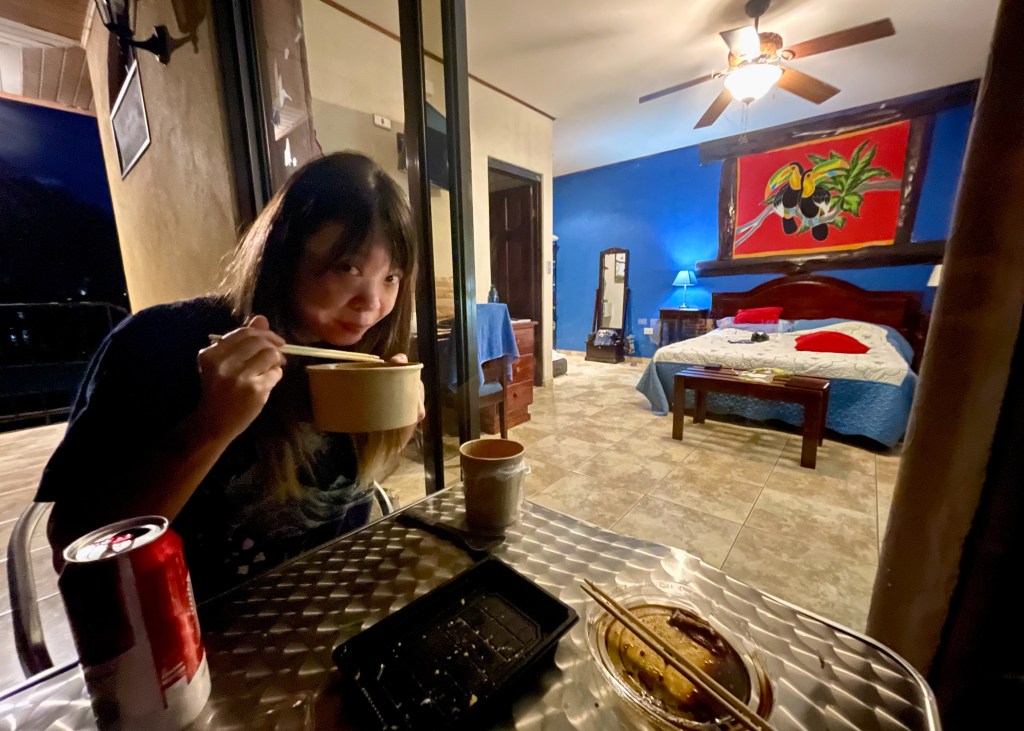
Our hotel is run by two ladies in late middle age. Sisters? Partners? It’s unclear. They fuss over us, despite our unruly arrival at nine in the morning. We’re given comfy armchairs and strong coffee while they prepare a room. Within half an hour, we’ve moved into a spacious room with a view and a colourful toucan painting above the bed.
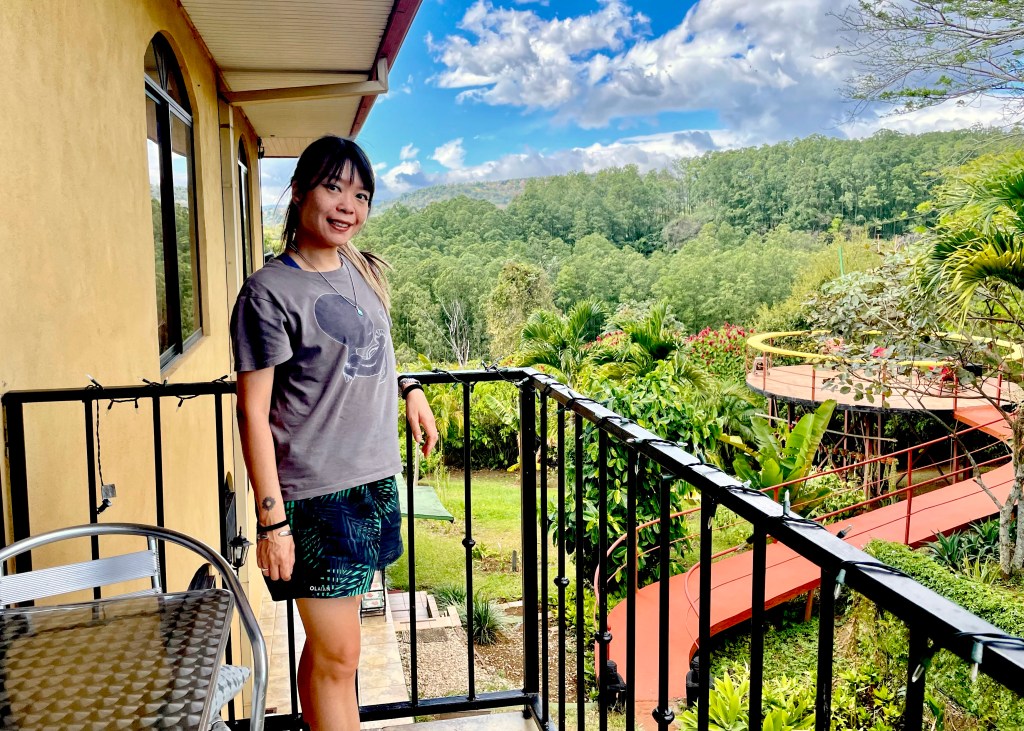
It’s only at this point I realise the hotel serves breakfast only. We’d expected to lay low for two days, resting at the hotel. Except for a greasy burger joint, there are no restaurants in the neighbourhood. I briefly entertain thoughts of surviving on nuts and dried fruit before we hit on Plan B.
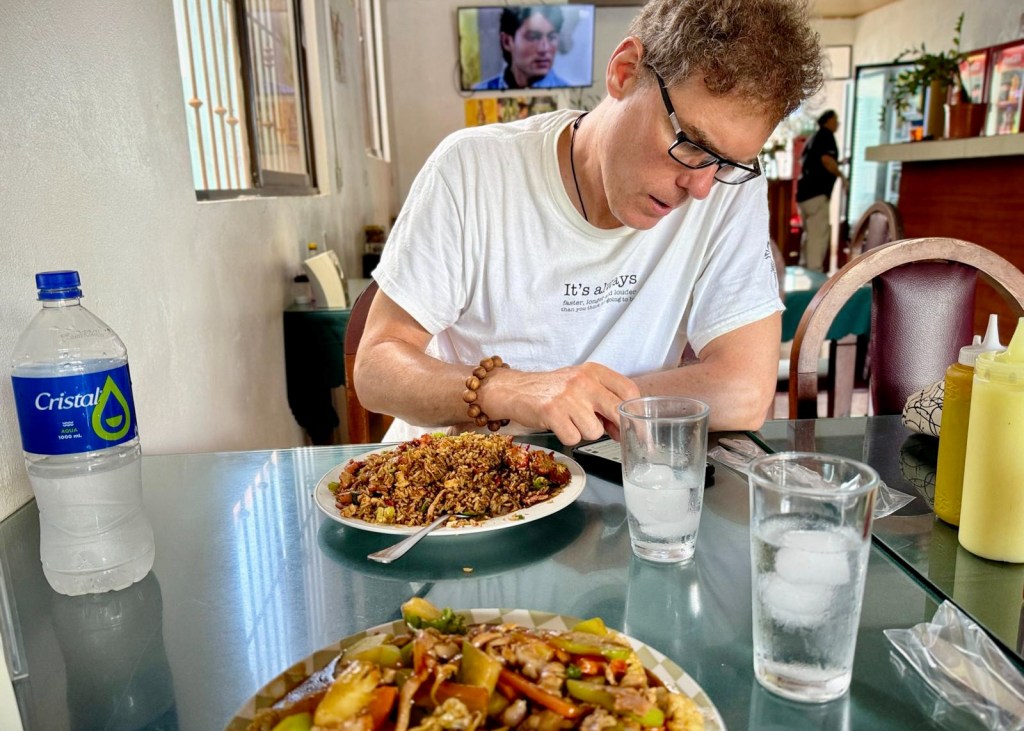
Stage 1 of Plan B is a half-hour walk back to the neighbourhood we stayed in when we arrived four weeks ago for lunch at an unprominsingly-located Chinese restaurant. The walk takes us through a scruffy neighbourhood, but we’re confident enough in Costa Rica now to know that it should be safe by daylight.
We’re the only customers at the no-frills restaurant, where the local waitress is curious to see a real Chinese customer. The menu consists solely of fried rice and fried noodles. We order one of each. Enormous servings arrive — one dish between us would have been enough. Desperately full, we stagger out and call our second Uber of the day — a woman driver this time. It’s impossible not to notice her size (a thyroid condition, perhaps?) and her resemblance to Bonnie Grape in What’s Eating Gilbert Grape?. Back at the hotel, we rest up, recover from our early start, and watch the sun set over the hills.
Stage 2 of Plan B is to secure dinner using Uber Eats — the first time we’ve used Uber for anything but rides. Half an hour later, a bowl of ramen and a California roll show up. We eat on the balcony enjoying the cool night air of the central valley.
More Guatemala videos on YouTube, then bed. Tomorrow is our final day in Costa Rica.
Wednesday 25 February
Three memorable encounters on our final day in Costa Rica.
At breakfast, I get chatting to a fellow Brit. He must be in his seventies, has run a small hotel in the Ugandan rainforest for twenty years, and has come all the way to Costa Rica for a spot of twitching. He’s even brought his binoculars to the breakfast table. Our last day in Costa Rica is his first. I can vividly recall our first morning four weeks ago as I pass on what limited advice I can offer and wish him well.
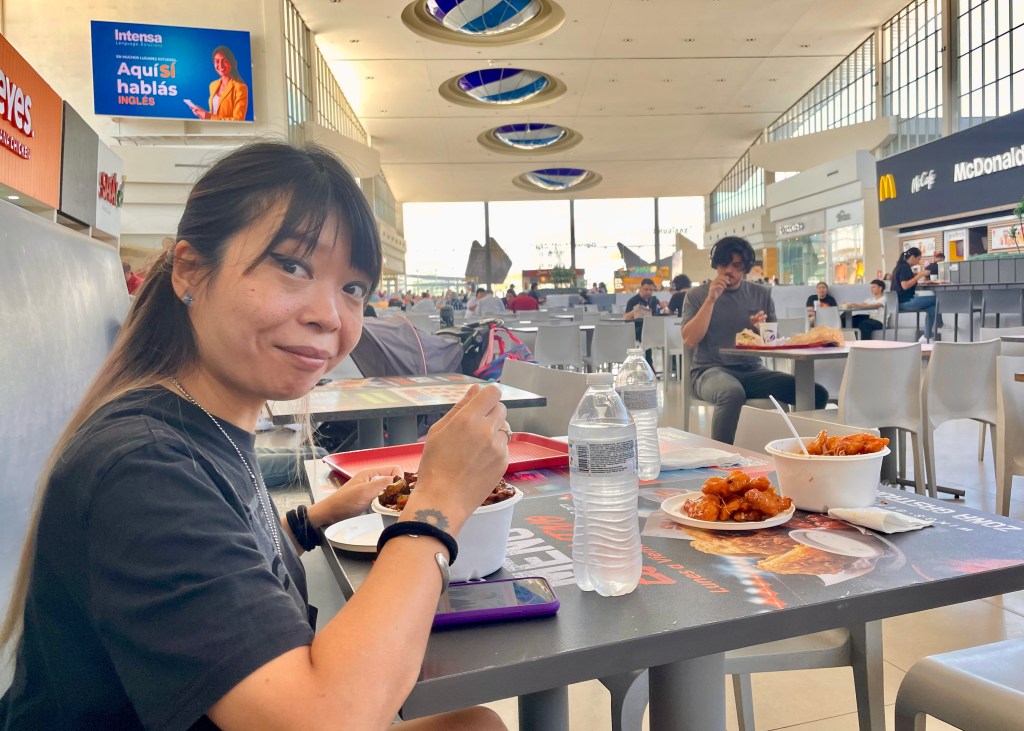
Lunch is in a modern mall in nearby Alajuela. After securing a new hairdryer for K — she’s been using whatever our accommodation provides until now — we scout the food court. We settle on an outlet serving ‘dis dis rice’ or ‘dis dis fried noodles’, which they refer to here as chop suey — a term used with local creative license. The staff are local, but the cashier is from Guangzhou. K enjoys a brief chat in Cantonese for the first time in months, until the queue behind us grows restless.
Halfway back to the hotel, our taxi halts at traffic lights. A father and son are begging car to car carrying a laminated flag, which I think identifies them as Venezuelans. Our driver confirms their nationality and I’m about to slip them a few colóns when the light turns green and we’re forced to pull away. Our driver reveals he’s also an immigrant — a Cuban who’s lived in Costa Rica for twenty years. He’s some sort of artist, moonlighting as a taxi driver. My Spanish is sufficient to establish he isn’t a painter, but hits a wall shortly thereafter. I’m not familiar with his Cuban hometown, but he assures me its beaches far surpass those of Manuel Antonio. “All they have there is monkeys!”, he snorts, and we both burst into laughter. It’s my most productive conversation in Spanish yet.
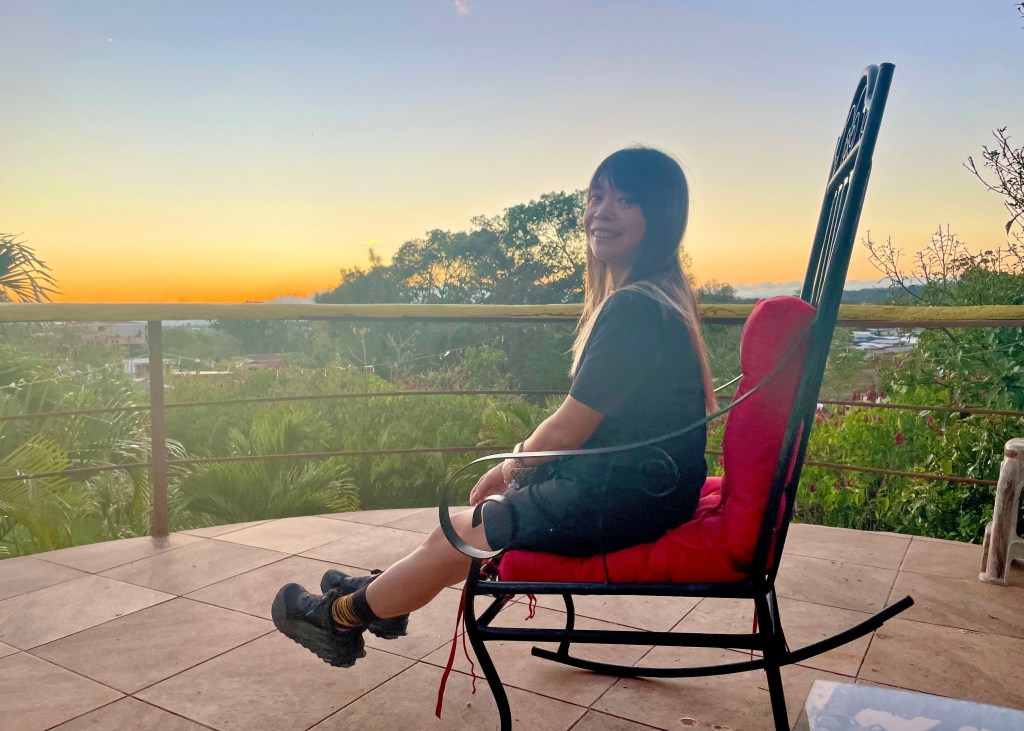
I finish some work at sunset. We slip downstairs to the hotel’s viewing platform, where we perch on rocking chairs watching dusk fall on Costa Rica for the final time. Uber Eats proves less successful tonight. The dumplings and sui mai that arrive are barely edible, leaving us thankful for the enormous lunch we had earlier.
I’m asleep by ten. Tomorrow, we start again somewhere else.
 Two On Tour
Leave a comment