A new continent. Same old rain.
Saturday 31 January
Latin America, in my mind’s eye, is coups, juntas and civil wars. Which is why we’re on a plane to Costa Rica, a country that famously abolished its armed forces decades ago.
On the tarmac queuing to board our flight, we’re whipped senseless by a bitter wind. But after three weeks of leaden Spanish skies, Madrid at least sends us off in cheerful sunshine. Once onboard, we sit an hour waiting for stragglers from a connecting flight. Finally, we tear down the runway and we’re on our way to Central America.
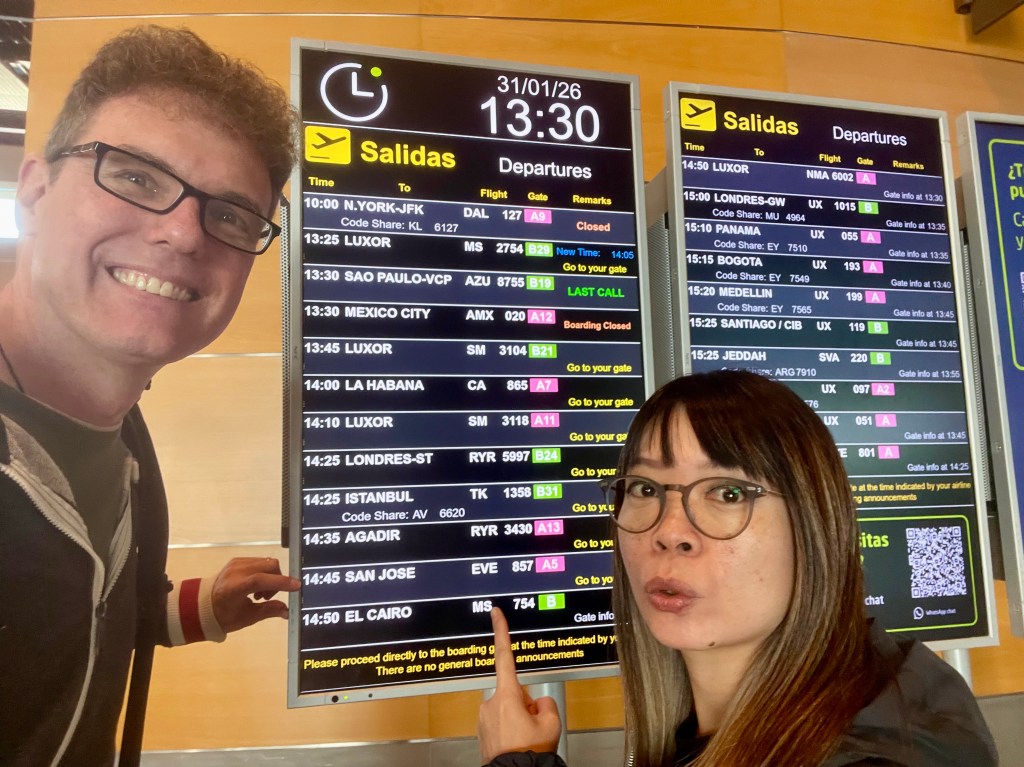
Iberojet serve the most miserly meal I’ve ever had on an aircraft: a few lumps of chicken, two mouthfuls of rice, and a microscopic cube of chocolate brownie. That’s it for eleven hours. Thankfully, I have a stash of nuts and dried fruit, which I reach for regularly as we crawl millimetre by tedious millimetre across the flight screen. We’re flying right through Costa Rican daytime, so we focus on staying active, dozing as little as possible. I rewatch Woody Allen’s Vicky Christina Barcelona (“Everybody finishes the summer a little wiser and with a lifetime of memories” – Robert Ebert) and take a punt on Clint Eastwood’s The Mule (“Doesn’t quite achieve the emotional resonance it seeks” – ditto), and let iTunes deep cuts and podcasts do the rest.
It’s only as we approach the Caribbean that I realise our late departure might have consequences. We’re not due to land until eight, and the hotel front desk closes at ten, as does its restaurant. I start mentally scrambling for a Plan B. Thankfully, my fretting is uncalled for. Our brand new eSIM earns its keep immediately: I text the hotel from the immigration queue and arrange for a late arrival and two chicken pesto sandwiches. Even stopping to buy a few colóns at an extortionately marked-up exchange rate, we’re briskly through the airport and into a taxi.
San José’s suburbs are drab, then gone. Before long we reach our little oasis on the edge of the jungle, where we’ll spend two nights to shake off the jet lag. The guard hands us a key and within minutes two enormous chicken pesto sandwiches arrive at our door. We’ve made it — jet-lagged, overfed, but finally back in the tropics.
Sunday 1 February
It’s light at 6am. After Spain’s interminably dark winter mornings, this feels almost too good to be true. I peer through the hotel window and see sunshine and tropical foliage:
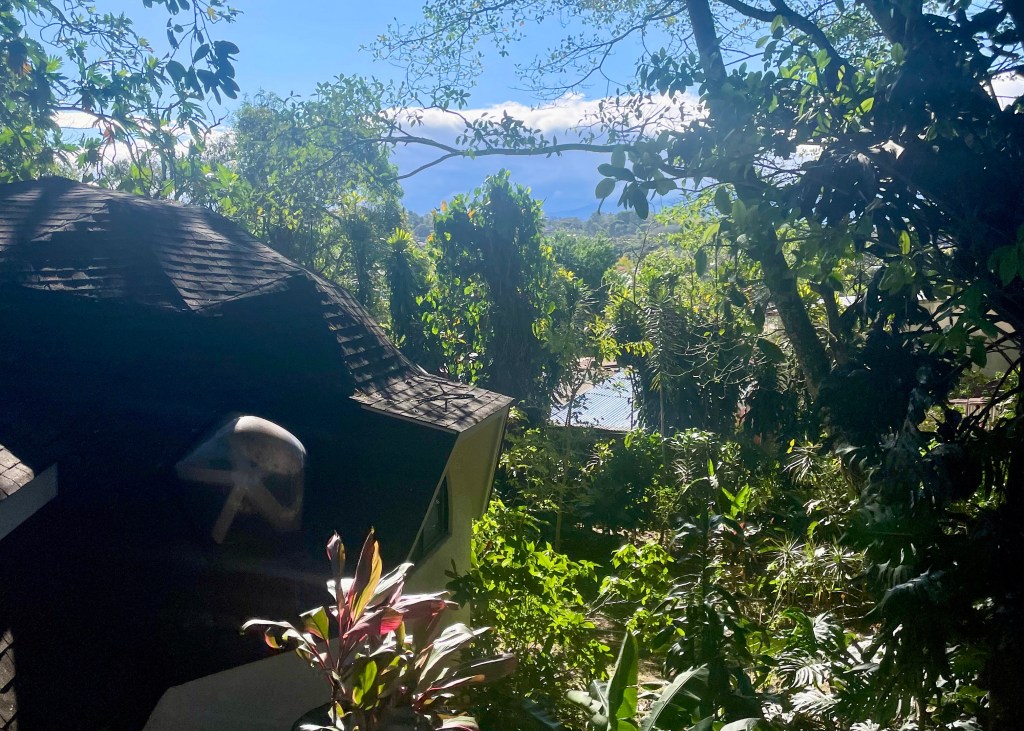
Breakfast is served on the hotel patio: I pick the traditional Costa Rican gallo pinto of beans, rice, eggs and fried plantain, and guzzle multiple cups of coffee strong enough to jolt me out of any residue jet lag. The staff switch easily between Spanish and rudimentary English. I manage to stumble through mostly in Spanish and leave with a takeaway coffee and a hairdryer for K.
Given we’re at the same latitude as Ho Chi Minh City, it’s surprisingly (but pleasantly) cool. We’re a kilometre above sea level, and we’ll remain in these highlands along the spine of Central America for much of the next five months. K joins me for a dip in the hotel pool. It’s bracing, but we wouldn’t want to miss our first opportunity for an outdoor morning swim in nearly a year.
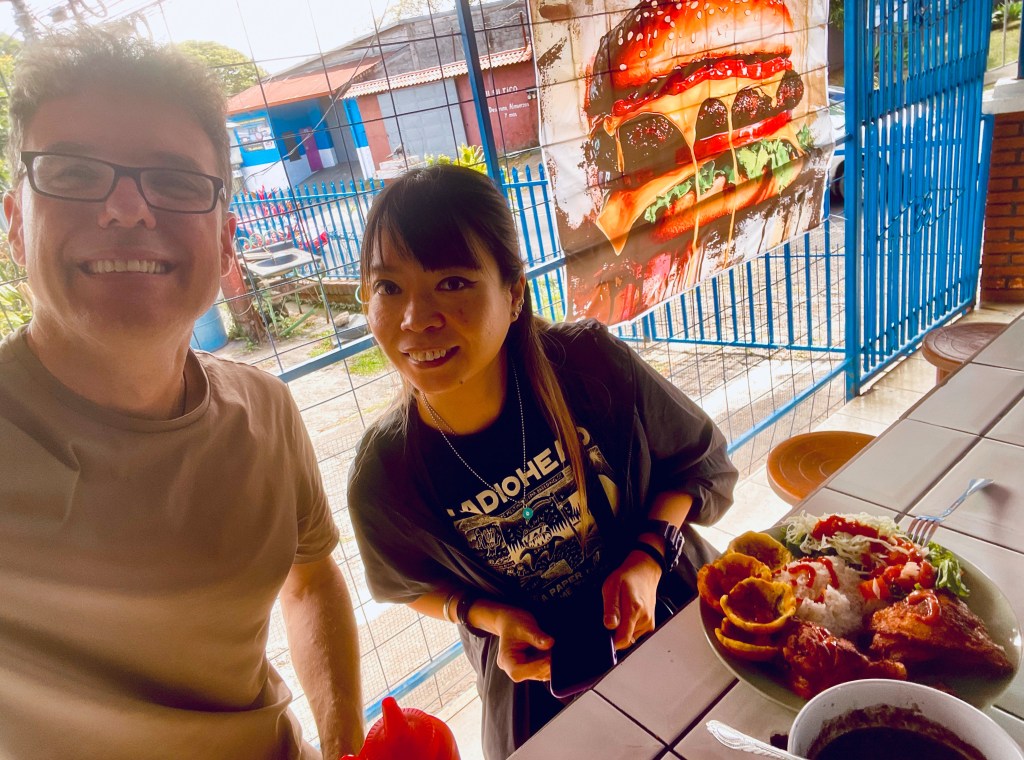
At lunchtime we skulk off the hotel grounds to a tiny local soda restaurant. The two other customers shuffle along the counter to make room as the owner, a woman in her thirties, bustles around fixing them enormous plates of rice, beans, pulled pork, and salad.
“We’ll have what they’re having!” I venture in broken Spanish when she finally turns her attention to us. “Sorry, that was the last of the pork,” she laments. “But I do have chicken.” “Perfect”, I reply.
She springs into action. One person, everything from scratch. Slow food indeed.
While we wait, K, ever the news junkie, discovers that our first day in Costa Rica coincides with a presidential election. That explains the cars with flags and horns zipping past the restautant.
An hour after arriving, our lunches are finally served, every bit as enormous as those our now‑departed fellow customers demolished. They’re delicious. The owner talks us through her homemade condiments and we fall into a deeply broken conversation of sorts in Spanish. She’s Cuban, she arrived in Costa Rica two years ago, and she opens seven days a week. Her husband, who’s now joined us with their young son, works as a baggage handler at the nearby airport. I keep diplomatically quiet about our own flitting around the world.
With Herculean effort, we finish almost everything on our plates. I wish her good luck with her new life in Costa Rica as we nurse our bursting stomachs back to the hotel.
The afternoon is admin and exploring the hotel’s jungle trails. We may be in a new continent, but the dense green flora is reassuringly reminiscent of Hong Kong.
Dinner is a less adventurous affair at the hotel restaurant. By seven, it’s cool enough to pull on a hoodie. I try the ceviche — marinated raw fish; K opts for a vegan bowl. Still reeling from lunch, we’re soon full.
Back in our room, we fire up Match of the Day, but I soon doze off. It’s been a promising start.
Monday 2 February
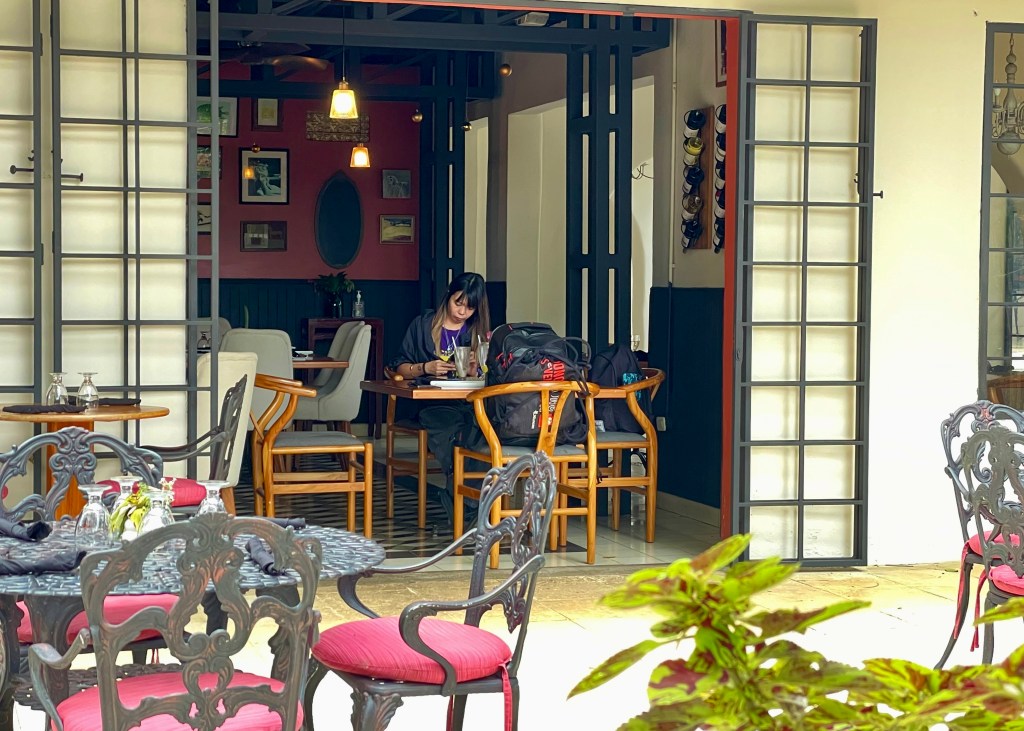
The day starts with a text from our ride company: pickup for La Fortuna delayed by 90 minutes. At first I’m non-plussed, but when the hotel staff usher us to an upstairs lounge where we can wait in comfort, things improve. I research accommodation for August in Bangkok; K, as ever, reads the news. We head downstairs to the hotel restaurant for lunch. Afterwards, K sifts through my provisional Airbnb choices while I wander off to explore the jungle trails again:
At three, we clamber into the back of a minivan, where two other passengers are doomscrolling on their phones. I immediately understand why a ride of little more than 100 kilometres in Costa Rica takes three hours: the roads are twisting single carriageways and prone to patches of alarming potholes. Still, it’s more interesting than hurtling along a featureless motorway. We wind through the lush, tropical landscape with rolling hills rising in the distance. After an hour we catch a glimpse of our first Costa Rican town of any size as we pass through bustling San Ramón. Soon after, we climb into the hills and vanish into low cloud. I’m expecting sunshine to return when we descend, but this is wishful thinking. The sky stays grey. Before long it starts to drizzle.
We reach prosperous-looking La Fortuna at dusk, going about its business under half-hearted rain. Not quite what I had in mind in the middle of the dry season. Rain just seems to pursue us. The flat is functional but is the most affordable we could find. We know the drill: unpack, then supermarket.
At La Fortuna’s main supermarket, backpacks — our shopping bags — are forbidden. A guard politely ushers us to a bank of lockers to stash them until we’ve paid. This is new.
After Spain’s reassuringly affordable supermarkets, we’re prepared for the shock of Latin America’s second most expensive country (after Uruguay, apparently). We’re even ready for, but still disappointed by, the poor selection of many our staples: plain yoghurt, non-dairy milk, nuts. And the processed bread is beyond horrifying. We stock up as best we can, calculating adjustments to our diets for the coming weeks.
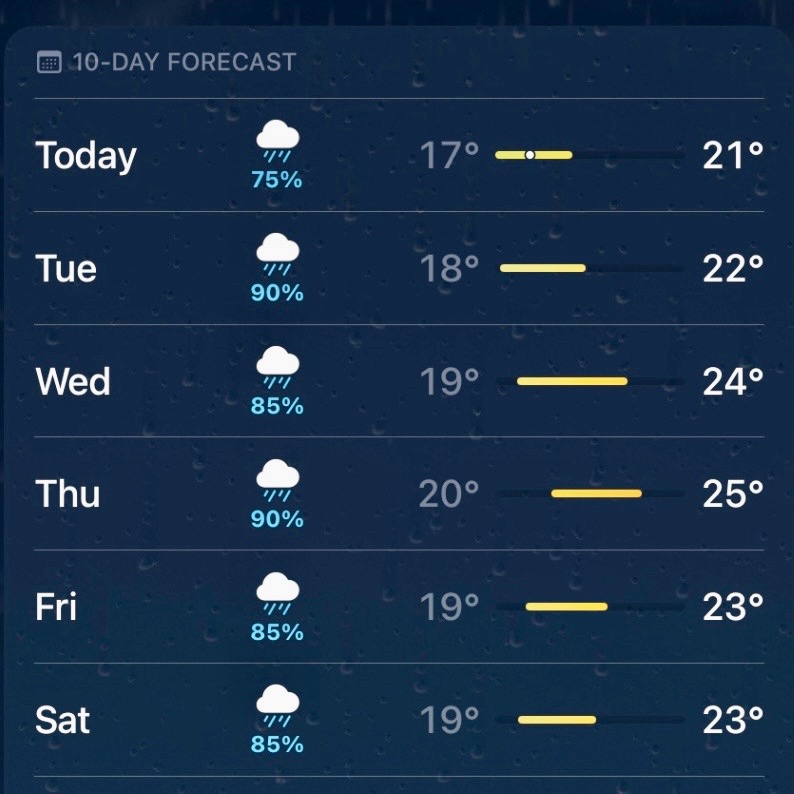
Back at the flat, I check the forecast. It ain’t pretty:
Tuesday 3 February
I wake to the sound of rain. Sigh. Sitting on the balcony with a cup of tea, there’s no sign of Arenal volcano — just a curtain of thick cloud and a steady patter.
After a breakfast of fresh papaya, plantain, yoghurt and nuts, the cloud begins to lift. Suddenly, I’m looking at Arenal’s perfect cone. The flat may be functional, but the view is anything but.
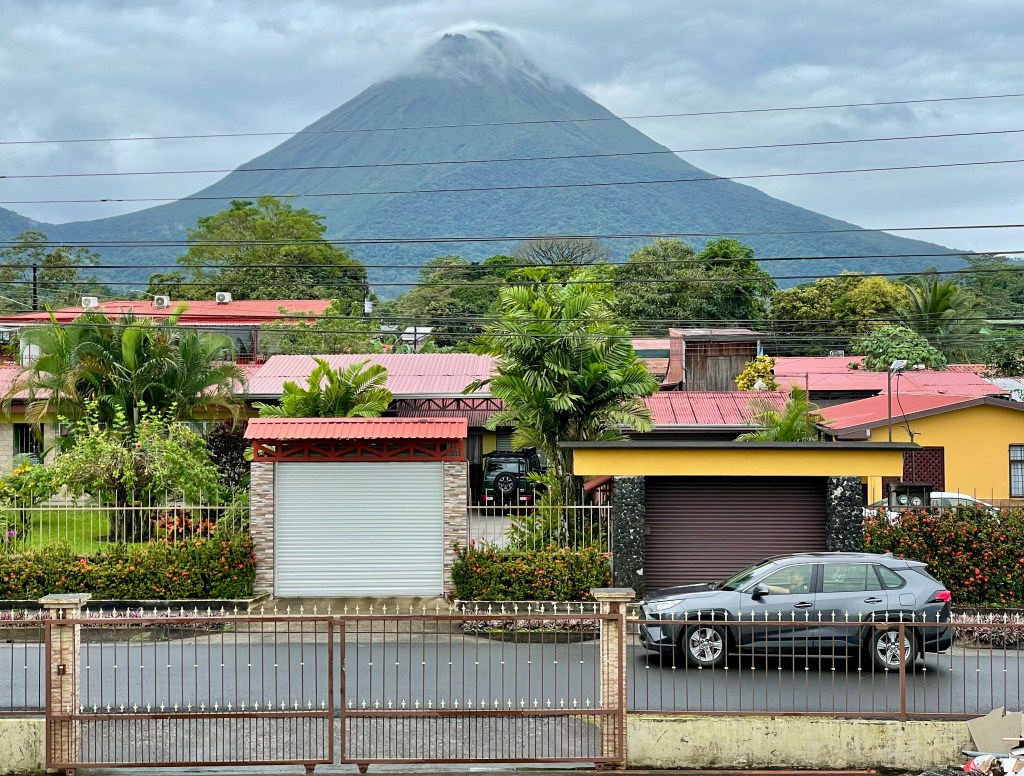
Nothing too adventurous for our first full day in La Fortuna: we wander the town centre around the four sides of its tidy, square park. As any self-respecting tourist town should, it has endless ways to part visitors from their money. Whether your bag is quad-biking or a tea towel printed with an adorable sloth, La Fortuna has it covered. I toy with a pair of thick-soled flip flops stamped with the Costa Rican mantra pura vida, but decide to wait — we may be only 10 degrees from the equator, but it’s not hot enough here at the moment to need them.
Despite existing for little other purpose than to service tourists like us, the town feels laid back, uncrowded and unhurried. I like it enormously. We wander the aisles of another supermarket (Super Christian — what a name!) to gauge what’s available at what price. Decent bread remains impossible to find, but after casing two supermarkets, we’re beginning to sort the affordable (tropical fruit), the occasional treat (good chocolate), and the off-limits expensive (farewell, olives).
The rain stops at lunchtime, but the weather remains unsettled. Our guide for tomorrow’s volcano hike texts to suggest postponing if our schedule allows. It does. We’re happy to potter one more day before launching into the area’s many sights.
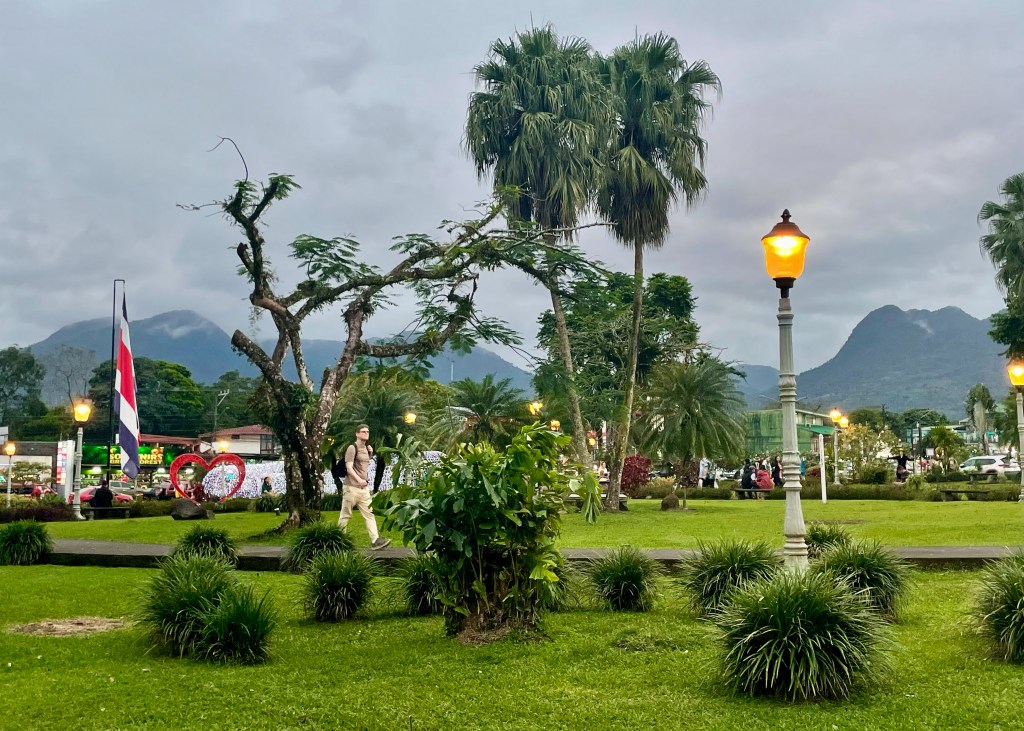
As dusk falls, I’m reluctant to head back to the flat despite lugging a heavy backpack full of groceries. This is such a magical spot. I want a photo of the park as night falls but need someone to pass by to inject a bit of human interest. No one obliges, so I hand my phone to K and become my own passer‑by:
Wednesday 4 February
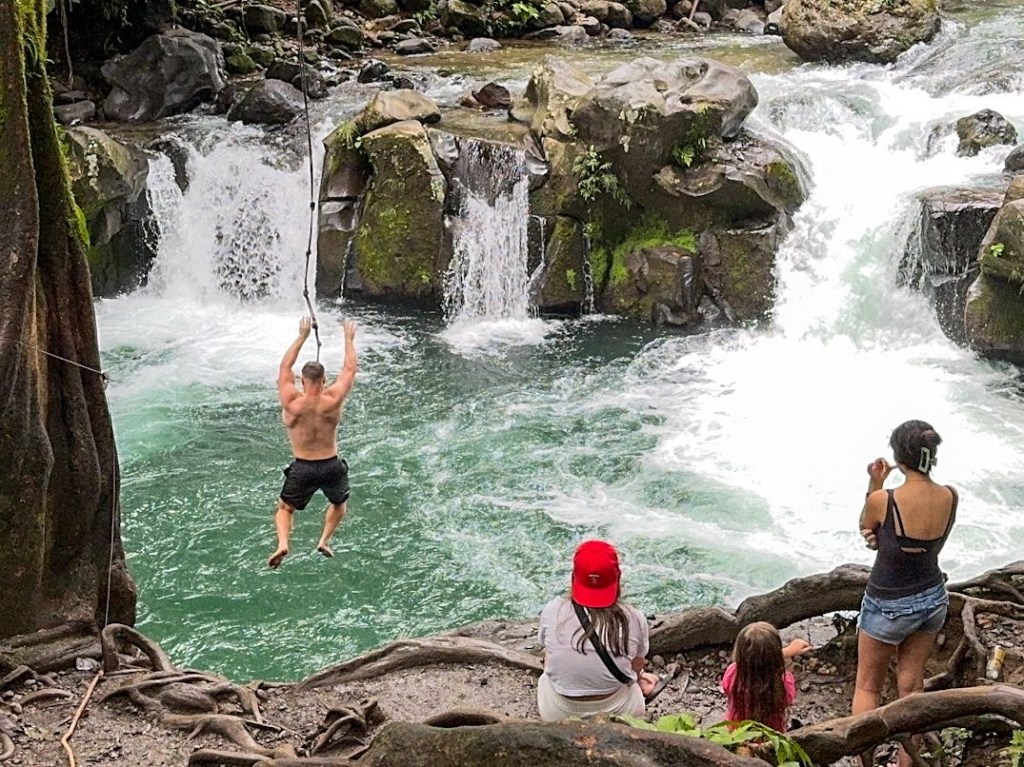
We use our extra day of pottering to wander out of La Fortuna to a nearby river, where a rope swing launches the brave — or the simply reckless — off a riverbank ledge into the water below. A couple of steely souls try, and splash safely in. But like most others, we’re present strictly as spectators. We tramp a hundred metres along a trail further downriver and size up the bank as a possible bathing spot should we return another day.
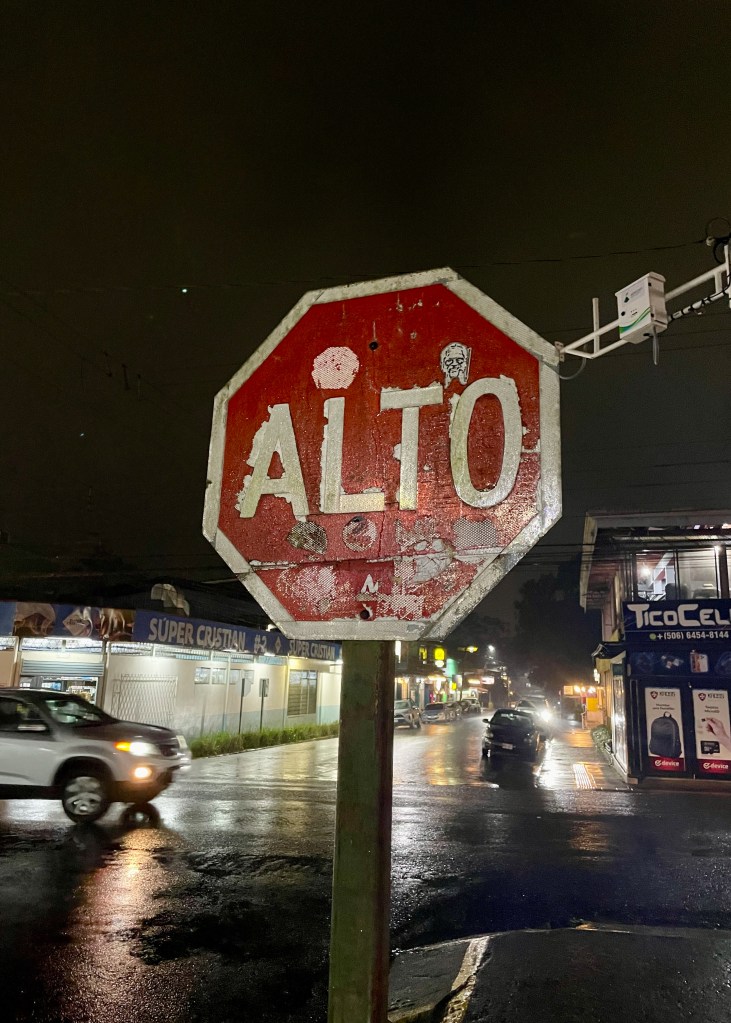
A curious lingustic fact about Costa Rica (and Central America in general, I believe): in Spain, stop signs say “Stop”. Here they say “Alto”. Since alto means tall, and thus makes no sense on a stop sign, I rummage online and discover that alto is borrowed from the German “Halt!” As to why a German word has spread to this part of the world, I hit a brick wall.
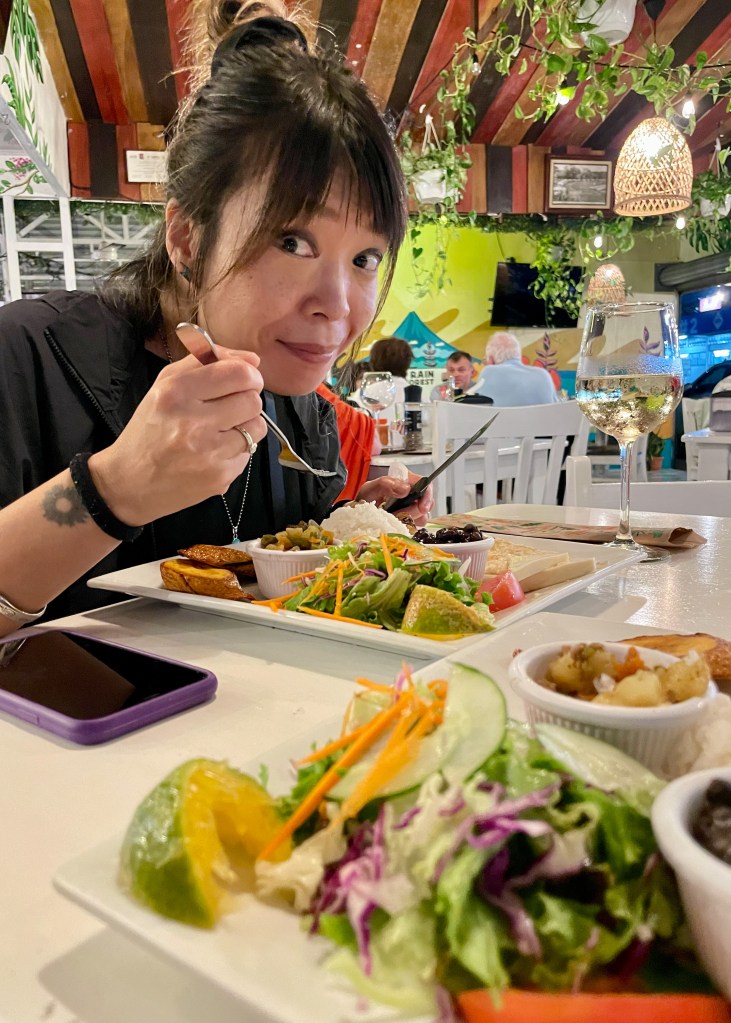
Our first restaurant meal in La Fortuna lurches from Plan A to Plan B to Plan C: closed, full, and finally open. But Plan C is fine. We order casados, curious to see how they compare to Sunday’s enormous platters. They’re passable. Smaller portions — not necessarily a bad thing — jazzed up by a homemade chilli chutney that turns up halfway through. The restaurant is full and lively. Everyone’s a tourist. I overhear the couple next to us tell the waiter that they’re from Belgium, while a group of lads in jock gear nearby sound Swedish. Our waiter humours us by letting us order in Spanish, despite his clear comfort in English.
Back in the flat we watch Skyscraper Live, Netflix’s real-time documentary of Alex Honnold’s recent free solo ascent of Taipei 101. At first, I can barely watch. It’s psychological torture. But I gradually relax, making a mental note never to become a free soloist myself. It’s exhilarating, despite the best attempts of Netflix’s irritating, over-dramatic hosts to spoil it.
Thursday 5 February
We knew Costa Rica was going to be anything but cheap, but it still takes my breath away every time we part with a hundred-plus US dollars in one swoop. Earlier this week it was the shared shuttle to La Fortuna; today it’s a tour of a chocolate and coffee plantation. But money is just experience tokens with no cash value on death – although I’m sure we’ll find similar tours for less outlay when we reach Guatemala.
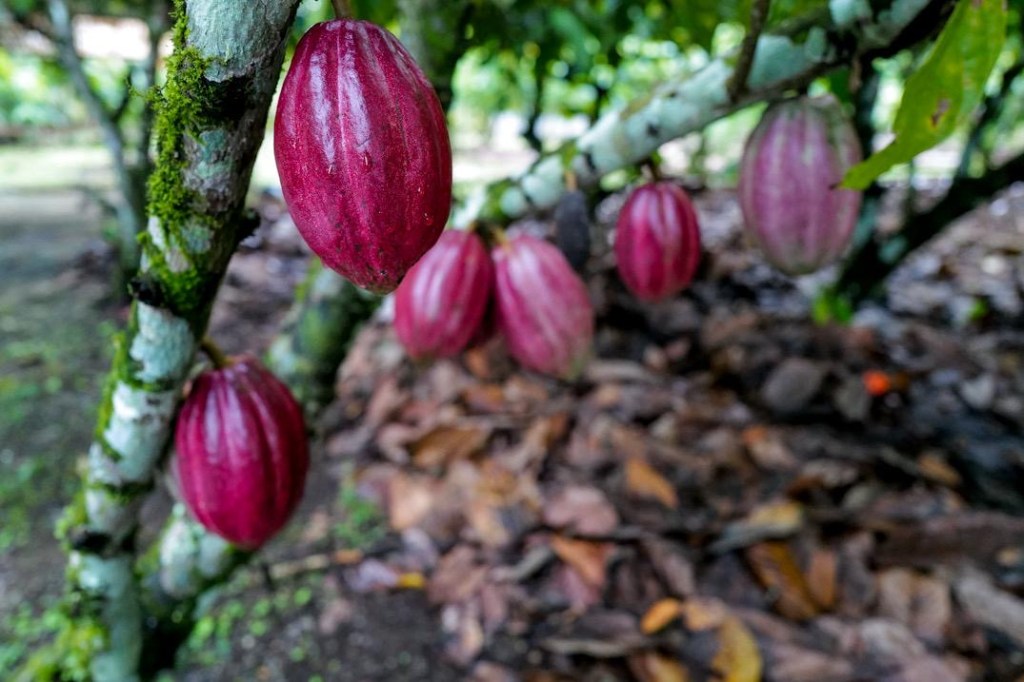
I’ve never seen a cacao pod growing on a tree. Our guide, Alberto, hacks one open and the twelve of us — half Americans, the others Germans, Danes, and us — each squeeze out a raw bean covered in a milky layer of flesh. We suck the flesh, then discard the raw bean. The flavour is faintly cocoa. I pretend to detect subtle notes, but really it tastes like nothing much. The point is clear: raw cacao is far removed from a bar of chocolate. Next, we’re taken through the post-harvest journey of the humble cacao bean: fermentation, roasting, followed by grinding into a thick, bitter paste. We sip a small cup of xocolātl, “bitter water”, a compound of xococ (bitter) and atl (water or drink). Cocoa literally means “bitter” in Aztec. Who knew?
Finally, we’re given small pellets of finished chocolate to nibble at 100%, 85%, 70% and 60% purity. The only other ingredient is sugar, and the chocolate rapidly becomes sweeter as its purity decreases. K agrees that the 85% we regularly eat hits the perfect spot between bitterness and sweetness.
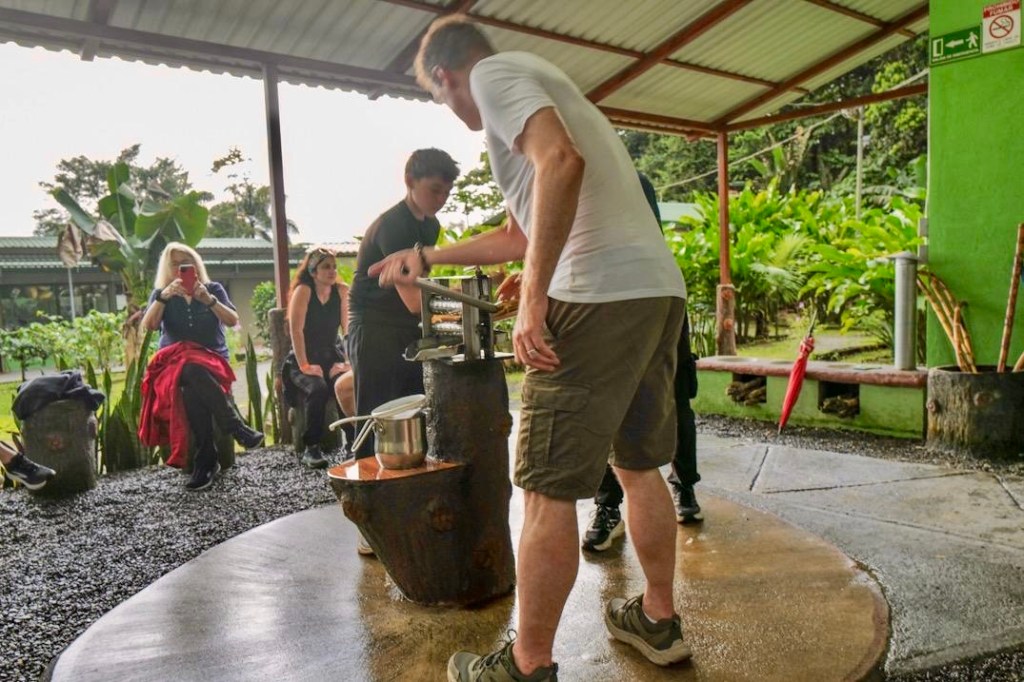
After a brief interlude in which I help run a length of sugar cane through a mangle — it produces a surprising amount of juice — we switch to coffee production. Disappointingly, there are no beans on the coffee bushes in the tour area, so we head straight to a roasting demonstration. Another member of staff roasts a handful of beans in a tin and tips them onto a tray for us to inhale. If only every breath of every day smelled this good. We inspect light, medium, dark, and over-roast beans and learn that medium roast has the most complexity. Later, Google informs me that Starbucks over-roast their beans because the overpowering flavour cuts through the milk and syrups that drive their margins. This explains why black Starbucks coffee tastes so disgustingly acrid.
It’s a thoroughly engaging couple of hours. Exit through the gift shop, where we buy an obligatory bag of coffee and a bar of chocolate before climbing back into the complimentary minivan for the short ride back to La Fortuna, arriving as dusk falls.
Friday 6 February
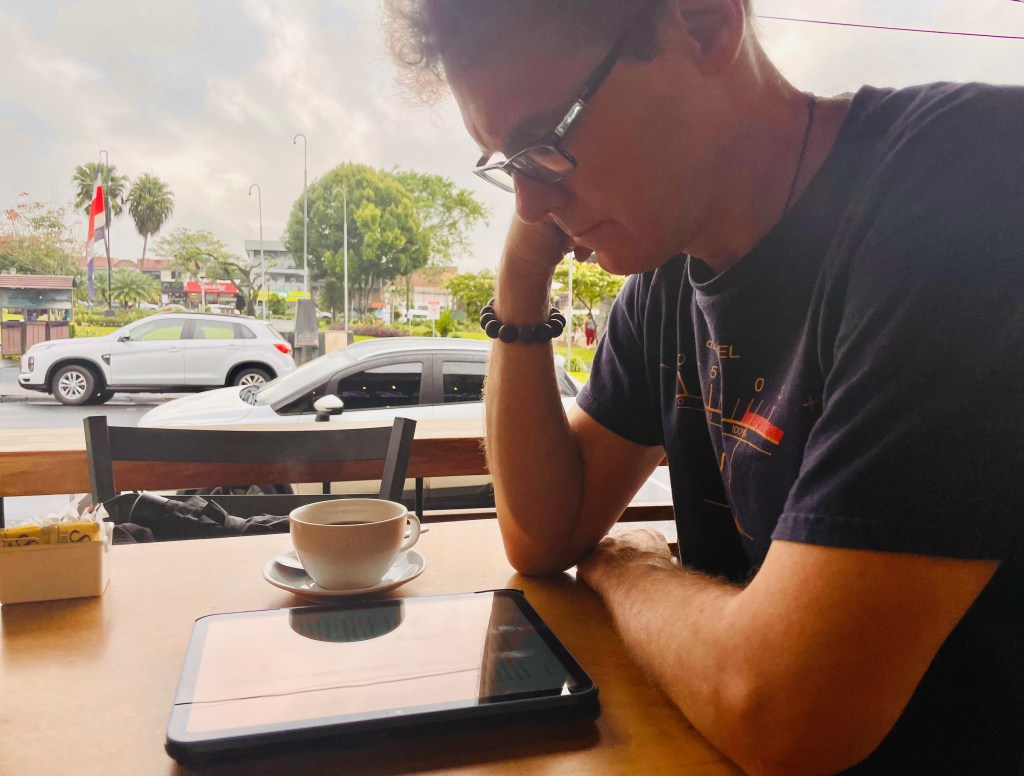
Rain all day. This corner of Costa Rica has an unorthodox idea of what a dry season is. It’s rained every day since we arrived, but today is the splashiest yet. We lay low, venturing out only for groceries and an afternoon coffee. My stamina for rain tourism is limited. I’m very happy to be here. Everything remains new and exiciting. But I wouldn’t say no to a dry day.
Saturday 7 February
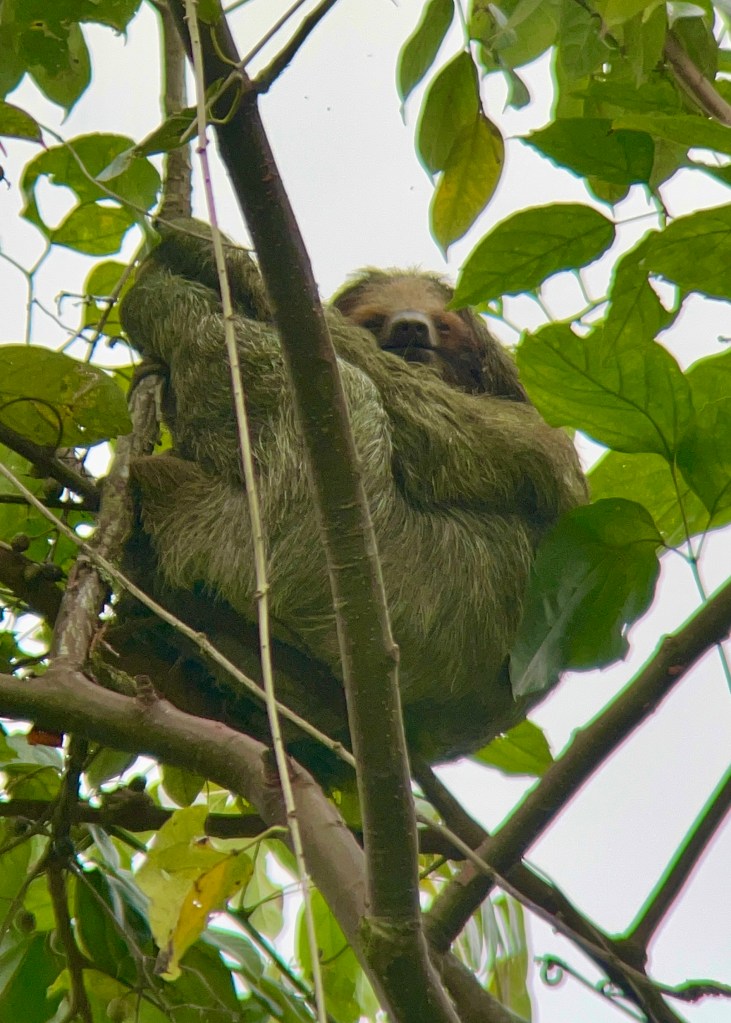
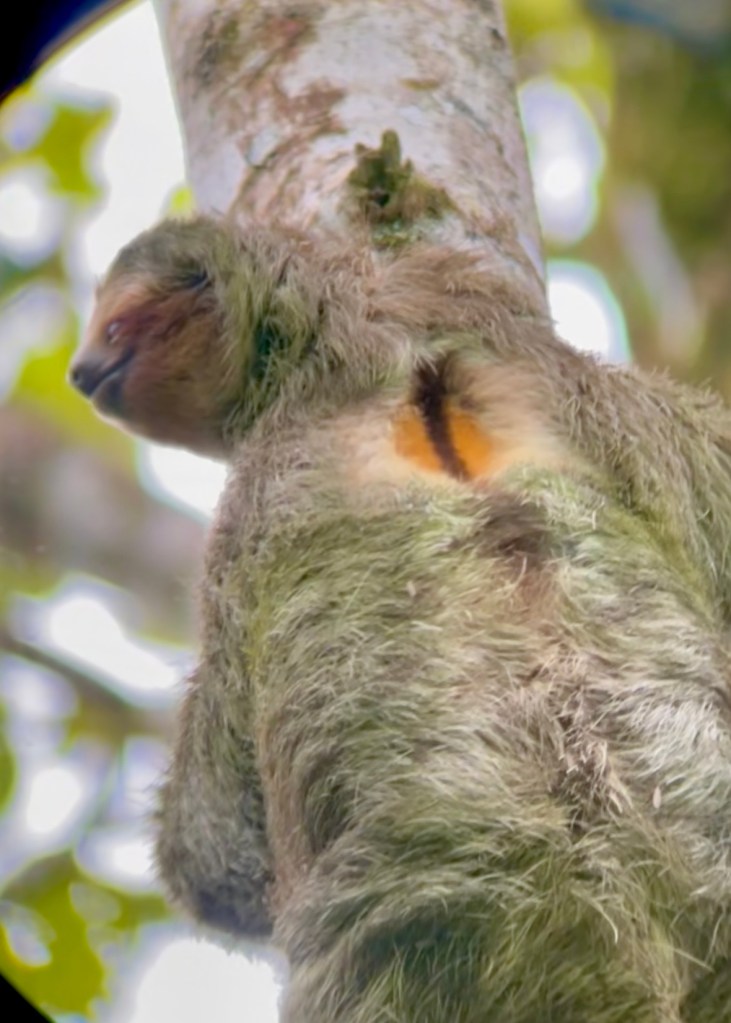
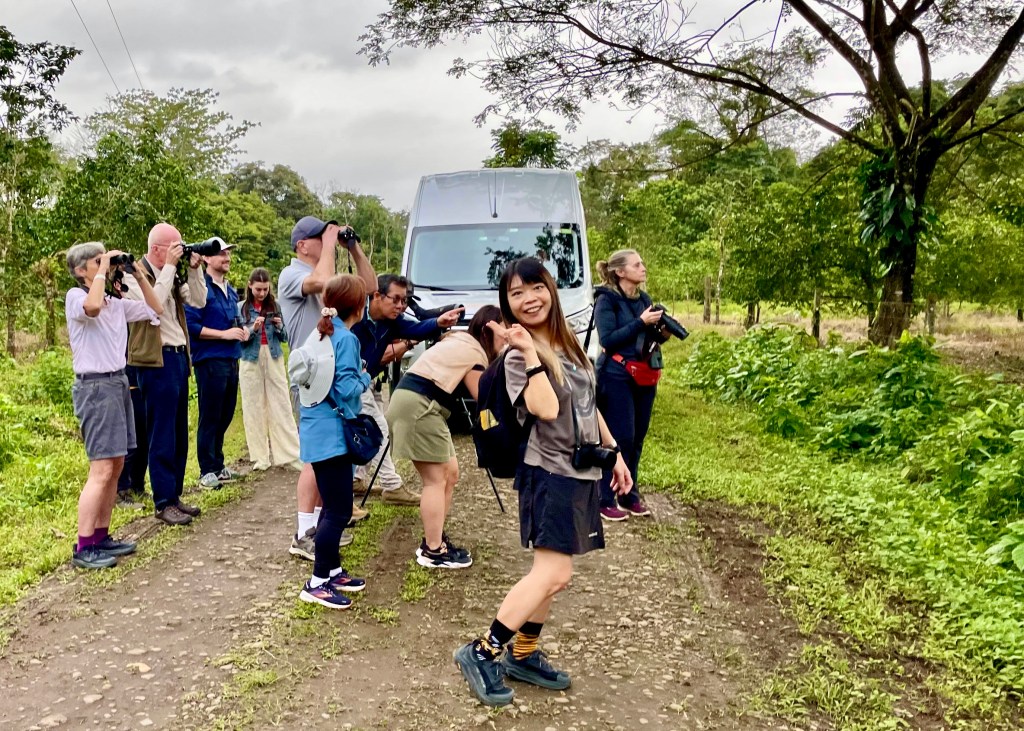
Sloths sell themselves. Their smiling faces and slow-motion gymnastics make them instant crowd pleasers. So, together with a minibus full of fellow sloth fans, we head off on safari. Ten minutes out of La Fortuna, we stop on a muddy forest track and binoculars are handed out.
The first sloth our guide spots is asleep in the nook of a tree branch. But the second is in slow descent, easing down from the canopy. Against the jungle backdrop, they’re hard to spot, even with binoculars. But our guide has a smart trick: he sets up a telescope on a tripod and presses our phones to the lens. We’ll all go home with souvenir videos.
No sloths are out and about at out next stop. Instead, a flock — does twenty count as a flock? — of toucans chase each other playfully through the trees. Satisfied with our mini-safari, we’re driven to a café deep in the jungle for hot chocolate and tropical fruit. As we step out, K spots something high above us. It’s an anteater climbing a tree trunk into the canopy. Encounters are rare, apparently. We’re lucky today.
At the café, our guide encourages us share our sloth videos via AirDrop. This is only partially successful. Are our files too big? Or perhaps most of us are simply too old to master this trick? Even K, usually technically competent, flounders. I’m certainly no help. Instead, I get talking to the only native Spanish speaking couple in our group: a couple from provincial Argentina, on their honeymoon. She’s an English teacher and this is their first time travelling outside Argentina. They have no great ambitions to travel the world. For the most part they’re happy exploring their own country. That’s fine. The world’s crowded enough without everyone needing to see it.
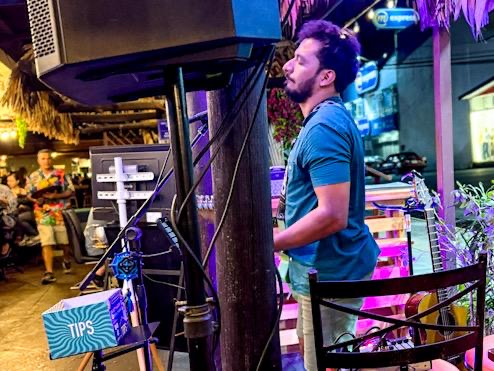
Later, we eat downtown at a place that was full when we tried it on Wednesday. Arriving earlier works. Everyone’s a tourist — I suspect this is how it will be for most of our time in Central America, especially here and Guatemala. We’re right next to tonight’s live music, a one-man band who creates bass and percussion loops, over which he sings and plays guitar. We get several Bob Marley classics and other international staples by U2 and Daft Punk. They’re songs that usually sound tired and worn, but watching him build them piece by piece makes them fresh again tonight. Even I find myself tapping my foot appreciatively. Praise indeed.
Sunday 8 February
After yesterday’s wildlife encounters, today’s ambitions are modest. I venture out only to drop off laundry and acquire a pair of those thick-soled flip flops stamped with pura vida. Arresting words, but it’s hard to feel their spirit as the rain seems to have moved in permanently. Since arriving on Monday, we’ve barely experienced a moment of sunshine.
Shortly before bedtime in Costa Rica, in Hong Kong Jimmy Lai receives a 20-year prison sentence. Unless used as a bargaining chip, he will almost certainly die in prison.
“(This) will go down in history as Hong Kong’s most shameful act of persecution of journalists and leave an indelible black mark on a city that was once the bastion of press freedom in Asia”, says the Committee to Protect Journalists, journalism’s ‘Red Cross’.
“When you have to invent a law and invoke it in retospect…”, quips a regular contributor to the comments section of the Big Lychee blog, finding dark humour where there’s very little to laugh about.

Monday 9 February
On the minibus, Johnny, our guide, is struggling with the lunchtime casado order. “Who wants chicken? Hands up again, please. Quiénes quieren pollo? Levanten la mano otra vez, por favor.” That seems to nail it. He darts effortlessly between English and Spanish, but some ears haven’t been paying attention. Our group today includes a party of ten Argentinians; the rest hail from Sweden, Amsterdam, and rural Michigan. Johnny repeats everything, sometimes starting in Spanish, sometimes in English. It’s precisely the kind of rough Spanish input I need, and I’m surprised how much I can follow.
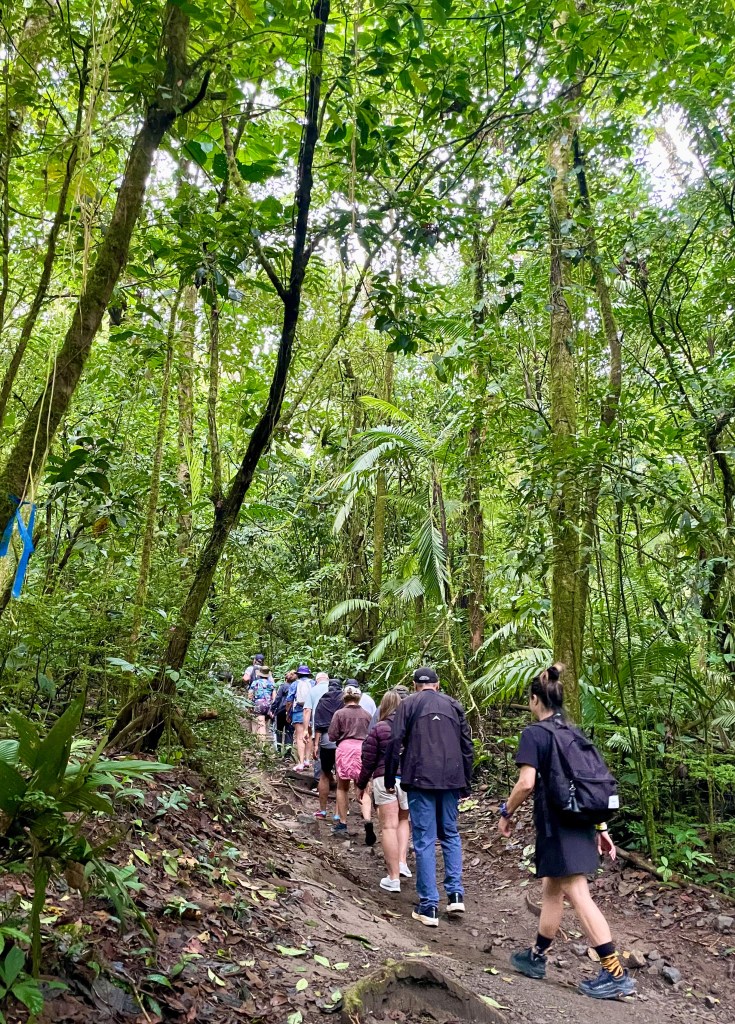
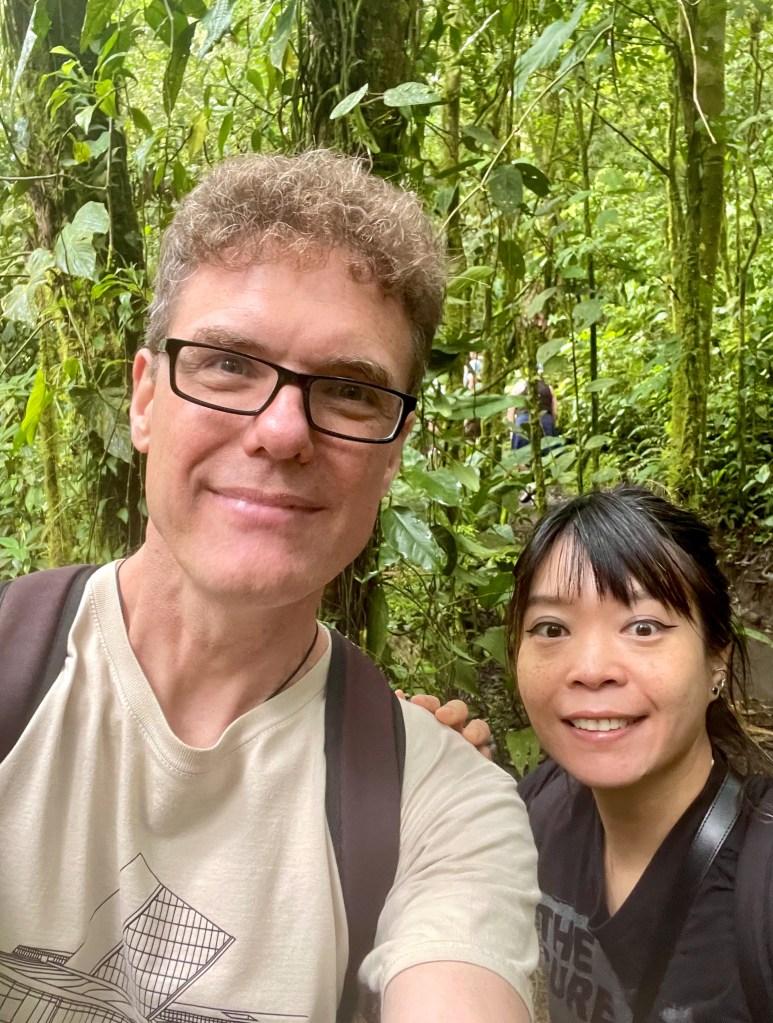
We’re heading a few miles out of La Fortuna to hike through the jungle up to an outcrop of lava on the lower slopes of Arenal volcano. On a clear day, we would have stunning views of the volcano cone towering over the surrounding jungle. But yet again the cloud is low and thick. As we climb an easy path into the rainforest, we’re realistic about our chances of seeing much beyond the person in front of us.
It stays dry until the moment we reach the lava field, where the rain immediately sets in. K and I reach for the cheap supermarket ponchos we brought for exactly this eventuality. The four Swedish girls are less prepared and disappear under their increasingly wet hoodies, which seem to offer more optimism than protection.
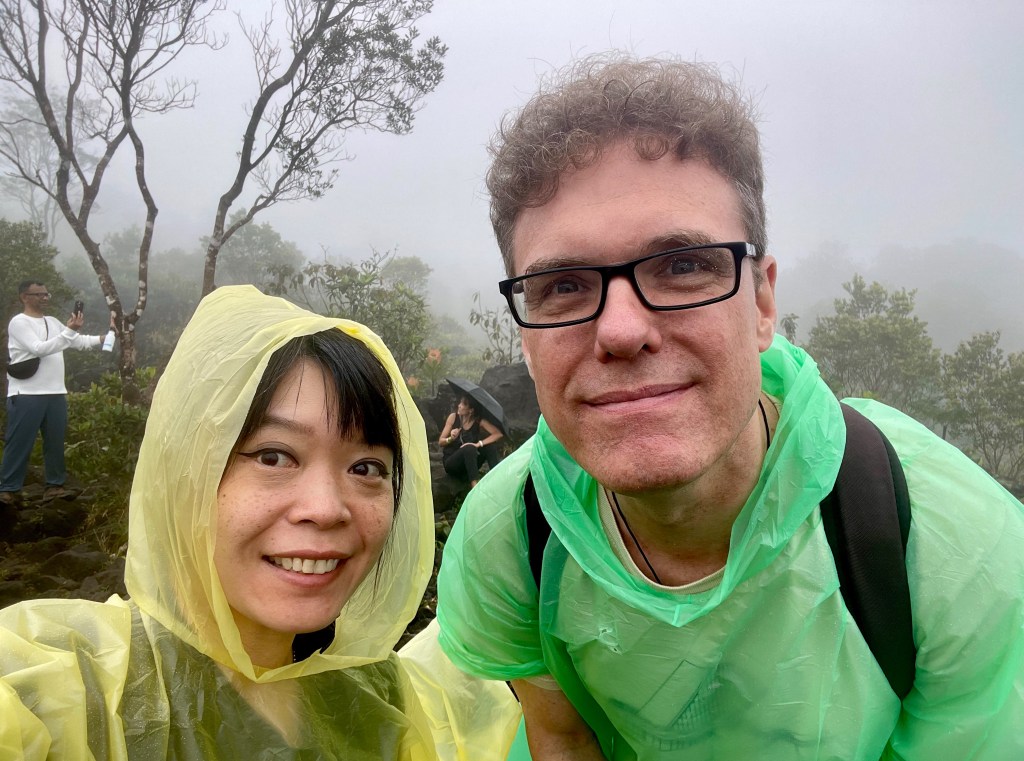
While there’s no dramatic view, drama arrives in its own small way when one of the Dutch group trips on the wet rock and tumbles in slow motion. She lands in a crumpled heap, narrowly avoiding bashing her head on a jagged lump of lava. Had she been a metre closer, I could have grabbed her before she fell. Fortunately, she’s okay. She’s nursing a nasty scrape on her forearm, which Johnny attends to with a first-aid kit.
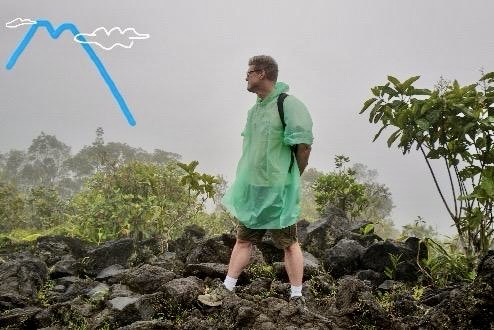
Once she’s patched up, we trudge back down in steady rain to a shelter near the trail head where our casado picnic lunches are waiting. We chat with the couple from rural Michigan and, at their prompting, I find myself recounting my Greyhounding trip across the American heartland almost forty years ago.
Back at the trail head, there’s been a mix up and we wait a long, wet half hour before our minibus finally collects us and takes us to a nearby spot to bathe in the volcanically-heated river. It’s a popular place, and our party of twenty doesn’t help the congestion. We find space in the middle of the current, where I clutch my new flip flops tightly to stop them floating off downstream. It’s a lovely setting deep in the jungle, the warm volcanic water at odds with the dismal rain falling on our exposed heads.
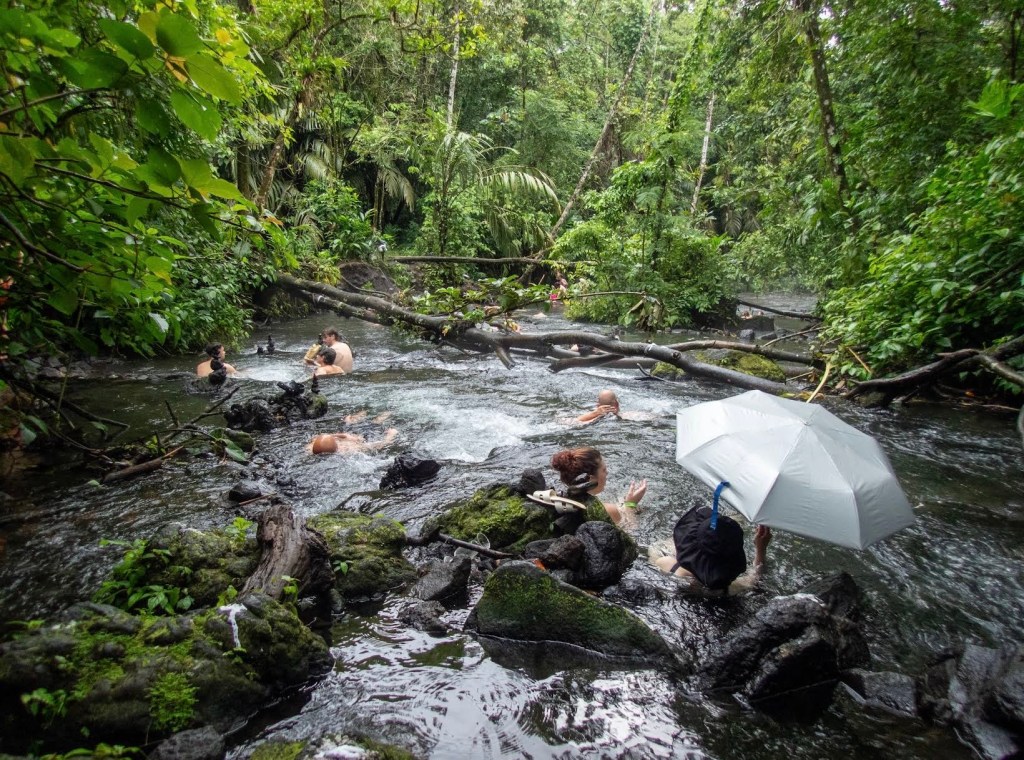
Back in the minibus, we scramble into as many clothes as we can in the cramped space. As we ride back to La Fortuna, I regularly wipe the mist from the window to peer out at the rain. We arrive back at Volcano View (the irony) with an armful of damp gear. Thankfully, we still have two days to coax it dry. That may be optimistic.
Tuesday 10 February
Another quiet day. It’s raining when I wake up. It’s still raining well after dark. Never mind. We had no plans anyway. Instead, we spend time researching destinations and flight prices. We leave the flat only for afternoon coffee. At the café, curious, I run full paragraphs of my Isabel Allende book through Google Translate. I want to see if I can make sense of the Spanish. I can. This is promising.
Wednesday 11 February
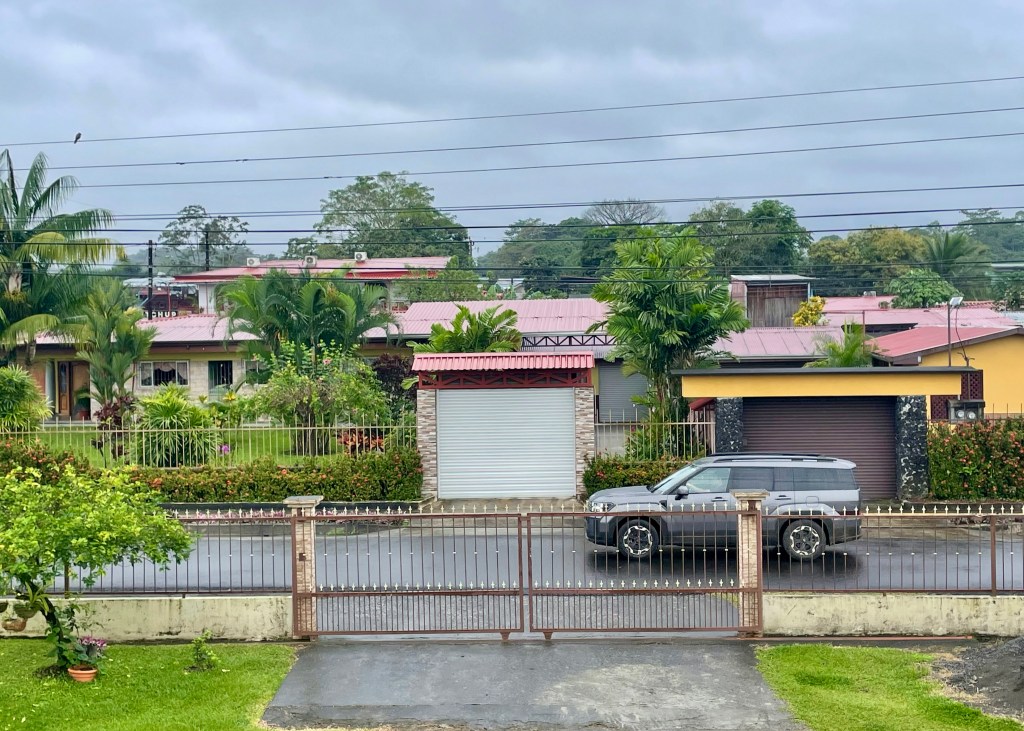
The rain doesn’t let up, so we stay indoors all day tending to travel and life admin. In our ten days here, La Fortuna has offered two kinds of weather: rain or looks-like-rain. A shame. This is how La Fortuna was supposed to look:
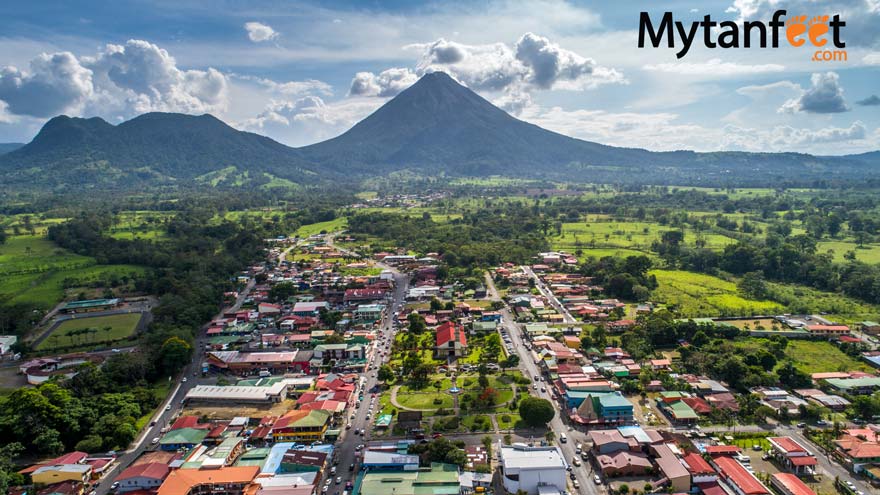
Too bad we didn’t see it in its full glory.
Dinner is on the town’s main square, talking through possible adjustments to our rough itinerary for 2027 over soft shell tacos.
We’re off to San José tomorrow for a couple of nights, then on to the Pacific coast, where we’re hoping for clearer skies.
 Two On Tour
Leave a comment