It’s our first time in Africa, exploring the pink desert oasis in the shadow of the Atlas Mountains, and the road to the Sahara desert.
Tuesday 16 September
Our taxi driver for the short ride from Crawley to Gatwick is a young Romanian who’s lived in the area for many years. He’s full of suggestions about what to see and do in Romania. But his advice will have to wait for another time. Today we’re flying to Marrakesh.
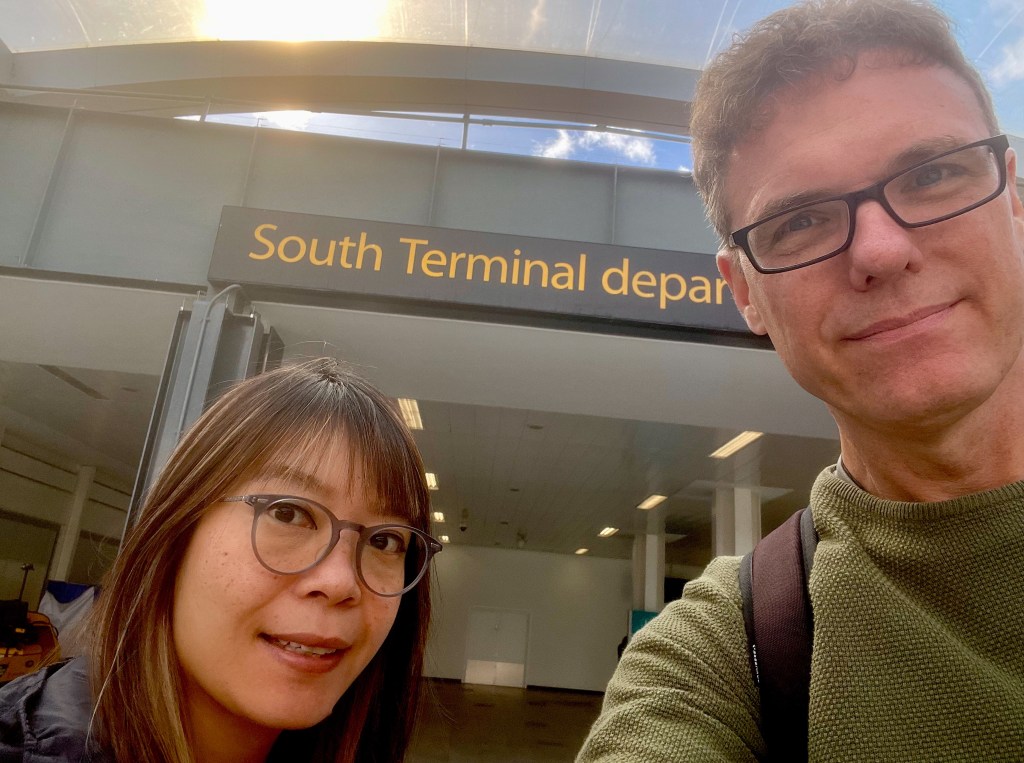
As we finish lunch at the airport, I quickly check that no new editing work has come in. Much to my chagrin, it has. I spend the following hour in the departures lounge with my laptop balanced on my knees tapping away. I manage to complete the job and snap the lid shut just as our gate is indicated.
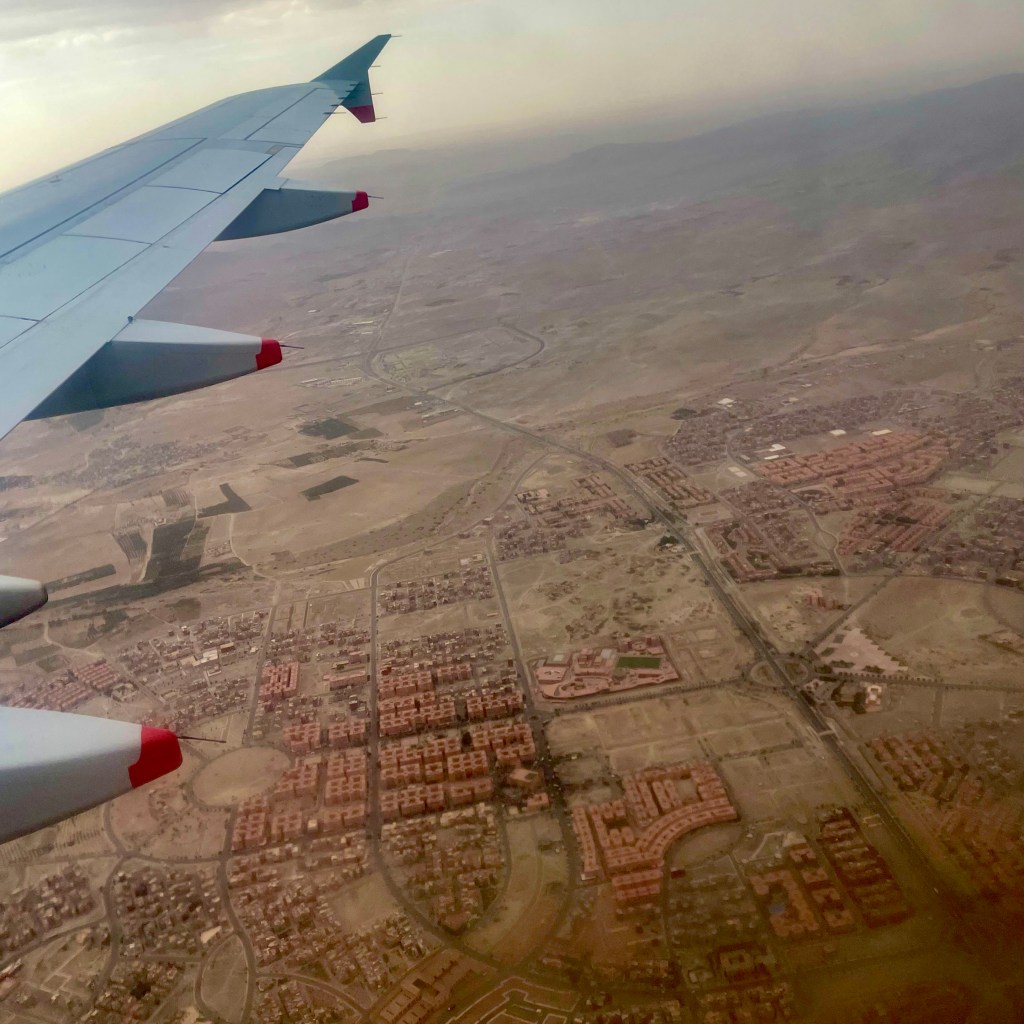
For a change, I have a window seat for the three-hour flight down to Marrakesh. I follow the geography below as much as I can before the reflection of the sun off the wing becomes too bright and I reluctantly pull down the shutter.
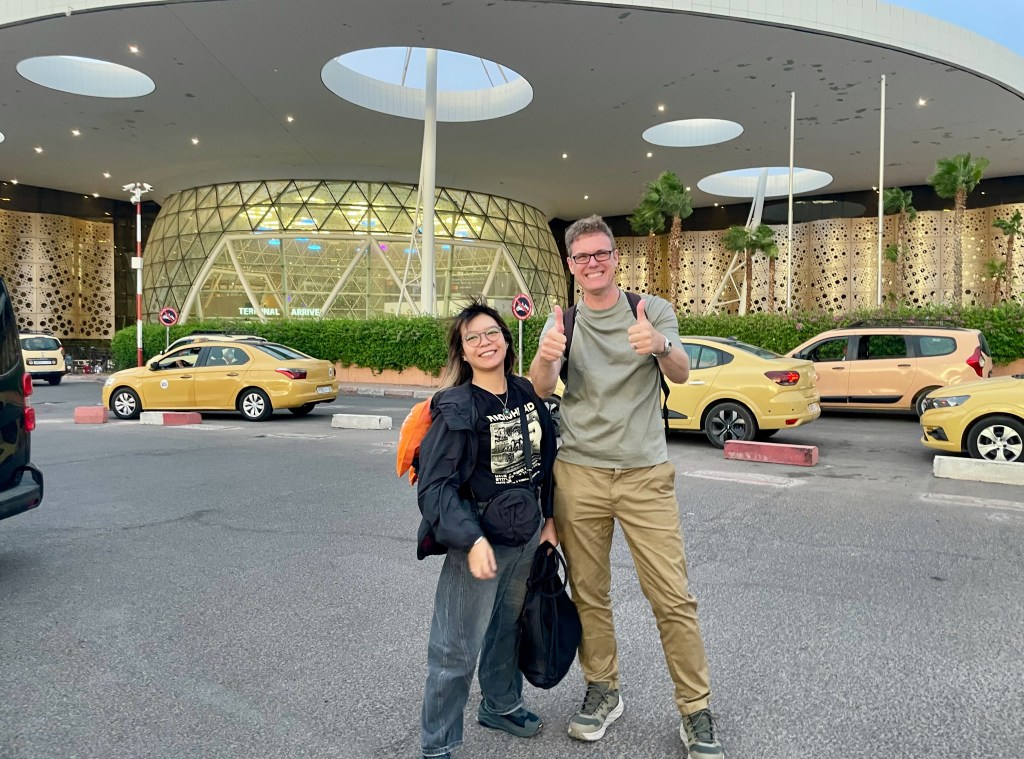
I only pull it back up as we prepare for landing. The harsh landscape looks even more ominous as Marrakesh is shrouded in patches of thick rain cloud. We navigate the architectually stunning airport smoothly, picking up SIM cards and local currency from an ATM that, according to online chat, doesn’t charge exorbiant fees. Our (English-speaking) driver is outside to greet us and drive us to Riad Amina.
I love Marrakesh immediately. Spots of rain fall as we drive into the city past fields of olives. We reach the magnificent medieval red city walls, where the driver darts through and weaves through the medina to our riad. (We’re both reminded of Chiang Mai, as reimagined in the north Africa desert.) The streets become narrower and narrower until we stop opposite a tight alley, from where a cheerful young man called Mohammed steps out to guide us to the riad. We wheel our suitcases through a maze of gloomy passages until we reach a heavy cast-iron door. Mohammed knocks, the door opens, and we step into Riad Amina.
Peaceful bliss is my first impression. We’re served hot sweet mint tea and some small slabs of some sort of coconut cake, and left to soak in the atmosphere of the courtyard until we’re ready to check in. Our room, on the ground floor overlooking the courtyard, is adequate (more stylish options are available for those operating on larger budgets). It has an impossibly high ceiling and cool terracotta tiles. It’s modest, but it certainly beats the Barrington Lodge in Crawley last night.
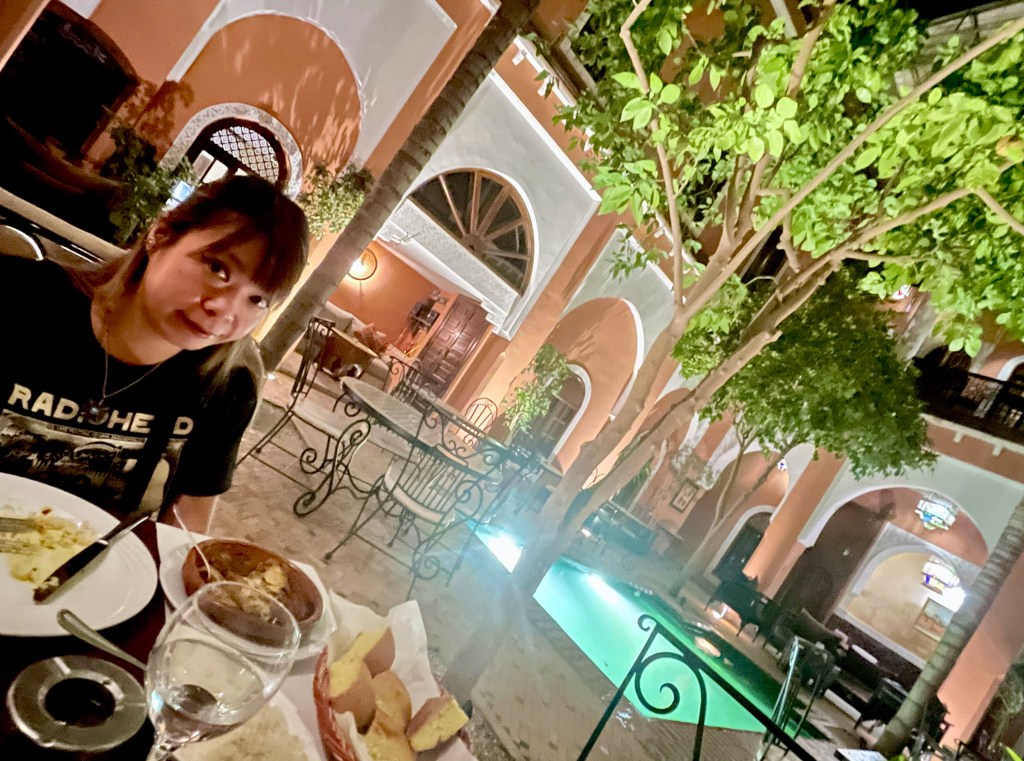
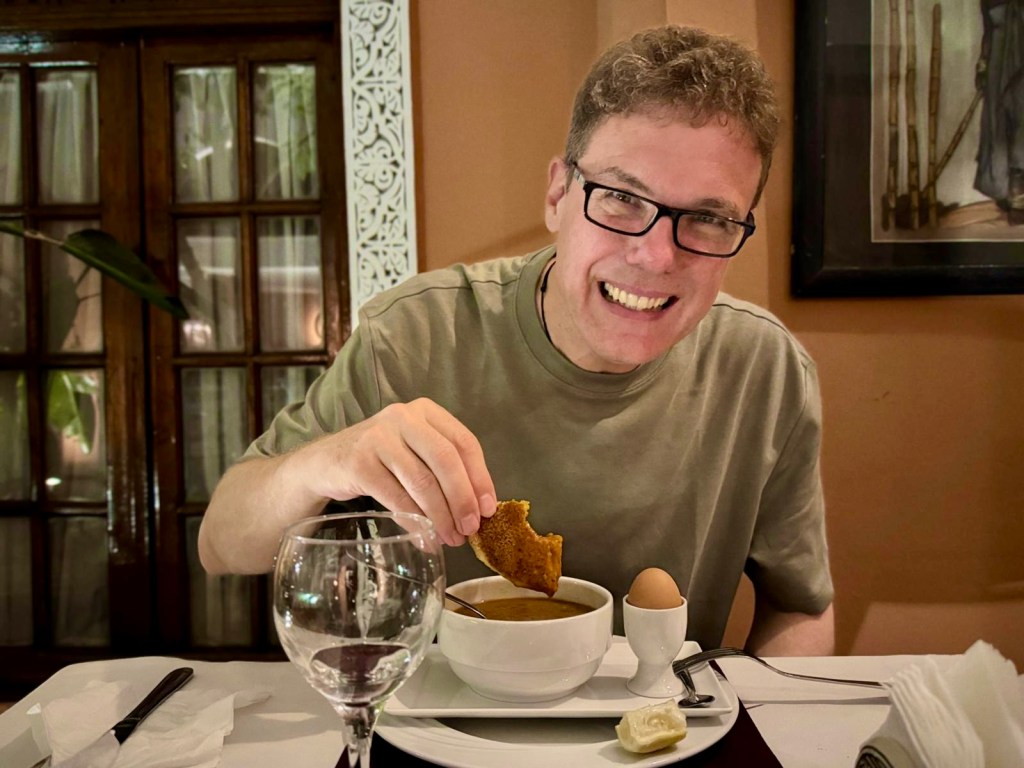
We step back out into the courtyard to eat: fish patilla for me, chicken tajine for K, both preceded by a steaming bowl of delicious harira soup. And to think that last night we were eating at Wetherspoons. We’re alone in the courtyard tonight. It’s silent except for the sound of trickling water in the small pool.
Before we retire for the night, we chat with Keltoum, the manager. She’s effortlessly charming and helpful. It’s been a good start. The madness can wait until tomorrow.
Wednesday 17 September
I’m the first person to arrive for breakfast at Riad Amina. The tourist season is only beginning to stir in Marrakesh, yet by the time I finish my pancakes, msemem and yoghurt, every table is occupied and a gentle babble of French, English and Arabic wafts over the tranquil courtyard.
It’s already late morning when we step out to explore in the baking heat. Marrakesh is a frenzied tangle of life—colourful, chaotic and congested. Scooters weave through the medina alleyways, swerving wildly to avoid defenceless pedestrians. It’s an emporium of art and craft: hundreds of tiny shops display their wares of carpets, rugs and cushions, tidily arranged nuts, brightly coloured soaps, polished leather bags, traditional Muslim attire, fly-blown meat cuts, and garish tourist trinkets. We have a vague plan to wander south towards the centre of the medina, but quickly abandon any attempt to follow a route suggested by our guidebook. The medina is simply too much of a warren, and every lane is equally appealing.
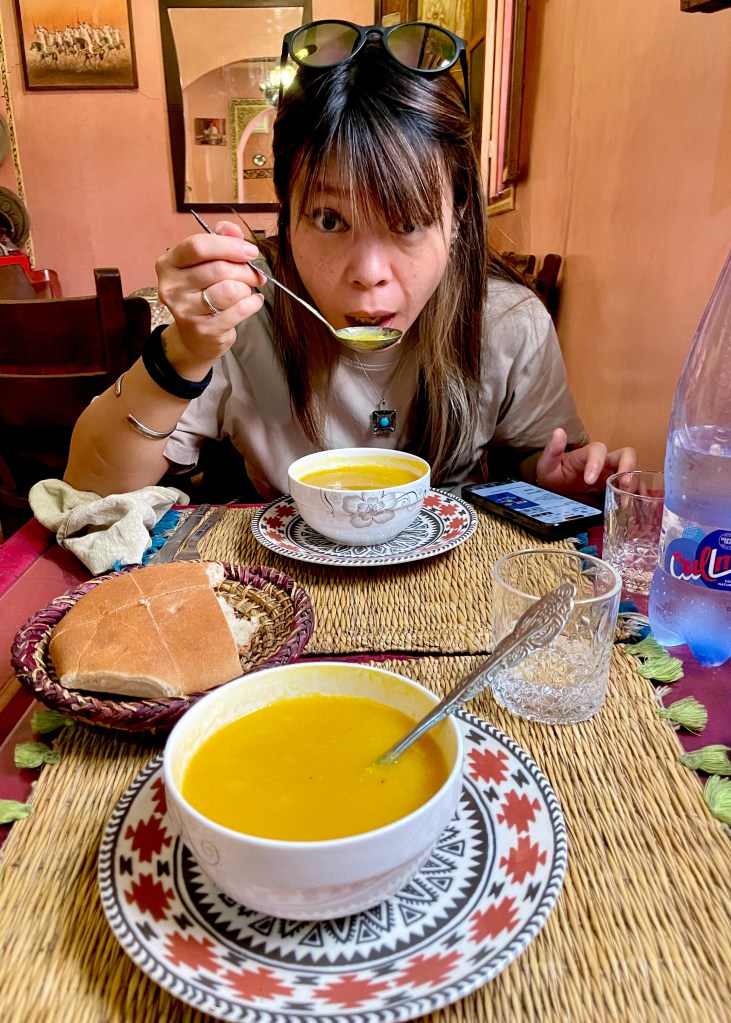
We eventually retrace our steps back to a small upstairs restaurant we spotted earlier, and head up and inside for lunch. We’re the only customers. The menu is in French only, which suits me fine—finding my feet in French with other non-native French speakers is part of the appeal of Morocco for me. We both order a bowl of potage aux legumes and a large bottle of eau gazeuse and tuck in.
Revitalised, we continue feeling our way through the medina, eventually arriving at Jemaa el-Fna. ‘La Place’ is underwhelming in the harsh early afternoon sun, besides which large sections of it are fenced off (repaving work?) After a cursory loop around the square, we once again dive into the maze of the medina, eventually finding ourselves quite by chance outside the intriguingly named Museum of Confluences.
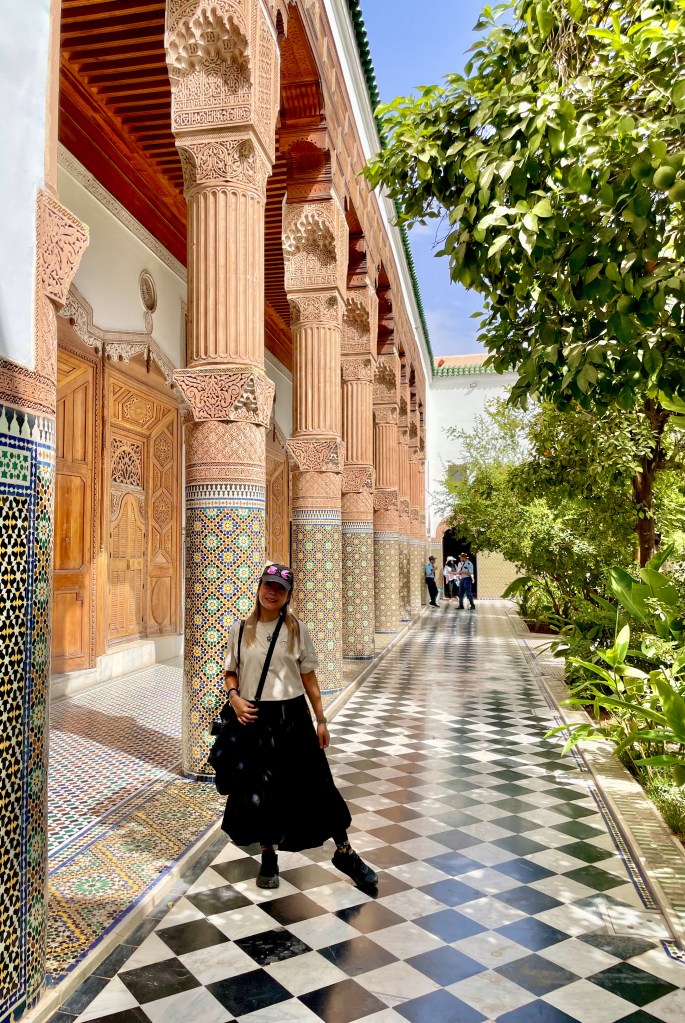
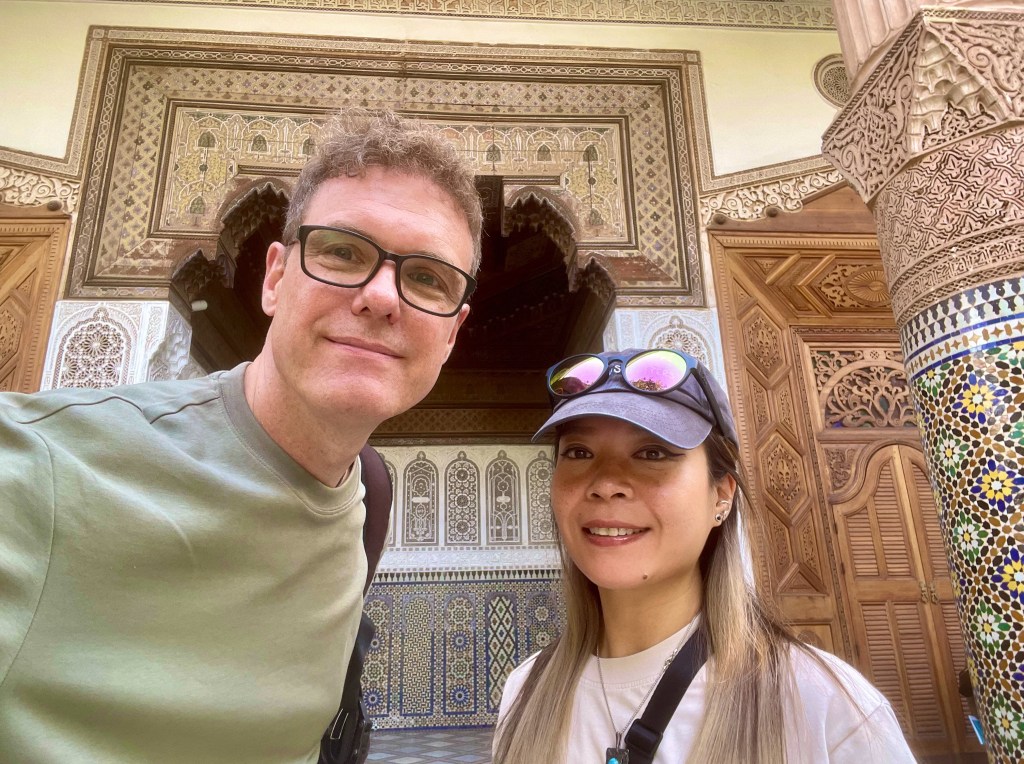
The Museum of Confluences turns out to be another restored riad arranged around a central garden planted with orange and quince trees laden with fruit. The various rooms showcase different Moroccan crafts such as weaving and ceramics, but the real attraction is the beautiful architecture of the riad itself, all geometric tile work that rivals the best of Turkey.
After a pitstop for coffee, we retrace our steps to Riad Amina to relax until we feel hungry enough to step out for dinner. Like yesterday when we arrived, the air is thick and heavy with imminent rain. Earlier we spotted another tiny upstairs restaurant not far from our riad. We find it and climb two floors to the covered rooftop terrace. Once again, we’re the only customers. A stiff breeze is blowing as dusk falls on Marrakesh. The terrace lamps are swinging wildly as spots of rain fleck our faces and bright bursts of lightning race across the sky to the south. Eventually, the rain can hold off no longer and we’re forced to retreat to the ground floor to eat. The food is simple and hearty. By the time we’re ready to leave, the storm has passed and the flagstones in the lane outside are already dry. We head back to Riad Amina. Day 1 in Morocco has gone very well indeed.
Thursday 18 September
Day 2 in Marrakesh. Once again, it’s late morning before we’re ready to step out from the tranquility of Riad Amina. We dive into the chaotic medina, soon stopping for a lunch of gazpacho (Andalusian, not Moroccan) at another tiny rooftop restaurant. We’re under a sun umbrella, but when the sun comes out (it’s been overcast and damp all morning), my head is slightly exposed. Rather than do the sensible thing and slip on my hat, I stick it out because we’ve almost finished lunch. I’ll regret this later in the day.
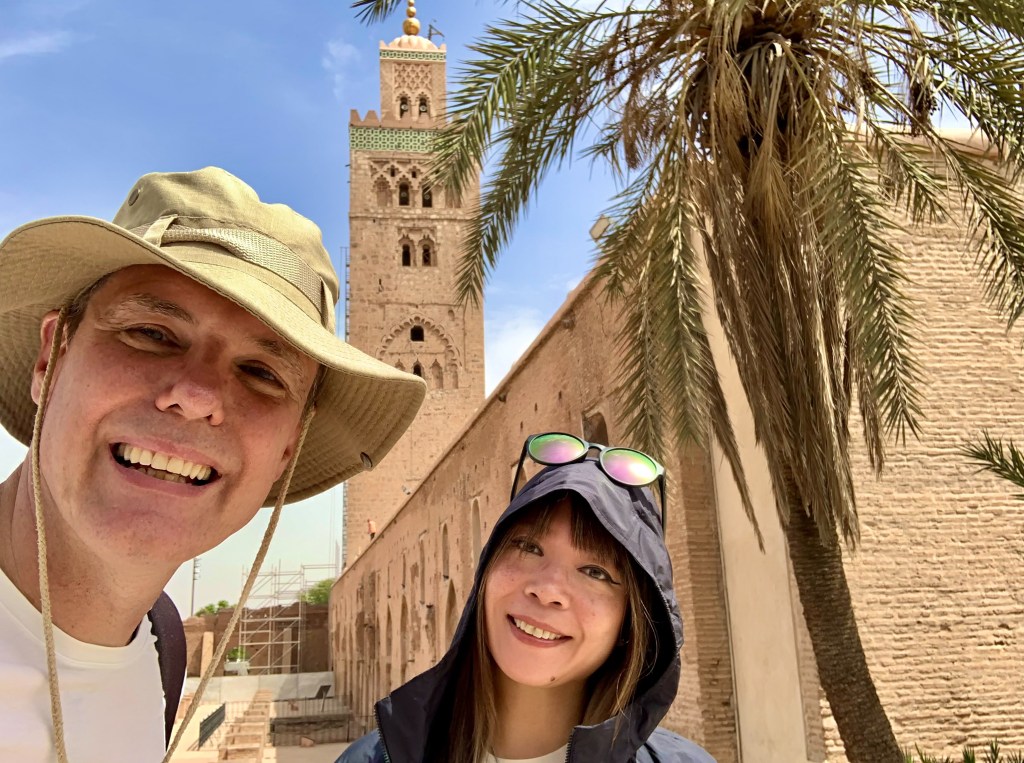
We want to visit the grounds of the Koutoubia Mosque, wander in adjacent Park Lalla Hassana, and gawp at the luxurious La Mamounia (the hotel Paul McCartney sang about on the eponymous song from ‘Band on the Run’). We do all these, but even with headgear, we’re desperately exposed in the powerful sunlight. By the time we retreat back into the shady lanes of the medina after half an hour, we’ve had more than enough sunshine for the day. We set off for the House of Photography.
The House of Photography is a small museum housed in yet another riad on a dusty backstreet, displaying some of the earliest photos taken in Morocco that date from the 1880s. It’s well worth the hour we spend there. After afternoon coffee nearby, we retrace our steps to Riad Amina to rest for a couple of hours. I sit under the roof terrace reading as thunder rumbles nearby and the late afternoon turns once again to rain.
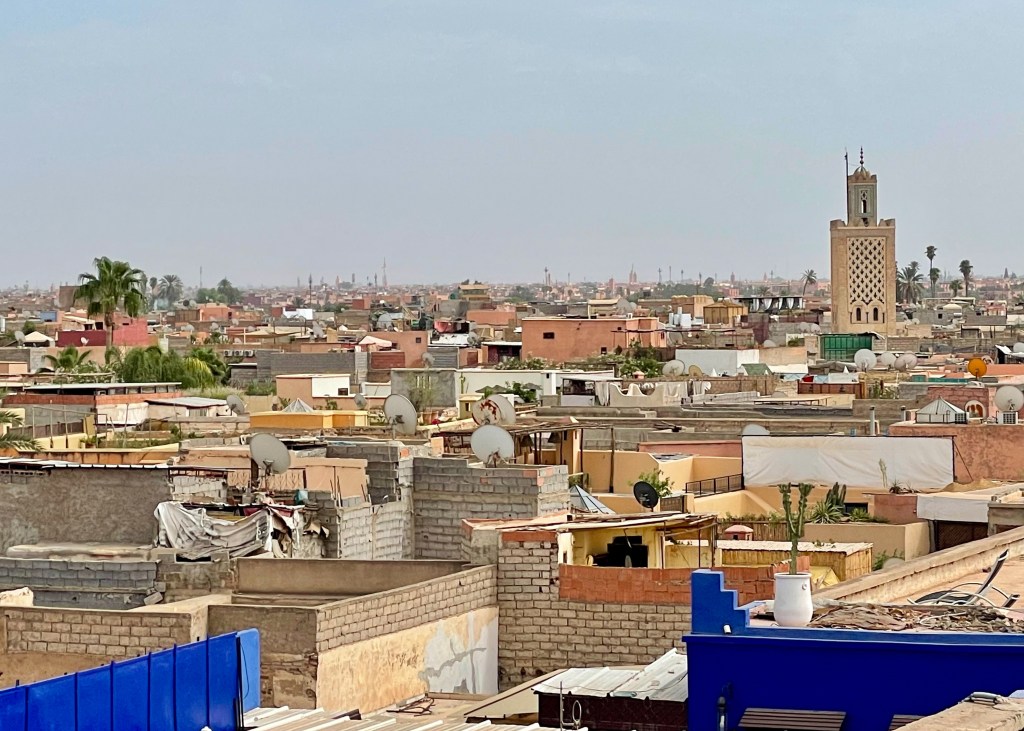
We head back into the medina in search of dinner. We identified a place earlier, close to other tiny restaurants we’ve eaten in. We climb to the roof terrace to discover that, once again, we’re the only customers. I know it’s early in the tourist season, but the souks are full of tourists. Where do they all go to eat? We don’t necessarily want to join them; we’re just curious where they are. I assume ‘La Place’ is teeming, but it’s a long walk, and I now have a splitting headache courtesy of that direct sunlight on my head at lunchtime. We feel a little isolated as we tuck into our tajines alone on the rooftop (without a view). But we soon attract the company of two hungry street cats.
Back at Riad Amina, I soon fall asleep, shaking off a mild dose of sunstroke.
Friday 19 September
A very different day today. After two days of weaving our way through the narrow lanes of the medina souks, today we strike out to visit the nouvelle ville. We’ve no particular plan; we simply want to get a feel for modern urban Morocco before we arrive in Casablanca on Monday.
We stop for a lunch at a modern cafe on a street corner. I order a couscous au poulet as I’ve read it’s the traditional Friday meal in Morocco. But I’ve forgotten how big a serving I received when I ordered the same dish at a restaurant a couple of evenings ago. For lunch, it’s easily enough for both of us. But K’s happy with her quinoa salad and declines to help me out. I won’t need a big meal tonight.
With full stomachs, we locate a big Carrefour in a modern mall nearby. The mall is air conditioned, and we’re happy to linger. We spend half an hour checking out the supermarket, getting a feel for what’s available, and at what price. It’s all good reconnaissance for our much-anticipated return to a life of self-catering next week.
Leaving the air conditioning, we step back onto the hot street to locate any of the several art galleries in the Gueliz neighbourhood. We see a sign for the Musee d’art et de Culture de Marrakesh and decide it will do just fine. The entrance fee is an eye watering €15 each, but we’re already inside and it’s hot out there, so we grudgingly pay up and enter.
No wonder we’re the only visitors: it’s mildly diverting, but certainly not worth the entry fee—especially given that it’s tiny. Thirty minutes later we’ve already given our full attention to every painting and photograph, and we’re back on the sweltering street in search of coffee. A nearby cafe obliges us with two cafe normales, which perks us up for the hot forty-minute walk back to Riad Amina. (A taxi would be an option, but it’s not as if they’re air conditioned. And we’d have to deal with taxi drivers.)
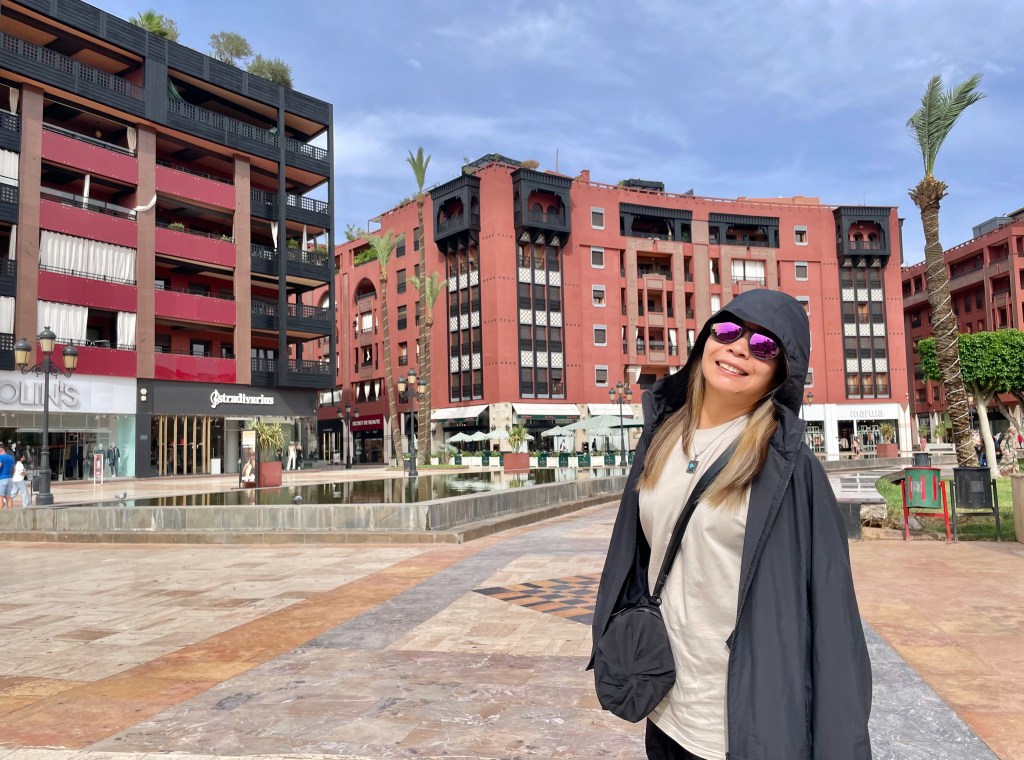
Back at Riad Amina, we kick back for a couple of hours. In search of a restaurant where we won’t be the only customers for dinner, we spy a place five minutes from Riad Amina where we can see two couples eating on the rooftop terrace. We climb up and join them. I order a modest falafel bowl, K a pastilla. They turn out to be good choices, although this time it’s K’s turn to struggle to finish her food. They have zero alcohol beer, too. I’ve missed having any kind of beer with dinner since we arrived in Marrakesh. Into the desert tomorrow…
Saturday 20 September
A little before 8am, K and I climb into a Toyota Landcruiser and we glide off through the still quiet streets of Marrakesh. We were expecting to be part of a larger group; instead, we find that we have a private tour. Our guide, Omar, speaks excellent English (his fourth language) and is equally excellent company. By nine o’clock we’re climbing into the spectacular Atlas Mountains, stopping for a cafe normale at a roadhouse minutes before it’s overrun by groups from minivans and even a full-size coach.
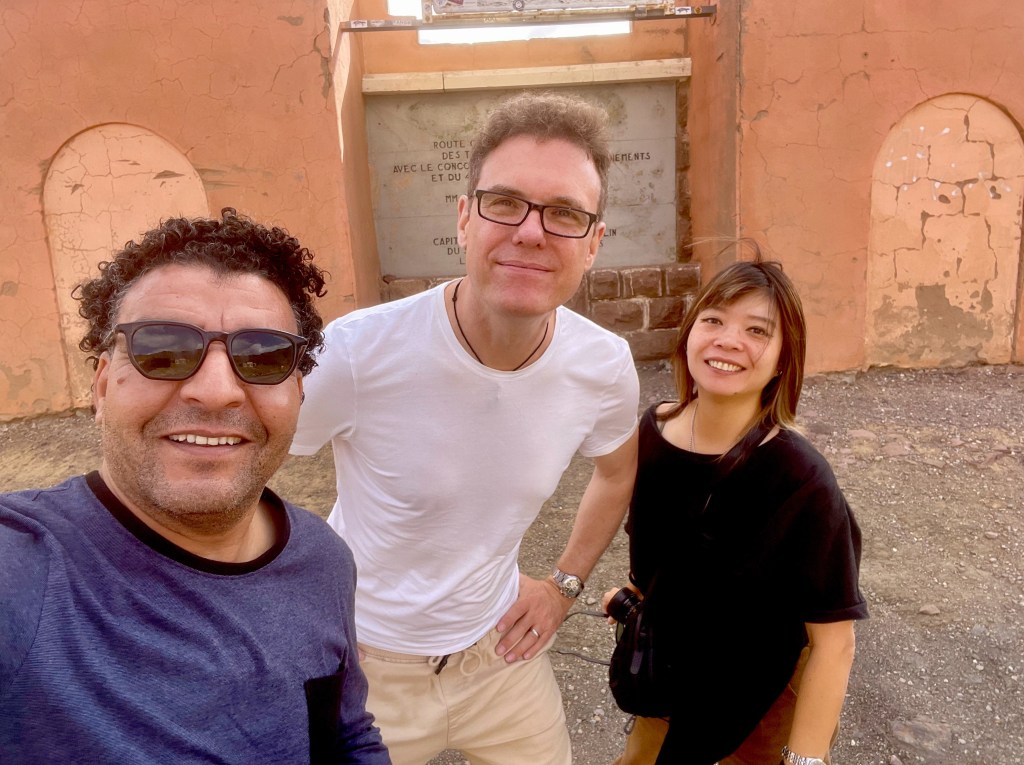
As we cross the highest paved pass in the Atlas Mountains, the temperature drops to a balmy 18 degrees. It soon climbs again as we ease down into the plain below, passing scattered villages that were half destroyed in the earthquake of 2023. From the comfort of our Landcruiser, it’s sobering to reflect that many people died here.
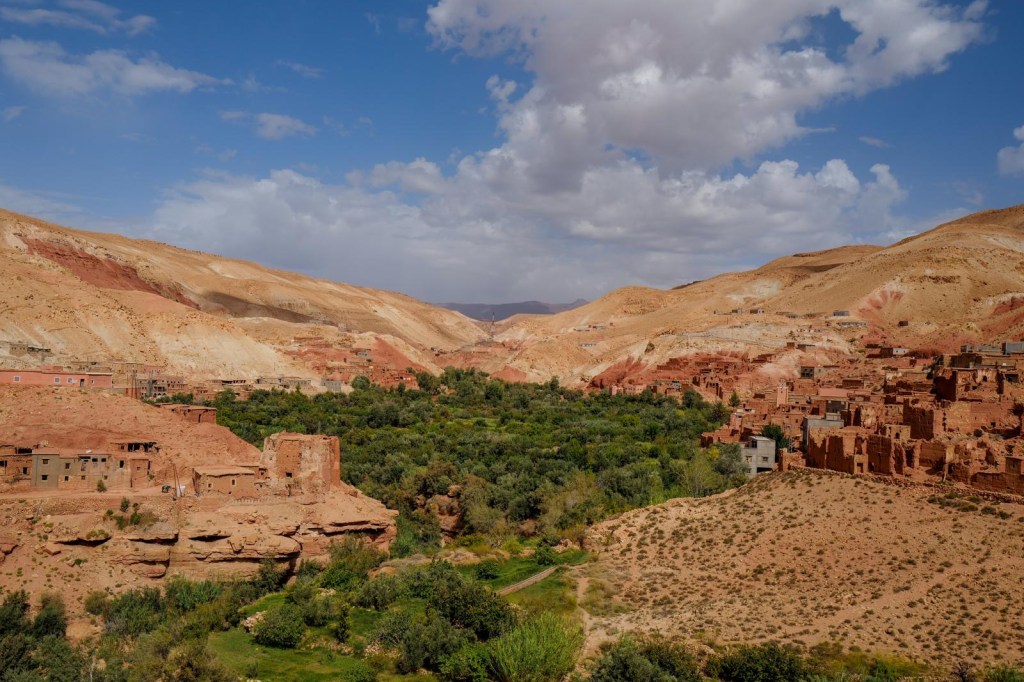
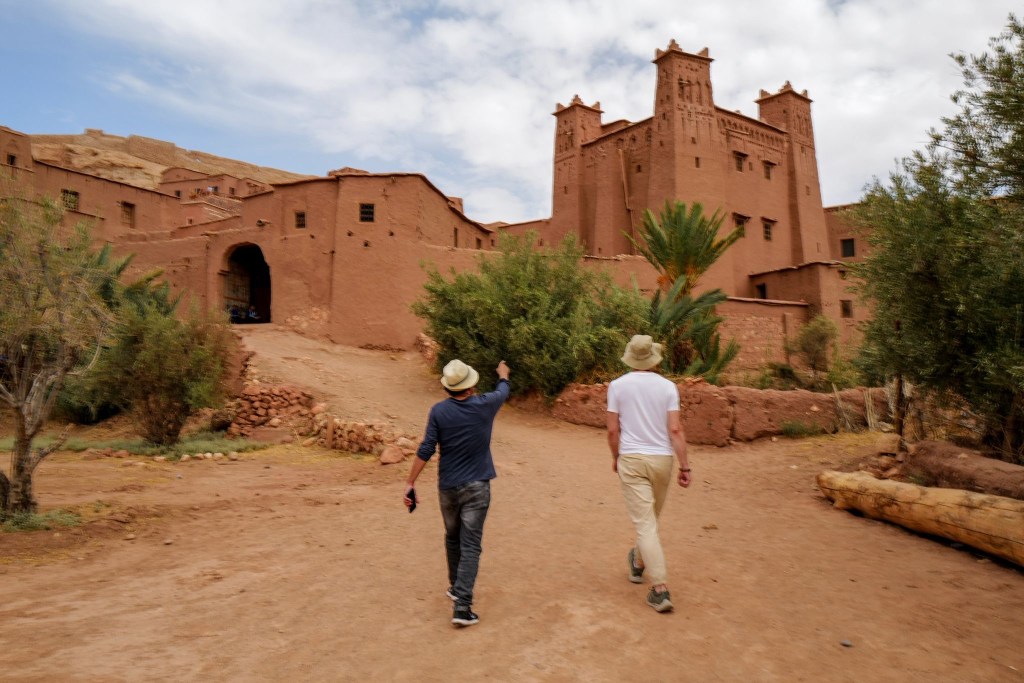
We arrive at Ait Benhaddou, a historic ighrem along the former caravan route between Timbuktu and Marrekesh, where Omar takes us up into the old adobe buildings. We’re far from the only ones there: the narrow lanes are thronged with tour groups, many Spanish speaking.
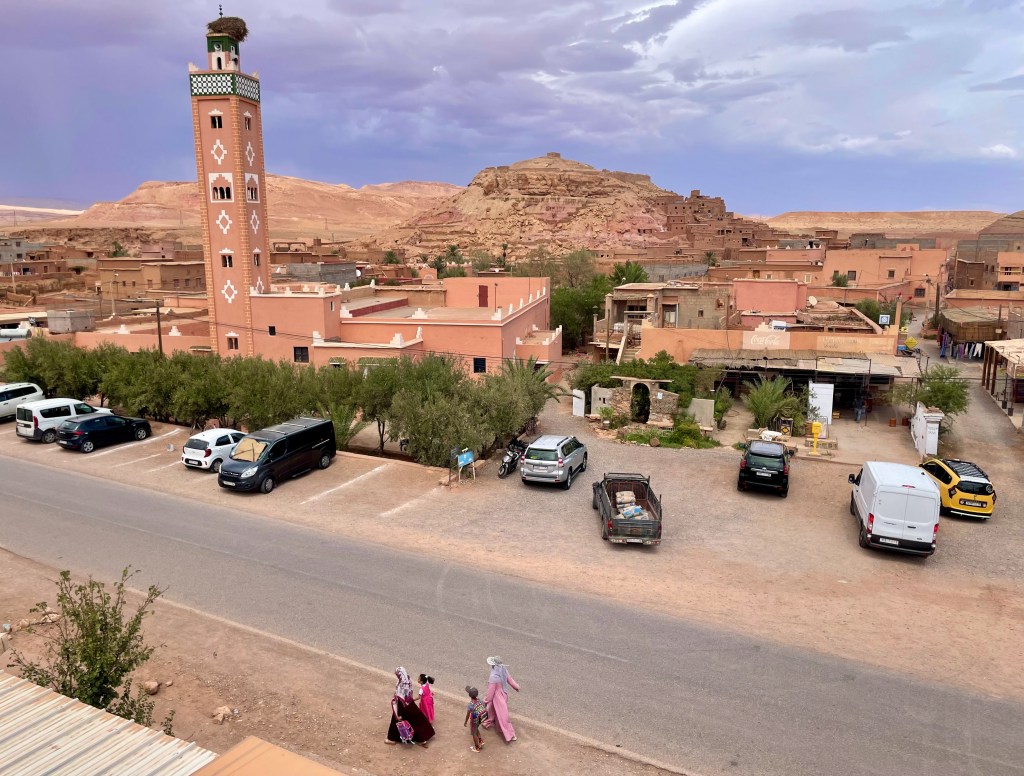
On the sheltered rooftop terrace of a restaurant on the main road, we pause for a lunch of omelettes. The sky is rapidly clouding over, and as we leave to continue south into the desert we feel a few isolated raindrops.
Not long after lunch, Omar is pulled over by the gendarmerie for an imagined minor traffic infringement. As he winds down the window, I’m surprised to see that the gendarmerie is a twenty-something woman wearing heavy makeup. Their conversation starts pleasantly enough but soon becomes heated. It’s not looking good. The young gendarmerie struts off to fetch her superior. Omar continues to remonstrate, but he seems to be on firmer ground. His license is returned along with an apology and we’re back on our way.
“The trouble is,” explains Omar, “these young gendarmeries barely know the law themselves. Often they’ve bribed their way through their training, or they secured their position through contacts.” He tells us that he explained to the young gendarmerie that what she had pulled him over for—crossing the central line to overtake a motorbike that was indicating right because another gendarmerie had pulled it over—wasn’t an offence at all, and that he would be happy to defend himself in court. They backed down. “You see? I know the law better than they do,” he quips.
As we head deeper into the far south, Omar laments the corruption that he says permeates everything in Morocco. I ask him what other issues Moroccans are currently riled up about. High prices is one, he says. The pitiful state of healthcare is another. Omar turns out to have tragically firsthand experience of inadequate healthcare: his firstborn child died shortly after birth when no surgeon was available, not only in his hometown but even in Marrakesh, to operate on his newborn son, who was born with part of his intestine exposed.
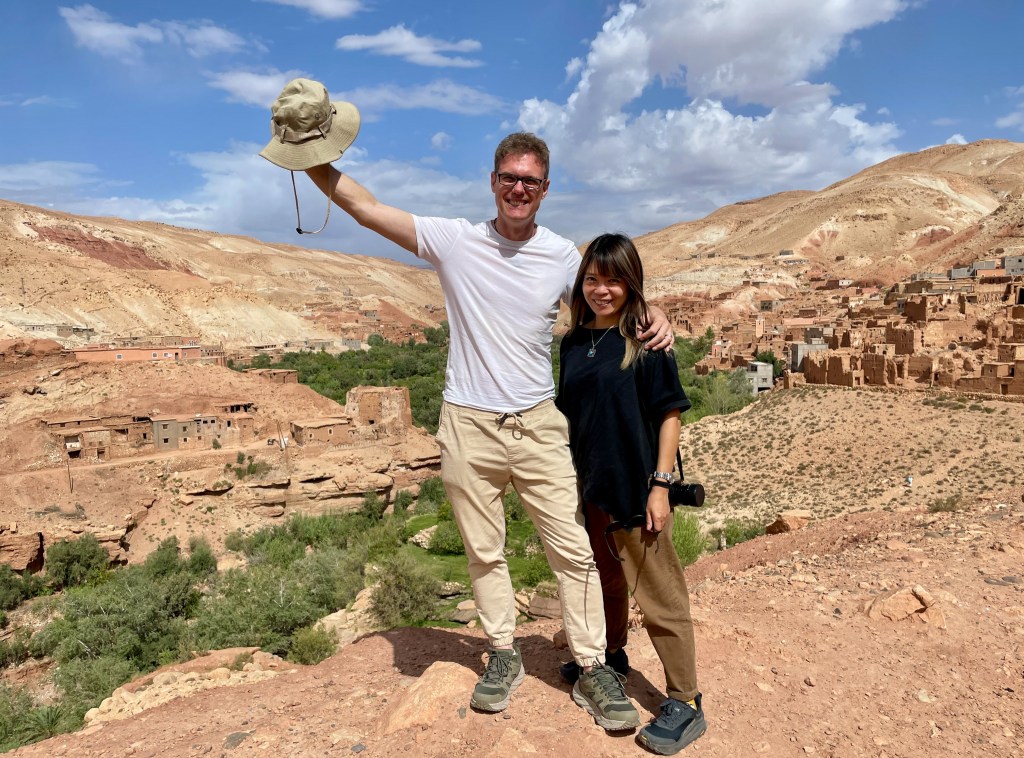
Omar hasn’t long finished recounting this personal tragedy when we start hitting patches of torrential driving rain. It’s as spectacular as it is unexpected. A fierce desert wind whips up clouds of dust just ahead of the rain, which clears the air and leaves a fresh small of damp earth as we wind our way along a long river valley carpeted in date palms.
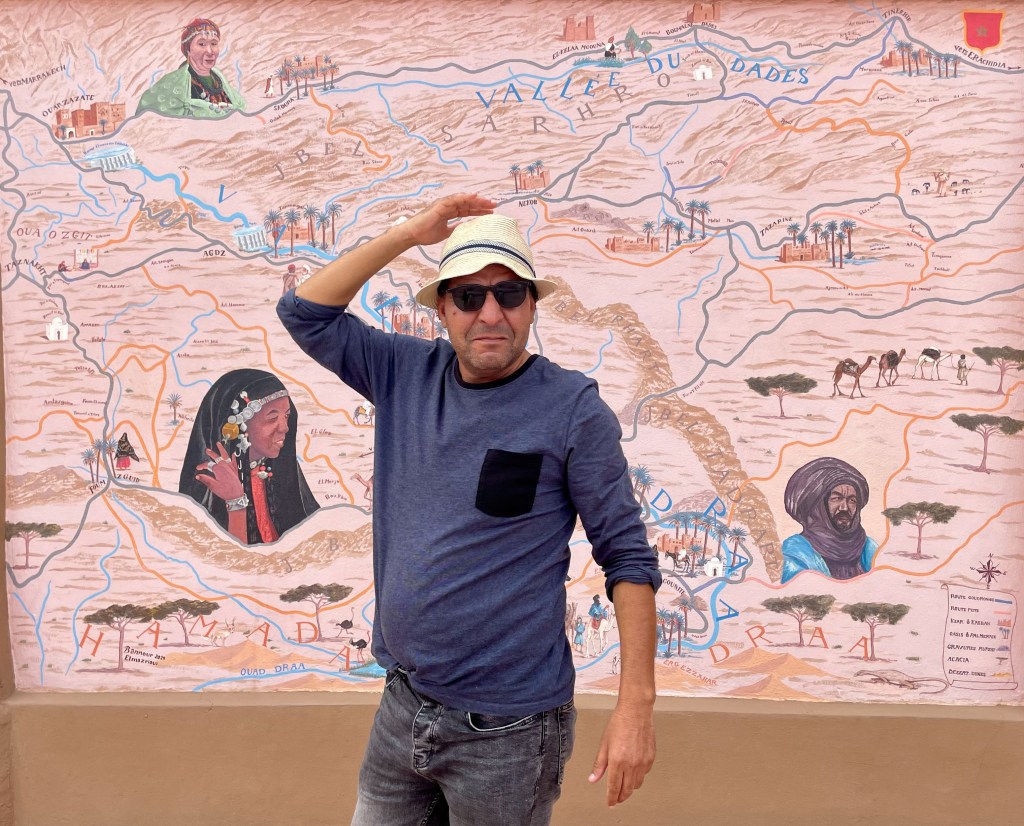
The rain continues to chase us all the way to Zagora, the last town of any size before the vastness of the desert. In Zagora, we briefly step out of the Landcruiser to study a municipal map of the area only to find ourselves barely able to stand, let alone breathe, in a violent dust storm. It seems touch-and-go whether we’ll be able to ride camels to the desert camp.
When we reach the camels, I struggle to pull on my light sun jacket that will offer my face some protection from the windborne sand. But when we plod off (it’s a strange feeling sitting atop a camel as it gets to its feet) the wind drops, the rain holds off and we spend the next hour crossing scenery that at times could be the surface of Mars.
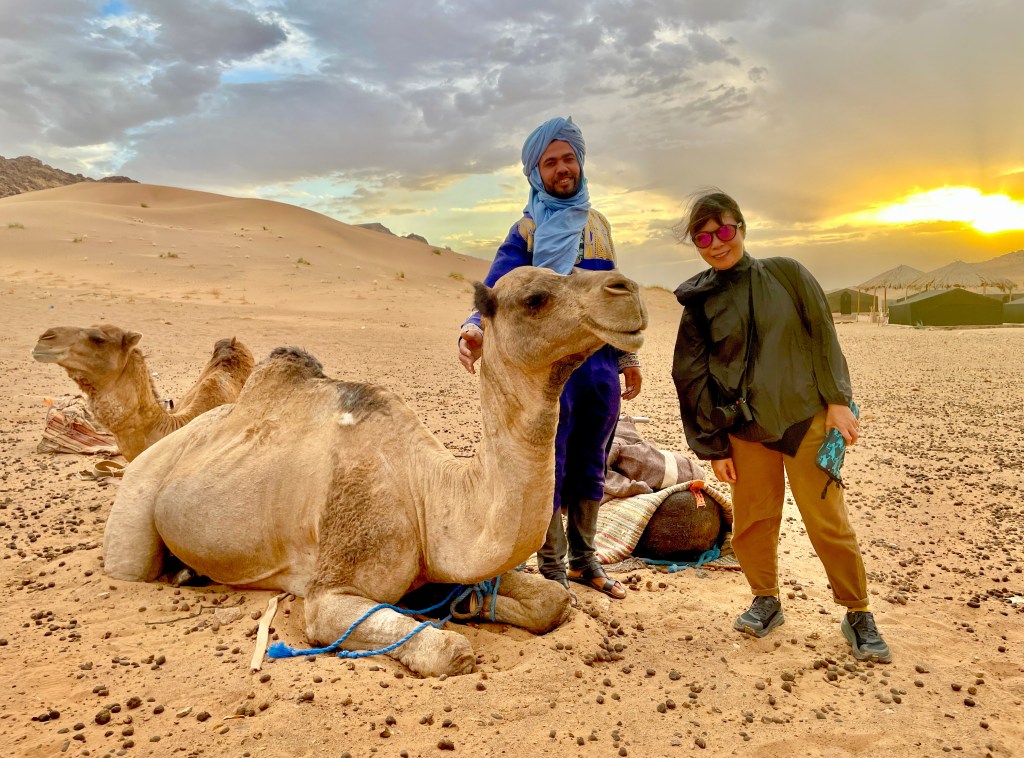
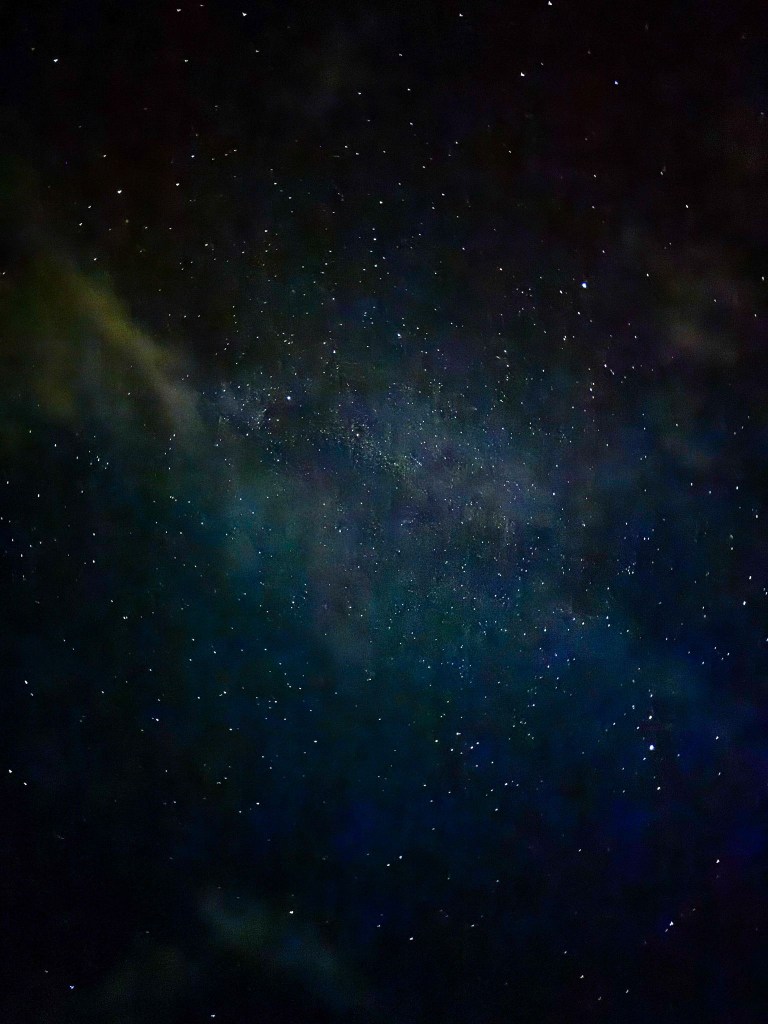
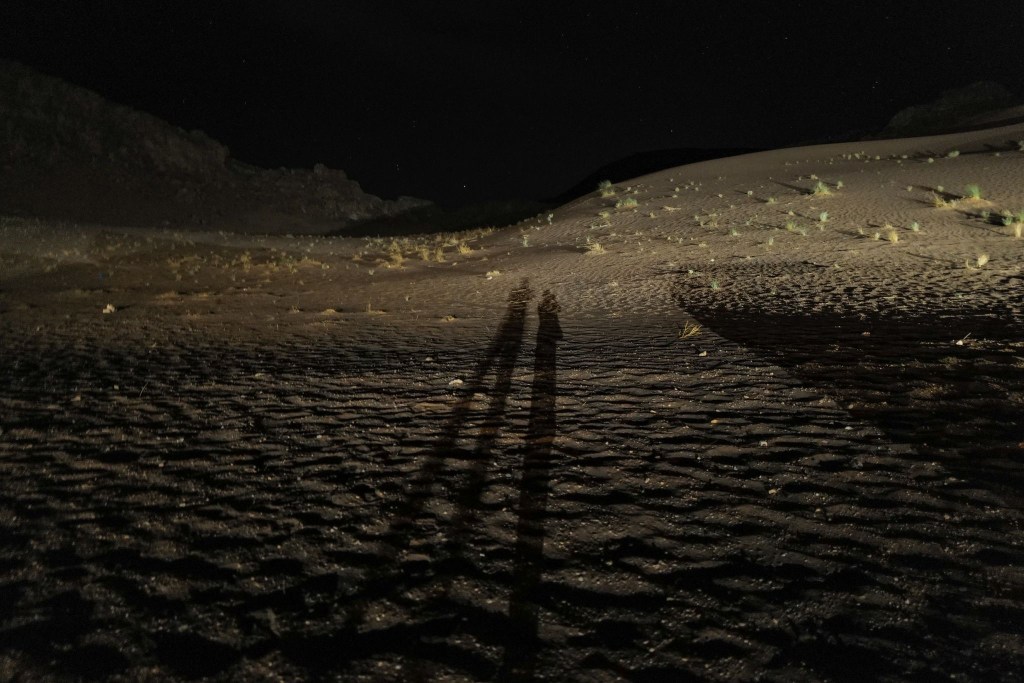
We arrive at the desert camp shortly before sunset. Right outside the camp is a real Saharan sand dude, which we scramble up to watch the sun disappear somewhere in the direction of Zagora town. After dinner, we feel too old to join the youngsters, both locals and tourists, playing djembes around the camp fire. We prefer to wander outside the camp and gaze up at the stars and the Milky Way in the desert night sky.
Despite our suede-lined tent being baking hot, we soon drift off to sleep.
Sunday 21 September
We’re up at dawn to climb a low sandy ridge close to the camp to watch the sun rise over the desert. Unfortunately, K and I have a misunderstanding about how long she’ll need to get ready, so I initially climb up alone and find a spot for us on a low rock among the other dawn chasers. I partly descend again to help K up the last stretch. She’s the last one to reach the top for sunrise, tired, thirsty and grumpy.
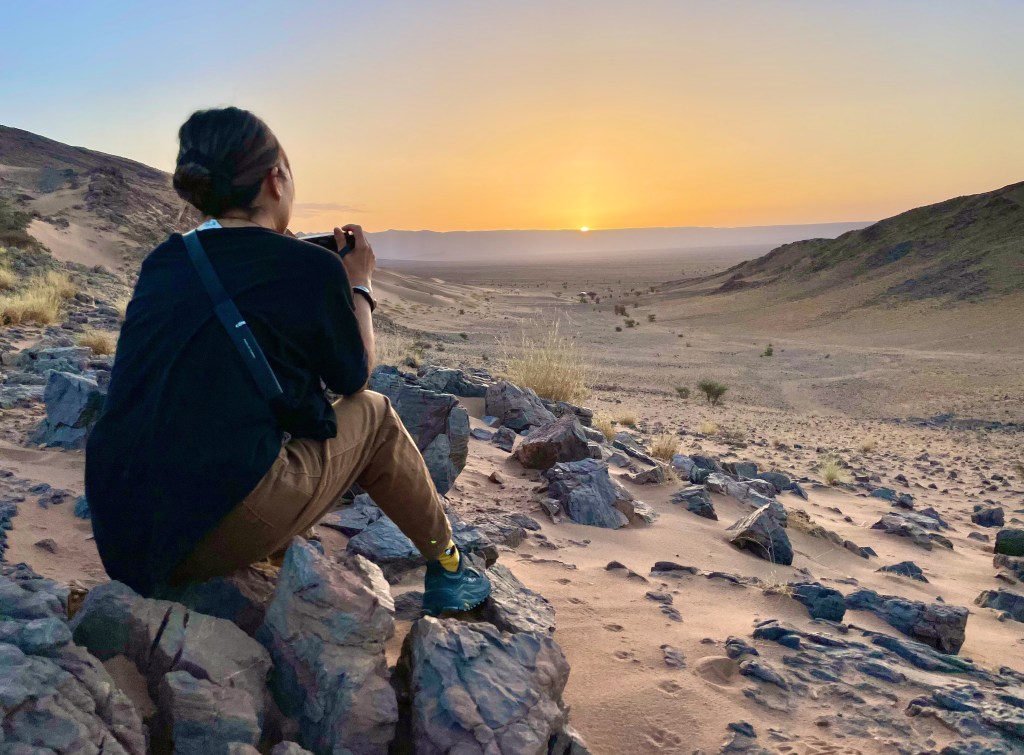
The sun rises and shortly after everyone heads back down to the camp for breakfast. K perks up with coffee, no matter how weak. As soon as we’ve finished breakfast, we’re back on the camels to trek back to our vehicles. Both of us are already camel sore, so it’s some relief when the return trek turns out to be much shorter—our vehicles have come an extra mile or so up the nearby road.
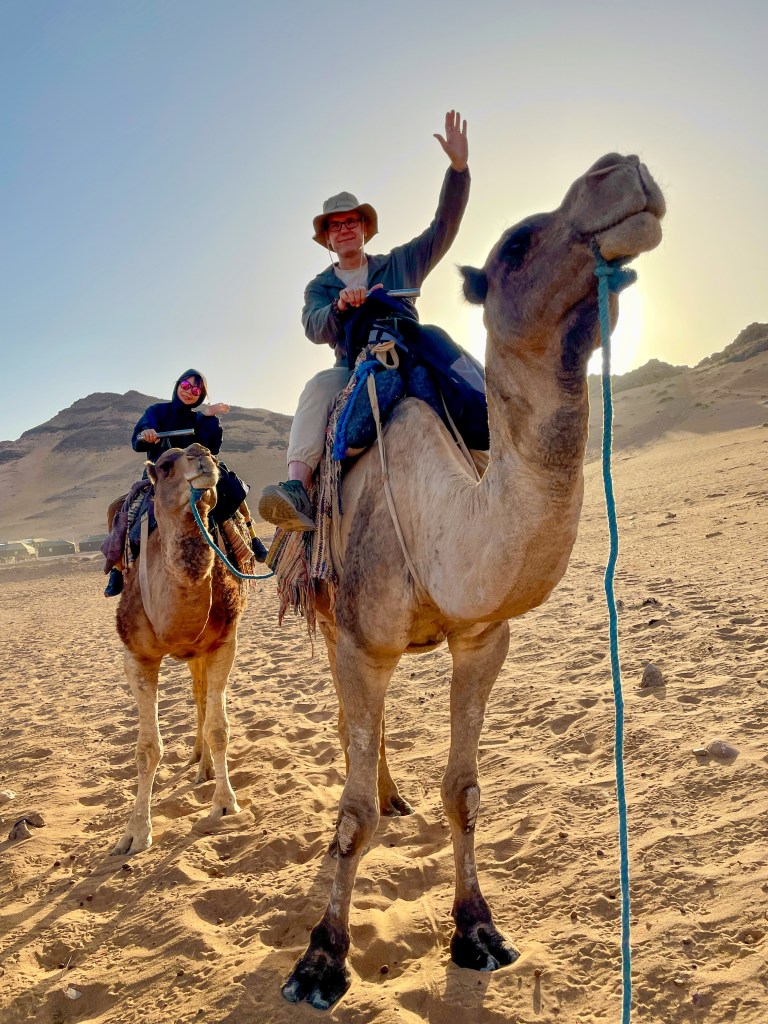
Back in the Landcruiser with Omar, we begin the long ride back to Marrakesh. There are further stops for expressos as we retrace yesterday’s journey, occasionally venturing onto alternative roads for variety. Yesterday’s torrential rain and dust storms have passed; today it’s all bright blue sky and open vistas. We stop at the town of Ouarzazade, home to Atlas Studios, the ‘Hollywood of the Desert’, where we wander around the sets used for international blockbusters including ‘Gladiator’ and ‘Game of Thrones’—the sets left in place to generate cash from tourists.
After a lunch of chicken and mushroom crepes in a restaurant near the studios, we’re back on the road. We climb over the Anti Atlas Mountains, then the Atlas Mountains, and descend onto the plain and to Marrakesh, where we say goodbye to Omar. He’s been a first-class guide and excellent company. I’m sorry to see him go.
After resting a while, we briefly head out to the tiny restaurant we visited on Friday. We’re drained, camel sore, and tiring of being cooped up in the small riad room. We’re both looking forward to having our our flat again in Casablanca tomorrow.
 Two On Tour
Leave a comment