More human tragedy against a beautiful backdrop.
Tuesday 5 November
We like to be early, so we find ourselves at Sarajevo bus station an hour before our departure time, stamping our feet to keep warm. It was zero degrees when I checked my phone at dawn. It’s still decidedly chilly when our bus sets off at 12.30.
The drive down to Mostar is eye-poppingly beautiful. The road first leads over the mountains and down to Konjic, where we pick up a river, which becomes Lake Jablanica. The lake appears to be used as a reservoir, and it could clearly use some water. Past the lake/reservoir, we come to Jablanica itself. Last month, days before we arrived in Bosnia, this town was hit by a devastating, deadly flood that cost 19 lives. Most of the town looks unscathed, but on the outskirts the flood damage is easy to spot: piles of mud and debris, a half-destroyed house that looks like it was almost washed away, and a section of the main Sarajevo-Mostar railway line that hangs in mid-air where the ground has collapsed beneath it.
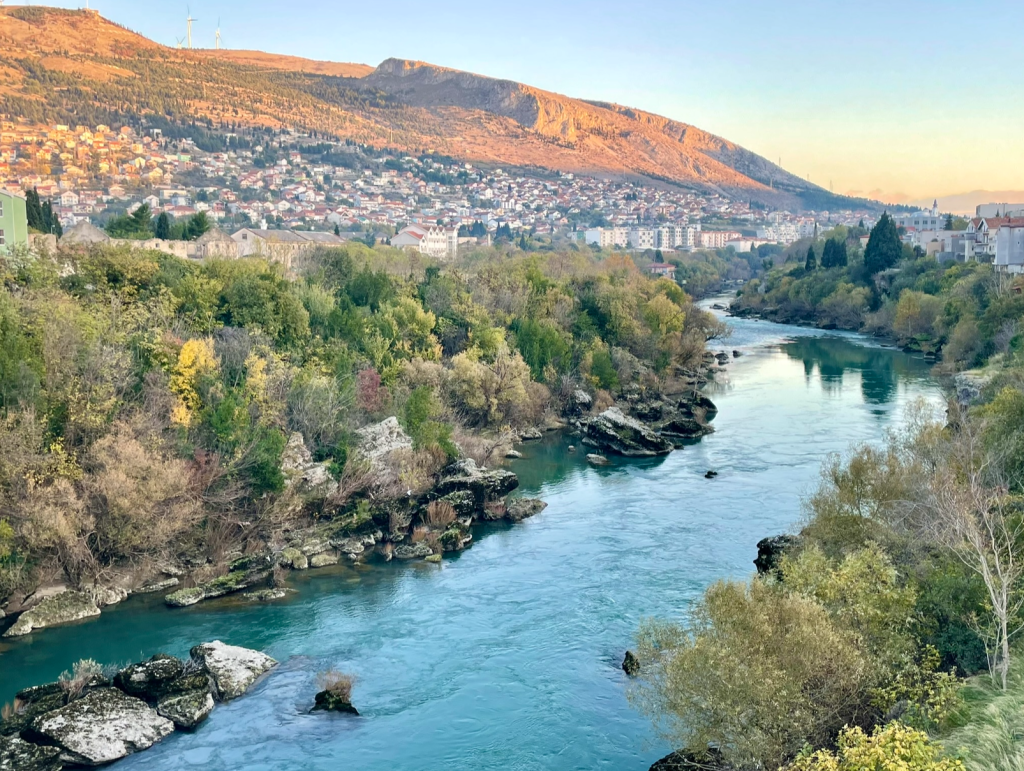
Jablanica is also where we pick up the Neretva River, which we follow along a frequently stunning gorge all the way to Mostar, an hour south. Stepping off the bus, it’s noticeably warmer. When we crossed those mountains, we also crossed into a more Mediterranean climatic zone. The hills above Mostar look more like Naxos than Sarajevo, and there’s much less evidence of autumn.
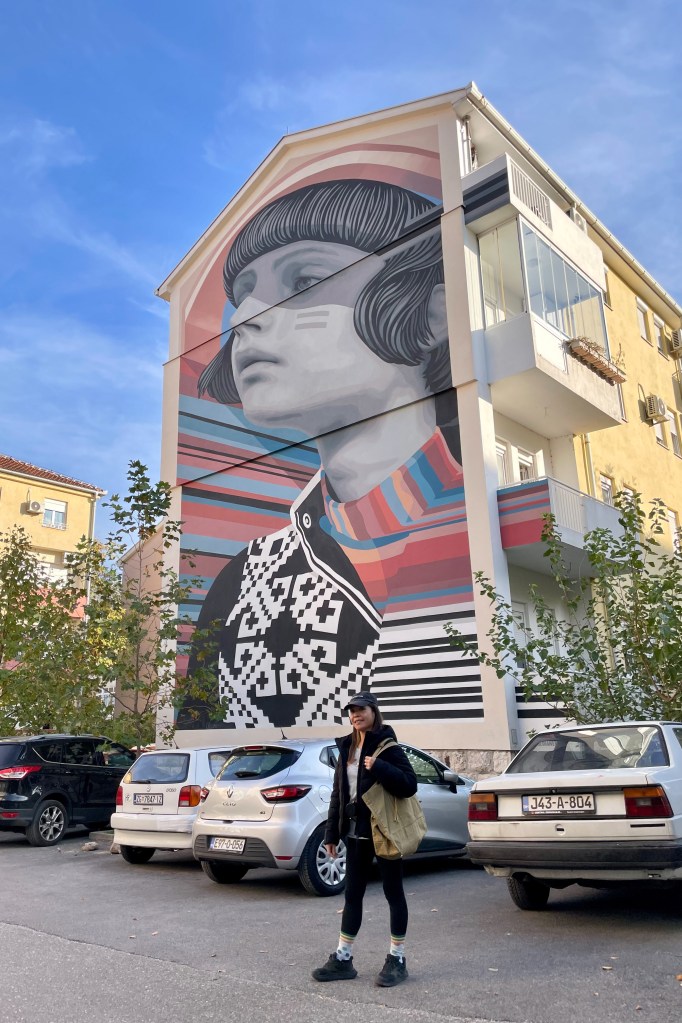
Our Airbnb is a ten-minute walk from the bus station. Our host, Riki, has sent us a a video showing us how to find it, so locating it and getting inside is straightforward. The immediate neighbourhood is adorned with some striking and beautifully painted street art – the best we’ve seen since KL last winter.
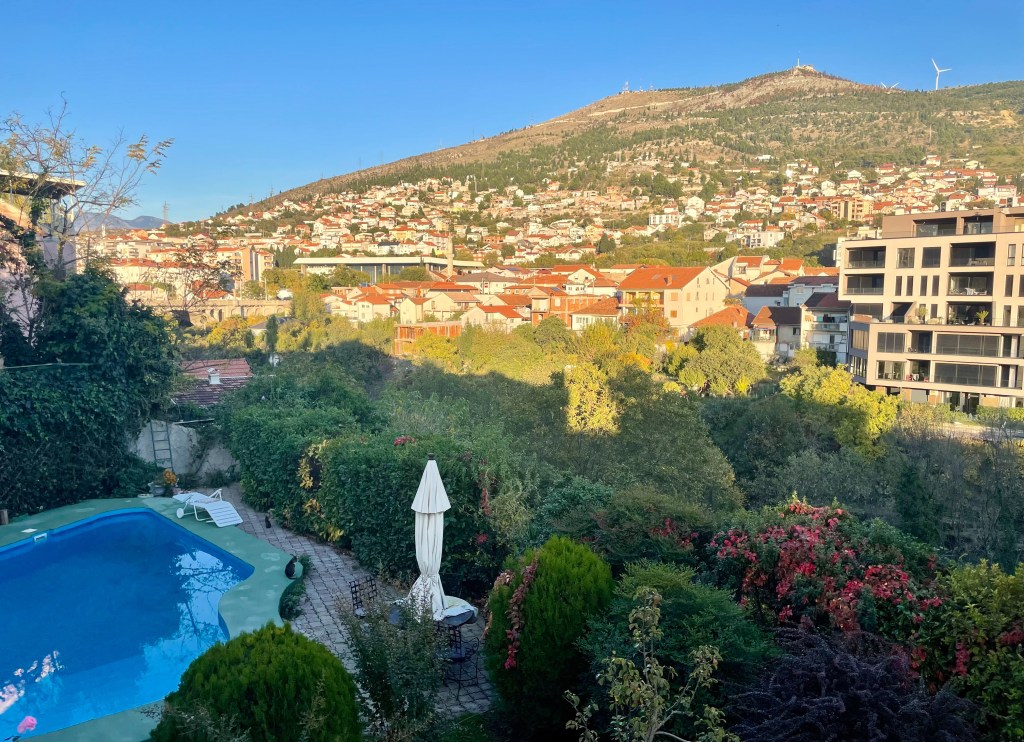
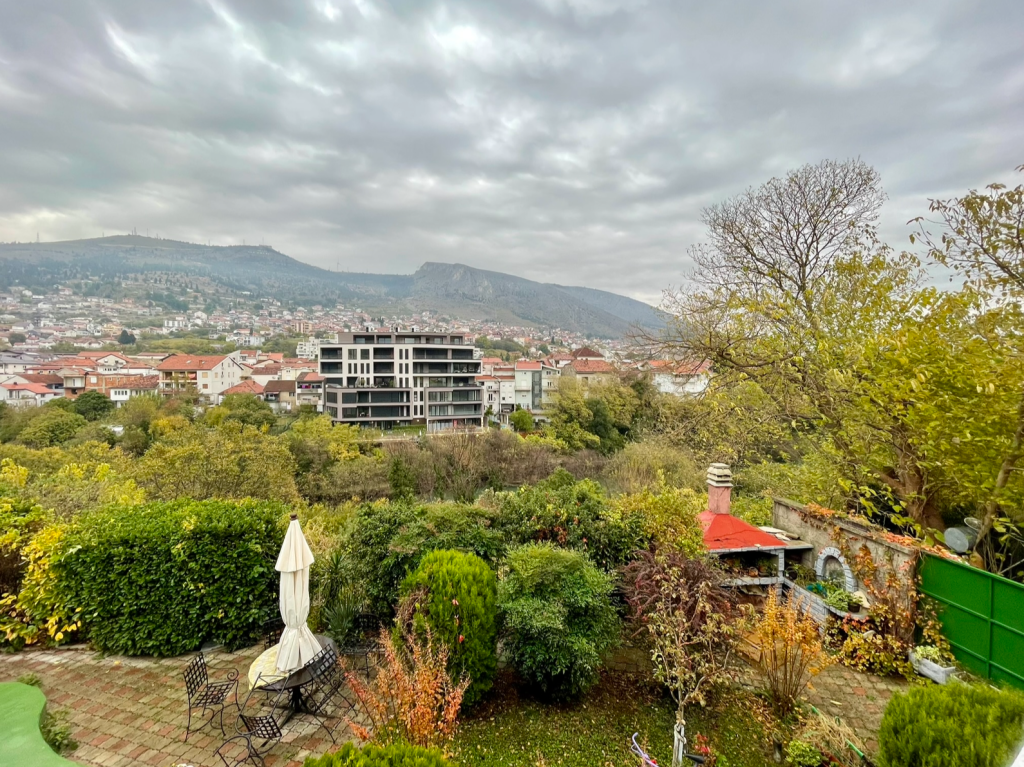
The flat is a good size and has a fantastic view looking east over the river towards the hills. Our Sarajevo flat was so well-equipped that our next flat was bound to slightly disappoint (no coffee machine, no instant hot water, a rather small area to use as kitchen dining room and living room), but the overall size and those views go a long way to make up for these small inconveniences.
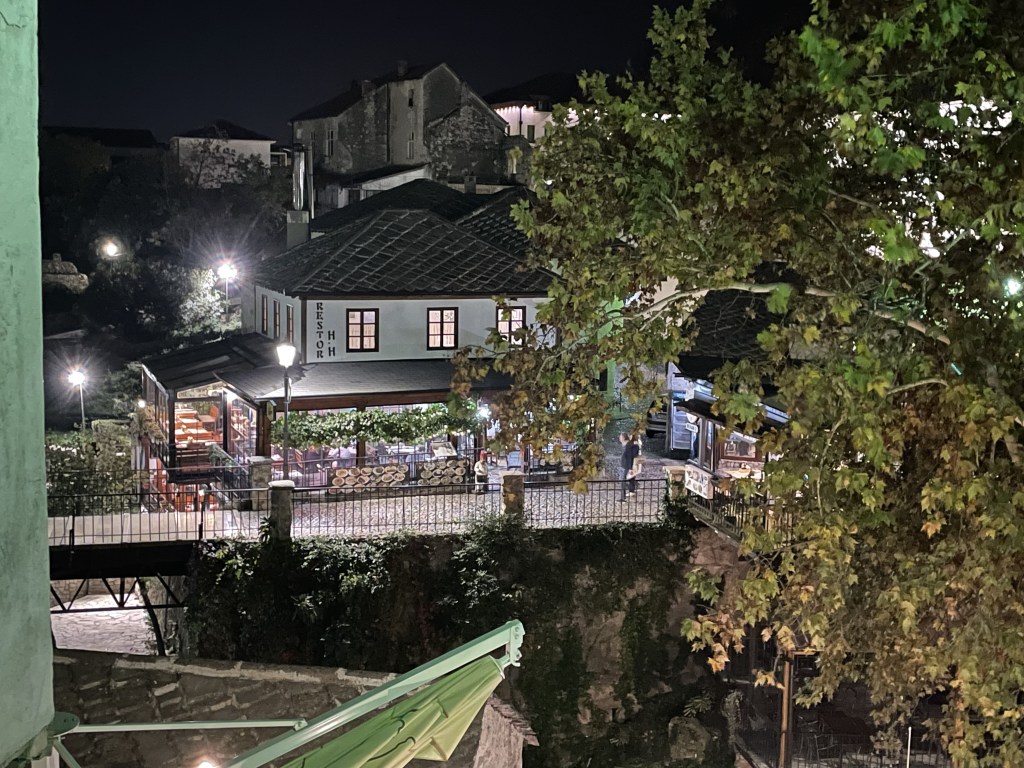
Once we’ve unpacked, we head for the nearest supermarket, five minutes away in a large, modern centre. Groceries put away, we walk down to Mostar Old Town to find something to eat. The Old Town is quiet on a Tuesday night in November: we almost have the famous bridge to ourselves as we wander round to get acquainted with the town. The restaurant I’d singled out on Google Maps seems to no longer exist, but we compensate well by choosing another one nearby that’s friendly, welcoming and affordable.
Wednesday 6 November
Today is somewhat overshadowed by convicted felon and insurrectionist Donald Trump comfortably winning the US election. We’re back where we were eight years ago. Eight years on, at least I can take comfort from living life pretty much entirely on my own terms.
We wander into Mostar Old Town looking for a museum that appears to be closed. Instead we’re ushered into a sort of bookshop/craft shop near the Old Bridge, where we watch a short video showing Mostar in the war years. We’ve entered Herzegovina now. Having spent much of the last month learning about the Bosnian Serb siege of Sarajevo, I now need to start getting my head around the Croatian bombardment of Mostar. The town was clearly left in a shocking state: at the end of the war the Old Town seems to have looked like central Berlin in 1945.
Already, it’s not long before sunset. So we have a coffee outside on the cobbled street near the bridge, which is still busy in November. It must be hell in the summer. Our waiter speaks good English (“Lovely jubbly!”). When we go inside to pay, we get chatting on account of the menu prices being in euros rather than Bosnian marks. She says the foreign tourists in Mostar are very different from those in Sarajevo (Turks and Chinese were the most conspicuous). Most tourists here are western Europeans who come up from Dubrovnik for the day – hence the widespread acceptance of euros. Very few Turks, unlike Sarajevo.
Thursday 7 November
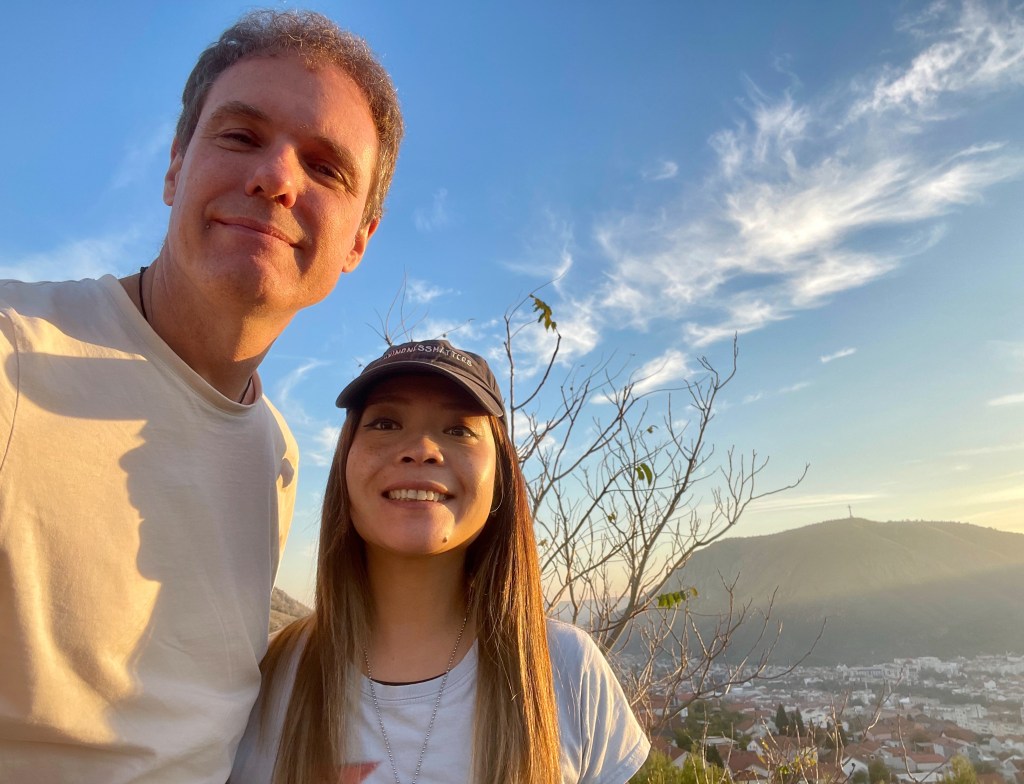
We head up the hillside on the east side of Mostar for a view of the town. Finding the right spot, we decide to stick around until the sun disappears behind the hills on the other side of town. We try to walk back down to the town by completing a loop, but find ourselves chased by a large very unpleasant looking dog defending its territory. We end up walking down the same way that we walked up. The hillside neighbourhood is only accessible from the town through a single lane unlit tunnel under the railway, with a single narrow pedestrian lane separated from the traffic by a calf-high metal railing. The wing mirrors of passing cars are something to be very wary of. By the time we pass through on our way down, it’s dark in the tunnel and I need a torch. Some infrastructure investment needed here!

Friday 8 November
In search of the sole branch of the sole bank that doesn’t charge for ATM withdrawals, we walk deep into the Croatian side of Mostar. Having seen lots of FK Velez graffiti in our first couple of days elsewhere in Mostar, here the graffiti is all for HSK Zrinjski. Later, I read up on the history of these two Mostar teams and immediately get a better sense of the sectarian divisions that still run deep in this town.
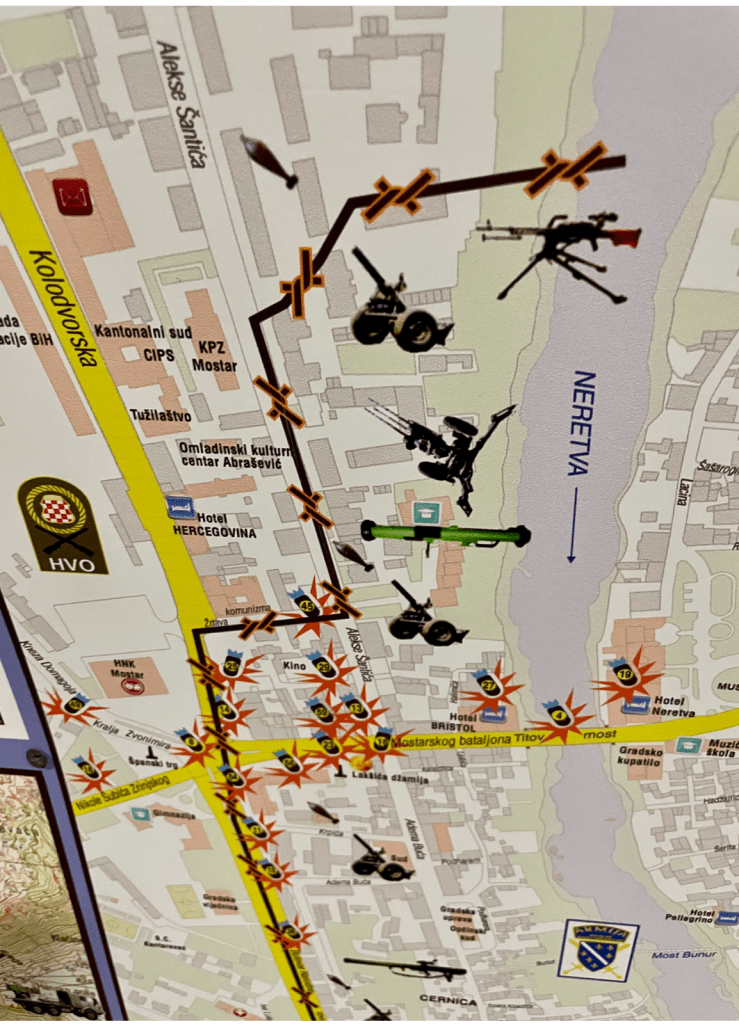
The Museum of War and Genocide Victims has a map of Mostar during the war and I realise that the neighbourhood we’re staying in was right on the front line and largely destroyed during the war. I suspected something dreadful had happened here on account of all the new blocks of flats, and the single war-ravaged shell of an old block nearby. This confirms as much. The museum is otherwise very similar – and occasionally identical – to its namesake museum in Sarajevo: lots of objects telling personal stories.
Today really brings home the war and the ongoing frostiness between the Bosniak and Croatian communities here. The Old Town is chocolate-box pretty, so it’s rather sad to learn that it’s largely something of a facade hiding deep ongoing tensions. For the moment, these seem to find a release valve through football at least.
Our Airbnb is located right in the middle of this map:
Saturday 9 November
We join a small group tour of Herzegovina. Sanyel, 40-something, is our guide and driver. Cody is a 32-year old golf course builder from near Queenstown, NZ but currently working in Edinburgh. And Stanley, 21, is from Taiwan but currently studying Spanish in Jaen, Spain. On a brilliantly blue Saturday morning, we set off for Blagaj, and then on to Pocitelj and – after lunch – the Kravica Waterfalls. Sanyel’s English is adequate but far from fluent, but he’s affable if a little reticent. It turns out that this is sideline work from his full-time job as a delivery driver all over Herzegovina and on into Croatia. He doesn’t so much guide us as take us places, tell us we’ll all meet up in 40 minutes, and head off for a coffee. (There’s something to be said for this approach to tour guiding. Let’s face it, 98% of what a more conventional tour guide tells you will be lost forever by the following morning. Sanyel just lets us wander around, take photos, and just do our own thing.)

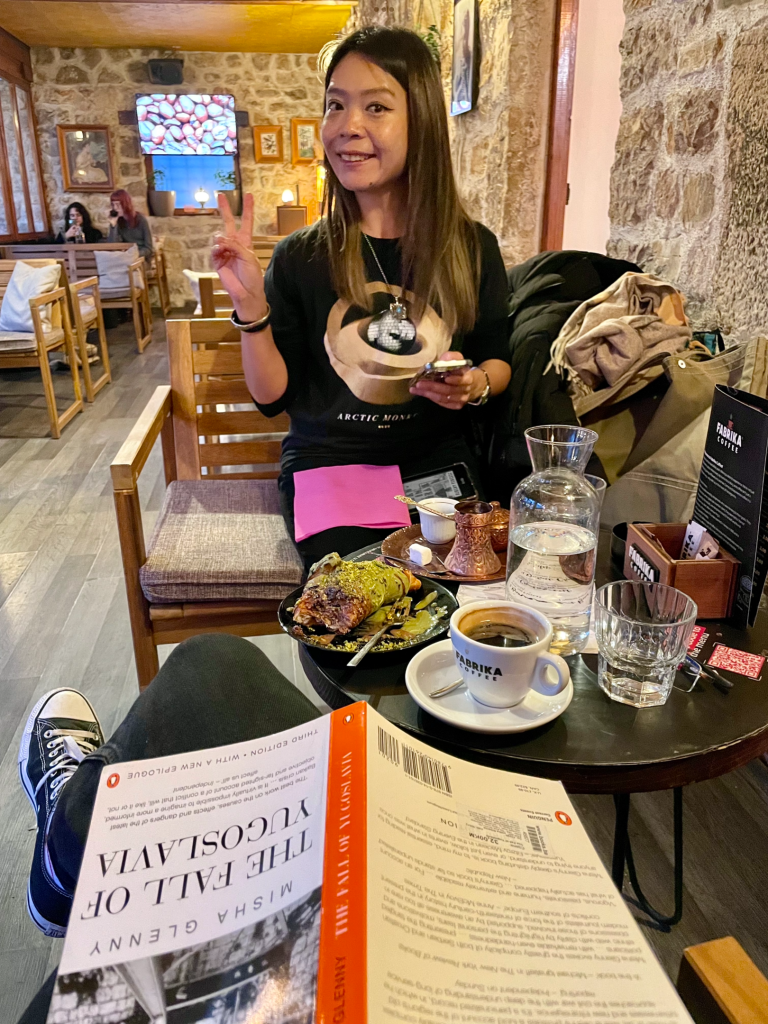
The sights Sanyel takes us to are all worth visiting and make some nice photo opps. But what really stays with all of us is driving through the border town of Capljina and seeing ubiquitous Croatian flags. These aren’t just locals flying flags from their homes; these flags are officially decked out on Capjlina’s main street. I was aware that the border area was populated mostly by Croats, but this is a shocking display of sectarianism. I’m currently reading Misha Glenny’s ‘The Fall of Yugoslavia’ and listening to a deep-dive podcast series on the history of Yugoslavia: I clearly have a lot to learn from these.
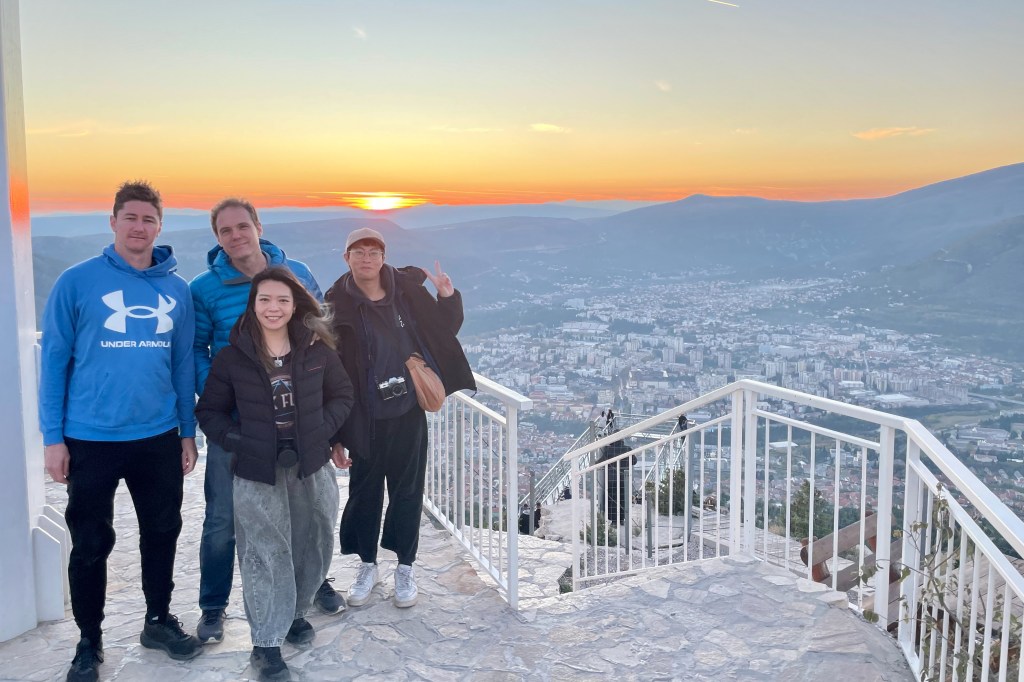
Before dropping us back in Mostar, Sanyel drives us up to the glass bridge viewing platform at the top of the hill overlooking the town. The sun is just about to set and we spend a magical few minutes peering down at the town and taking photos.
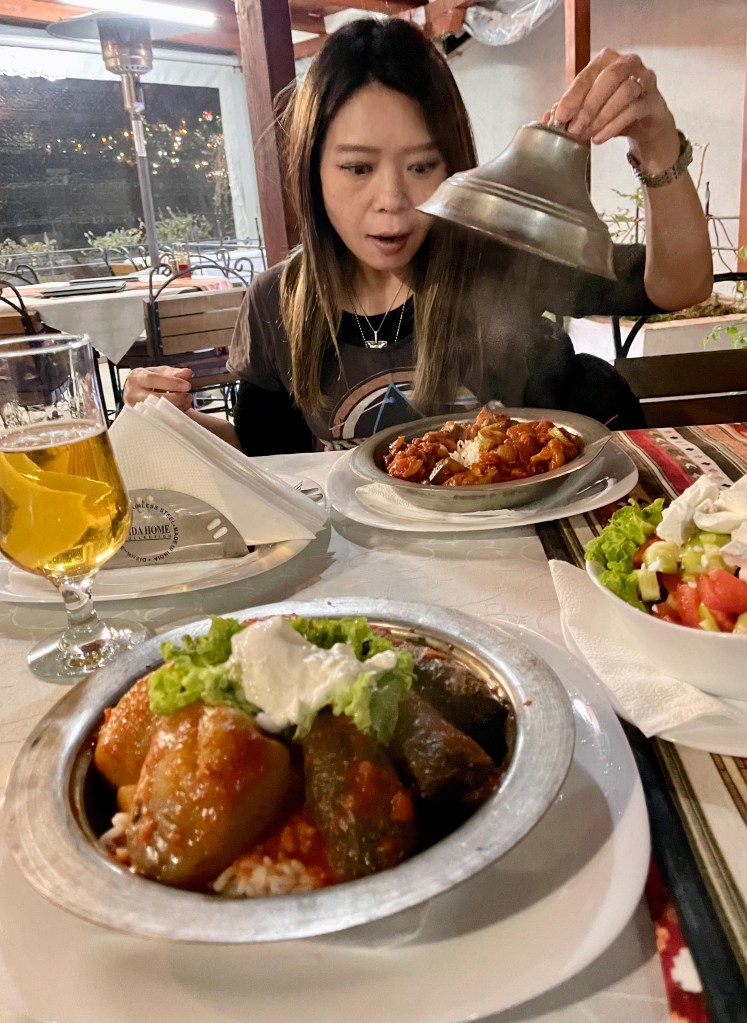
We chill for an hour or two before walking back into town for our Saturday night restaurant meal. A very friendly restaurant tout had handed us a flyer when we were in the Old Town on our first night. We held onto the flyer, so we decide to try the restaurant tonight. It’s excellent, although far more comfortable after I ask our waiter to turn on the outdoor heater next to our table!
Sunday 10 November
A very quiet day. After our tour of the highlights of Herzegovina yesterday, today is a day for life admin and a bit of reading. We head out for a few groceries late afternoon, but, unlike Sarajevo, all shops appear to be closed on Sundays here. Fortunately, we still have enough in the fridge and cupboards to see us through tonight. We’ll head back to the shops on Monday morning.
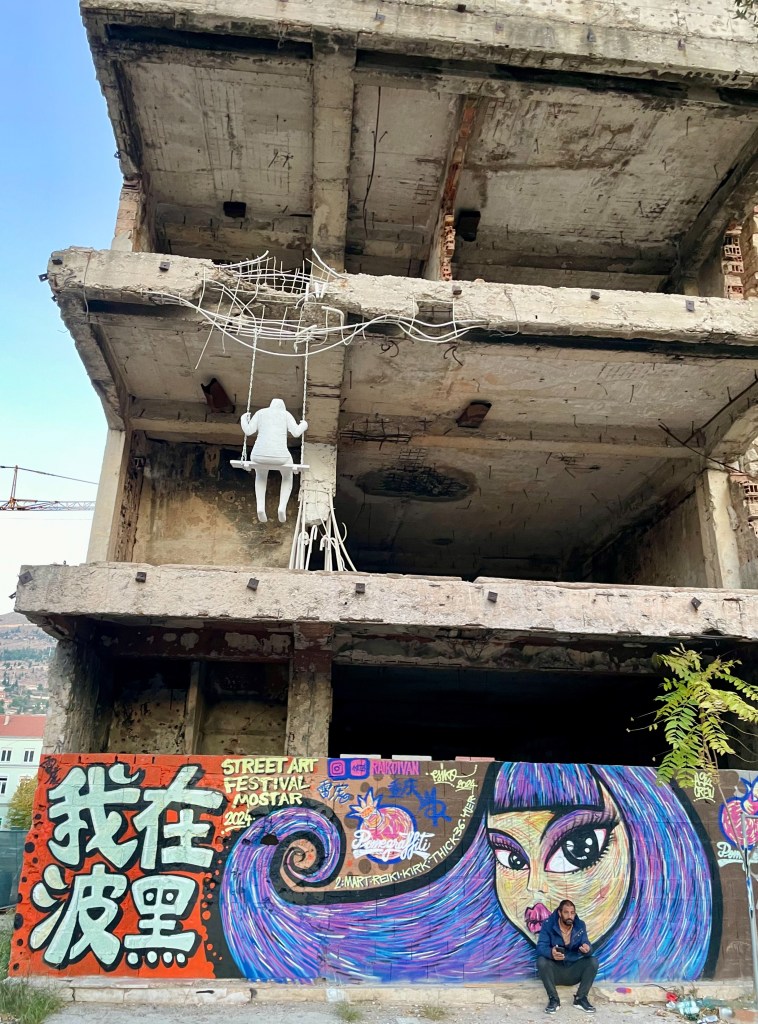
We walk a loop back to the flat, taking in the road parallel to the one that we’re staying on. This takes us past this curious sight on a building that hasn’t been patched up since the war. (There are rather of lot of buildings in a similar sorry state compared with Sarajevo.)
Monday 11 November
It’s refreshing to have a few days without editing or writing jobs to attend to, although I do have to spend part of the morning filing my UK tax return. Life after 39 is mostly admin, after all.
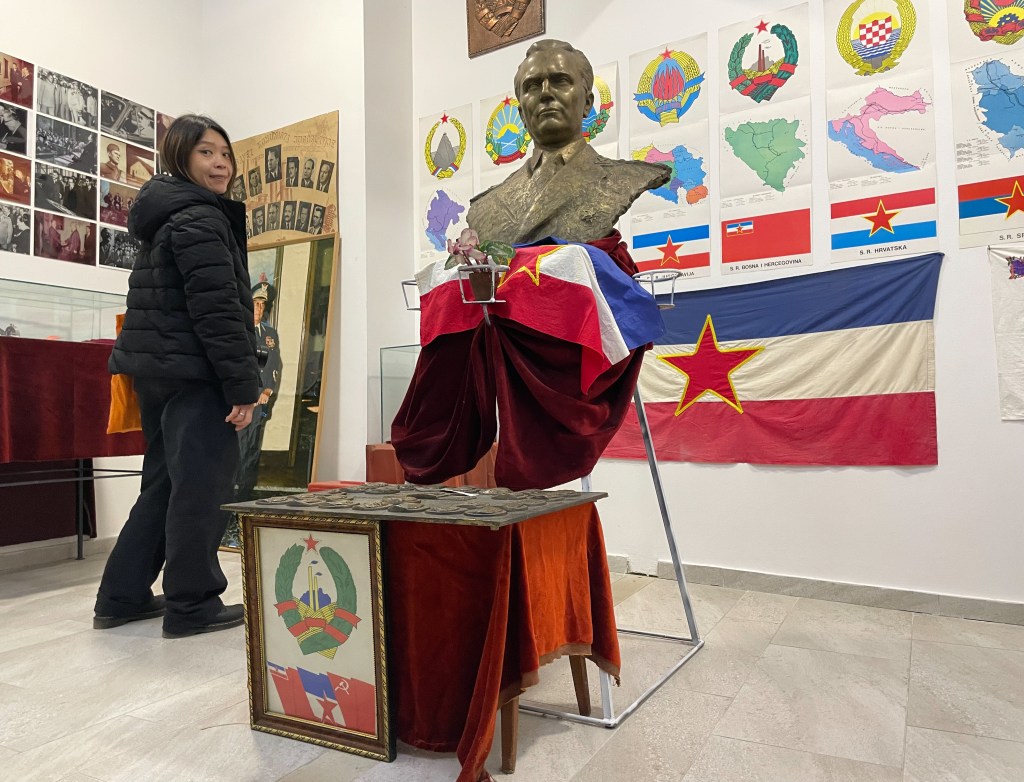
After lunch, we head out to the curiously named Bosnaseum in the Old Town. It turns out to be a bit of everything: ethnic clothing (Bosnian, Croat and Serbian, although they’re all much of a muchness to my eyes), crafts, a display on the Communist period, and of course a collection of photos documenting the war in Mostar.
By the time we emerge, it’s getting dark. We head to a café we noticed last week, order coffee and cake, and stick our heads into our books. Although it’s some way from the Old Town, its menu is printed only in English.
Tuesday 12 November
I’m just kicking off what should be my final substantial project for the year except for the FB Magazine next month. I’m writing a few corporate video scripts for the Alumni Affairs Office. I knock the first one off before lunch.
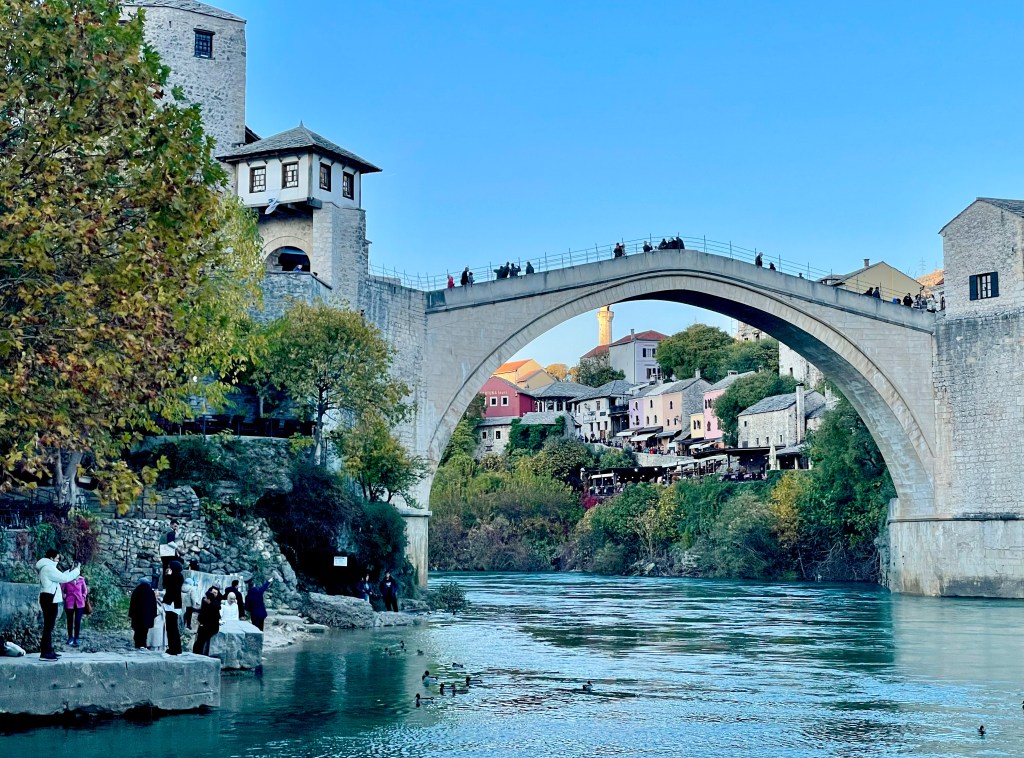
After lunch, we head to a good vantage point to the south of the Old Bridge to get some good photos. One upside to the ever-earlier sunsets is that the golden hour for photos is now around three to four o’clock in afternoon – no need to wait until well into the evening.
The speed at which the river flows is even more impressive when we’re right down at the water’s edge. A couple of idiotic kids are throwing stones at the ducks in the river. I bark at them and they stop, but Kathryn’s pissed off with me for being grumpy. On this occasion the welfare of the ducks comes before Kathryn’s desire for a quiet life.
We head back to the café we visited yesterday, order the same, and read our books again until it’s dark outside. It’s just over a week until we arrive in Split, so back at home, we watch YouTube videos about Split and its environs to start getting the lay of the land.
Wednesday 13 November
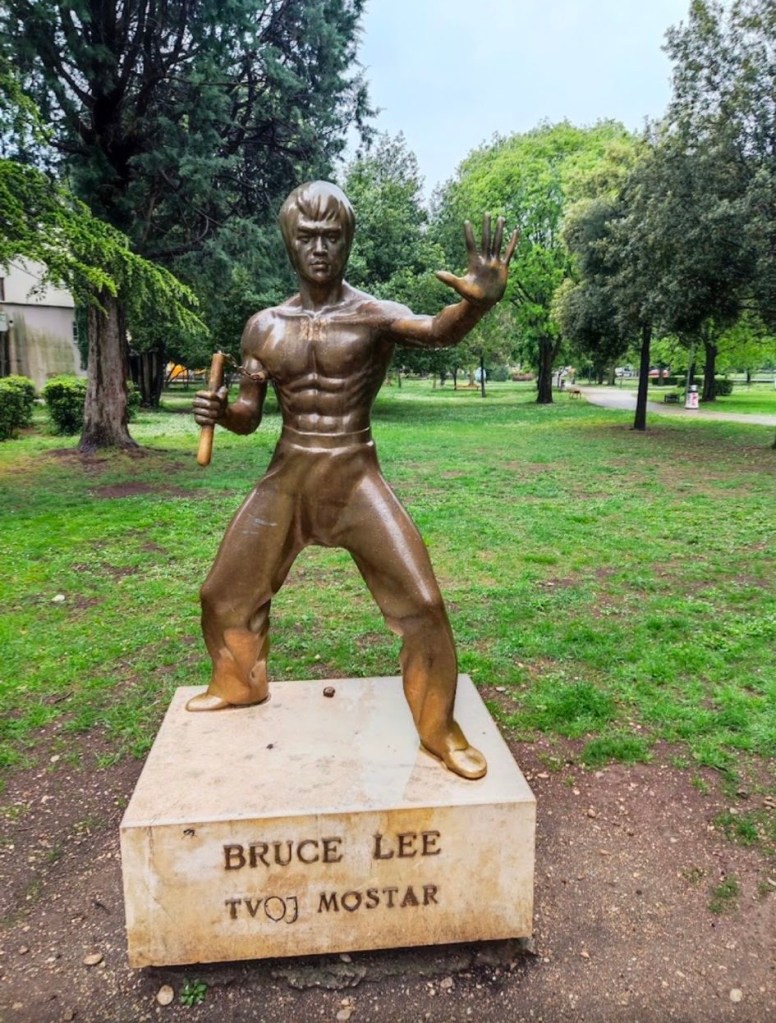
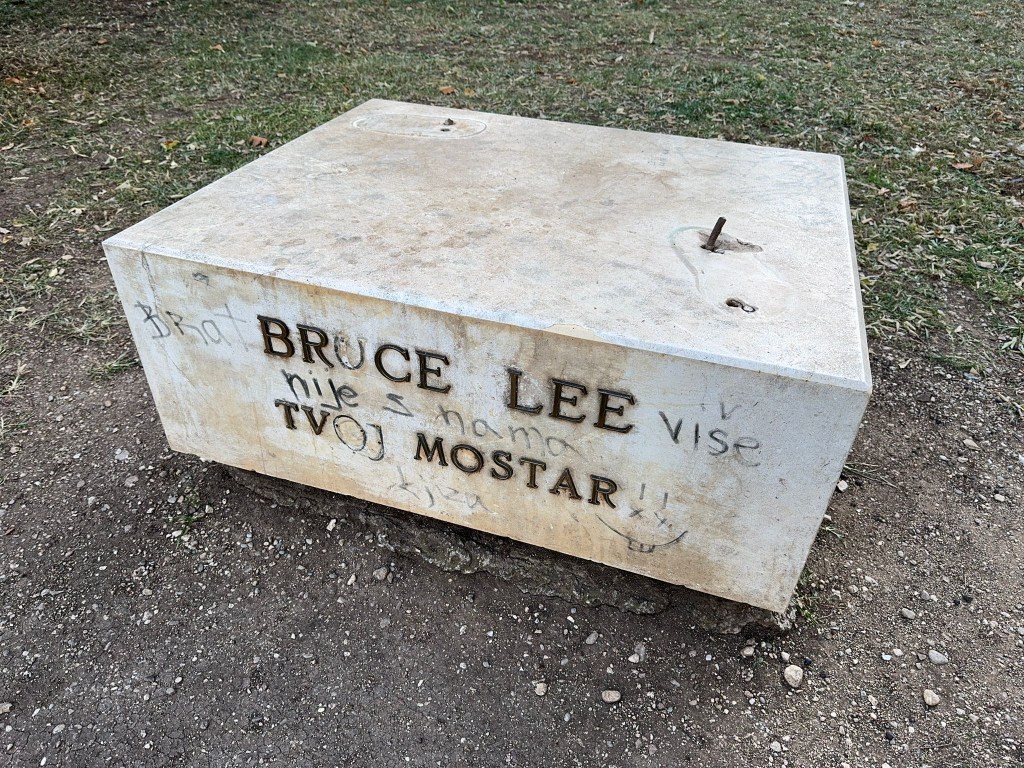
We plunge deep into the Croatian side of Mostar heading for the Partisan Memorial Cemetery, a surreal memorial/cemetery of crumbling stonework and puzzle-shaped headstones. On the way there, in Mostar’s main park, we stumble across the empty plinth of a statue of Bruce Lee. Curious as to where the statue went, we do a bit of Googling and find that it was stolen earlier this year and cut into sections to be sold as scrap, at which point the suspect was arrested.
More bizarre still is the fact that Mostar ever had a statue of Bruce Lee: it was unveiled a day before Hong Kong unveiled its own Bruce Lee statue on the occasion of his 65th birthday in 2005. Apparently, Bruce Lee was huge in this part of the world and the statue was supposed to bridge the competing nationalisms in the city. You can barely make this stuff up, but it seems the Bosniak community and the Croat community took to complaining that the statue faced THEIR community in an aggressive fighting stance (objectively wrong: Google the statue and he’s clearly in a defensive stance). Inevitably, the statue became something of a symbol of tension between the two communities. Like I say, you can’t make this stuff up.
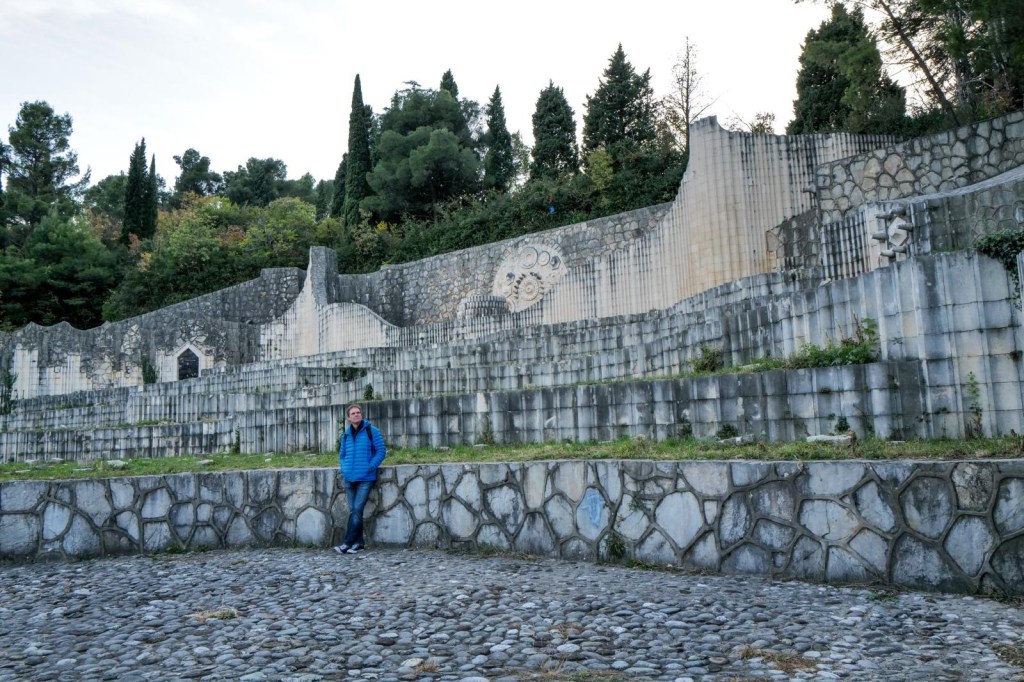
At the somewhat dilapidated Partisan Memorial Cemetery, two teenage girls sit chatting and listening to music. Again, you can’t make this stuff up: they’re listening to the Scorpions’ ‘Wind of Change’, the quintessential, boilerplate sound of the falling Iron Curtain.
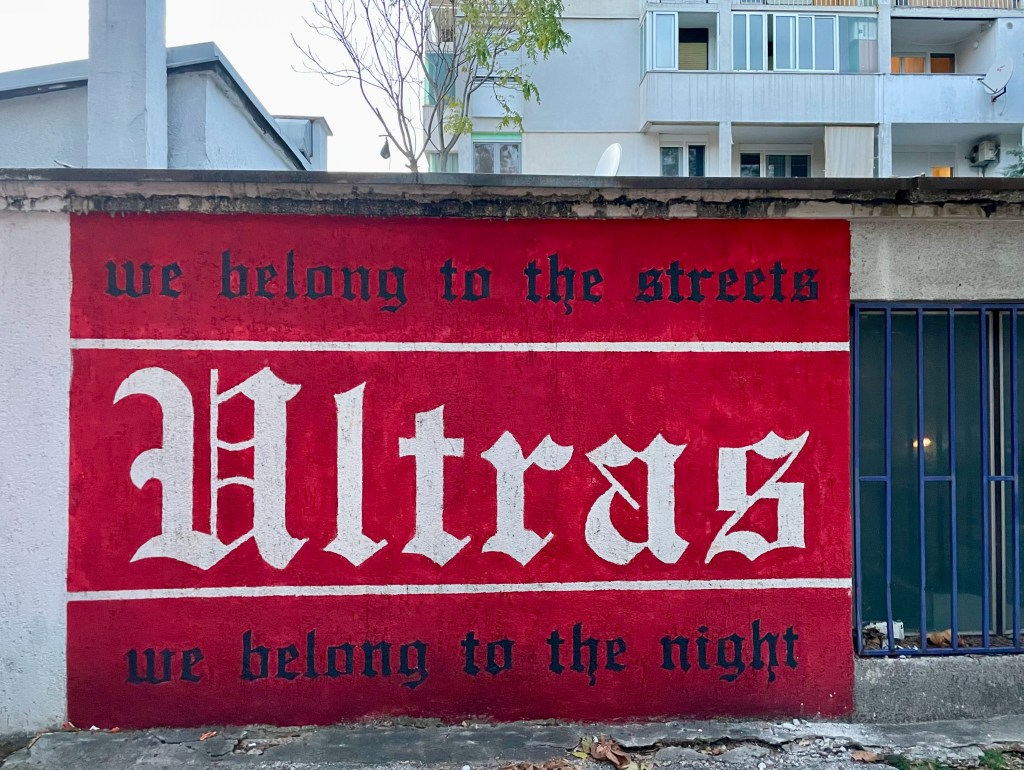
We walk on past HSK Zrinjski’s modest stadium – formerly bitter sectarian rivals’ FK Velez’s stadium, of course – and up to a vantage point in a residential neighbourhood where we can look down onto the pitch where Luka Modric played for a season near the start of his career. There’s a lot of Ultras grafitti in the surrounding streets (often in English). It feels aggressive and unwelcoming in the way that English football used to feel back in the bad old days of the 70s and 80s.
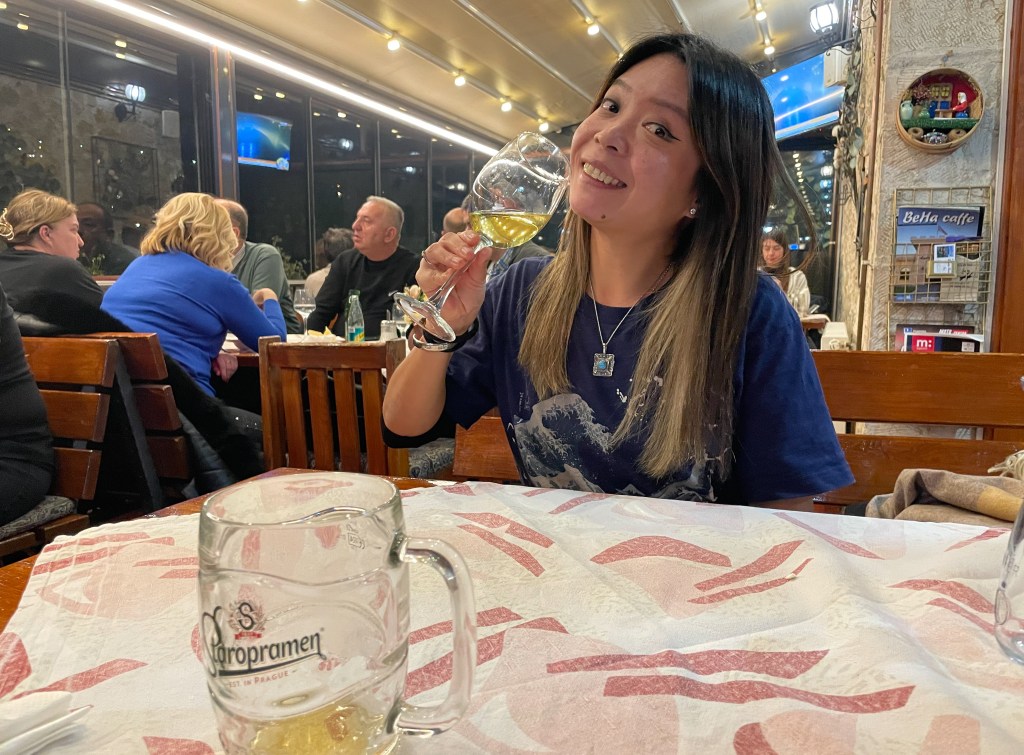
It’s Wednesday, so it’s an eating out night. We head back to the restaurant in the old town that we ate at on the night we arrived. Tonight, it’s much busier and a lot of customers are smoking. Indoors. We’ve noticed this several times in cafes and restaurants, but tonight it’s like Saturday night in a pub twenty years ago. We come out reeking of cigarette smoke, hoping that Croatia will be more civilised.
Thursday 14 November
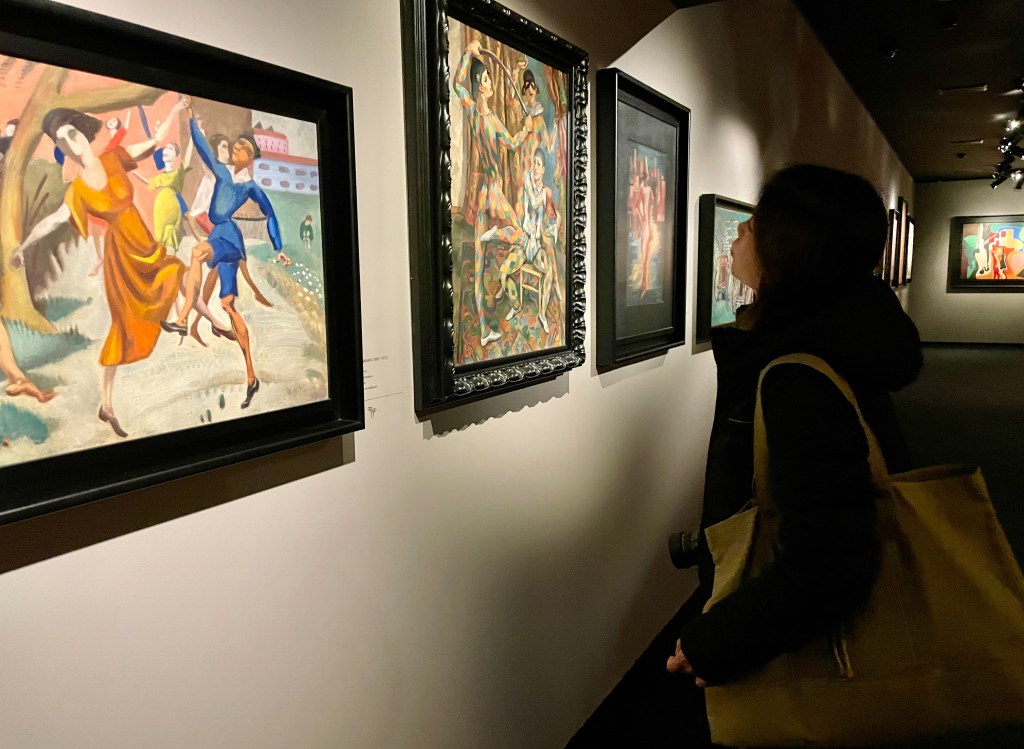
Nine years ago, we got married on the Star Ferry on a warm and sunny autumn day. Today, it’s steely grey in Mostar, and there’s a chill wind a-blowing. It’s a perfect day to visit the Hub of Fine Arts. This turns out to be an excellent decision. The gallery is modest, but it turns out to be an exceptional collection of world-class art – “Dynamic Italian Futurists, intellectual Russian Constructivists, sensitive French Post-Impressionists and revolutionary Fauvists, enthralled Spanish Cubists, complex German Expressionists and American Abstract artists are gathered under one roof in order to present the wealth and creative challenges of the first half of the 20th century”, so says the website.
It would be marvellous even if we had to share the gallery with dozens of others. As it is, we’re the only visitors for the whole hour we spend there. We have to ourselves, for as long as we want, the world’s only Degas sculpture on public display, and a Modigliani. Being alone with world-class art is deeply stirring. It reminds me of being alone with Bruegal the Elder’s ‘Landscape with the Fall of Icarus’ in Brussels a few years ago. Magical.
We fall into a long chat with the gallery manager, a lovely former English teacher from Sarajevo who moved to Mostar early this year to manage the gallery. We mention the very visible sectarianism here in Mostar and she confirms that it’s a very different vibe to Sarajevo. The difference in Mostar, she says, is that many people who did terrible things are locals, and they still live here. In Sarajevo, the Serbian Chetniks were overwhelmingly not locals and slunk away into the Srpska Republic after the war. Here, it’s still raw at times. But she’s broadly optimistic and a believer in the power of time to heal – although she despairs at the sectarian hooliganism whenever HSK Zrinjski play FK Velez.
Back home, we settle down to watch Icelandic movie ‘And Breathe Normally’. Mostar seems a fitting place to watch this wonderful, if slightly implausible at times, movie about human decency and the desire to do the right thing.
Friday 15 November
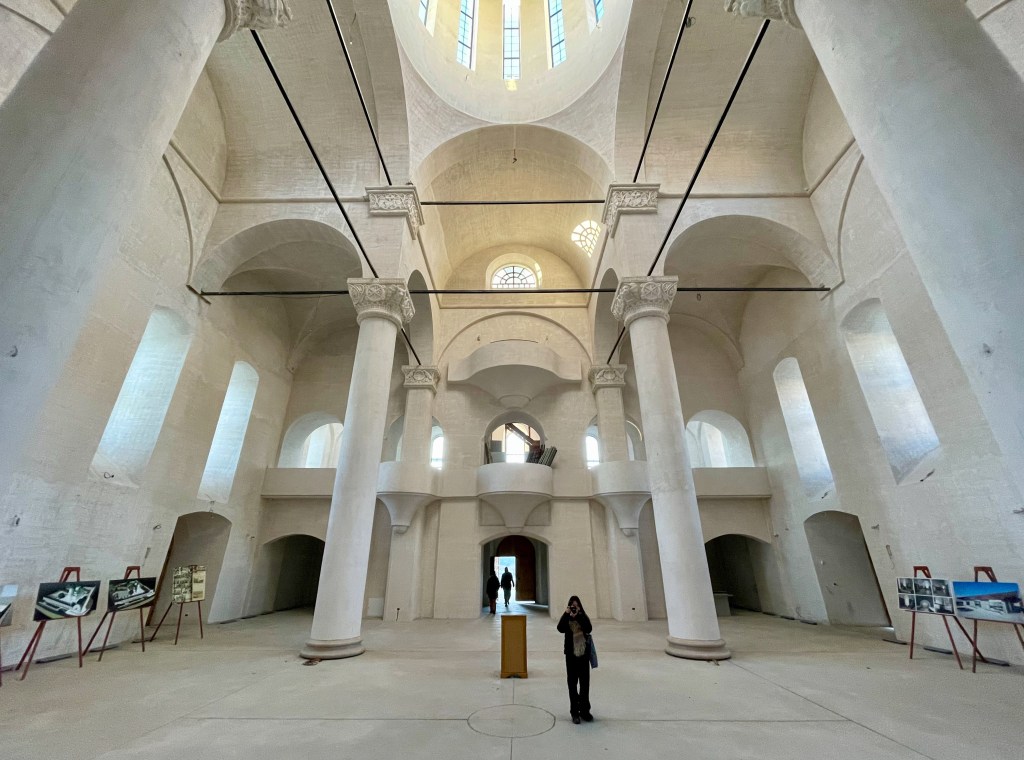
The sun’s back, but there’s a biting wind today as we walk up to the rebuilt Orthodox cathedral overlooking the town. On reaching it, we discover that it’s still under construction. I’ve never been in a church still being built. The construction itself is just about complete but the walls are waiting for paint, frescos, tiles or whatever is planned for them. The electric fittings are bare. And it’s empty save for an small exhibition of artist impressions of the finished cathedral and its outbuildings (if they’re ever finished – it’s only 3.30 on a Friday but no one’s working here today). A couple of other curious visitors arrive in the few minutes that we spend inside. They look as bemused as we do.
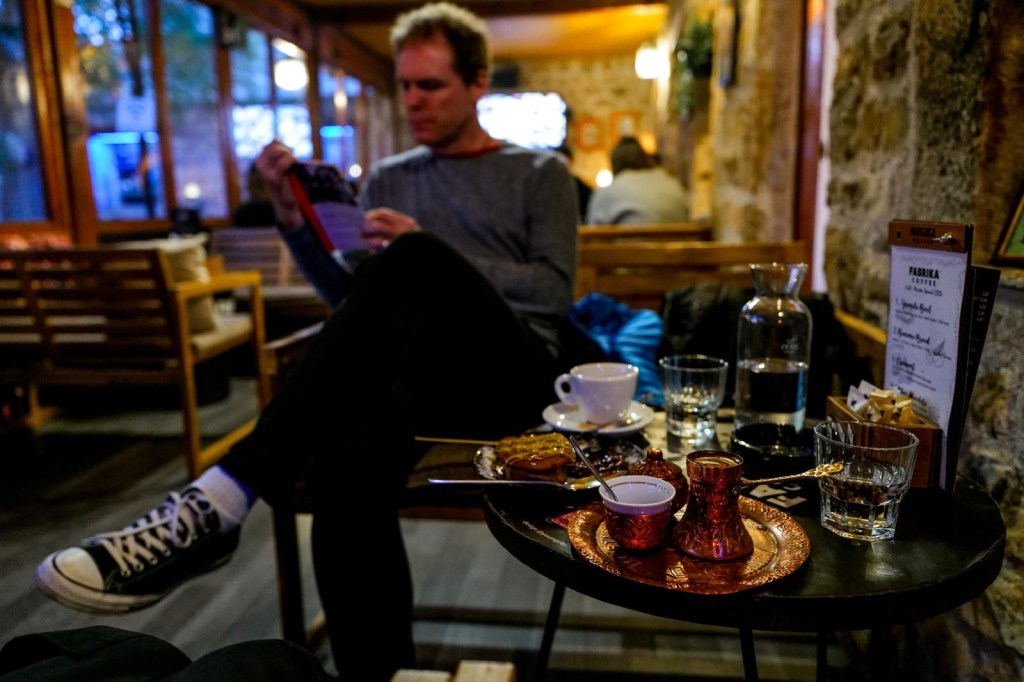
Back in town, we head back to our now regular cafe, Fabrika Coffee to catch up on some reading. The music today is 90s British guitar bands. It’s tough trying to get to the bottom of the causes of the Yugoslavian civil war while tapping my foot to Suede, James, the Charlatans, and even the House of Love.
Saturday 16 November
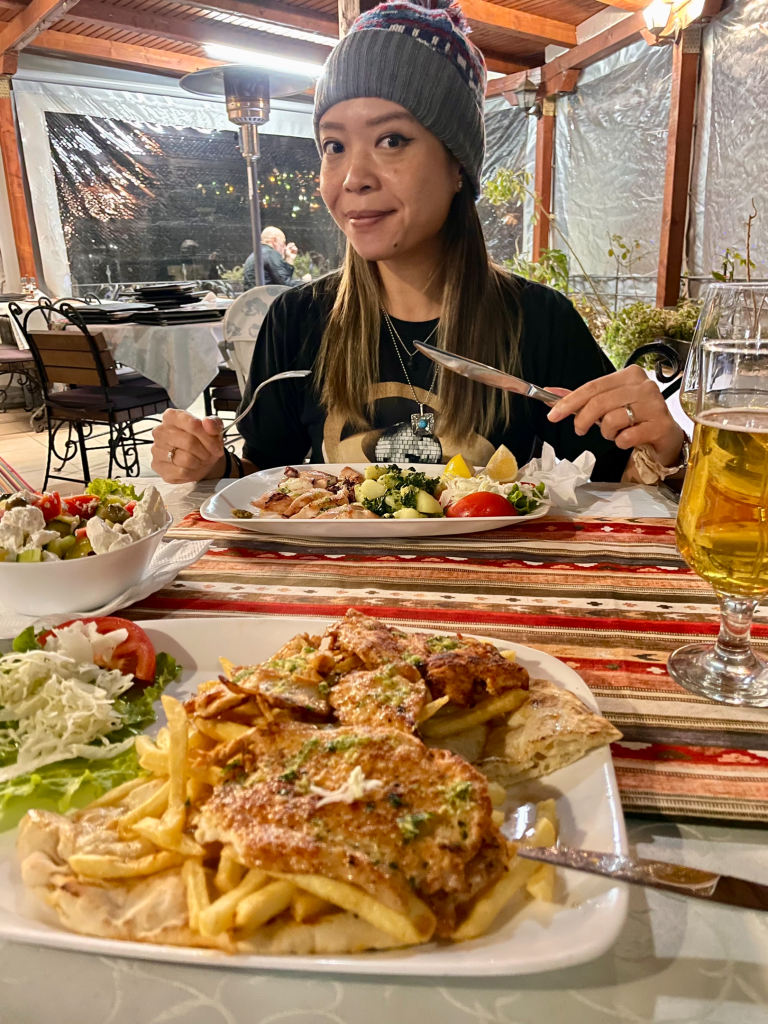
A quiet day. Grocery shopping. A chilly stroll into the Old Town to eat out. And that’s it.
Sunday 17 November
Another quiet day. I head out for an afternoon stroll around the north end of the town. It’s mildly diverting and gets me out of the flat. My mind has very much rolled over to preparing for our next destination now. I’m still happy to be here in Mostar, but we’re treading water now.
Monday 18 November
Yet another quiet day. Groceries. To the bus station to check if we need our tickets printed (we don’t). And then to our regular cafe, Fabrika Coffee. More Sister Sledge today. Black Box. The Cure. A croissant smothered in a creamy pistachio sauce. They ask if we’ll leave them a review on Google. Of course we will.
Tuesday 19 November
We’ve known for a few days that our final two days in Mostar are going to be wet. We can live with it. We’ve done all that we wanted to do. The drizzle starts after breakfast. By mid-afternoon, it’s raining heavily. I finish the last of a series of drafts for the Alumni Affairs Department shortly after lunch, then spend a content couple of hours adding some recently discovered songs to iTunes. I don’t even step out of the flat today.
Wednesday 20 November
Our final day in Mostar is very low key. It’s wet and the temperature is dropping by the hour. We only step out of the flat after dark to visit Fabrika Coffee one last time (they’re playing Junior Murvin’s ‘Police and Thieves’ today – is this the best cafe for music anywhere in Bosnia, I wonder?)
We leave Fabrika Coffee in heavy rain and walk down to the Old Town one last time to enjoy a final meal out. A few other hardy souls have found their way to the restaurant, but we’re almost the only people out in the streets in the Old Town tonight. We have Mostar’s magnificent bridge entirely to ourselves. It’s rather magical despite the grim weather.

 Two On Tour
Leave a comment